5000 years of Sweden’s first people

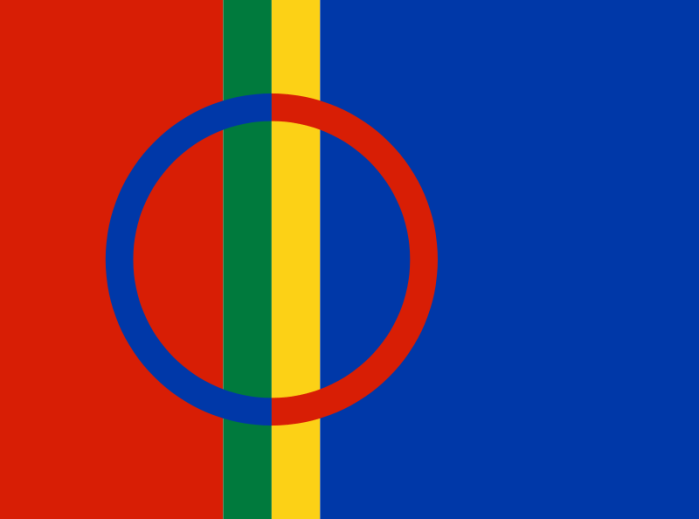
sapmi-flagsapmi

Did you know that Sweden has an indigenous people? I know, isn’t that cool?!

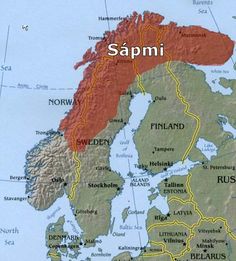
Just like Australia has the Aborigine and China has the Pamiri – Sweden has the Sami. For about 5000 years, the Sami people have lived way up in the arctic north of Sweden in the homeland they call ‘Sapmi’. Today Sapmi actually covers not only Sweden, but also Norway, Finland and Russia. Historically, the Sami were referred to as Lapps, but today this is deemed a derogatory term.

Today, February 6th, is the National Day of the Sami. Today, the Sami flag should be flown and the Sami national anthem is sung in the local Sami language.  The first time this day was celebrated was in 1993 in Jokkmokk, Sweden.

The Sami are the only indigenous people in Scandinavia that are recognised and protected by international convention. The United Nations estimates that there are over 370 million indigenous people living in over 70 countries worldwide. This is roughly 6% of the global population.

Today, around 10% of the Sami population of approximately 70,000 work within the traditional work of reindeer herding. Most of the rest of the indigenous Sami population is urbanised. Like many indigenous people around the world, the Sami have also been treated very badly by the colonising inhabitants of their country. Scandinavia has a legacy of law and assimilation that denied Sami their rights, and an state-sanctioned history of the removal of generations of children for placement in boarding schools and missions. A recent film called ‘Sameblod’ depicted this shameful era of Swedish history.

It took until 1989 for Sweden to recognise the ‘Sami nation’. Sami pupils are entitled to be taught in their native language, although a loophole enables this right to be sometimes bypassed. In 1998, Sweden apologized for their wrongs against the Sami. To make up for past suppression, the authorities of Norway, Sweden and Finland now make an effort to build up Sami cultural institutions and promote Sami culture and language.

However, it is far from rosy in the arctic north. Conflict over land rights, herding rights, exploitation rights are still raging on across Sapmi. Today, the Sami are experiencing cultural and environmental threats, including unwelcome oil exploration, mining, dam building, climate change, military bombing ranges, and exploitative tourism.

Apart from through activism, it is in the Sami parliaments that the main conflicts are debated.  There are three, unconnected Sami parliaments spanning the region – Sweden founded in 1993, Finland in 1973 and Norway in 1989. Russia has not recognized the Sami as a minority and, therefore there is no official Sami parliament (an unrecognised one exists). These democratic parliaments stand up for Sami heritage but have very weak political influence.

Like many nations around the world, Sweden and their neighbours have to balance the ghost of a shameful past with the conflicts of the present and the hope of the future. Without doubt, discrimination against the Sami people still exists.

This is why today, February 6th, is so important as a day of celebration and recognition but also as a day of atonement.

 

The top 5 searches about Sweden

When looking at Pinterest for the top searches on Sweden, the following 5 come out on top. Is it old stereotypes still living on?

1) Girls

2) Travel

3) Stockholm

4) Flag

5) Women

An old joke is that Sweden’s best export are its women. They are sent out on missions to bring back fresh blood. Judging by Pinterest, there’s still a strong interest in meeting flag-bearing Swedish girls in Stockholm.

Swedish words for poo


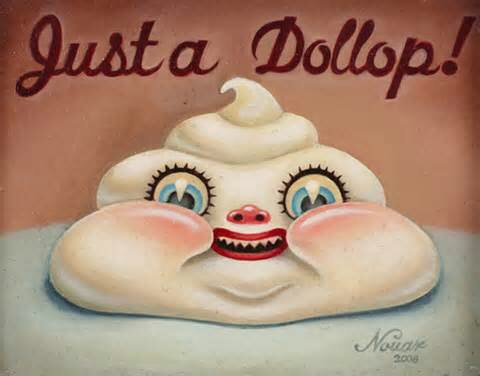
In a restaurant in Stockholm last night, I happened to use the word ‘klutt’ to describe a small dollop of food. My dinner companions did a double take and asked me to repeat what I said. ‘En klutt’ I said. They looked at each other and burst into laughter. You see, a ‘klutt’ does describe a small dollop. But not food. It’s a small dollop of poo. Sometimes, speaking a foreign language just ends up going so wrong!
This led to a conversation on the different Swedish words for poo. I made a mental note of them, so I could share them with you. I also googled some other words. Here they are. Enjoy!

  • Bajs – poo
  • Bajskorv – poo sausage (a turd)
  • Klutt – a small dollop of poo
  • Skit – shit
  • Blaffa – a huge mound of poo
  • Lort – piece of poo, sometimes dried out
  • Avföring – defecation
  • Exkrement – excrement
  • Mocka – big pile of poo, often from cattle
  • Rövgröt – poo with the consistency of porridge
  • Lös avföring – diarrhea
  • Racerbajs – diarrhea that requires running to the toilet
  • Sprutlack – explosive poo that covers a large surface

Any other words I’m missing that just have to be on this list?

The worst day in Sweden

Tomorrow, the 24th January, could arguably be the worst day of the year in Sweden. Dark, miserable, cold and poor.

The month of January is notoriously an impoverished month, following the financial excesses of December. Many people struggle through January with their evenings in front of the telly, their long walks at the weekends and their packed lunches at the office. And as the 24th arrives, this deprivation reaches its pinnacle.

You see, most Swedes are paid on the 25th of the month. New, fresh crowns rattle into bank accounts up and down the country. Pubs and restaurants fill up and Ikea is like rush hour in Piccadilly Circus as the consumerism treadmill grinds into action.

But not tomorrow. Tomorrow, the 24th January, sucks. And as we put our leftovers into the fridge to be eaten for lunch, we can be happy that this misery is soon over. On Thursday, we can drink a latte, buy an expensive lunchtime sour dough toast, and knock back a few gin and tonics after work. And maybe, just maybe, be a little less provoked by the sunny holiday pictures on social media.

So hold on, there is light at the end of this long, dark tunnel.

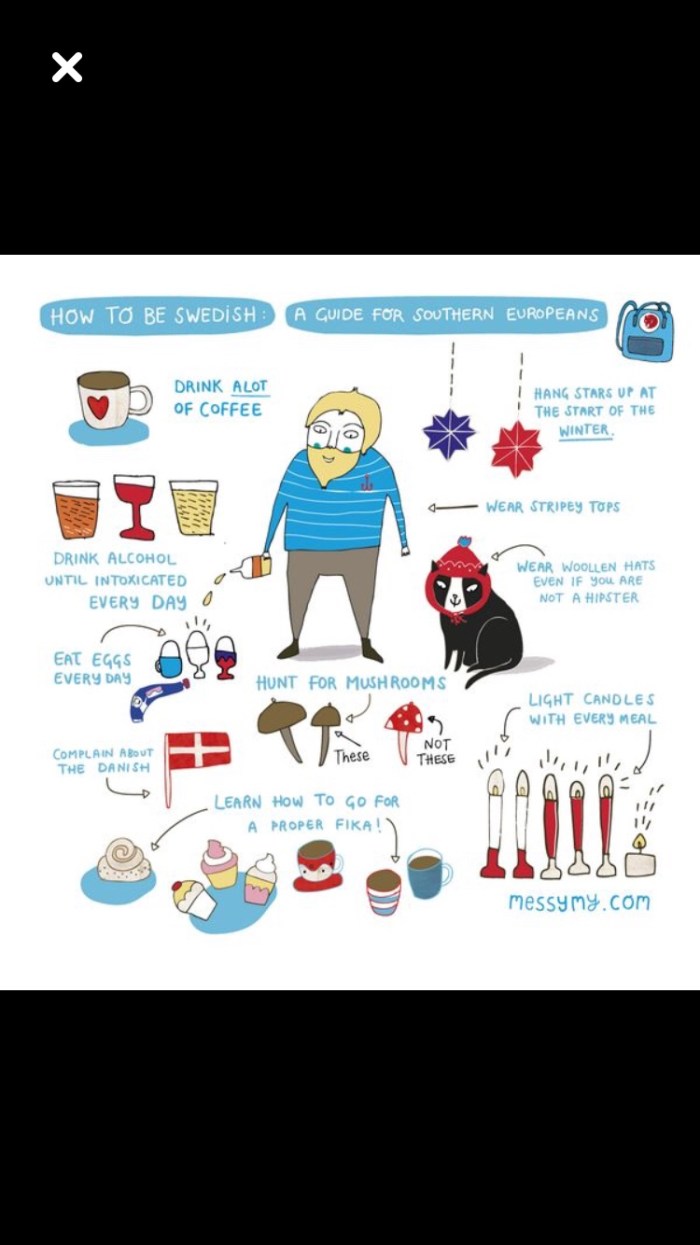
How to be Swedish?

Stumbled across this graphic on ‘How to be Swedish – a guide for Southern Europeans’. I have to say that there are many things I don’t recognize from living among Swedes. ‘Eat eggs every day’? ‘Complain about the Danish’? ‘Drink alcohol until intoxicated every day’?

With tongue in cheek, one can have a giggle at images like this. As long as one remembers it’s all just stereotyping and not the truth, then it’s ok. In my work with cultural training, this is an issue that comes up time and time again. Just when we think our society has risen above stereotyping, our cognitive biases take hold and we start putting people in boxes again. This is the biggest barrier to intercultural exchange, as it effects how we communicate and how we trust. It is both a stumbling block and a danger.

It’s good to be aware of cultural tendencies, or potential stereotypes, but then we must never forget we are meeting an individual. We don’t meet a culture, we meet a person. If we can always keep that in mind, then we are closer to creating an interaction based on curiosity and openness rather than on prejudice.

New Swedish words

Every year, the Swedish Language Institute announces which new words have made it into the Swedish dictionary.

Some of the words are totally new, some have been given a new meaning but all reflect the cultural and political influences of the year.

Here are 10 of the new words from 2017:

1) ‘alternativa fakta‘ – alternative facts. Coined by Trump minion Kellyanne Conway

2) ‘dabba‘ – to dab, a type of dance move

3) ‘döstäda‘ – to death clean. To clean out one’s possessions before death so that surviving family members don’t have to

4) ‘fejkade nyheter’ – fake news

5) ‘knäprotest‘ – to kneel in protest

6) #metoo

7) ‘plogga‘ – to jog and pick up rubbish at the same time

8) ‘serieotrohet‘ – series cheating – to watch an episode of a series without your partner (when you are supposed to be watching it together)

9) ‘skogsbad‘ – a form of therapy where one emerses oneself in the forest to reduce stress. Called ‘shinrin-yoku’ in Japanese.

10) ‘veganisera‘ – to make a vegan version of food that normally contains animal products.

To see the whole list, go to http://www.sprakochfolkminnen.se

Sweden’s ’Oxe weeks’

I heard on the radio today that somebody felt ‘helgtrött’ – suffering from ‘ weekend exhaustion’. Just as well then that today starts a long work period with no public holidays. After the extended Christmas, New Year and Epiphany break, there isn’t another break until Easter on 30 March 2018. That’s almost 12 weeks!

Many Swedes think that this is dreadful and have coined the phrase ‘oxveckorna’ which literally means oxe weeks. Now begins the period of working as hard as an oxe!

Sweden: the day before New Year’s Eve

New Years Eve is tomorrow – a Sunday. That means that it is not possible to buy alcohol as the shops controlled by the state-run alcohol monopoly are closed. If you want wine or spirits to toast in 2018, today is the last day to buy it. On a Sunday – no way! All over the country, Swedes thronged to buy their alcohol which resulted in queues and serious congestion. Here is a picture put up on Facebook today. A normal queue for the day I’m guessing – this one in Bromma in Stockholm.

What would you have done? Stayed in line or stormed off in a new year’s huff?!

Photo: Kim Nilsson

A literal Swedish Christmas

Swedish is often a very literal language. Yesterday, the 26th December, is a good example of that.

In the UK, the 26th December is known as ‘Boxing Day’. In many countries it’s St Stephen’s day – in Finland, it’s ‘Stefani Day’. In Ireland it’s ‘Wren’s Day’. In South Africa, it’s the ‘Day of Goodwill’.

And in Sweden? Well, here comes the literalness.

It’s called ‘Second Christmas Day’.

A Swedish Christmas tradition since 1960

In Sweden, since 1960, something has happened every day in the run up to Christmas. A tv series called ‘Julkalendern’ – Christmas calendar- is broadcast early in the mornings from Dec 1 to Dec 24. Sent in 15 minute episodes, it is a different story each year and often stars some of Sweden’s leading actors and comedians. It is very popular amongst children, and is a cozy seasonal tradition. After each episode, viewers can open the relevant door in their advent calendar, which accompanies the program. The stories can vary widely, but most usually there is a Christmas / winter theme and a moral message suited to the time of year.

‘Julkalendern’ sits deep in the souls and psyche of many Swedes. Most cherish fond childhood memories of getting up in the dark to watch an episode before heading off to school. In 1999, a competition was launched to identify the most popular ‘julkalender’ of all time. The winner was a spooky ghost story called ‘the mystery of Greveholm’. Closely behind were ‘Sune’s Christmas’, ‘The old woman who shrunk to the size of a teaspoon’ and ‘Magical times’.

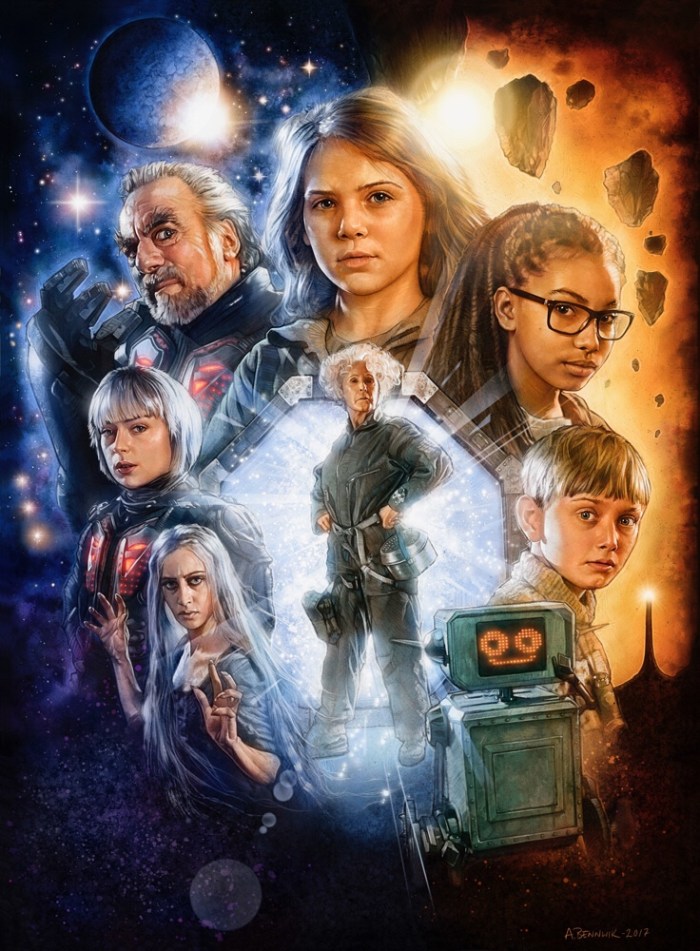
This year, the story is called ‘Hunt for the crystal of time’ and is starring a very popular, recently-deceased Swedish actor as the obligatory evil bad guy. In the series, he plans to stop time the day before Christmas Eve and the only people who can stop him are three children who have to journey to the center of the universe to do so.

It’s all very exciting – what if they fail?! There will be no Christmas ever again!

We’d all better hope they succeed! In just 5 days, we’ll find out!!!!

‘Julkalendern’ can be watched on SvtPlay you’d like to catch up!