Sweden’s pink Thursday

jesus-washing-apostles-feet-39588-gallery.jpg

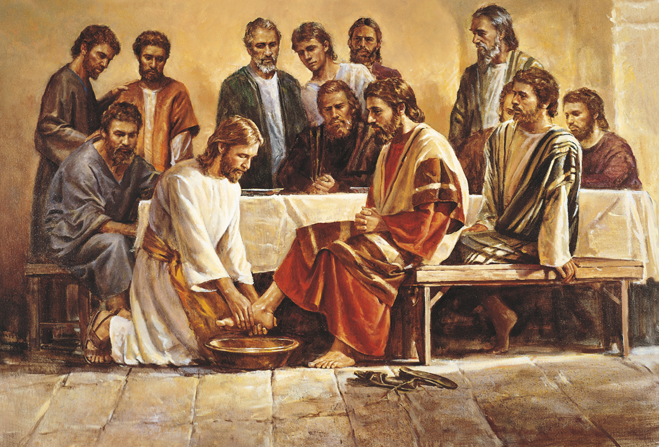
Today, the Thursday before Easter is called ‘Skärtorsdag’ in Swedish. As the word ‘skär’ translates as a shocking pink colour, many people joke that today is ‘pink Thursday’. But the word ‘skär’ in this case relates to something else – something far more biblical.

The word ‘skär’ is an early Nordic word meaning clean and pure. And here, we see a parallel to the English word for ‘Skärtorsdag’. In English, today is called ‘Maundy Thursday’ and it relates to the religious rite known as ‘the maundy’ which involved the ritualistic cleaning of feet. According to Christian belief, today was the day that Jesus performed this act until the recipients had clean and pure feet. It also is the day of the infamous Last Supper.

However, in Sweden today, ‘Skärtorsdag’ is not celebrated in any great religious fashion but in a pagan manner. A old pagan belief in Sweden was that on this day witches would mount their broomsticks to fly away to the legendary mountain known as Blåkulla. At Blåkulla it was believed that the devil held his earthly court. There the witches celebrated their sabbath and danced with the devil.

In modern day Sweden, we see this reflected in the many children who dress up as witches. These kids paint Easter cards and walk around the neighbourhood knocking on doors to wish everybody a happy Easter. In exchange, they hope to receive Easter sweets.

Why Swedes are easy to make fun of

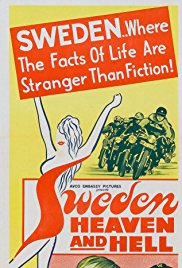
sweden heaven and hell

In an article written about the New Zealander stand-up Al Pitcher, he says Swedes are easy to make fun of. I guess he would know as he has built a successful career on it, in which he masterfully manages to navigate the difficult path of ridicule and affection.

But it got me thinking. Is it true that Swedes are easy to make fun of? I would suggest that the answer is – yes!!

Here’s my theory….

1. Swedish Extremism

According to the World Value’s Survey, Swedes are the most extreme country in the world – in values that drive society forwards. Typically non-traditional, non-religious and modernistic, Sweden deviates radically from most other places around the world. And this is one reason why it is easy to poke fun at them, they are so different from the rest of us.

2. Self-actualisation

Research backs up the claim that Swedes are individualistic – probably one of the most individualistic societies in the world. In Sweden, individualism relates to the right to make own life choices, voice ones own opinion, take care of oneself, be independent of others. Built on this is a strong concept of self-actualisation – ‘the right to be me’. This is the right to develop my life exactly as I want, and not how others want and it is very strong in Sweden. I think this encompassing sense of individualism and self-actualisation produces a need to learn about oneself, to focus inwards and to belly gaze. This means that humour pointed at the direction of a Swede is seen an opportunity for Swedes to learn something about themselves, or other Swedes. It’s often not taken personally, but is often welcome, and is subconsciously perceived as one element of a greater journey to self-realisation.

3. Being unSwedish

I would venture that Sweden is the only country in the world where being unlike the national standard is seen as a compliment. In the UK, and the USA for example, being ‘unBritish’ or ‘unAmerican’ is seen as a negative, almost treasonous trait. But in Sweden, being ‘unSwedish’ is positive. This means that there is not a national sense of protectionism or patriotism to the identity of being Swedish – which suggests that jokes and ridicule at the expense of the nation are more acceptable.

4. Swedes are funny

Maybe it’s not the classic stereotype, but Swedes are in fact a funny bunch. And my that I mean both ‘funny haha’ and ‘funny peculiar’. Their dark sense of humour usually includes a sense of irony – which means that they can usually take ridicule as much as they can give it out.

5. Remoteness spawns peculiarities

Let’s face it, living in a relatively small country in a remote location and a frozen climate makes you do funny things:

  • consuming copious amounts of caffeine to stay awake
  • delighting in enormous amounts of sugary goods to stay awake
  • working hard in the winter to be free in the summer
  • consuming alcohol at weekends to forget the working week
  • marrying, divorcing, marrying, divorcing
  • going out into ‘the nature’ for fresh air, light and to commune
  • traveling to the sun to escape the winter – and seeing it as a right
  • eating salted or pickled or cold food on festive occasions
  • taking naked saunas in the winter, and bathing naked in the summer

and many many more…. Let’s face it, there is a lot to make fun of!


If you like this blog, please share it and spread the word!


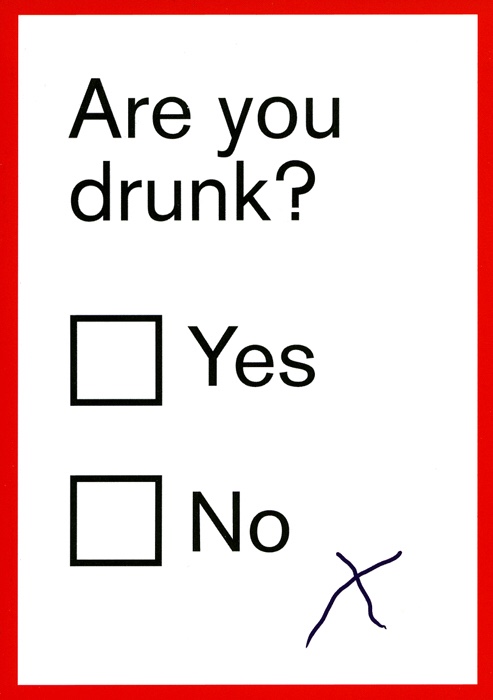
30 ways that Swedes are drunk

Yesterday was St Patrick’s Day, known for its partying and boozing. This inspired me to collect a list of Swedish words and expressions for being drunk. Not surprisingly, it seems that Swedes have as many words and expressions for being drunk as they do for snow. Might there be a connection here? Here we go:

1) Full – the usual, neutral word for drunk

2) Dragen – extremely drunk

3) Rund under foten – round under the feet – literally wobbly drunk

4) Bra i gasen – energetic drunk

5) Glad i hatten – happy in the hat – merry drunk

6) Packad – wasted

7) Radiostyrd – radio controlled

8) Aprak – drunk as a monkey

9) Dyngrak – very drunk

10) Tankad – tanked

11) Plakat – very drunk

12) Full som en kastrull – drunk as a saucepan

13) Berusad – tipsy

14) Onykter – tipsy

15) Pruttfull – ‘fart drunk’

16) Överförfriskad – had too much to drink

17) Bladig – tipsy

18) Snygg – drunk (also ‘good looking’)

19) På lyset – lit up

20) I dimman – in the mist

21) Dretfull – very drunk

22) På sniskan – tipsy

23) Kalasad – drunk and been partying

24) På kanelen – on the cinnamon

25) karatefylla – so drunk that you have no body control

26) pissepackad – pissed

27) påverkad – under the influence

28) slirig – tipsy

29) drucken – drunk

30) på pickelurven – between tipsy and drunk

A crucial night for Sweden

Tonight is the end of a gruelling six weeks. Tonight an important decision is made in Sweden – a crucial decision some might say. Tonight, millions of Swedes gather together to jointly arrive at their conclusion. From North to South, East to West, amongst mountains, by lakes, on islands and in cities, Swedes crowd around their TVs to watch the biggest show broadcasted in the country. This is bigger than royal weddings, political funerals or sporting events. This is huge. Tonight, Swedes decide who should represent them in this year’s Eurovision Contest.

Choosing a representative takes 6 weeks in Sweden. 5 weeks of semi finals, a second chance competition and then the final. It’s a combination of tradition and torture.

But tonight it is all over and Saturday evenings are finally released for other entertainment. In a puff of glitter, the winner is chosen by public vote and jury and then it is all over. Apart, that is, from the after party, the post analysis and the pre programs for the approaching Eurovision Contest in May.

Sweden might be a county of moderation, but Eurovision is a major exception. If anything’s worth doing, apparently it’s worth doing properly. By dragging it out. And out. And out.

The world’s longest cross country ski race – Vasaloppet in Sweden


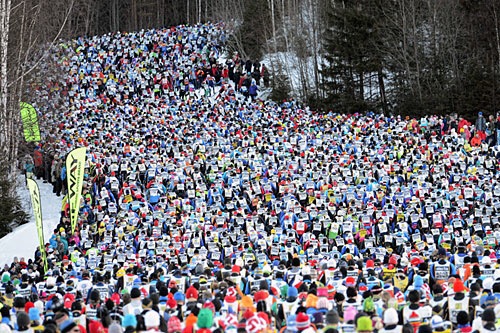
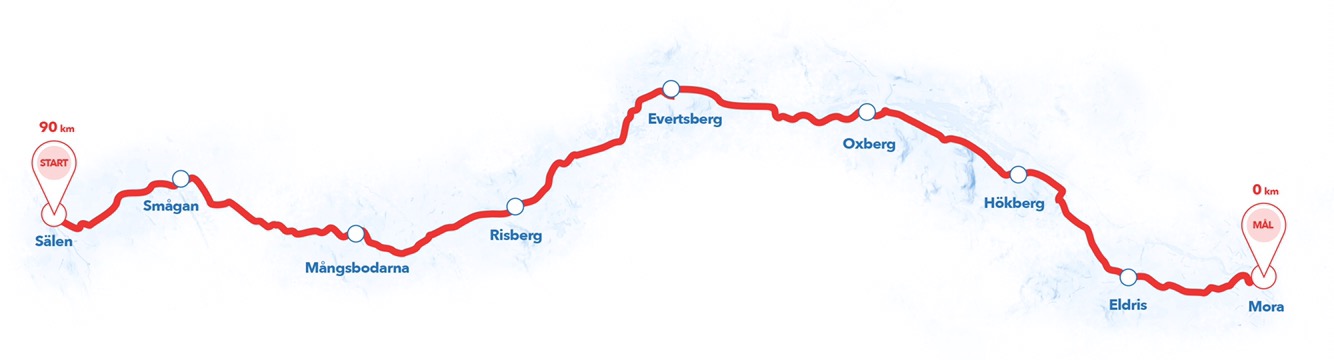
Today, the world’s longest cross country ski race takes place in Sweden. Called Vasaloppet, it entails participants skiing 90 kilometers from start to finish. It’s an extremely popular international race, which can take up to 12 hours to complete, and which is broadcast live on tv. When tickets to participate are released, they sell out in 15 minutes – it’s that popular.

The first Vasalopp was in 1922 and takes place annually, the first Sunday in March and it is a first sign of spring.  It’s an amazing sight to watch, as more than 15000 mad, happy skiers glide along, the swishing sound of ski on snow filling the air.

For the elite athletes, 12 hours to complete the race is of course unthinkable. They go considerably faster. The person who has completed the race fastest is Jörgen Brink, who in 2012 won the race in just over 3 hours 40 minutes, roughly 25 km per hour.

So why is this race called the Vasalopp? Well, it takes its name from a Swedish king. The race commemorates the escape to Norway, through the forest, of King Gustav Vasa in 1521. Legend has it that he carried out the gruelling journey on skis,  but experts believe he more likely completed this escape on snow shoes. Nevertheless, out of this legend sprung the race which is so popular today.

Modern day skiers don’t see the experience as an escape, they see it as a challenge and for many of them it’s a rite of passage.

And as you sit watching the TV comfortably from the sofa, with tea and toast, you take vicarious pleasure in this long, amazing Swedish race.

Demolishing Swedish treats

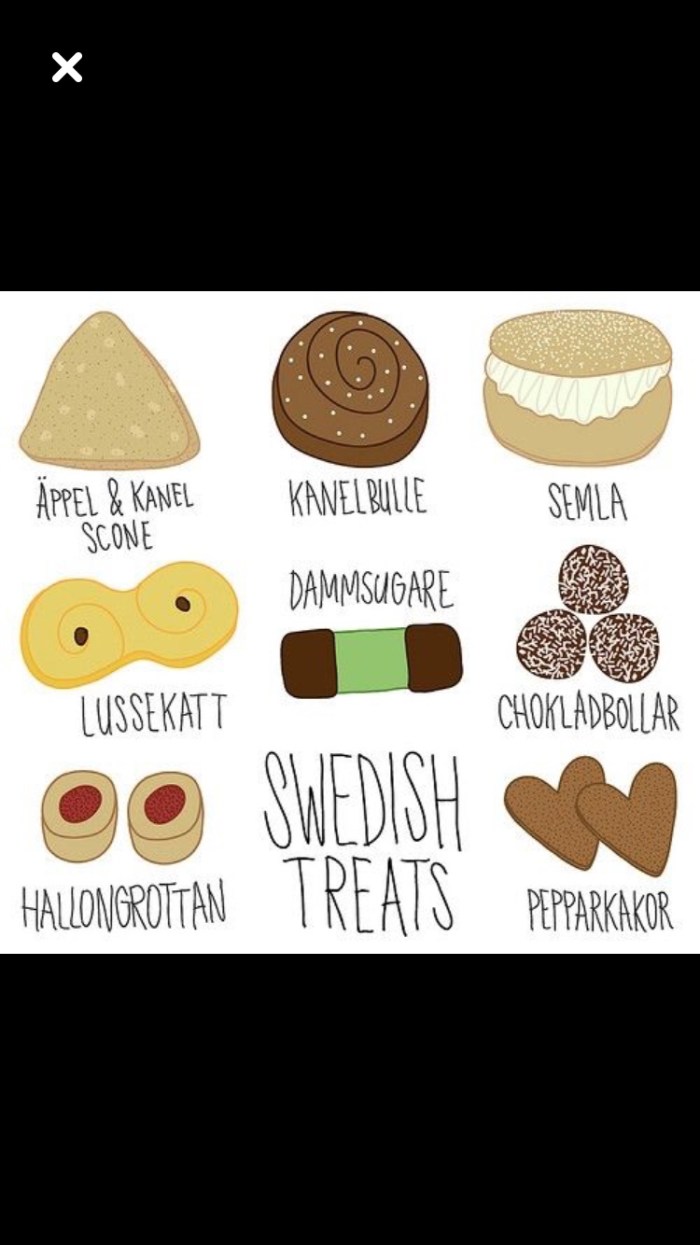
Many Swedes love to ‘fika’ – the tradition of drinking coffee and eating a cake. So much so that somebody decided to create the graphic above about popular Swedish treats. While the drawing is nice, the picture rather shows the meagreness of a Swede’s cake options. What then are some of the terrible choices depicted?

In a previous blog I’ve talked about the creamy bun known as semla, which I happen to think is delicious. In my opinion the semla is the best of them all. It is the king of Swedish treats reigning large over the other, to be honest, rather underwhelming alternatives.

The apple and cinnamon scone – as a British person I would not call this a scone. I don’t know what it is. Some kind of triangular bit of plaster. So, no further comment.

Probably the most popular dry-as-a-bone pastry associated with Sweden is the ‘kanelbulle’ or the cinnamon bun. Sold predictably in every bakery and cafe in Sweden and in their millions at Ikea, the cinnamon bun is only redeemed when drenched in melted, oozing butter.

Then there’s the ‘lussekatt’ – a disgusting saffron bun baked and sold in December. If you like bland, yellow bakes that give you indigestion for hours then this is the one for you.

The ‘dammsugare’ – or vacuum cleaner – is a marzipan roll dipped in chocolate. They can contain a bit of Swedish liqueur ‘punsch’ to take the edge off their otherwise plasticky taste. Altogether pointless and unsatisfying.

‘Chokladboll’ or chocolate ball is a linguistically dubious treat. Traditionally given a racist title, they are basically cocoa balls rolled in coconut. An unpleasant eating experience, these balls tend to ‘grow in your mouth’ as they say in Swedish….

‘Hallongrotta’, literally means raspberry cave. These are vanilla biscuits filled with raspberry jam that melt in the mouth. Unless they’re rock hard. They are a traditional biscuit which seem to evoke memories of grandmas and hot kitchens for many Swedes.

‘Pepparkakor’ are crisp gingerbread biscuits eaten around Christmas time. A ubiquitous classic eaten with Swedish mulled wine – ‘glögg’. They are a must during the festive season in homes, offices and often served covered in bacteria in shops. They come in many sizes and shapes, such as love-hearts, stars, people and goats. Yes, you read that correctly – goats.

So none of the above have a patch on the creamy, gooey, airy, almondy delight that is the semla. I know what I’m ordering with my coffee!

Any other Swedish treats that you think rival the almighty semla?

Swedish sport break – state sanctioned disease control

In Stockholm, we are in the middle of winter sport break. Called Sportlov it’s a traditional time for the schools to close mid-term and Swedes to head off to the ski slopes.

This tradition was introduced in 1940 and was initially a way to save energy. Heating up schools cost money and, due to rationing, councils were instructed to drastically reduce their heating expenses. To give the pupils something meaningful to do while the school was shut, the authorities organised various activities, many focused on being outdoors and exercising. During the 50’s, experts realised that infection spread less widely at this time of the year if schools were closed for a week. So the winter sport break became cemented as an official disease control method.

Nowadays, many families drive up to the mountains to go skiing, some fly off to the Alps for the same purpose. Others head for warmer climes.

For those of us left in town, it’s wonderful.

There is hardly anybody on the buses and tube, traffic is significantly thinner and less noisy and it’s easy to get a seat at lunch time. Add to this the current snow storms and it is sheer bliss.

And the fact that there are hardly any children in town means the rest of us don’t get infected with nasty kid flu bacteria on our way to work.

That’s what I call a win-win!

50 words for snow!

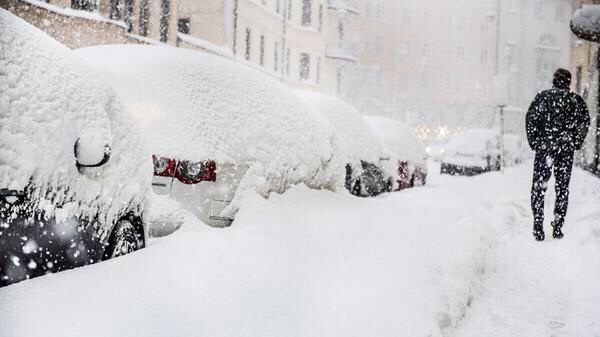
Last year, I started a list of Swedish words for snow and lost energy at 25. This year, as the snow tanks down outside and the cities are hit with ‘snow chaos’, I decided to expand the list from 25 to 50!

Not surprisingly when living in a country where it snows a lot, people start to see differences and nuances in the type of snow, whereas in English the word might just be an unsatisfactory ‘snow’. The Swedish language makes it easy to join words together to describe these nuances.

Here is a list of 50 Swedish words related to snow.

1) Blötsnö – wet, slushy snow
2) Drivsnö – snow that is blown into troublesome snow drifts
3) Aprilsnö – snow in April, according to suspicion signifies plenty of food for the coming season
4) Hårdsnö – compacted hard snow
5) Konstsnö – artificial snow
6) Kramsnö – squeezy snow, perfect for making snowballs
7) Julesnö – snow at Christmas
8) Klabbsnö – wet, warm snow for building snowmen
9) Kolsyresnö – frozen carbondioxide
10) Kornsnö – small white snow breadcrumbs
11) Lappvante – thick, falling snow
12) Lössnö – snow that can loosen and be dangerous
13) Majsnö – surprising and unwelcome snow in May
14) Modd – snow that has partly melted due to salt
15) Natursnö – real snow (as opposed to artificial)
16) Nysnö – fresh snow, crisp and white
17) Pudersnö – powder snow
18) Rekordsnö – an unusual amount of snow, breaking previous snow records
19) Slask – slushy snow mixed with rain and dirt on the ground
20) Snö – snow
21) Snöblandat regn – snow mixed with rain
22) Muohta – the Sami word for snow (it is said the Sami actually have 200 words for snow!)
23) Snörök – faint particles of snow that look like smoke
24) Yrsnö – snow being whipped around by the wind in all directions
25) Åsksnö – snow that pours down during a thunder storm

26) Snökanon – a sudden blast of snow that suddenly hits a place, and feels like snow has been dumped on you

27) Jungfrusnö – virgin snow

28) Snösmocka – a huge amount of snow

29) Snötäcke – snow on the ground

30) Sjösnö – snow over the sea that can roll in over land

31) Snöfall – snow in the air

32) Flingsnö – snow with larger crystals

33) Skarsnö – a crispy surface on a blanket of snow

34) Packsnö – thickly packed snow

35) Pärlsnö – snow like small pearls that hurts when it hits your face

36) Snöglopp – wet snow mixed with rain

37) Spårsnö – snow that allows footprints to be formed

38) Fjöcksnö – a light, fluffy snow

39) Flister – snow the consistency of salt that stings the face when it falls

40) Flaksnö – a sheet of snow

41) Upplega – snow on the upper side of a tree branch

42) Firn – liquid-like snow that can initiate an avalanche

43) Fimmel – sandy snow that falls at low temperatures

44) Själja – a thin layer of ice on top of the snow that resembles glass

45) Knarrsnö – crispy snow that creaks when you walk on it

46) Snöfyk – wet snow

47) Torrsnö – dry snow

48) Månsilver – a poetic word to describe the dusting of snow

49) Snöis – snow on cold water that forms an icy solid surface

50) Stöp – a mixture of snow and ice resembling porridge that forms on top of cold water
How Aslan led to Sweden – a personal story of a Swedish odysse

A long-time friend of mine recently wrote a post on Facebook, instigated by the recent school shooting in her home country, USA. In her post, she writes her personal story about her 30 year experience of living in Sweden. With her permission, I am publishing it here. Please read it, I think it sums up the way a lot of people who move to Sweden feel. Here it is:

‘For anyone who might be interested, I would like to share a milestone in my life.

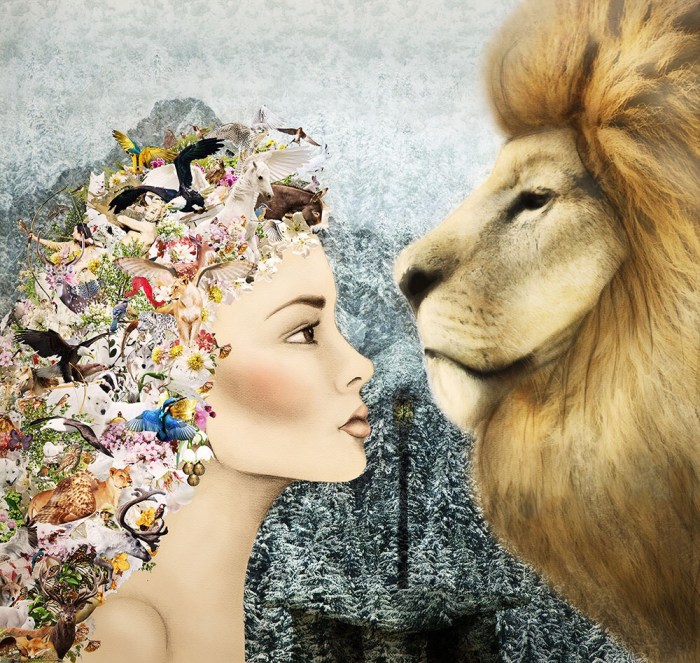
30 years ago this week, I took the adventure that Aslan gave me. (If you’ve read ‘The Narnia Chronicles’, you understand that reference.) I packed up my clothes and few belongings, waved a tearful goodbye to my parents at Dulles International Airport in Washington and moved to Sweden. I knew that the love of my life lived there, and that was most important, but I didn’t know much else. I had NO IDEA how the trajectory of my life would change.

Among the things I have experienced in Sweden are the following:

* An AMAZING Swedish family which took me in, accepted me with all of my weird American quirks and loved/loves me like my own family. They ARE my own family now. Along the way, my Mother-in-law and older sister-in-law were instrumental in helping me learn Swedish. Their patience was infinite. My younger sister-in-law, Marina, has become one of my closest friends, but, she talked so fast, I couldn’t understand a word she said. Sometimes, I still don’t. 😂❤️

* A society, while not being perfect, holds 2 particular values to be self-evident:

1. We have a responsibility to those who are less fortunate and that responsibility should be incorporated into government policy.

2. Women and men are equal.

* A year of paid maternity leave with each child.

* Unparalleled care through 5! major surgeries, NONE of which I had to pay for.

* A school system which treats me like a professional and gives me a great deal of freedom as to what and how I teach my students in order to reach curriculum goals.

* AMAZING colleagues from a plethora of nations, cultures and languages who are passionate about our students and who are a daily reminder to me of the common humanity of every person on the planet.

* I NEVER have to worry about a gunman in my school. 😔

Forrest Gump said, “Life is like a box of chocolates. You never know what you’re going to get.” So far, I’ve gotten a box of ALL of my favorite kinds. Who knew on that cold Sunday in February of 1988 when my parents hugged me goodbye.

Thanks for reading’. ❤️

It’s Fatty Tuesday – Swedish style!

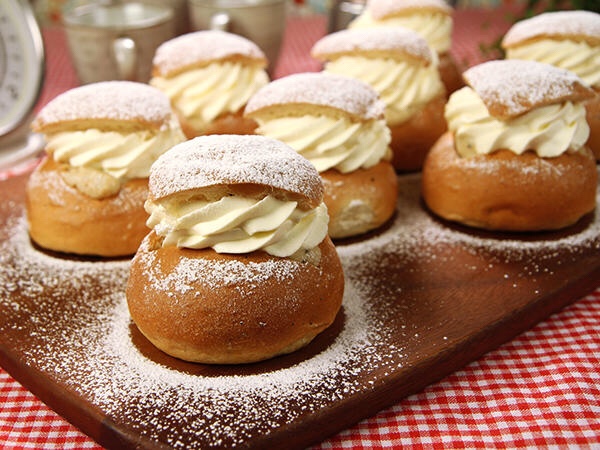
Today it’s ‘Fat Tuesday’ in Sweden, known as Shrove Tuesday or Mardi Gras around the world. While in the UK we eat pancakes and in Latin America they scoff down fried bread, Swedes celebrate by eating the traditional cream Lent bun – the ‘semla’. I’m also clearly going to indulge. In fact, my mouth is watering just writing this blog.

The semla is a creamy bun filled with delicious almond paste. They were eaten traditionally in Sweden to commemorate the start of Lent and the great Fast. In the south of Sweden, they still refer to them as ‘fastlagsbullar’ – Shrovetide buns. Nowadays however, semlas are usually sold anytime between Christmas and Easter.

I just love them. I could eat a barrel load. But I’d end up looking like a barrel if I did. I love the taste of them, and the feeling of luxurious indulgence. I also love the knowledge that as you take a bite into a creamy semla, you are biting into over 500 years’ history of Scandinavian baking.

The word ‘semla’ comes from the Latin ‘simila’ which means fine flour and originally referred just to the bun without any filling. As long ago as the 1500’s, bakers started to hollow out the middle of the bun and fill it with cream and butter. As ingredients became more available, bakers started adding almond and cardemon and the type of semla that we know today developed towards the end of the 1800’s. After rationing of sugar and dairy products ceased at the end of WW2, the semla took off and became very popular.

Nowadays the semla trend has reached new heights. Every year bakers around the country try to launch new types of semla, with their own spin on it -for example, the semla wrap, the semla burger, the semla layer cake, the semla cocktail, the chocolate semla, the vanilla semla, the lactose-free, gluten-free vegan semla.

All delicious I’m sure, but I’m a traditionalist in this matter. Give me a round fluffy cardemon-scented wheat bun brimming over with whipped cream and almond paste.

And give it to me NOOOOWWW!!!