The National Day of the Sweden Finns

In Sweden, you couldn’t swing a cat without hitting somebody Finnish or of Finnish heritage. Almost everybody knows somebody with a Finnish connection. In fact, there are so many Finns living in Sweden that they have their own commemorative day. And today is that day.

Today, 24th February is ‘Sverigefinnarnas’ Day, (Sweden Finns Day) – the day that celebrates the roughly half million people who live in Sweden and have Finnish as their mother tongue.

So why are there so many Finns in Sweden?

There has been a long history of emigration between the two countries, especially in the border regions of the north. However, a larger emigration happened when 70,000 young Finnish children were evacuated to Sweden during WW2. 15,000 are believed to have stayed and an unknown number to have returned as adults.

Then, in the 1950s and 1960s the migration from Finland to Sweden was considerable, chiefly due to economic differences between the countries. Sweden had the industry, the jobs and the housing. This caused some alarm in Finland with most of the emigrants in their most productive age — although many of them returned to Finland in the following decades.

In the year 2000, the Sweden Finns were recognised as an official national minority group in Sweden. In fact, the Sweden Finns are the largest national minority group in Sweden. Other large minority groups come from former Yugoslavia, Irak, Syria and Poland – although these do not have official national minority group status.

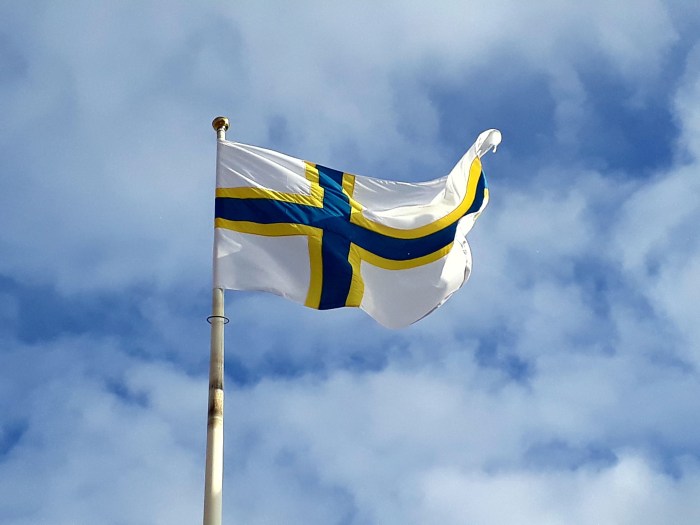
In 2007, a flag was designed which combines the Swedish and the Finnish colours.

If you’re in Sweden today, you may well see this flag flying proudly around the country.

Swedish winter break – take those kids away!

Around this time of the year, schools In Sweden have a week’s holiday. Called ‘Sportlov‘, it’s a traditional time for a winter sport break. 

This tradition was introduced in the early years of WW2 as a way to save energy. Heating up schools cost money and, due to rationing, councils were instructed to drastically reduce their heating expenses. So shutting the schools seemed like a good idea.

To give the pupils something meaningful to do while the school was shut, the authorities organised various activities, many focused on being outdoors and exercising.

Serendipitously, experts realised, during the 1950’s, that infection spread less widely at this time of the year if schools were closed for a week. So the winter sport break became cemented as an official disease control method. 

Nowadays, many families head off to the mountains to go skiing, some head off to the Alps for the same purpose. Others may fly away to the sunny beaches of the world.

For those of us left in town, it’s sheer bliss. 

The gym is empty. The streets are spacious. There is hardly anybody on the buses and tube, traffic is significantly thinner and less noisy and it’s easy to get a seat at lunch time. 

And the fact that there are hardly any children in town means something great for the rest of us.

We don’t get infected with diabolical kid bacteria that would knock us out until mid March.

The only 2 Swedes to win acting Oscars

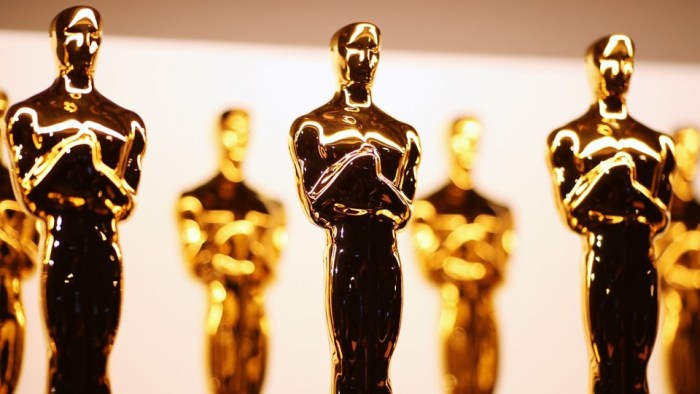
On Sunday, it’s the annual Oscar’s gala and this year there are 2 Swedish nominations included. Over the Oscar’s 91-year history, 14 Swedes have taken home a statue. Many of these academy awards are for lighting, costumes, photography and direction. Not much for acting. In fact, despite Sweden’s excellent acting corps, only 2 people have won an Oscar for their acting talents.

Do you know who they are?

Below, you will find their names.

1944, Ingrid Bergman for Best Lead Actress in ‘Gaslight’ and in 1956 for ‘Anastasia’. She also won for Best Supporting Actress in ‘Murder on the Orient Express’ in 1974

2016, Alicia Vikander for Best Supporting Actress in ‘The Danish Girl’

Sweden has also had a few actors who were nominated and didn’t win:

1972, Ann-Margret for Best Supporting Actress in ‘Carnal Knowledge’ and Best Lead Actress for ‘Tommy’ in 1976

1989, Max von Sydow för Best Lead Actor in ‘Pelle the Conquerer’ and in 2012 for Best Supporting Actor in ‘Extremely Loud and Incredibly Close’

1990, Lena Olin for Best Supporting Actress in ‘Enemies: a love story’

Swedish legend Greta Garbo never actually won an Oscar, although she was nominated 4 times. In 1955, she was given an honorary Oscar however.

This year, Sweden has no acting nominees. So we’ll have keep our fingers crossed for the categories best make-up and best music instead.

6 reasons why Swedes take Eurovision so seriously

We are in the middle of the Eurovision qualification rounds (known colloquially as ‘Mello’) in Sweden – three weeks in, three weeks to go. This extended selection period occupies every Saturday night for 6 weeks, and results in the song and artist who will represent the country in the big final in Israel.

People gather up and down the country to have ‘Mello’ parties. Social media and traditional media are full of comments about the bad quality of the contestants this year (and every year). People are raging that the wrong songs are voted to move on in the league table.

Nobody, and I mean nobody takes their Eurovision (ESC) more seriously than the Swedes.

But why is that? Here are a few theories:

Brightening up the winter blues. Mello comes during the deepest, darkest, dreariest time of the year. The glittery colourfulness of Mello brightens up February and early March, when nothing much else happens.

Reliving the glory days. ABBA’s legacy is a constant reminder to Swedes that they once reached long-lasting global fame and it all started at ESC. Every year is a hunt for the next big thing, when the international light will shine once more on this little country in the north.

Organized ‘religion‘. Sweden is, relatively speaking, not a religious country. So the human need for organising ourselves into a collective manifests itself in other ways. Hockey and football become a form of organized religion. And ‘Mello’ is another variation on the same theme. Ask Swedes why they like Mello and many use the word ‘folk fest’ – a ‘national party for the people.’

Swedish traditions. Sweden is a country that is good at holding on to traditions – crayfish parties, snaps songs, semla cream buns, Easter trees – to name just a few. Therefore it is easy for this society to absorb, and structure, new traditions. Halloween is now a thing here. So is Valentine’s Day. So Mello becomes another tradition and slots nicely into the national calendar.

Vicarious extrovertism. Swedes are not generally known for being outgoing and extroverted, although there are of course exceptions. This means that Mello becomes so attractive, as it’s an opportunity for Swedes to live vicariously through the ‘crazy’ performers who dance around in sequins and funny outfits. It’s also an opportunity to push your own boundaries and wear a glittery hat or a pink feather boa. And all under organised, acceptable conditions.

Love of music. Because some Swedes actually like the music.

Which theory is most accurate do you think? Do you have another theory?

The most popular names in Sweden

Oliver was the most popular name for male newborns in the UK last year. And Olivia was the most popular female name. In London, it was Amelia and Mohammed and in Ireland it was Jack and Emily.

So what about Sweden in 2018? Just-released information from Sweden’s office of statistics give us the following answer.

The most popular top 5 names for male newborns were:

  1. William
  2. Liam
  3. Noah
  4. Lucas
  5. Oliver

In fact, there are 44010 males in Sweden with the name William. And 58 females!

And for newborn girls it was:

  1. Alice
  2. Maja
  3. Lilly
  4. Ella
  5. Wilma

Interestingly, there are 38957 females called Alice in Sweden. And 22 men!

The names Ture, Lias and Amir are the fastest climbing names in the list of boys’ names. And for girls, Hailey och Bianca. The names Sebastian, Neo, Simon, Emelie, Ellinor, Idun and Noomi have left the top 20 list.

If you want to see how many people have your name in Sweden, go to svenskanamn.alltforfaldrar.se

Remember to follow me on Instagram! watchingtheswedes

What exactly is a quisling?

Sweden might have a government soon. Months after the general election, an unconventional middle coalition seems to be forming, which includes former opposition parties from left and right. All of this is an attempt to keep an extreme right wing party out of the government. However, it’s not without its critics.

One party in particular – the right-oriented Center Party- have been strongly criticized for being turncoats and traitors. One disgruntled politician called the leader of the Center party a quisling. While we use this term in English, I was curious to check into where the word comes from and why it is such a serious insult.

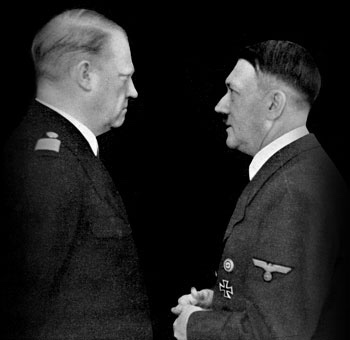
According to Wiki, quisling is a term originating in Norway, which is used in all the Scandinavian languages and in English for a person who collaborates with an enemy occupying force – or more generally as a synonym for traitor. The word originates from the surname of the Norwegian war-time leader Vidkun Quisling who headed a domestic Nazi regime during the Second World War.

Interestingly, the use of the word quisling predates the war though. In 1933, the term was used to describe the followers of Quisling who was in the process of starting a national fascist party based on the German nazi model.

In 1940, Quisling attempted to seize power in Norway, as he wanted to collaborate with Hitler. His coup d’etat failed, and he and his followers were declared criminals. In the British Times the headline was ‘Quislings everywhere’, and the term became synonymous with traitor – a word to ‘carry the scorn of mankind throughout the centuries’, to quote Winston Churchill.

So there we have it. A word taken from a pitiful, slithering fascist who was a traitor to his country and collaborated with an enemy power. Sounds more like a description of Trump if you ask me.

It seems then definitely out of proportion that the word is currently being used to describe the leader of Sweden’s Center party.

Of course many people are disappointed, and she has had to make some difficult compromises. But there is one promise she has not backed down on, however difficult it might be – to never give fascists a position of power in Swedish politics. And though not ideal for her, she has moved to the middle to prevent this.

The irony then is in the fact that she is being called a quisling. She is not a quisling, she is in fact the complete opposite.

Why Swedes celebrate their names

Today is Svea’s Name’s Day. And October 8th is my Name’s Day. Well, not quite….but almost. It is Nils. And since I’m called Neil, well, I take Nils as my day.

Some of you might be wondering what the hell I’m talking about. What is a ‘Name’s Day’? Well, it’s like this. In Sweden, every day has a name, sometimes two. And if your name happens to be represented in this way in the calender, then you can celebrate your day. Strange? Maybe. Unusual? Not really.

A Name’s Day is actually a tradition in lots of countries such as Bulgaria, Croatia and Ukraine. According to Wiki, the custom originated with the Christian calendar of saints: believers named after a saint would celebrate that saint’s feast day. In Sweden, however, there is no longer any explicit connection to Christianity. It’s been a tradition since the Middle Ages and started because the church wanted the people to celebrate Name’s Days instead of birthdays which they viewed as a pagan tradition.

There are different lists though some names are celebrated on the same day in many countries. In 1901 a comprehensive modernization was made in Sweden to make the list up to date with current names. This also happened in Finland, but not in other countries.

But Name’s Days are not without their controversy. The monopoly on calenders, held by the Royal Swedish Academy of Sciences, expired in 1972 and so did the official name day list. And then all hell broke loose. Competing lists emerged and finally in 1986 a new list with three names on each day was designed to create harmony in the Name’s Day chaos. But people weren’t happy. Seven years later, this list was revised and reduced to two names per day. But Swedes were still dissatisfied with this and the Swedish Academy produced a new two-name list which was finally accepted and brought into use in 2001. Although it does not have the official status of older lists, it is now universally used in Sweden.

One alternative calender, however, is the Diversity Calender which appoints each day with a more diverse selection of names to represent modern-day society.

How this tradition arrived in Sweden is unclear. Maybe it was imported by foreign religious leaders or merchants, or maybe it’s to do with the fact that the Swedish Protestant Church retains some traditions similar to the Catholic. Whatever the origin, it’s a reason to celebrate. And Swedes love to celebrate!

So, come on Svea, today’s your day – January 2nd! Happy Name’s Day to you!!

If you’d like to check out if you’re privileged to have a Name’s Day go to www.dagensnamnsdag.nu

Sweden’s Las Vegas on the Baltic Sea

Did you know that Sweden was once a great political power? The Swedish Empire exercised control over the Baltic region for over 100 years. The beginning of the Empire is usually taken as the reign of King Gustav Adolf in 1611, and the end as the loss of territories in 1721 following the Great Northern War. Sweden had control of Finland, Estonia, Latvia, Denmark, Norway and parts of Germany. It is rumoured in Swedish history that King Gustav Adolf had an ambition to make the Baltic Sea a large lake inside Sweden.

This was all a very long time ago, and today things don’t look quite the same for Sweden. Today, the most common boats that travel over the Baltic Sea are ferries and cruise ships. These huge ships traffic, amongst other destinations, Stockholm, Helsinki, Åbo, Åland, Visby, Riga, Gdansk, Rostock and Tallinn. Today, they are not for invading Swedes but mostly for multinational tax-free shopping, city breaks, partying, cruising, transporting goods and touristing.

The specific party boats between Sweden and Finland are a Swedish classic. They are also a special case – they are a kind of ‘booze cruise’ and are an interesting study in how many varying levels of intoxication there are. It’s hard to say who wins the competition in being most drunk and going berserk – the Swedes or the Finns – but both nations give it a good attempt. These boats are notorious locations for partying and, like Las Vegas, what happens on the ferry stays on the ferry. It’s a fascinating sight to witness.

The boats have various well-used bars, nightclubs, cabaret lounges with tacky stage performances, a mix of good to production-line restaurants, basic and luxury cabins, spa, poker tables, slot machines, karaoke, bingo and tax free shopping. Everything is ambitiously designed to give passengers a fun night or two at sea.

You don’t have to party like crazy to travel these boats however. Lots of families, couples and calm groups of friends use the boats as transportation or as cruises and mini breaks. With an upgrade, you can experience nicer restaurants and better cabins. The view out of the window is also very pretty as the boats glide gently through the thousands of islands in the archipelago and out into the open sea.

So, whether you’re looking for beautiful scenery, a sociological study of the Swedes and the Finns, or wanting a wet party night, then jump on a cruise ship from Stockholm and venture out onto the Baltic Sea.

Swedes and their alcohol – a Swedish odyssey?

When visiting Sweden, people are often struck by the system for purchasing alcohol. In bars and restaurants everything goes as expected but if you want to buy a bottle of, for example, wine or whisky then this is done in the state-owned alcohol shops known as Systembolaget. These shops have restricted opening hours closing at 6 or 7pm on weekdays and 2 or 3pm on Saturdays. On Sundays and Public Holidays they are closed.

Sweden’s alcohol monopoly started in the 1800’s and the national company Systembolaget was formed in 1955.

Systembolaget has a retail network of circa 426 stores, around 25 in Stockholm. The company has an interesting mandate from the Swedish state – to help limit the medical and social harm caused by alcohol and thereby improve public health. This explains why access to alcohol is restricted through the number of stores, opening hours and retail rules, and why the corporation is aims not to maximise its profit. In other words, the alcohol monopoly is highly socio-political -its foremost aim is to stop people consuming alcohol, or at least to consume it responsibly.

Although strange for many visitors, it’s a concept that seems to work – Swedes consume on average 9.1 litres of pure alcohol per person annually, less than many other countries.

However, it is at times like Christmas that the restricted opening times become more obvious. This year, the shops are closed for 4 days from yesterday at 3pm. Up and down the country, long queues were reported. I saw this with my own eyes, and had a weird recollection of old pictures from the Second World War or Soviet Russia. People seemed to be in a good mood while they waited, though it meant waiting for almost an hour outside some branches.

I guess it’s the price you pay for lack of forward planning. Anyway, I hope everybody got what they wanted and that they have a boozy, woozy, snoozy Christmas worth queuing for.

Sweden’s most horrifying and thought-provoking monument

On the main square in the western Swedish town of Karlstad, there is a statue. A striking statue. A significant statue. A statue that was once voted the ugliest statue in the country.

The statue represents a strident woman holding a broken sword, with her left foot placed firmly on the decapitated head of a ghoulish soldier. It’s fairly gruesome. And it certainly has impact. But the message might surprise you.

Raised in 1955, the statue is actually a peace monument which commemorates the dissolution of the union between Sweden and Norway in 1905. Previously, the two countries were unified under the same monarch, and their separation could have led to bitter and bloody conflicts but it didn’t. It was carried out peacefully and paved the way for long-term cooperation between the two neighboring nations.

The statue has many nicknames amongst the town’s locals – ‘the old bitch with the wash paddle”, ”horror woman’ and ‘monument of horrors’.

Even if you find the statue unnerving, there’s no denying that it’s inscription is poignant. Using clever Swedish alliteration, the message reads:

Feuds feed folk hatred, peace promotes people’s understanding”

If you’re ever in the area, the monument is worth a look. She is a powerful representation of a significant moment in the history of Sweden and of Scandinavia.