Swedish ‘Ski shooting’ – the king of the hybrids

In the Swedish town of Östersund, the World Championships in biathlon is currently taking place. For the uninitiated of you, the biathlon is a winter sport that combines cross-country skiing and rifle shooting. In Swedish, it is called ‘skidskytte’ – literally ‘ski shooting’. The sport is a race where the contestant with the shortest total time wins. Depending on the competition, missed shots result in extra distance or time being added to the contestant’s total.

The biathlon is an example of a hybrid sport – one which combines two or more sports in order to create a new sport. Waterpolo, which combines swimming and handball, is another example. Biathlon is the king of the hybrids as it is the only one to be recognised as an Olympic sport.

As usual, I got curious about what other hybrid sports exist. So I did some research. Here are some of the, according to me, funniest ones:

Bossaball – combines the many elements of volleyball, football, gymnastics and the Brazilian martial art Capoeira. Strangely, it is played on an inflatable field with 2 trampolines at each side of the net. These allow players per side to bounce high to spike or touch the ball.

Chess boxing – weirdly combines the sport of boxing with games of chess in alternating rounds. Chess boxing fights have been organized since early 2003.

Darchery – combines darts and archery, using crossbows and arrows typically used for archery, but the target is a dart board.

Footgolf – combines football with golf. Players kick a football into large holes placed around a golf course.

Headis – combines table tennis and football. Players use their heads to hit a football across the table tennis table and net. Sounds exhausting.

Kronum – combines handball, football, basketball and rugby played on a circular field with four goals at each end.

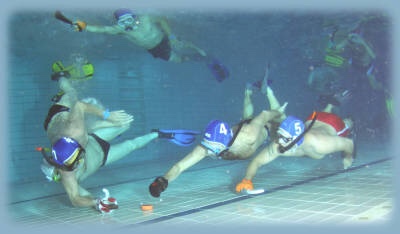
Octopush – combines swimming, diving and hockey. Players try to push around a hockey puck at the bottom of a swimming pool. The goal is to shoot the puck with a small, curved piece of wood into the opposing team’s goal.     
Do you play any of these sports? Or do you play another hybrid sport? Let me know!

Please share this post if you liked it, and follow me on Insta #watchingtheswedes
It’s fatty Tuesday – Swedish style!

Today it’s ‘Fat Tuesday’ in Sweden, known as Shrove Tuesday or Mardi Gras around the world.

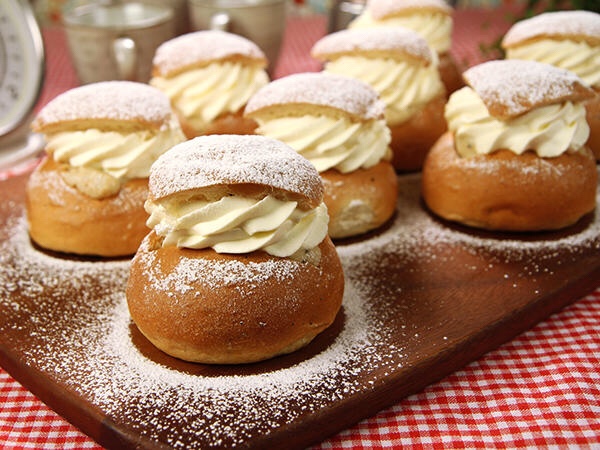
While in the UK we eat pancakes (today is even called Pancake Day) and in Latin America they scoff down fried bread, Swedes celebrate by eating the traditional cream Lent bun – the ‘semla’. I’m also clearly going to indulge. In fact, my mouth is watering just writing this post.

The semla is a creamy bun filled with delicious almond paste. They were eaten traditionally in Sweden to commemorate the start of Lent and the great Fast, leading up to Easter. In the south of Sweden, they still refer to them as ‘fastlagsbullar’ – Shrovetide buns. Nowadays however, semlas are usually sold anytime between Christmas and Easter.

I just love them. I could eat a barrel load. But I’d end up looking like a barrel if I did. I love the taste of them, and the feeling of luxurious indulgence. I also love the knowledge that as you take a bite into a creamy semla, you are biting into over 500 years’ history of Scandinavian baking.

The word ‘semla’ comes from the Latin ‘simila’ which means fine flour and originally referred just to the bun without any filling. As long ago as the 1500’s, bakers started to hollow out the middle of the bun and fill it with cream and butter. As ingredients became more available, bakers started adding almond and cardemon and the type of semla that we know today developed towards the end of the 1800’s. After rationing of sugar and dairy products ceased at the end of WW2, the semla took off and became very popular.

Nowadays the semla trend has reached new heights. Every year bakers around the country try to launch new types of semla, with their own spin on it -for example, the semla wrap, the semla burger, the semla layer cake, the semla cocktail, the chocolate semla, the vanilla semla, the lactose-free, gluten-free vegan semla. This year, the gross-sounding fermented Baltic herring semla was revealed.

But I’m a traditionalist in this matter. Give me a round fluffy cardemon-scented wheat bun brimming over with whipped cream and almond paste.

And give it to me NOOOOWWW!!!

The world’s longest cross country ski race – Sweden’s ‘Vasalopp’.


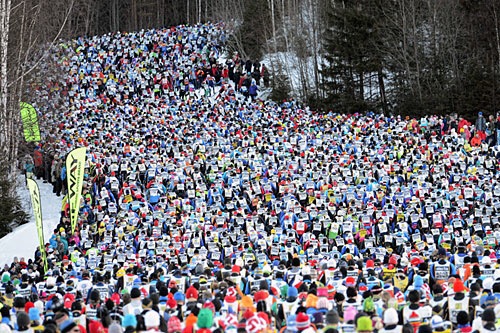
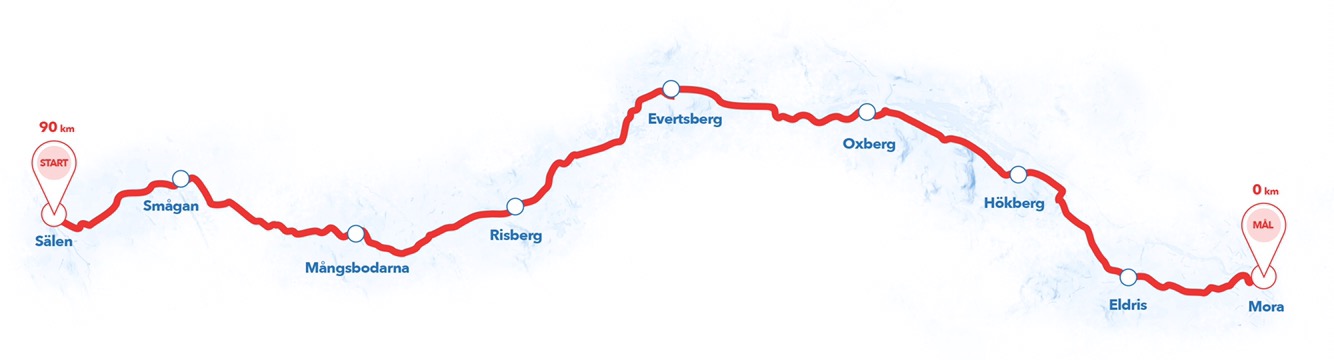
Today, the world’s longest cross country ski race takes place in Sweden. Called Vasaloppet, it entails participants skiing 90 kilometers from start to finish. It’s an extremely popular international race, which can take up to 12 hours to complete, and which is broadcast live on tv. When tickets to participate are released, they sell out in 15 minutes – it’s that popular.

The first Vasalopp was in 1922 and it takes place annually, the first Sunday in March and it is a first sign of spring.  It’s an amazing sight to watch, as more than 15000 mad, happy skiers glide along, the swishing sound of ski on snow filling the air.

For the elite athletes, 12 hours to complete the race is of course unthinkable. They go considerably faster. The person who has completed the race fastest is Jörgen Brink, who in 2012 won the race in just over 3 hours 40 minutes, roughly 25 km per hour.

So why is this race called the Vasalopp? Well, it takes its name from a Swedish king. The race commemorates the escape to Norway, through the forest, of King Gustav Vasa in 1521. Legend has it that he carried out the gruelling journey on skis,  but experts believe he more likely completed this escape on snow shoes.

Nevertheless, out of this legend sprung the race which is so popular today.

Modern day skiers don’t see the experience as an escape, they see it as a challenge and for many of them it’s a rite of passage.

And as you sit watching the TV comfortably from the sofa, with tea and toast, you take vicarious pleasure in this long, amazing Swedish race.

Swedish expressions: to get a bloody tooth

Years ago I sang a solo at a concert. It was the first time I ever sang solo, and I was nervous. Thankfully I didn’t die and actually it went ok. After the show, a friend came up to me and said ‘har du fått blodad tand?’ – ‘have you got a bloody tooth?’

So, what does this expression mean? Well, it’s not ‘bloody’ in the sense of ‘damn’. It’s more in the sense of ‘covered in blood’.

To understand this, we need to go to the animal kingdom. Many animals are herbivores in the early stages of their lives. The saying refers to the moment when an animal eats a bloody prey for the first time. After that, all they want is meat and blood. They develop a taste for it and don’t want anything else.

During the Middle Ages the metaphor moved into the Swedish language to mean that somebody wants to do something more often after trying it once. They have been inspired often by a success and want to continue.

In English, we can say ‘he has tasted blood’. Another translation that closely matches the meaning would be ‘to have your appetite whetted’ for something (whetted is an old English word for sharpened).

So, have you got a bloody tooth for something? If so, what?

Please share this post if you liked it.

#watchingtheswedes

Friday nights in Sweden = ‘Fredagsmys’!


fredagsmys2

I was just in my local supermarket doing a quick bit of food shopping. Although the place was relatively empty at that time of day,  I noticed that a few of the aisles were the most popular. Throngs of people gathered in the TexMex aisle, the soft drinks aisle and the aisle displaying crisps.

Of course, I thought! It’s Friday! And in Sweden, that means Fredagsmys!

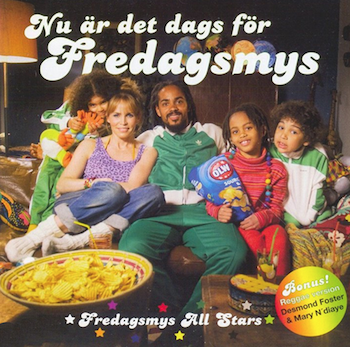
‘Fredagsmys’ is loosely translated as ‘Friday Cosying’, and it is a relatively modern ritual in Sweden established in the 90’s. Prevalent up and down the country, ‘fredagsmys’ is when friends and families gather together to mark the end of the working week. it’s mostly associated with families and children and traditions differ family to family. However,  one common denominator seems to be that food should be easy and quick to make. In other words, Friday night is a huge night for tacos and pizza in Sweden.

Gathering around food for cosy family evenings has a long tradition in Sweden. In the 1800’s and 1900’s something called ‘Söndagsfrid’ (Sunday peace) was popular. Then in the 1970’s ‘kvällsgott’ (Evening Goodies) became a concept.

The concept ‘fredagsmys’ became popularised in a high-profile advertising campaign for crisps. With the perky slogan ”Now it’s the end of the week, it’s time for Friday cosying”, (really, it’s perky in Swedish), they captured the Swedish market and encouraged the consumer to devour potato chips on Friday nights. In 2006, the word ‘fredagsmys’ entered the Swedish dictionary.

So how does your Friday night look?

What kind of cosying are you planning?

Diverse Sweden Part 1: Swedish Sikhs

diversity

I remember when my parents visited me in Sweden and remarked in surprise that there were a lot of ‘dark-haired people’ here. Somehow, it didn’t match their stereotype of the Swede as being tall, white, blonde, blue-eyed Christians.

It’s interesting to see the response on people’s faces when they realise who is in fact Swedish. Sure, Alexander Skarsgård, PewDiePie and Robyn all fit the mould. But that Seinabo Sey, Zlatan Ibrahimovic and Neneh Cherry are Swedish is often met with a surprised gasp. Stereotypes really are hard to shift.

Sweden is a fairly diverse country – ethnically, religiously and culturally. About 25% of the population is born abroad or has both parents born outside of Sweden. Extend that to one parent and the number increases to around a third of the Swedish population.

I am a true believer in cultural diversity. So, to celebrate the plurality of this kingdom in the north, I am starting a series of posts that will shine the light on various religious and ethnic groups that exist amongst people with Swedish citizenship. My hope is that it will dispel some of those stereotypes of Swedes that exist and that it will broaden your mind regarding what it means to be Swedish.

First out…..Sikhism

sikh-men-sabres-min.jpg

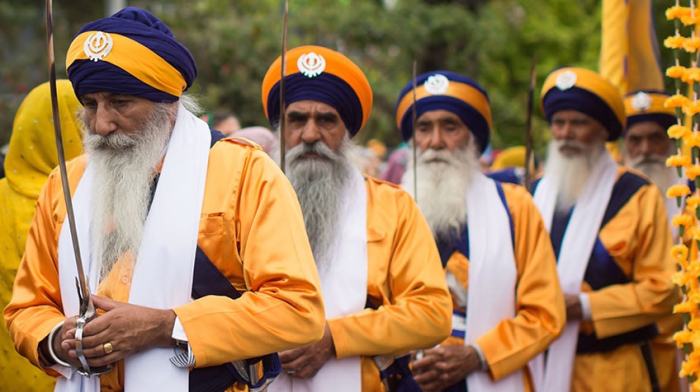
Growing up in the multi-religious UK, as I did, I saw a lot of Sikhs. What distinguished them from others was the fact that some of them wore a turban (known as a ‘dastaar’). Sikh bus drivers, police officers, doctors all wore their dastaar together with their uniforms, and today they are exempt from wearing helmets when riding a motor bike. I remember it causing great debate in the media and the discussion revolving around the ‘ridiculousness’ of this head gear. What ethnic British people failed to realise, and many still do today, is that the Sikh dastaar is not just a means to keep the head warm. The dastaar is an integral part of the unique Sikh identity, representing piety, self-respect, honour and purity of mind. Under the dastaar, the Sikh keeps the hair uncut as respect to the Gurus and to God – the idea being that hair is part of God’s creation and therefore should be kept as God intended it.

In Sweden, Sikhism is a small minority of an estimated 4000 people but in the world there are 30 million Sikhs, mostly living in Punjab in India. Sikhism was founded in the 16th century by Guru Nanak and is based on his teachings and those of the 9 gurus who came after him. The Sikh religion is a hands-on religion – believing in doing good deeds rather than merely carrying out rituals. For a Sikh, the concepts of honesty, generosity and equality are strong corner stones. In Sweden, Sikhs have their places of worship – a Gurdwara – in Stockholm, Gothenburg and Malmö – and anybody is welcome to these places of worship, regardless of religious belief. The Sikh religious scripture is called the Guru Granth Sahib. Interestingly, Sikhs consider the book a living Guru and it is therefore treated in the same respectful manner that a person would be.

Sikhs try to avoid 5 vices, in order to live better lives. These vices are something we could probably all think about avoiding: lust, greed, attachment to things of this world, anger and pride.

In a couple of weeks on 14th March, it is ‘Vaisakhi’ – the Sikh New Year. This year it will be year 551 (time begins at the birth of founder Guru Nanak).

Sikhs started to emigrate to Sweden in the 1970’s. Some came as job-seekers, others as refugees. The Sikh population is often referred to as an example of successful integration into Swedish society – as most Sikhs secured good employment and invested in the higher education of their children.


For more information about population statistics in Sweden, go to https://www.scb.se/en

For more information about Sikhs in Sweden, go to http://www.sikh.se

if you like this post, please share it in your media.

Also follow me on Instagram #watchingtheswedes


22 Swedish farts

outfart or infart dr heckle funny wtf signs

One of the fun things about learning a foreign language are the words that are rude, or funny in your own language.

Swedish has a few of them: slut, kräpp, plopp, kock, spurt

But the funniest one is probably the most purile; it is the ever prevailing ‘fart’, especially when you see it on street signs. This is the word that has most visitors to Sweden holding their sides with laughter.

Even after all these years, I can still have a little giggle when I think about the word ‘fart’ and its various usages in Swedish. In Swedish, ‘fart’ can mean a lot of things such as speed, drive, route, pace, spirit, vivacity, rate. But it is when it is put together with another word that it becomes amusing. Childish, I know…but here we go…

  1. utfart – ‘out fart’ – exit from a building
  2. uppfart – ‘up fart’ – driveway
  3. infart – ‘in fart’ (sounds painful) – entrance
  4. avfart – ‘of fart’ – exit from a motorway
  5. framfart – ‘forward fart’ (quite an accomplishment) – progress
  6. fartkamera – ‘fart camera’ (didn’t know these existed) – speed camera
  7. kringfart – ‘circular fart’ (also sounds painful) – causeway
  8. fartfylld -‘full of fart’ (know a few people like that) – speedy
  9. krypfart – ‘crawl fart’ – crawl
  10. luftfart – ‘air fart’ (the worst) – air travel
  11. fartrand – ‘fart stripe’ – go faster stripe on a car
  12. maxfart -‘maximum fart’ – top speed
  13. farthållare – ‘fart holder’ (dangerous) – cruise control
  14. blixtfart – ‘flash fart’ – flash speed
  15. fjärrfart -‘distant fart’ – transocean traffic
  16. halvfart – ‘half fart’ – half speed
  17. snigelfart – ‘snail fart’ – snail speed
  18. förbifart – ‘passing fart’ – ring road
  19. fartgräns – ‘fart limit’ – speed limit
  20. marschfart – ‘marching fart’ (like a hit and run!) – cruise speed
  21. överljudsfart – ‘supersonic fart’ (impressive!) – supersonic speed
  22. fartblind – ‘fart blind’ (although deaf is probably preferable) – when you become desensitised to the speed you are driving and stop noticing it


If you like this, please share it. Let’s see if we can share some farts over social media!

Also, please follow me on Instagram, where I put up other content – films and pics! #watchingtheswedes

Thanks!


The National Day of the Sweden Finns

In Sweden, you couldn’t swing a cat without hitting somebody Finnish or of Finnish heritage. Almost everybody knows somebody with a Finnish connection. In fact, there are so many Finns living in Sweden that they have their own commemorative day. And today is that day.

Today, 24th February is ‘Sverigefinnarnas’ Day, (Sweden Finns Day) – the day that celebrates the roughly half million people who live in Sweden and have Finnish as their mother tongue.

So why are there so many Finns in Sweden?

There has been a long history of emigration between the two countries, especially in the border regions of the north. However, a larger emigration happened when 70,000 young Finnish children were evacuated to Sweden during WW2. 15,000 are believed to have stayed and an unknown number to have returned as adults.

Then, in the 1950s and 1960s the migration from Finland to Sweden was considerable, chiefly due to economic differences between the countries. Sweden had the industry, the jobs and the housing. This caused some alarm in Finland with most of the emigrants in their most productive age — although many of them returned to Finland in the following decades.

In the year 2000, the Sweden Finns were recognised as an official national minority group in Sweden. In fact, the Sweden Finns are the largest national minority group in Sweden. Other large minority groups come from former Yugoslavia, Irak, Syria and Poland – although these do not have official national minority group status.

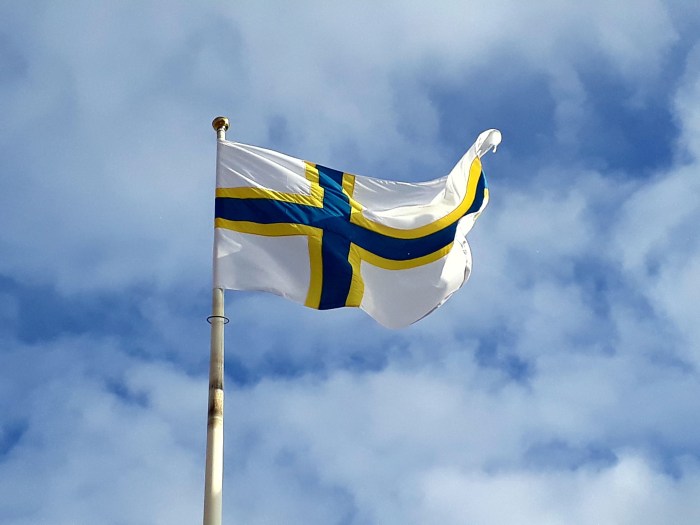
In 2007, a flag was designed which combines the Swedish and the Finnish colours.

If you’re in Sweden today, you may well see this flag flying proudly around the country.

When Swedes have diarrhoea

We’ve all been there. Those embarrassing moments when the belly rumbles and we have to race to the toilet to evacuate as quickly as possible. An all round unpleasant, and undignified, experience.

Well, February in Sweden is synonymous with sickness and right now there’s a stomach flu flying around the country. So last night at dinner, conversation moved onto sickness and landed on a colloquial Swedish word for diarrhoea.

The discussion was about where this word comes from. So, true to form, I researched it.

And I have the answer.

The word in question is the Swedish word ‘rännskita‘. One theory was that it originated from the word ‘takränna’ which is a gutter, and would reflect the speed at which the water runs down the drainpipe. But actually that’s not it.

The word is a combination of the old Swedish word ‘ränna’ which means ‘to run’ (often quickly) and the word ‘skita’ which means to shit. It’s directly translatable to the English ‘ to have the runs’.

Although it sounds like a new word, it actually entered the Swedish language in 1587! I guess it was a problem back then.

So there you go. Another fascinating foray into the Swedish language with ‘Watching the Swedes’.

If you liked this post, please share it.

Please follow me on Instagram #watchingtheswedes

Swedish winter break – take those kids away!

Around this time of the year, schools In Sweden have a week’s holiday. Called ‘Sportlov‘, it’s a traditional time for a winter sport break. 

This tradition was introduced in the early years of WW2 as a way to save energy. Heating up schools cost money and, due to rationing, councils were instructed to drastically reduce their heating expenses. So shutting the schools seemed like a good idea.

To give the pupils something meaningful to do while the school was shut, the authorities organised various activities, many focused on being outdoors and exercising.

Serendipitously, experts realised, during the 1950’s, that infection spread less widely at this time of the year if schools were closed for a week. So the winter sport break became cemented as an official disease control method. 

Nowadays, many families head off to the mountains to go skiing, some head off to the Alps for the same purpose. Others may fly away to the sunny beaches of the world.

For those of us left in town, it’s sheer bliss. 

The gym is empty. The streets are spacious. There is hardly anybody on the buses and tube, traffic is significantly thinner and less noisy and it’s easy to get a seat at lunch time. 

And the fact that there are hardly any children in town means something great for the rest of us.

We don’t get infected with diabolical kid bacteria that would knock us out until mid March.