Dispelling the Swedish myth

swedish flag

One myth about Sweden is the one of the socialised society where schools, hospitals and care of the elderly is free and open for all and of the highest quality.

As the years have progressed since the haydays of the 50’s and 60’s, this has become a myth – a very stubborn stereotype.

Privatisation and deregulation of education and health care, supported by political parties on both sides of the ideological spectrum, has seen to it that the model of the past is almost unrecognisable today. Many believe that Sweden has sold out their heritage – a unique system based on solidarity has become an individualistic system based on profit and an illusion of free choice.

To start with health care in Sweden is not free. It is cheap, but it’s not free. A visit to the hospital, or the doctor, costs around 200 Swedish crowns. Dental and optical care is astronomical and medicine, though subsidised, is costly.

Many hospitals, medical centes and schools are run for profit. Private shareholders run these services, funded by taxes, and streamline the business in order to take out a profit at the end of the year. This is never more apparent than in the educational branch. In the 90’s a reform allowed for parents and children to choose the school they wanted to go to and that the tax funding for the child’s education would follow them regardless of which school they attended. The reform opened up for so-called ‘free schools’ – privately run enterprises that could offer attractive school services. The more children chose these particular schools, the more income the school would receive in the form of the tax funding that they brought with them. The idea was to improve competition, increase quality and promote choice. And that is great if it works. But time and time again, we see unserious players jumping on the opportunity to make a fast buck and caring too little for the quality of the service they provide their consumers.

Overseas Investors profit from Swedish tax payers. A wave of overseas private venture capitalists have now seen the opportunity to make money out of the school and health care system in Sweden. Funded by Swedish tax payers, they can in a short period make a lot of profit, if they are skilled at cutting back and ‘effectivising’ their service. Making the most money requires that the child’s education, or the elderly person’s care, must take a back seat. If more educated staff are required, or better equipment or premises are needed, this is often not prioritized as it eats directly into shareholder return. There have been cases of schools going bankrupt, leaving thousands of pupils out in the cold – with incomplete education and a sabotaged future.

The question is can this system be maintained and, if so, how is quality ensured so that the lives of children and the sick are not jeopardised for profit?

So, many aspects of the original Swedish social model have been reformed away. While the myth outside of Sweden might be of a systemised caring eutopia, the reality is somewhat different.

Swedish obsession

20140724-095102-35462304.jpg

What is it with Swedes and their obsession with temperature? The whole of the summer, you hear people discussing the temperature in various parts of the country, the temperature of the water, the night temperature, the evening temperature. It seems like a very factual and logical way to describe an experience, as opposed to using emotional words such as hot, balmy, lovely, refreshing etc.

Even in the winter, the temperature obsession continues, this time to describe how many ‘degrees cold’ it is. And being sick with a cold is often determined by your temperature rather than how you actually feel.

I guess it’s not surprising in a country with such shifting seasons that people are obsessed by the weather and how hot or cold it is. It’s also a useful small talk point, everybody knows the answer!

Anyhow gotta go, it’s 26 degrees outside and it’s 22 degrees in the sea!

Have a Gay National Day!

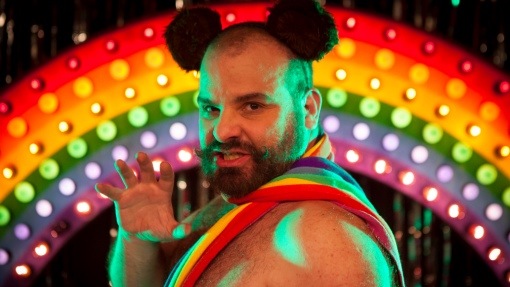
Tomorrow 6 June is Sweden’s National Day and there are many celebrations going on around the country to celebrate the nation. This is the day Swede’s gather to celebrate their Sweden, and they do it in a variety of ways. With the rise of extreme right wing parties in the EU and in Sweden, a National Day might seem dubious to some people. However, If you want to avoid the ‘traditional’ celebrations, one suggestion is that you make your way to Boulevard Teater on Götgatan on Södermalm in Stockholm. There, at 7pm, National Day is being celebrated with a twist. A very gay one.Stockholm’s Gay Choir are holding the first of three concerts. The second two concerts are at 3pm and 7pm on Saturday 7 June.

All of the songs have Swedish roots and reflect how the choir sees Sweden, what it means to the HBTQ community and why they love their country. The songs are a mixture of passion, glamour, tragedy, vulnerability and joy. In an environment of increasing intolerance, these songs are needed and Stockholm’s Gay Choir stand up for openness, love and acceptance. Tickets can be bought at www.stockholmsgaykor.se or on www.ticnet.se or the box office at the theatre.

So if you want a different kind of celebration, a modern and diverse perspective – have a Gay National Day!

See you there! 🙂

Please share and spread this blog!

20140605-154535.jpg

20140605-154623.jpg

The sub-culture of the Swedish ‘raggare’

Image

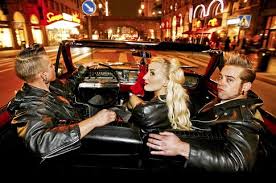
Yesterday afternoon in the centre of the quaint town Norrtälje, the silence was interrupted by the sound of ‘Let’s Twist Again’ blaring out from loud speakers from a car. The car was an old American brand, and had an American flag on the back of it. Two greasy guys sat in the front seats, elbows out of the windows and they cruised around the town centre looking pleased with themselves.  

These guys are called ‘raggare’ in Swedish. This fascinating sub-culture in Sweden is related to the ‘greaser’ culture in the USA and they are known for their love of rockabilly and 1950’s American pop culture. They dress in 50’s clothes, grease their hair back and dig the 50’s sound. Think James Dean. Think Rebel Without A Cause.The ‘raggare’ culture is very much associated with rural small towns and has a working class, somewhat ‘trashy’ feel.

You’d think that would mean these ‘raggare’ are young, like in the picture above, but often they’re not. They are mainly middle aged, paunchy Swedish men who enjoy meeting and showing off their retro American cars.

Nowadays, it seems that most Swedes look at the ‘raggare’ with a mixture of affection, amusement and mild disapproval. However, when the phenomenon began in the 1950’s it caused moral outrage in Sweden. Mainstream Swedes were worried about alcohol, drugs, violence and unprotected sex in the back seats of the cars and many campaigns were started to ban the ‘raggare’ from cruising the streets.

There are many events for ‘raggare’ every year. One well-known one is the long drive around Stockholm, playing loud music and drinking beer to rub rural rebellion in the faces of the city dwellers. Another event is ‘The Power Big Meet’ which happens in the town of Västerås and is actually the world’s largest classic car show.

Begging for clarity – Swedish EU politics

Image

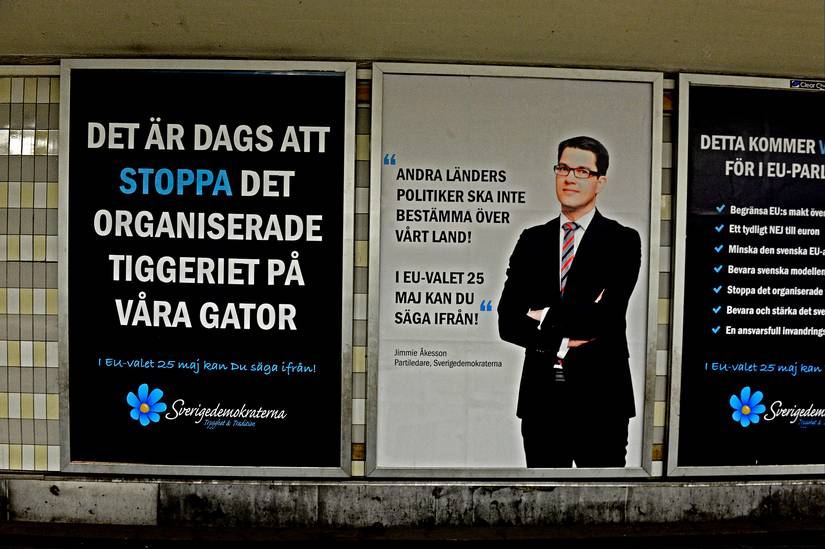
The EU campaigns are in full swing and Sweden’s right wing nationalistic party (SD) has already caused a stir. Huge signs have been put up in the underground and direct mail shots have been dumped in people’s letter boxes describing their policies. One particular policy is against ‘organized begging’.

From their program: ‘In Swedish Towns beggars from other EU countries have become a common sight…..The organized begging must be stopped. Visa requirements should be introduced for countries that abuse freedom of movement within the EU.’

This, and other policies, have caused outrage amongst many. People are calling for action against the SD, people are criticizing them for racist actions, people are burning, returning and even eating up their printed policy material.

But here’s the thing – SD are smart at rhetoric. Very smart. Just like other populistic nationalistic parties throughout history, they are very good at raising issues that ordinary people care about and they are not afraid of stating their position. Agree or not, they are the only party as far as I know to communicate an actionable position about the issue of begging.

And this is where I think the other parties are about to make a costly mistake. Almost everybody I know in Stockholm has an opinion about the influx of street beggars from other EU countries. Everybody is uncomfortable with it and doesn’t like it. It goes against the grain, and many Swedes are really divided as to whether they should ignore the beggars, buy food for them or give them cash. It is a daily challenge for many and a common topic of discussion. It is a modern dilemma, and, dear politicians…this makes it a pressing political issue! Ignoring the issue of begging will not make it go away. Ignoring it does not reduce anxieties nor does it deal with the underlying issues of poverty and inequality in our society.

The way for the Alliance, the Greens, Fi, the Left Party and the Social Democrats to deal with the SD is not only to express outrage and criticism. It is to state clearly, publicly and unequivocally what their party’s actionable policies are in relation to the increased begging on our streets.

Failure to do this is equivalent to pushing many voters straight into the hands of the SD.

Come dine with me, my place 7.30

ImageImage

As a Brit, I sometimes experience differences between myselves and Swedes. But this has never been more apparent than in the two TV cooking shows ‘Come Dine with Me’ in English and its equivalent Swedish program *Halv åtta hos mig’ (My place, 7.30).

Watching these two shows, many differences are obvious. The shows shine a very clear light on the differences between the UK and Sweden. The shows have the same format and are part of the same franchised concept, but cultural differences make them into two totally different programs.

The educationally entertaining Swedish program has the following:

  1. A focus on the food and the interesting recipes
  2. Polite, if somewhat stilted conversation, mostly about the food
  3. A female narrator that is slighty, but not too, sarcastic
  4. Participants who are friendly and polite and seem to have things in common with each other
  5. Participants ‘dressed up’ very nicely for the occasion
  6. Homes that are Nordically cool, clean and well-organized
  7. Carefully selected wine for the dinner, and not too much alcohol so that participants can focus on the food

The hysterical British version has the following:

  1. A focus on getting drunk and arguing with each other, the food is secondary
  2. Confrontational, loud conversation (as people are drunk) about all subjects under the sun, often toilets and sex and very little about the food
  3. A male narrator that is a complete bitch about the contestants and personally attacks the participants’ appearance
  4. Participants who have been cast for the show as they are complete opposites, very opinionated and at each others’ throats from the very first evening
  5. Participants often wearing themed fancy dress, such as prostitutes, Alice in Wonderland, disco, bling, pirates, gangsters. Often lots of short skirts and cleavage.
  6. Homes that are quirky at best, and unhygenic at worst
  7. Wine, wine, wine, vodka, gin, wine, wine, wine

Now what cultural conclusions can we draw about the Swedes and the Brits from these differences?

If you liked this blog, please share it!


The battle of the Swedish chocolate ball

Image

What you choose to call it – racist or politically correct?

The interesting thing about language and culture is that they are constantly in flux. As time goes on, languages develop and as more people travel or migrate, cultural behaviours change. This can be a scary thing for some people who don’t want to see change happening and who cannot embrace the new aspects of their culture. They fiercely hold on to the past, their old cultural identites and behaviours and actively work against the positive influences that a cultural mix brings.

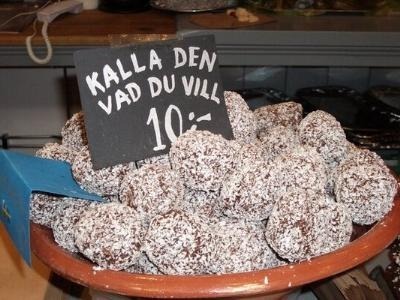
One such example of this is the chocolate ball, a kind of cake that is very popular in Sweden. Previously, in less enlightened times, these chocolate balls were called ‘negerbollar’. This translates as ‘nigger balls’ or ‘negro balls’. Understanding the offensive nature of the name, this chocolate delicacy was officially renamed some years ago. But a certain section of the population, who I am guessing are not black, hold on to their right to call them nigger balls. Yesterday, was so-called ‘negerbollen day’ on Facebook and 21 000 people had signed up their support to say ‘negerboll’. In a counter move, an organization refusing to use this title was set up claiming tomorrow as ‘Chocolate Ball Day’.

In a country with a self-image of tolerance, the chocolate ball has become a symbol of political correctness versus racism.

Sweden is a country with the right to self expression and freedom of speech. But with that right and freedom also comes responsibility. Just because we can say whatever we want doesn’t mean we should. If with our words we can cause harm, or personal offence, I think that we should choose other words. In cultural theory, there is a concept of the in-group and the out-group. One way to look at this is that the in-group is the group in the majority, they set the rules, the create the standards and decide the norms. The out-group is in the minority, and they are very aware of how injust some of the behaviours of the in-group are. The in-Group is usually blissfully ignorant of these things because they don’t have to think about it. But it is the in-Group that has the power to make the change. Chocolate balls are just one example of that. It’s not about being politically correct, it’s about realising that with the language we use, we create gaps in our society. We might not care if we say ‘nigger balls’ but as long as somebody else is offended then we should change our words. The majority of Sweden has done that, but not all.

We are all in in-Groups sometimes and all in Out-Groups sometimes. Maybe it’s our religion that puts us in the out-Group or our sexuality, skin colour, origin, profession, education, place we live, unemployed status, interests and hobbies, political beliefs, choice of clothes. If you reflect for a moment over a social out-group you identify with and then pick a derogatory word for that group. Then put that word in front of the word ‘cake’. How does that feel? Probably not ok.

So let’s think broader than our own perspectives. We have a history of language and culture to be proud over, but that doesn’t mean we can’t change it. A small word can make a huge difference to improving integration and harmony in a society.

So is ‘negerboll’ racist? It depends. If you are aware that it is loaded with multiple meaning, that you might seriously offend others and that you’re using it politically – then yes. It is extremely racist. If you live isolated in a part of the country where you do not know that ‘neger’ is an offensive word to others but you think that it just means chocolate – then no, it’s not racist. But you do need to get out more.

Sweden’s Got Talent

Image

All over the world. the franchised talent shows ‘Country’s got talent’ and ‘X Factor’ unveil contestants with surprising talents. We all know about Paul Potts, Susan Boyle and recently the fantastic Sam Bailey in the UK, who caused a storm when they opened their mouths and sang. This storm was mostly caused by the contradiction of their appearances and their incredible singing capabilities. The same applied to America’s Got Talent’s sweet singing, musical goth by the name of Andrew de Leon.

What about Sweden then? The current series of ‘Talang’ has shown a breadth of skill and inventiveness but I’ve felt, in comparison to the UK and the USA, it’s all a bit amateur. Until last night. Up on the stage walked Glenn Edell,a seemingly shy unemployed father. He stood on the stage, shaking and opened his mouth to sing. And he proved that Sweden’s got talent.

Still, the surprise factor was lacking a little. Compare it to this fantastic 8 year old Norwegian girl Angelina Jordan who recently blew audiences away with her bluesy, jazz voice. She’s so good, you almost suspect foul play.

So, Sweden does got some talent. But does Norway got more?