Swedish goats on fire

/home/wpcom/public_html/wp-content/blogs.dir/6dc/32262531/files/2014/12/img_4735.jpg

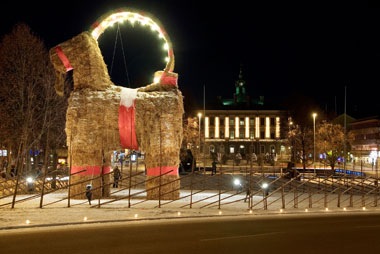
Since the 60’s, in the town of Gävle, north of Stockholm, they have had the Christmas tradition of building a large hay goat in the town centre. Oddly, the goat is a Christmas symbol in Sweden. This ‘Gävle Goat’ has become famous throughout the nation because it has spawned another, less Christmassy tradition. Every year, with few exceptions, the giant goat has been vandalised or set on fire.

This year, guards have successfully intercepted several people during the weeks prior to Christmas who had a mission to set the goat aflame. But it survived! This year, the fortunate goat made it to Christmas Eve without being graffitied, singed or doused in any form of flammable liquid.

But will it make it to 2015? Or will it go up like a New Year’s firework? Well, that cliffhanger will be resolved in a few days.

My dad thinks you’re ugly

IMG_4486.JPG

Swedish children’s television presenter Sannah Salameh has recently pointed the spotlight on Swedish body obsession and social control. In a text, she describes how a little girl approaches her on a railway platform and says ‘My dad thinks you’re ugly’. Quite naturally, Sannah is upset and angry, but keeps her composure. It’s not the fault of this little child but of her father who teaches her that judging others by their appearance is valid. Interested, I googled Sannah and ended up on a consumer forum. I was shocked by what I read there, by the vile and bilious comments people felt entitled to write about her appearance. Some people were even demanding she be removed from the tv as the way she looks offended them and scared their children.

In Sweden, as in many other western countries, there is a strong fixation around appearance. Having the right body, the right face, the right clothes is seen as important. Deviate from this and there must be something wrong. You are not seen as an individual but reduced to the fact that you are overweight or dark skinned or ‘damaged goods’, regardless of how talented or intelligent you might be. Thanks to social and established media this seems to have escalated over recent years.

And people like Sannah Salameh end up in the crossfire.

Swedish culture is driven by two strong values – individualism and self actualization. The right to be yourself and to be responsible for your own life. The right to be who you want to be and make the most of yourself. These manifest themselves in different ways in society, for the most positive. But here we have a contradiction. Does Individualism and self actualization only apply as long as you fit into a pre-determined template?

I want to give a big shout out to Sannah Salameh. She is a fantastic, talented woman who, despite her fears and insecurities, stands up for herself and for all women. Don’t let yourself be reduced to your appearance. Don’t let others decide your worth.

And to all fathers of little girls – teach them that their value lies in their intellect and their hearts, not in the way they look.

Swedish social control or just health consciousness?

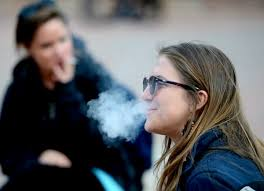
smoking outdoors

For a long time, there has been a ban on smoking Indoors in public places in Sweden. A new law is now being prepared to ban smoking also in outdoor public places such as bus stops, beaches, parks and even on people’s private balconies.

It’s unclear as yet if this law will pass but it’s an interesting case of Swedish beaurocratic imposition on the freedoms of the individual. Those for the ban claim the argument of health consciusness and respect for others in the public environment. They also claim that public spaces will become more accessible for people who today cannot move freely in public spacers such as asthmatics. Those against the ban claim that this is the state ínvolving themselves in something that is about individual choice and that barbecuing should also be banned in public spaces by the same argument.

Those for the ban suggest that it is easier to deal with unpleasant smoking habits if the law is on your side. For example, if a neighbour smokes on their balcony, and this smoke rises up into your apartment, it’s easier to get them to stop by throwing the law book at them.

Culturally, I think this is interesting. Is this about facilitating dialogue? I don’t believe so.

I think it’s more about the Swedish tendency to want to create law and legislation to solve interpersonal problems.

The seriousness of xenophobia

us and them

In Greek, the word xenos means strange or foreigner. The word phobos as we know means fear. Putting those together gives us the well-known concept of xenophobia – the deep-rooted, irrational fear of something strange or foreign. Xenophobia can present itself in many ways, including the fear that immigrants and refugees are too abundant in a society.

In cultural research, we often talk about in-groups and out-groups. The in-group is usually the majority who belong to a somewhat homogenous culture. The out-group are the ‘others’ who live side by side but rarely amongst the in-group. One way to look at xenophobia is to see it as the relations and perceptions of an in-group towards an out-group. This may include a fear of losing identity, suspicion of the out-group’s activities, aggression, and desire to eliminate their presence to ensure a presumed security.

Xenophobia in a society is often aimed at a group of people who are not considered part of that society, eg beggars from Rumania and refugees from Northern Africa. When xenophobia becomes systematised it often leads to hostile and violent reactions, such as the phsyical attacks on beggars that we are seeing in Sweden or the call for expulsion of immigrants by SD voters. In extreme cases of systemitised xenophobia, genocide becomes the result.

To combat this issue, the Council of Europe in 1993 formed “The European Commission Against Racism and Intolerance”>. This is an independent human rights monitoring body specialised in combating racism, discrimination, xenophobia, antisemitism and intolerance. The organisation produced The Vienna Declaration and Programme of Action, also known as VDPA – a human rights declaration. In this declaration it clearly states the following:

”the VDPA urges all governments to take immediate measure and to develop strong policies to prevent and combat all forms and manifestations of racism, xenophobia or related intolerance, where necessary by enactment of appropriate legislation, including penal measure.’

We know that the winds of fear are sweeping over Sweden and Europe. And we know that governments can do what they can to combat this – changing policy, engaging in dialogue, ignoring the issue, closing the borders. But as soon as there is a manifestation of racism or xenophobia I think Sweden should have a zero tolerance policy. This might include infringing on civil liberties such as freedom of speech and right to demonstrate, but xenophobia is a creeping cancer that leads to horrific actions. We just have to take a look through history to understand that.

Ett öppet brev till Jimmie Åkesson

20140913-111047-40247371.jpg

Dear Jimmie
När jag flyttade till Sverige för 20 år sen kom jag till ett land som välkomnade mig med öppna armar, som såg mig som en individ som kunde bidra till svenskt samhället både ekonomiskt och kulturellt. Jag fattade rätt snabbt att jag tillhörde en priviligierade grupp – den engelsktalande invandrare. Min invandring sågs inte som ett problem, folk tyckte det var roligt att prata engelska med mig och vi enkelt hittade gemensamma beröringspunkter. Jag undrar ofta hur min integration hade varit annorlunda om jag hade kommit från Somalia eller Rumänien. Saken är så här, det som jag bidrar med till Sverige sitter inte i mitt ursprungsland. Det som jag bidrar med är mänskligt. Alla vi har nåt att bidra med och genom det berikar vi det samhället som vi lever i. Du Jimmie vill begränsa invandring, du vill stänga dörren till livrädda människor som söker fristad en stund. Du ser bara parasiter och inte människor. Du ser inte vad de kan ge utan vad de tar.

Jag antar att du liksom jag aldrig upplevt krig. Du har inte behövt genomlida smärta, rädsla och hot. Du har levt ett tryggt liv i Sverige. Det är kanske därför du verkar sakna empati. Jag tycker vi som har det tryggt har en skyldighet att ta hand om dem som behöver vår hjälp och det gäller de inom och utanför Sveriges gränser. Du snackar så fint om att hjälpa folk på plats bara dem inte försöker komma hit. Sverige hjäper behövande lokalt redan, och du vill faktiskt minska budgeten för det. Du pratar om integration men du menar assimilering. Att leva i ett integrerat och pluralistiskt samhälle betyder att man öppnar sig för skillnader, man söker synergier, man lever tillsammans och parallellt. Det betyder inte att man gör allt man kan för att hålla Sverige svenskt. Man omvärderar och omdefinierar vad det betyder att vara svenskt. Vi kan leva tillsammans och fortsätta att bygga Sverige. Det är möjligt. Men det krävs empati, mod och öppenhet. Och tyvärr verkar det vara brist på det hos dig.

På Söndag är det val, Sverige är ju en demokrati. Vi får se hur mycket stöd du har bland svenska folket. Jag vet att jag kommer inte rösta på er. Jag kommer satsa på ett parti som värdesätter olikheter och har en färgglad vision av Sverige. Med dig är framtiden bara mörkt.

My privileged Swedish bubble

I live a very privileged life in Sweden. I know it. I have a great job, a decent income, I own my flat in Stockholm’s trendiest inner-city area, I travel, I eat out at restaurants, I consume. I’m happily married, we have lots of friends, a BMW, trips to the theatre and to dinner parties. We have a country house. Everything’s smooth. Even at the A&E on Sunday after I sprained my ankle, I was in and out in less than 2 hours. Sweden has made this lifestyle possible for me, and many others. But it’s a privileged bubble we live in. We’re not confronted by the poverty in the suburbs, by the substance abuse in families. We don’t witness the children who fall out of the system because they happen to be born in a certain area, to certain parents. Our children are well-groomed, well-fed and well educated. We don’t see the horrors in old people’s homes, nor do we have to scrape together every last krona just to put food on the table because we’re sick, or injured or unable to find work. But this exists in Sweden. From our little bubble we just don’t see it. But it’s there. There are widening gaps in Swedish society between the old and the young, the rich and the poor, the educated and the uneducated, the sick and the healthy, the urban and the suburban, the always beens and the newly arrived. And the uncomfortable truth is the wider these gaps become, the more stretched our bubble becomes. And one day this bubble will explode.

Voting in an election is our democratic right. The dilemma is how we vote. Do we vote for what is good for ourselves or for what is good for our society? Do we protect ourselves or do we lift our eyes and look out of our bubble and see that what benefits society in the long run benefits all of us?

On Sunday, we make that choice.

Swedish vanity

A visiting friend of mine from Austria was walking in Stockholm taking in the sights. When I met her later that day, I asked what her biggest impression was. And her answer surprised me. It wasn’t about the beautiful buildings, the amount of water or the narrow streets. No, she said the following:

‘Well, the men really like their hair gel here don’t they’.

She was struck by the fact that the men on the street were pimped up, groomed and well styled. She perceived this as vanity.

It reminds me of a joke once told to me:

‘Why do Swedes always go outside when there’s lightning?’
‘Because they think someone’s taking a picture of them’

Are Swedes more vain than other nationalities?

What do you think?

20140301-100508.jpg

‘Vobba’ – a brand new Swedish complaint

Image

Perspectives-taking is one of the most important skills required for working in an multicultural environment. Anybody who’s travelled abroad knows that a new perspective is often one of the main impressions we receive. This is especially true if we travel to countries that are culturally and economically different from ours. In the context of the other society, we gain perspective on our own.

Yesterday, I returned from a trip to Thailand and Cambodia and was left, as often, with a humbling feeling. Cambodia is a dirt poor country, as yet not destroyed by tourism. The countryside, the cities and the people, raped by their recent history, are warm and humane and welcome us with open arms. Homelessness is rife, unemployment and sikness prevail. There, they really have a lot to complain about, and I’m sure at times they probably do.

Transport to Sweden, Monday  morning, breakfast television. As I sat there this morning and watched the local news to catch up on latest happenings,  I learned a new Swedish word. And this Swedish word reminded me of the importance of having perspective – ‘Vobba’.

‘Vobba’ is a combination of two Swedish words – ‘Jobba’, which means to work and ‘Vabba’ which means to be at home with a sick child and therefore free from work. In Sweden, parents receive support from the government to ‘Vabba.’

This new word ‘Vobba’ refers to parents who are home with their sick child but, thanks to technology, they also do a little work while at home, such as check emails or speak on the phone.

According to the report on the news this morning, one third of parents who have to ‘vobba’ feel stressed, and invaded, by it and find it impossible to balance their home and work lives with their sick child. 

What a problem! Oh dear me! I really don’t know how they cope! Not only are they paid to be at home by the tax payer, and their child is probably asleep in bed, but it’s really hard work to check a few emails on a smart phone while they’re having a cup of coffee.

Really??? Get some perspective!  

In countries like Cambodia, where daily survival is a struggle, they would be shocked by this new Swedish stress factor.

So, I am asking all of us to get some perspective on this issue and on all those other issues and compaints that we have. In the greater scheme of things, how important are they?

Instead of focusing on what is stressful, invasive or unfair, let’s focus on the positive! Sweden is a great country where parents get to be home with their sick child and are not forced to take a day’s holiday or leave the child with an unknown baby-sitter or force the sick child to go to school. That is fantastic!

Let’s focus on that instead and remember most people around the world don’t have it anywhere near as good as we do.


If you like this text, please spread it and share it!
A theory about Stockholmers

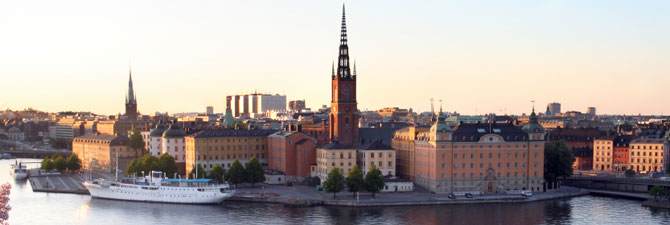
Stockholm

It happened again today. And, actually, it has happened once too often.

When I approached my office building this morning, there was a small group of people speaking Swedish standing outside in the cold. They couldn’t get into the building. As I have a pass card, I knew I could let them in. So, I smiled, and I said ‘I can let you in to the warmth’. There was no reaction, apart from a little wry smile. Swiping my card, I let them into the building and turned to look at them. Not one of them acknowledged what I’d done and said ‘Thank you.

This might seem like a small thing, but it happens all the time to me. I hold a door open for somebody. I get no ‘thank you’. I let somebody go on the bus before me. Nothing. Soembody bumps into me. And I apologise!

Why is this the case? Why do many Stockholmers not acknowledge or thank each other. It isn’t that they don’t see each other. Is it that they don’t care?

An interesting fact is that the vast majority of people in Stockholm come from somewhere else in Sweden. They have migrated from smaller towns and villages to seek work, love and excitement in the capital. My experience of being in towns outside Stockholm is that people are friendly, polite and acknowledging of each other. So what happens to these people when they move to the city?

I have a theory. I think that many Stockholmers who have migrated into the city have a perception of what a city should be. They seem to think a city should be fast-paced, tough, individualistic and unfriendly. That people should push themselves forward, and through, other people. That connecting with a stranger in a public place with eye contact, a small remark or a thank you does not belong in a capital city. I think that they are playing pseudo cosmopolitans.

In my opinion, this attitude is shamefully misguided. Citizens of much larger cities, such as New York or London, still find time to small talk, for politeness and to say sorry or thank you to each other. Try bumping into somebody in New York and not apologise. The price of impoliteness is sometimes harsh.

And the solution is easy. Say ‘thank you’ to the next person who does something for you today.

Really, it’s not that difficult.

Are Swedes always off work?

keep-calm-its-nearly-holiday-time

‘Swedes never work, they’re always on holiday’

This is a frequent comment I hear when I work internationally. Colleagues and sometimes customers abroad, are irritated by the fact that they can’t get in touch with Swedes from, for example, the end of June to the second week of August. Sweden seems to be shut down! ‘Swedes never work, and are also lazy’ – they say.

I, of course, defend Sweden’s holiday structure by emphasizing that people work longer hours in the winter to compensate for shorter hours in the summer time. Or that the winters are so long here, it’s only natural that people want to be off work during the warmest, brightest time of the year. Or that thanks to advances in technology, Swedish employees are often still accessible though they might not be at the actual workplace. Or I even try the argument that Sweden has a healthy work-life balance.

These arguments however often fall on stony ground and I am often disbelieved. People shrug their shoulders, shake their heads and roll their eyes. From their perspective, Swedes are spoiled.

I try to encourage cultural understanding, I really do. But sometimes it’s not that easy. For example, situations like this Christmas and New Year don’t help me to be more persuasive. While most Americans got 3 days off work and many Brits got 5 days of work, Swedes frolicked in the free time they were able to access. This festive period was commonly referred to as an ’employees’ Christmas’ meaning it was good for the employees and not for the employers. Many Swedes (and me too) are back to work for the first time today, and have been free since the 23rd December 2013. That makes a total of 12 days off work – 16 days if you also count the weekends.

You see Swedes don’t only take the national holidays off – they also take off the ‘Eve’. So although ‘Christmas Eve’ and ‘Midsummer’s Eve’ are technically not national holidays, they are celebrated as though they are. And then it’s also considered a right to be able to take off a half a day before the ‘Eve’ just in order to get ready for the approaching celebrations. If a national holiday falls on a Thursday or a Tuesday then there’s also something called a ‘Bridge day’. It’s not officially a holiday but most people take it off because there’s no point in going in to work for just one day is there? This Christmas season had a couple of bridge days in it to pad out the time taken off work and required only a little bit of personal holiday leave to be taken.

So the question becomes are Swedes happy that they got 16 days off work? I think most are. But on social media, in the office and on public transport, others complain that it wasn’t long enough, that they’re exhausted or that they need a break.

Mmm, maybe there’s something in the perception of the spoiled Swede?