Sweden: the day before New Year’s Eve

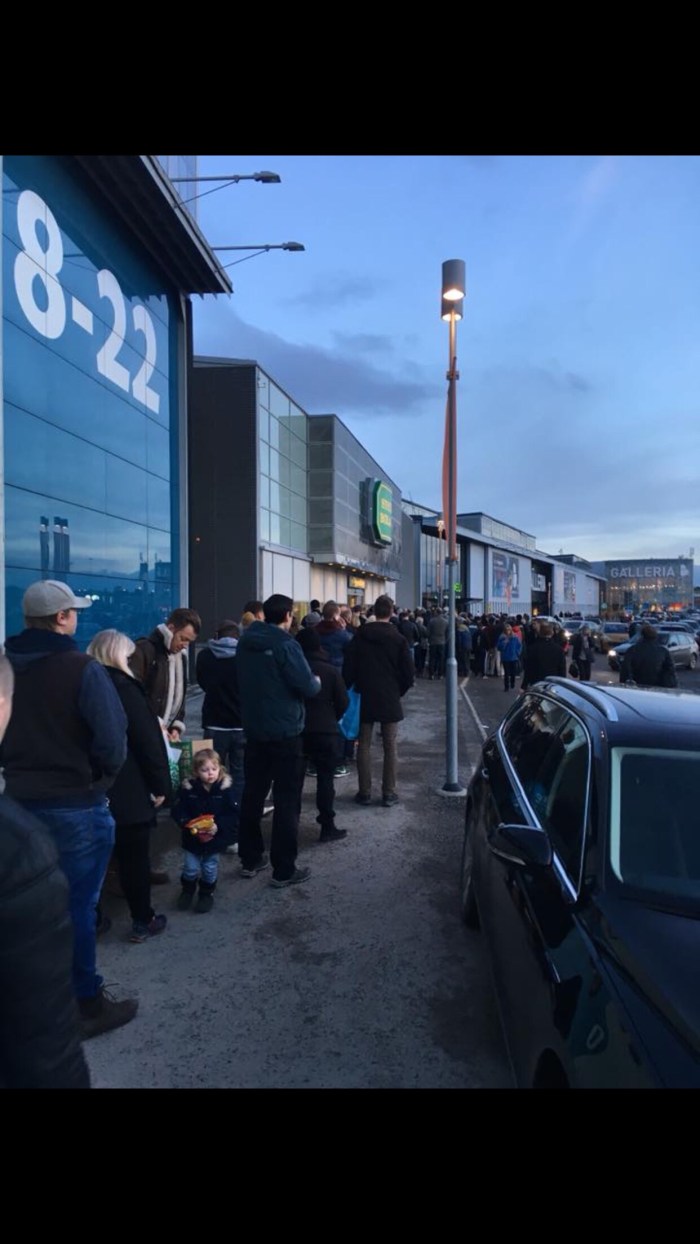
New Years Eve is tomorrow – a Sunday. That means that it is not possible to buy alcohol as the shops controlled by the state-run alcohol monopoly are closed. If you want wine or spirits to toast in 2018, today is the last day to buy it. On a Sunday – no way! All over the country, Swedes thronged to buy their alcohol which resulted in queues and serious congestion. Here is a picture put up on Facebook today. A normal queue for the day I’m guessing – this one in Bromma in Stockholm.

What would you have done? Stayed in line or stormed off in a new year’s huff?!

Photo: Kim Nilsson

A literal Swedish Christmas

Swedish is often a very literal language. Yesterday, the 26th December, is a good example of that.

In the UK, the 26th December is known as ‘Boxing Day’. In many countries it’s St Stephen’s day – in Finland, it’s ‘Stefani Day’. In Ireland it’s ‘Wren’s Day’. In South Africa, it’s the ‘Day of Goodwill’.

And in Sweden? Well, here comes the literalness.

It’s called ‘Second Christmas Day’.

A Swedish Christmas tradition since 1960

In Sweden, since 1960, something has happened every day in the run up to Christmas. A tv series called ‘Julkalendern’ – Christmas calendar- is broadcast early in the mornings from Dec 1 to Dec 24. Sent in 15 minute episodes, it is a different story each year and often stars some of Sweden’s leading actors and comedians. It is very popular amongst children, and is a cozy seasonal tradition. After each episode, viewers can open the relevant door in their advent calendar, which accompanies the program. The stories can vary widely, but most usually there is a Christmas / winter theme and a moral message suited to the time of year.

‘Julkalendern’ sits deep in the souls and psyche of many Swedes. Most cherish fond childhood memories of getting up in the dark to watch an episode before heading off to school. In 1999, a competition was launched to identify the most popular ‘julkalender’ of all time. The winner was a spooky ghost story called ‘the mystery of Greveholm’. Closely behind were ‘Sune’s Christmas’, ‘The old woman who shrunk to the size of a teaspoon’ and ‘Magical times’.

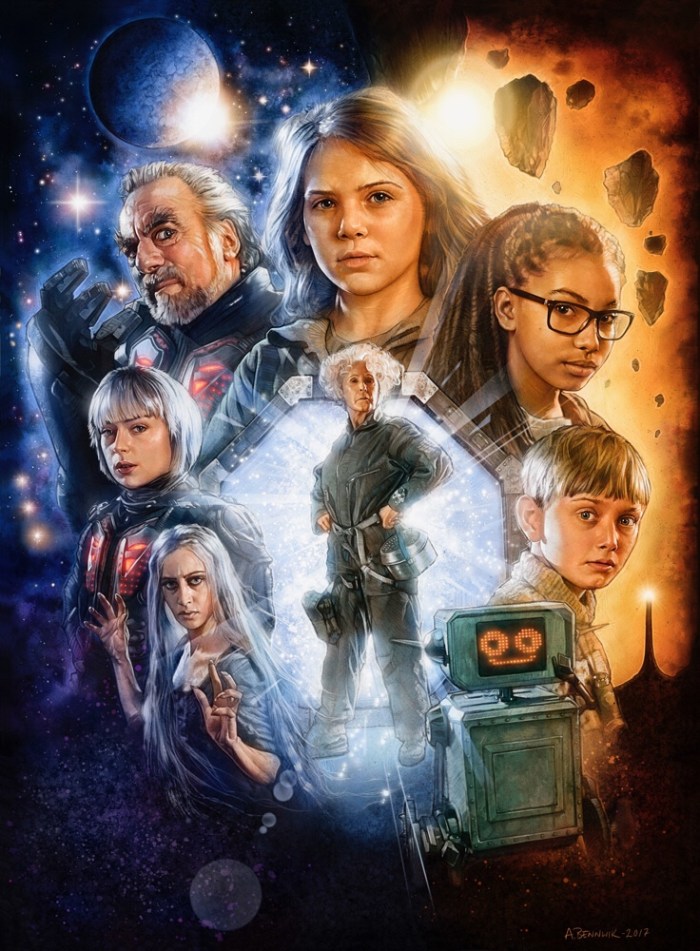
This year, the story is called ‘Hunt for the crystal of time’ and is starring a very popular, recently-deceased Swedish actor as the obligatory evil bad guy. In the series, he plans to stop time the day before Christmas Eve and the only people who can stop him are three children who have to journey to the center of the universe to do so.

It’s all very exciting – what if they fail?! There will be no Christmas ever again!

We’d all better hope they succeed! In just 5 days, we’ll find out!!!!

‘Julkalendern’ can be watched on SvtPlay you’d like to catch up!

Swedish Music Aid

Children are not for sale!

Did you know that every minute, 4 children are sold into the sex industry around the world? An estimated 2,000,000 children are victims of sex trade and many more in human trafficking. These figures are hard to grasp, and even harder to process. Sexual trading of children can involve local boys who are abused by tourists, impoverished girls who are sold as sex slaves to rich families, or children who are ordered like fast food on the internet. The actions of the perpetrators are ruthless and the list of assaults is endless.

But we can do something about it.

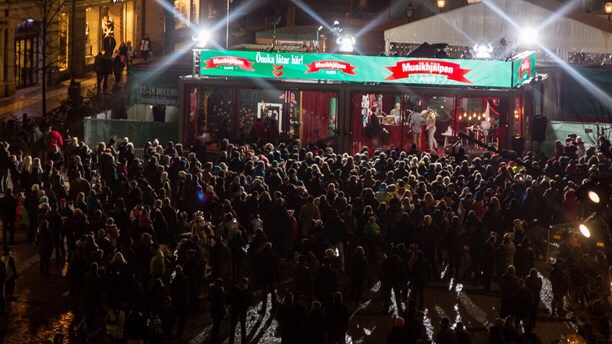
‘Children are not for sale’ is the theme of this year’s charitable Music Aid (Musikhjälpen) project in Sweden. For the tenth year in a row, three radio hosts are locked into a glass cube for 6 days on a square in a town somewhere in Sweden. This year the event takes places in the northern city of Umeå, and the hosts broadcast music and tv non-stop day and night to gather donations for their good cause. To raise money one can, amongst other things, request a song, carry out a fund-raising action and bid in the various auctions that take place. This is Swedish solidarity at its very best.

Today, 17 Dec, is their final day of incarceration – the hosts are let out of their glass cube this evening and the total amount that has been raised will be announced. The millions of crowns that they gather will be spent on prevention of the child sex trade, protection of at-risk children and rehabilitation of children who have been victims.

It is still not too late for you to make a donation. Download the Musikhjälpen app (mh2017) and make a contribution! You can also go to http://www.musikhjalpen.se or find the same on Facebook. Every donation counts!

Your contribution can save a child from a terrible, terrible fate.

Please donate! Please share this blog with your friends and encourage them to do the same.

Sweden’s badass king

Today, 30th November is an important day in Swedish history.

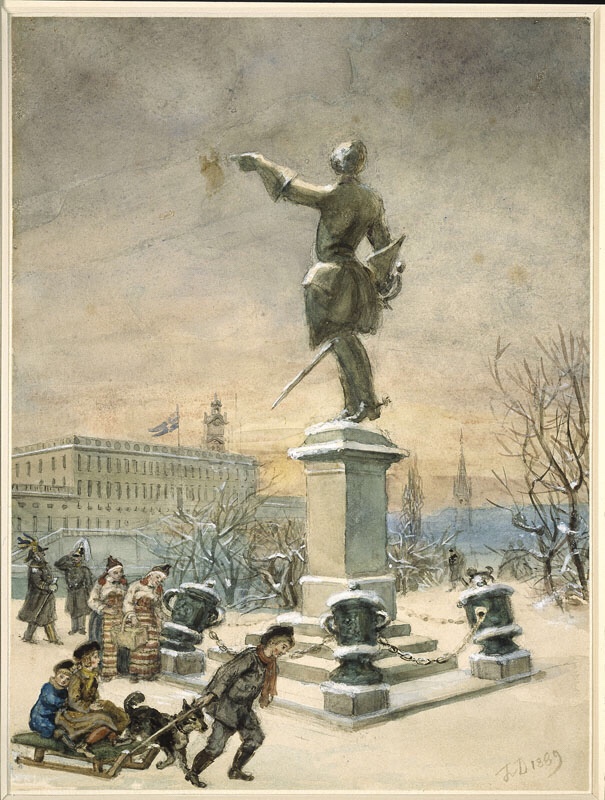
And it all revolves around a stoical King, whose statue can be seen in Stockholm’s Kungsträdgården Park.

Today, Sweden is a peaceful country and hasn’t been at war for over 200 years. But it wasn’t always so. Once upon a time, Sweden was a great power, a military giant with a much larger territory than it has today. And the King of the statue – Charles XII – had a lot to do with it. If you see the statue, he is pointing his finger east. And there is a good explanation for this.

Charles (Karl) was king in Sweden 1697-1718 and a bit of a badass. Apparently never registering physical pain, in the space of a few years, he transformed the small nation of Sweden into a formidable power, crushing his enemies under him. And then he lost it all. At this time, Sweden covered modern day Norway, Finland and other Baltic regions such as Lavonia.

Charles ascended to the throne age 15 and his youth was subsequently exploited by neighbours Denmark, Poland and Lithuania who decided to snatch land from him. In retaliation, he quashed Denmark’s invasion of Sweden and put an ally on the throne. Then, he responded to Russia’s attempt to occupy Livonia and Estonia, and won a sweeping victory at the battle of Narva, under the cover of a blizzard.

After later defeating Poland and Lithuania, he then turned his sights again on Russia. Like his statue, he pointed East. This was a mistake. Up until now, it seems like he just retaliated but this time he waged a war. Hubris perhaps? It was to be his downfall.

Unfortunately for Charles, Peter the Great had regrouped and, in a grueling cold battle, the Russians beat the shit out of the Swedes. Rather like what happens on the ice hockey rink today. Charles fled to the Ottoman Empire but made himself unpopular there so fled back to Sweden, riding across Europe on horseback in just 14 days. Obviously not on the same horse.

Back in Sweden, he saw his nation crumble. Russia took Finland. Denmark took other Baltic regions.

On Nov 30th, 1718 he was shot and killed in modern day Norway, thus marking the short period of Sweden as a great European power. The ‘Swedish empire’ crumbled and territory was taken.

In modern day democratic, peaceful Sweden, Charles XII is sometimes criticized as a blood thirsty tyrant. His war-mongering contradicts strongly with the Swedish Brand of today. But history is history. Rewritten, retold and reinterpreted.

Whatever Charles was, there is no doubt he was a hard core ass kicker. On a historical website I found, the writer describes Charles XII in the following way:

‘Charles was pretty badass.  He completely abstained from alcohol and sex and was pretty much uncomfortable doing anything other than leading his troops to victory or being stoic as fuck.  He lived fast, died young and when he went down he took the entire fucking country of Sweden with him.  What more can you ask for from a historical badass?’
Sweden’s insatiable appetite for Eurovision

Sweden must be the country that can call itself Eurovision fan number 1.

So insatiable is the thirst for ‘schlager’, as it is called in Swedish, that the journey towards the May 2018 final began today.

Today, it was announced in a live press conference who will be participating in ‘Melodifestivalen’ – the competition to choose Sweden’s representative. So insatiable is the thirst for ‘schlager’ that there are 28 contestants! 28!

According to the papers, the artists are a mixture of ‘new-comers, classic singers, comebacks, former winners, favourites and LGBT surprises!’ Also, oddly, a parody band and a fat tv cook.

So insatiable is Sweden’s thirst for ‘schlager’ that these 28 contestants start competing with each other in February – in 6 live televised competitions! February Saturday nights in Sweden are ruined for the uninitiated.

The weeks leading up to the Eurovision Song Contest are then filled with Eurovision trivia. So insatiable. Interviews with Sweden’s chosen representative, behind the scenes programs and analysis of every single one of the other countries’ songs grace our televisions. Then finally, once we are already saturated, the two semi finals come. God forbid Sweden doesn’t qualify. Then finally, the final comes. And Sweden usually lands somewhere in the top 10. Then comes the analysis.

Finally sometime at the beginning of June, we are released from the jaws of Eurovision. The summer comes and is filled with ‘schlager’ tours and festivals. And in November, it all kicks off again.

That’s life in the insatiable ‘schlager’ country of Sweden.

So that’s what ‘Dackefejden’ means

As recently as today, I heard the Swedish expression ‘sedan Dackefejden’ (since the Dacke feud). It is used, often ironically, to describe something very old. ‘I haven’t heard this song since ‘dackefejden’, for example. Or ‘that car looks like something from dackefejden’.

I became curious to learn about this Dacke feud that everybody’s referring to. So I checked it out.

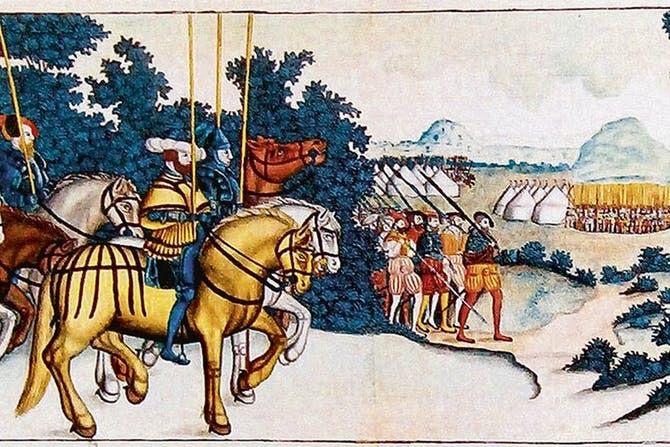
It happened 1542-1543, and was the biggest peasant uprising in Nordic history. It happened in the rural county of Småland in southern Sweden and was against King Gustav Vasa. The leader of the uprising was peasant Nils Dacke, and he was angry that the king had raised taxes and forbidden the sale of cattle and butter to the neighboring county of Blekinge, which at the time belonged to Denmark. Additionally, the king had plundered all the silver from their churches and wanted them to renounce their catholic faith.

So they rebelled, and took control of large parts of Småland and Östergötland. Such was their control, that Nils Dacke celebrated Christmas in Kronberg Castle outside of the town of Växjö.

Of course king Gustav Vasa wasn’t too happy about this feud and made various attempts to undermine the leaders. He offered sanctuary for those who surrendered, he slandered Nils Dacke as a false and unreliable person. And in 1543, he attacked – totally defeating and quashing the rebellion.

Nils Dacke was killed by the king’s soldiers. The people of Småland were punished with high taxes, the insurgents were banished to Finland, the leaders were executed and the whole of Dacke’s family was completely eradicated. So it really seemed to be a bad idea to argue with King Gustav Vasa.

And you literally won’t have met a member of the Dacke family ‘sedan dackefejden’.

5 things that are wrong with Sweden

When you’ve lived in a foreign country as long as I have, you become blind to the differences that were so obvious when you first moved here. That’s a natural development I guess. Call it emersion, or integration, or adaptation, or assimilation. Or in my case, Swedification.

However, there are still some differences in Sweden that I notice on a regular basis. Things so deeply ingrained in me from my cultural background that they still feel wrong in Sweden. Here are my top 5:

1) Front doors open the wrong way. Doors open outwards, instead of inwards. That means if you are visiting someone, ring their doorbell and stand on the landing, there is a big risk that you get smacked in the face as they open the door outwards, towards you. It’s just wrong!

2) Plumbing is often on the outside of the walls. Especially in bathrooms, and around radiators, ugly pipes are not hidden behind the plaster in the wall. They run up and down and side to side along the outside of the wall, visible to everybody. So ugly, and just wrong!

3) Driving. Swedes drive on the right side of the road. It’s just wrong.

4) The ‘tunnelbana’. On the underground (tunnelbana) in Stockholm, most people don’t wait for passengers to get off the train before trying to get on. As soon as the doors open, people pile in. At the same time people are trying to get out. The resulting caffuffle in the door opening is so unnecessary and just wrong!

5) Celebrating the Eves, instead of the Days. I’ll never get used to it. Especially at Christmas. Santa coming in the afternoon on Christmas Eve instead of the night between the Eve and the Day, is just wrong!

I know what you’re thinking. How unimportant all of this is.

And you’re not wrong.

I’m happy to live in a place where the only things that seem off to me are so minor. When it comes to values, structures, systems, behaviours, lifestyle and attitudes so much about Sweden is, for me, just right.

Take a breath – and speak Swedish.

Probably ‘antiestablishmentarianism’ is one of the most notorious long English words that exist. However, in general we don’t have so many long words in the English language. This is because we use the space bar to separate words. Unlike Swedish.

In the Swedish language, grammar rules allow many words that would be separated in English to be arbitrarily conjoined, making it one veeeerrry long word. This can be mind boggling for the new language learner trying to get a grip on the linguistic acrobatics of the Swedish language.

Here are some of the longest co-joined words in Swedish. Take a breath. And speak Swedish…

1) nagellacksborttagningmedel – nail polish remover

2) diskrimineringsombudsmannen – ombudsman for discrimination

3) realisationsvinstbeskattning – capital gains tax

4) hippopotomonstrosesquippedaliofobi – fear of long words!

5) blodsockerprovtagningsmaskin- blood sampling equipment

6) användervänlighetsundersökning – enquiry into user-friendliness

7) trafikavspärrningsarbetsupgifter – traffic barrier tasks

8) eurovisionsschlagerfestivalsfinalsdeltagare – eurovision finalist

9) korttidsanställdasommarlovspraktikanter – summer job workers with short term contracts

10) mindervärdighetskomplex – inferiority complex (what one gets trying to pronounce these words!)

And finally… try this one out. According to the Guiness Book of Records the longest Swedish word is nordvästersjökustartilleriflygspaningssimulatoranläggningsmaterielunderhållsuppföljningssystemdiskussionsinläggsförberedelsearbeten.

Non-binary Swedish and English

For a while now the non-binary pronoun ‘hen’ has been used in the Swedish language. ‘Hen’ is used to refer to somebody who does not relate or feel represented by the established pronouns for he (han) and she (hon). Initially met with ridicule by some people in Sweden, the ‘hen’ pronoun is slowly starting to gain in usage amongst Swedes and in ordinary vernacular.

I have long assumed that non-binary pronouns do not exist in English apart from the neutralizing use of ‘they’. Imagine my surprise when I read an article today in the Huffington Post which proved me wrong. The article talked about the queering of language. The guide to English non-binary pronouns are presented in the table.

It’ll certainly take some getting used to to add new pronouns into the vocabulary. However, language is one of our greatest tools for celebrating diversity and increasing inclusiveness.

For that alone, I think it’s worth the effort.