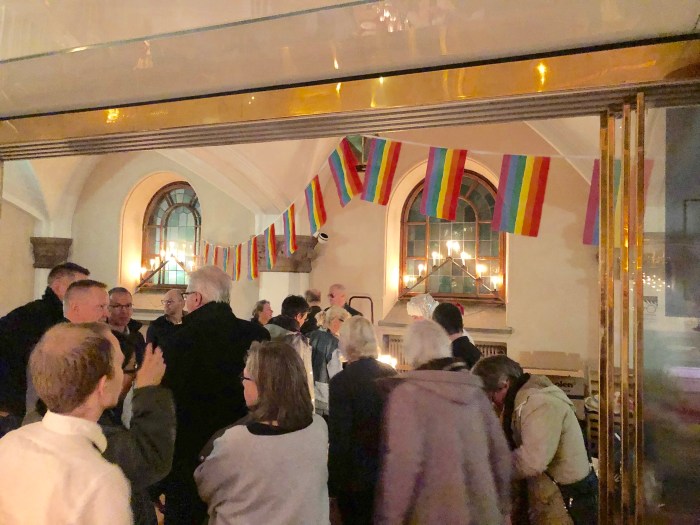
Have yourself a Merry Gay Swedish Christmas

With gay men being hunted down and ‘punished’ in Uganda, Tanzania, Russia and many other countries around the world, it is easy to blame religion for the persecution.

And the evidence to back this up is fairly compelling. Countries that have a strong foot in religion are often countries that have strong anti-LGBT policies and attitudes. Not always, but often. Fanatical interpretation of the scripture can be one explanation, as can the crushing concept of sin, and the devouring need to uphold traditional ‘family structures and values’. For example, in a recent comment, the Pope said a lot can be done for LGBT people through psychiatry.

Sweden is a country that separates the church from politics. It is a country where almost 90% of the population identify as atheist or agnostic. It is a place where religious morality does not usually dictate the behaviours and choices of individual citizens. Of course there is organized religion in Sweden, there are churches and there are priests. Of course there are minority religions in Sweden such as Islam, Hinduism and Judaism. Of course there are casual believers, devout followers and extremists. But compared to many other organized religions in the world, the Swedish Church is very liberal.

This was manifested in the recent service at a church in Stockholm, a service called Gay Jul (Gay Christmas). The slogan for the event was ‘come in as you are, come out as you want to be’. As I sat in attendance at this service, I witnessed a welcoming space, filled with members of the LGBT community, the church decorated in rainbow flags, and the words ‘Gay Jul’ emblazoned on the pulpit. I was moved by the openness of the church to welcome the minority group that is so often demonized and persecuted by the Faithful. It was an escape, and embrace, a sanctuary.

However, I was also struck by a sadness as I sat there in that echoing church. I realized the experience was a uniquely Swedish one, occurring in a small city in a small outpost of Europe and an unlikely sight in other churches, mosques, temples and tabernacles around the world.

In that church, amongst the rainbow flags, we were far far away from Uganda, and Tanzania, and Russia.


The relief of Swedish Advent


So it’s the first of Advent this weekend and this year it comes as a major relief for those of us in Stockholm.

You see at Advent, Swedes decorate their houses, apartments and windows with lights. From ceilings, illuminated stars are hung. On window ledges, electric advent candles are placed. On tables, four candles are positioned and one is lit every Sunday up until Christmas. Small candles, often red, are dotted about the home.

Some years, there is already deepish snow at the first of Advent, but this year in Stockholm, there isn’t. So it is very, very, very dark. The collective advent decoration is a definite reprieve from this darkness as light is spread into these murky places.

The word ‘advent’ comes from the Latin ‘adventus’ which means ‘arrival’ and is traditionally the start of the period where we wait for the arrival of nativity, or Christmas. Some religions also see it as waiting for the second coming of Christ. But in this secular society that is Sweden, the waiting is probably for the snow to come, the cold to hit, the water to freeze to ice and for winter to clasp its fingers firmly around us.

World Aids Day in Sweden

Lying here in the middle of the night, the sound of the rain beating on the windows and the wind howling around the rooftops. During these dark nights, my mind often wanders.

And right now, it is reminding me that Saturday is World AIDS Day.

My mind circles around the memories of friends and acquaintances I lost in the peak of the crisis in London. I remember all the talented celebrities who died, such as Freddy Mercury, Rudolf Nureyev, Arthur Ashe, Derek Jarman. I ponder the unnecessary number of beautiful young people, unknown to most of us, who succumbed to the disease over the last 30+ years. An estimated 35,4 million people have died from AIDS since the beginning of the epidemic, to quote the grim statistics.

Today, in Sweden about 10000 people live with diagnosed HIV and Sweden has become the first country in the world to achieve the UN goal for identification and treatment of people with HIV.

But that’s not the case on many other countries, where HIV continues to devastate communities and families. In East and Southern Africa, an incomprehensible 19 million people are believed to live with the infection, and an additional 25% don’t know their status.

World AIDS Day (WAD), designated on 1 December every year since 1988, is an international day dedicated to raising awareness of the AIDS pandemic caused by the spread of HIV infection and mourning those who have died of the disease.

In Stockholm, Noak’s Ark has a day of lectures, meetings and performances to commemorate the day. Check out their web page.

Tomorrow night, Friday 30 November, there is a WAD concert at Maria Magdalena Church on Bellmansgatan on Södermalm. I will be there to sing with my choir and to show respect for those who are living and who have died.

It starts at 17.30 and is open to all.

Please come along.

Do Swedes have no heart?

Working recently in India, one question I received was ‘why don’t Swedes greet us with heart?’ This was referring to when Indians visit colleagues in Sweden, or when they start working together in new constellations.

It is an interesting perception, and maybe not a new one. The experience of Swedes as cold, unfriendly and disengaged seems common, and genuinely baffles a lot of non-Swedish people.

Firstly, I would like to say that in general this is not true. It is just a perception. Many of the Swedes I know are kind, generous and affectionate. However, I do have a few theories as to why this perception prevails.

Expressiveness – how much it is appropriate to express emotion is something that we are trained in from childhood. Some cultures train their children to use their entire bodies when they communicate, others train their children to be more reserved. Generally Swedes are trained to be emotionally inexpressive. What they mean is clearly in their words, and not so much their bodies or faces. And this can lead more physically expressive cultures to presume they are cold. So it is important to understand that lack of expression should not be confused with lack of feeling.

Importance of relationships. Swedes do have many close friendships and family ties. However, this doesn’t necessarily extend to neighbors or colleagues. While in other cultures, strong close relationships with colleagues are essential for getting the job done, in Sweden isn’t the case. Relationships help, but they are not essential for carrying out the task. This means Swedes can go to work and be friendly towards each other, but don’t necessarily need to make friends or show a great deal if interest in each others private lives. This can be frustrating for people who come from strongly relationship-oriented cultures.

Independence. Swedish culture is amongst the most individualistic cultures in the world. In Swedish society, this manifests itself in the attitude that every able-bodied person can take care of themselves. This means that the Swedish attitude is generally if you want help you will ask for it. And you usually get it. The fact that help is rarely offered was a hard lesson for me to learn when moving to ‘unhelpful’ Sweden.

The peach and the coconut. Some cultures are like peaches – soft on the outside, easy to get into, open in communication, overtly friendly. Other cultures are like coconuts – hard shelled, difficult to get into and less open to people outside the group. Typically, but not exclusively, Swedish culture is ‘coconutty’ and Indian is peachy. This can mean it’s a challenge for people from peachy cultures to break into Swedish society and easy for them to form the perception that Swedes are cold and unwelcoming. My experience tells me, however, that once you break through the shell, the friendships that you make are very close and lasting. It is easy to assume when you meet a Swede that he or she is shy or introvert. This might be the case, but not necessarily. He or she might just be a coconut.

Sweden’s sand box

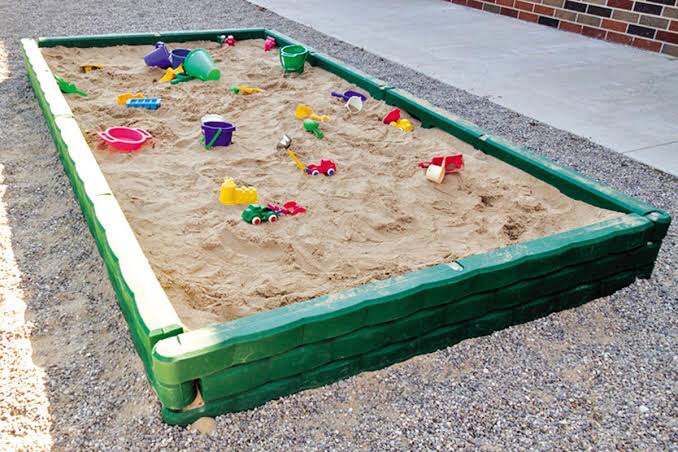
It’s been over two months since the general election, and still no government in Sweden. This is because the 8 parties can’t find a suitable coalition that doesn’t damage egos, betray voters, let in the nationalists or destroy alliances. It’s a bit like watching a discussion between toddlers in a sand box:

  • Ulf wants most of all to play with Ebba, Jan and Annie
  • Annie doesn’t want to play with Ulf, Ebba and Jan unless Isabella is allowed in
  • Annie and Jan definitely don’t want to play with Jimmy or Jonas
  • Annie and Jan want to play with Isabella but Isabella wants to play with Jonas and Stefan
  • Jonas is happy to play with Stefan and Isabella but not Jimmy or Ulf or Ebba
  • Stefan wants Annie and Jan to join in with Jonas and Isabella
  • Nobody wants to play with Jimmy, except sometimes Ulf and Ebba
  • Jimmy doesn’t know who he wants to play with

One wonders how it all will end. Well, how does this discussion in a sand box usually end?

In tears!

Spectacular Swedish serenity on All Saints’ Day

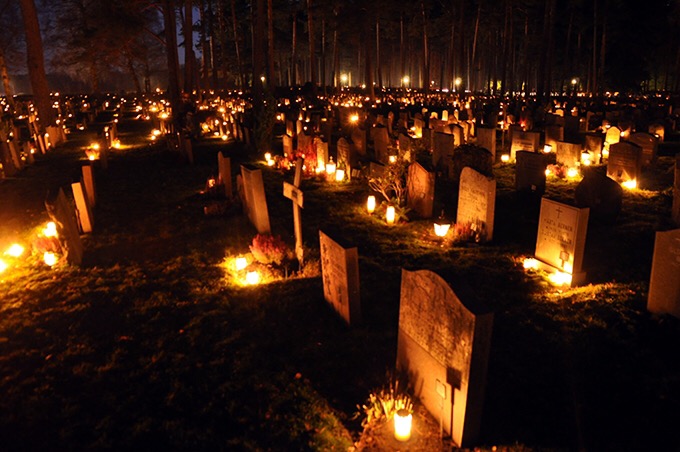
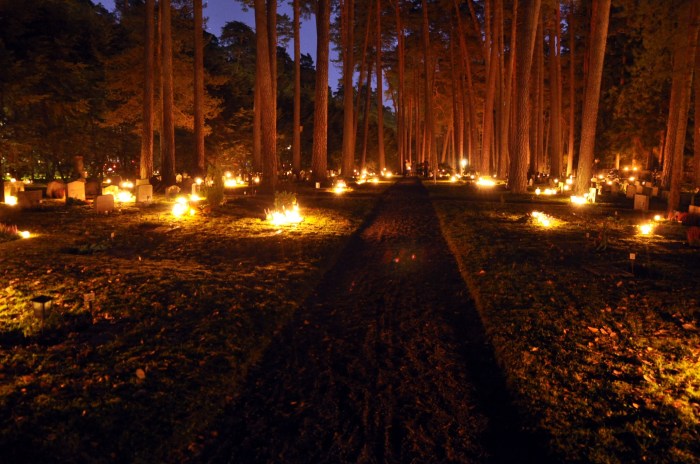
I remember walking around Stockholm when I had recently moved here. It was a pitch black Saturday evening in November, cold and crisp. As I approached a majestic church, I noticed that it was shimmering from the grave yard. This yellow and white light slowly flickered and cast shadows on the gravestones and the church wall. As if drawn by a magic spell, I walked up to the church and looked over the wall. The sight that met my eyes was spectacular and serene at the same time. Hundreds of candles were spread around the cemetery, decorating each of the graves. In the memory grove a bright blazing blanket of candles lit up the area. It was as if the spirits of the dead had come out to play.

In Sweden, the first Saturday in November is All Saints’ Day (the Sunday after All Saints’ Day is called All Souls’ Day to separate between the saints and the dead).

Since the 1800’s Swedes have, during this weekend, made pilgrimage to graveyards up and down the country to decorate the graves with candle light and to pay respect to the dead. It is a much more elegant and atmospheric tradition than the typical Halloween parties that otherwise have become very popular in Sweden.

It is a truly beautiful experience to walk through the churchyards this weekend. In the pitch black November Nordic darkness, it is a peaceful reminder of those who have gone before us. So head for your nearest cemetery this weekend and, if you happen to be in Stockholm, go to the Forest graveyard (Skogskyrkogården) for a specifically spectacular experience (pictured below).

Swedish expressions – ‘to buy a pig in a sack.’

In Swedish, this is a common phrase used to describe a situation where somebody has bought something without first fully examining it. And it proves to be a costly mistake. It’s also used to describe situations where somebody says yes to something without really knowing what it is – to their detriment. The expression ‘köpa grisen i säcken’ is the equivalent of the little-used English phrase ‘to buy a pig in a poke.’

But where does the expression come from?

Well, it dates back to the late Middle Ages when livestock was sold in the market places. Small animals were transported in sacks so as to make it easy to carry them. When you bought an animal, if you didn’t look in the sack, you might be in for a big surprise when you got home. You thought you bought a piglet, for example, but on opening the sack you realize it contains a rat or a cat.

It’s a bit like voting for a person or a party without fully understanding their politics and then being shocked afterwards. You really shouldn’t have bought that pig in the sack.

Have you been wondering who votes for Sweden Democrats?

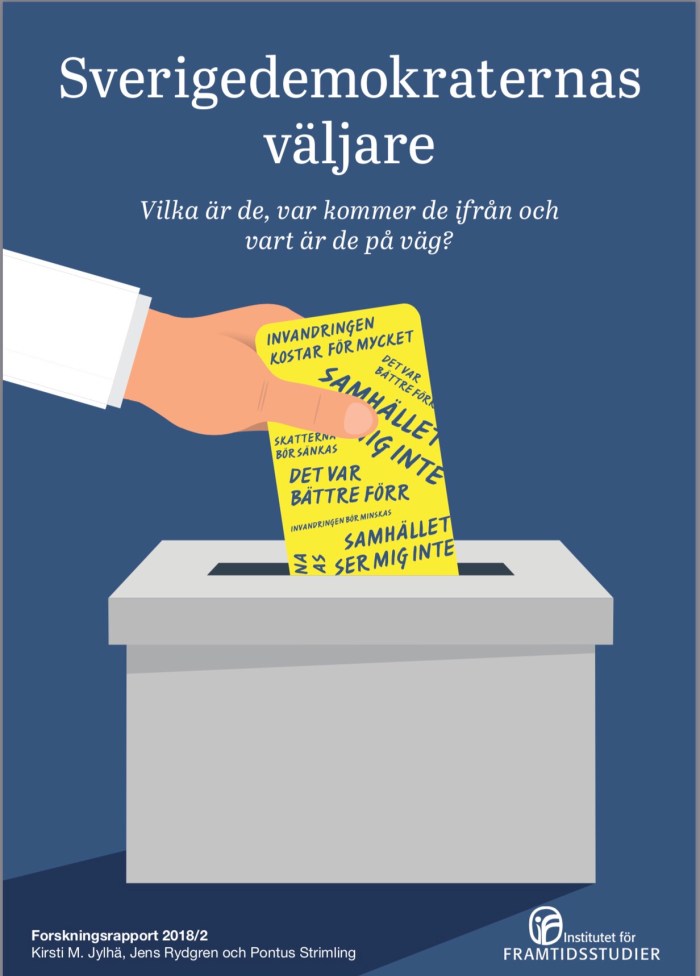
I was at an interesting lecture this week with researchers Kirsti Jylhä, Jens Ryding and Pontus Strimling. They were presenting the results from their research at the Institute of Future Studies into who are the Sweden Democrat’s (SD) voters, why do they vote for SD and where are they from? It’s taken me a while to mentally process and summarise what they said, but here is my take on it.

The research was carried out in the form of questionnaires on several thousand voters. The research tried to look at attitudes, origins, demographics and world views.

Fluid voters

The majority of the SD voters have moved from Socialdemocratic party (S) and conservative Moderates (M). 62% of the supporters are more likely to vote M in the future, if they don’t vote SD.

Critical to immigration

The majority of SD supporters have immigration as their main issue. They are critical of immigration in general and see immigration as a threat to society. Some of the voters, but far from all, have a deeper resentment or dislike for foreigners. The main driver is fear and criticism of a ‘failed’ immigration system. Almost 100% of SD voters believe immigration costs too much. Over 80% believe that immigrants weaken the Swedish culture. Over 90% believe that immigrants are responsible for increased crime rates.

Trust Swedes

The SD voter has a higher level of trust towards other Swedes than to those born outside of Europe with almost 70% saying they would prefer a native Swede as a neighbour rather than a foreigner. This was 19% for S voters and 37% for M voters.

Skeptics

The vast majority of the participants in this research were highly skeptical towards the government and other authorities. They have an innate, higher suspicion of politicians, media and the legal system than M or S voters. They also have a larger tendency to believe in conspiracy theories.

Feeling good

Previous research suggests that supporters of populist parties tend to be dissatisfied and marginalised by society. This research does not support that. Quite the opposite, SD voters are satisfied with their lives and their current situations and they do not perceive their quality of life has been reduced during the last four years. However, a common concern they have is that their standard of living with get worse in the future due to costly changes in society. In comparison to S or M voters, they have a much weaker optimism about the future.

Tolerance and respect not important

In comparison to S and M voters, SD voters tend to think tolerance and respect are not important qualities. In the raising of children, obedience is seen as a more important quality. However, the research could not prove a larger lack of empathy amongst SD voters compared to others.

Lower education

37% of SD voters in the research had a higher education (eg university). Amongst S voters this is 44% and 57% amongst M. The majority of SD voters are working class.

Conservative and authoritarian

SD voters in much higher numbers have a conservative and authoritarian view of society. For example, over 70% think that feminism has gone too far and it is the role of the man to support the family. Over 60% believed that a strong leader is necessary to control unwelcome behaviours in a society.

So, are SD voters stupid, racist and irrational? Judging by this research the answer is no. They are skeptical, critical and fearful.

And they are highly rational. It makes rational sense for them to navigate towards a party that resonates most with their attitudes.

Today is Election Day and soon we will see the result. What will win in Sweden? Will it be skepticism, criticism and fear? Or will it be pragmatism, openness and optimism?

To see the full report, go to http://www.iffs.se and look under publications.

Sweden’s politicians are slut spurting

I know, i know. It sounds gross doesn’t it? ‘Sweden’s politicians are slut spurting.’ However disgusting it might sound, it is exactly what they are doing.

With one week to go to the election, all the parties are in the final throws of their campaigning. In this final week, they try to get their message across by turning the gear up a bit. This final sprint to the finishing line is called a ‘slutspurt’ in Swedish. It’s often used to describe the final hurried days of a sale.

And it’s what they’re all doing.

They’re slut spurting on the tv, in the streets, in the media. It’ll be a relief when it’s all over I expect. That much spurting can’t be good for you.

How SD is seducing you

sd affisch

Standing on the train platform this morning I was confronted by a huge poster from nationalistic party the Sweden Democrats, asking me to vote for them in the approaching election. The poster consisted of men and women, all white, smiling down at me in a welcoming unthreatening manner. ‘SD 2018’ – the simple slogan emblazoned across the poster – intended to show me that those who support SD today are not nazis, criminals, sexists or homophobes (as proven time and time again in the press). On the contrary they are presented as ordinary, happy people who just want a change of government.

As I stood there, I understood how clever SD’s PR and Marketing people are. They have a strong understanding of influencing techniques – and they’re not afraid to use them to seduce the unsuspecting general public.

Psychologist Robert Cialdini is considered the guru of influencing skills. In his ground-breaking book, ‘Influence’, he introduced six key principles on which influence is based. Based on his extensive research, he found that if we apply these principles, we are able to persuade others more easily. Used positively, they can help move us towards agreement with each other, used negatively they can be applied to manipulate and even coerce people into making decisions that might be bad for them.

As I stood on the platform and absorbed SD’s poster, I realised how artfully they are using two of Cialdini’s principles. The principle called ‘Social Proof’ and the principle called ‘Liking’.

Social Proof
This principle relies on people’s sense of “safety in numbers.” If we see that others are doing something, we are more likely to do the same. It somehow feels validated. For example, we’re more likely to work late if others in our team are doing the same, put a tip in a jar if it already contains money, or eat in a restaurant if it’s full of guests. We assume that if lots of other people are doing something, then it must be OK. We’re particularly susceptible to this principle when we’re feeling uncertain, and we’re even more likely to be influenced if the people we see seem to be similar to us. That’s why commercials often use parents to advertise household products and why SD uses smiling, happy Nordic people.

Liking
Cialdini says that we’re more likely to be influenced by people we like. Likability comes in many forms – people might be familiar to us, we might just simply trust them or they might physically look like us. We have an inherent feeling of liking when we see them. Companies that use sales agents from within the community employ this principle with huge success. People are more likely to buy from people like themselves, from friends, and from people they know and respect. Facebook, for example, builds its business model on ‘liking’. SD uses this principle to manipulate us into thinking they are just like us. They think like us. They would never do anything to harm us. We can trust them.

As in previous posts, I am trying to shine a light on how SD is manipulating us, society and the election. They are masters of manipulation – spreading fear and uncertainty in the minds of the susceptible electorate, when in fact Sweden is currently booming and economically very stable. There are problems in society, no doubt, but these are not best solved by giving power to a party that we know is manipulative and devious. Judging by the level of scheming we see when they are trying to gain favour, just imagine how this will escalate if they have power.

A vote for SD is not a vote for a better Sweden.

Do not be duped into falling for the deceit.

You are being manipulated.

Do not be seduced.