Shedding my light on the Lucia debate


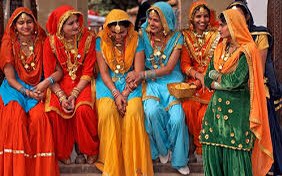
Today is Santa Lucia in Sweden – December 13th.  At the darkest time of the year, when we all are drained by the black mornings and afternoons, Lucia pays us a visit. With candles in hair and surrounded by a posse of singers, Lucia shines light into the dark depths of our spirits. The music plays. The choir harmonises. Lucia smiles at us. And slowly, slowly, the day awakens.

I love Lucia. Long live Lucia – this Sicilian martyr, who’s tradition is said to have come to Sweden via Italian merchants around the late 18th century.

Every year, towns around Sweden elect a Lucia and they visit shopping malls, old people’s homes and churches, singing and handing out gingerbread. And every year there is a debate about who owns the right to be Lucia. The answer to that question depends on your starting point – does one take a traditional view or a modernist view? The Swedish traditionalists will say that Lucia definitely has to be a girl, ideally blonde and blue-eyed. The modernists will say Lucia should reflect today’s society and therefore can be any colour or gender.

This year, as many before, the debate took a nasty turn. A large department store depicted Lucia as a gender-neutral, dark-skinned child. For some people, this was too much. Hateful, despicably racist, and, of course, anonymous comments flowed in via social media, revealing yet another crack in Sweden’s tolerant facade.  Consequently, the department store removed the advert to protect the child. This social media behaviour is unacceptable and should be in no way condoned. Having a view point is everybody’s right (be it traditionalist or modernist), but attacking a child is something totally different.

As I watched Lucia this morning I was reminded of the real message. The humanist message. Sure, Lucia is literally about bringing light to the dark day. But the metaphor is clear, if we care to remember it. It is about caring. It is about being open even when we feel closed. It is about community.

One of the songs the choir sang this morning is called ‘Sprid ditt ljus’ – and I think this sums it all up. Translated into English, the chorus goes: ‘Spread your light, in the darkest times, warm us now and let us all feel peace’

Maybe it’s just me, but I think who is elected Lucia isn’t that important. What’s more important is that we remember the point. We should open our eyes to the light that is shone on our society where we have growing social divides, enormous groups of displaced people, poverty, starvation, homelessness on our streets.

Once a year, Lucia shines the light. Can we find it within us to shine our lights on each other? I, for one, intend to try.

Happy Lucia! May the light keep you warm.


This thing about being tall 

At a height of 193 cm, I am at the tall end of the man scale. However, in Sweden, I am rarely reminded of it. While I am taller than the Swedish 182 cm average, I still blend in. It isn’t until I visit another country that I become reminded that I am towering over other people and height becomes a source of attention or in worse case ridicule. 

This makes me think of visibility in relation to the intercultural experience. Does the more visible we are affect the authenticity of the experience? 

I remember my first time in Asia how people pointed at me and laughed. I remember in Mexico how people wanted to touch me and in China how they wanted to take a photo with me. My physicality was strange to them and, as such, my presence was impossible for them to ignore. 

I genuinely think that my experience of other countries is coloured by the fact that I can’t hide. I am seen by everybody wherever I go. Shorter people can more easily disappear in the crowd and, as such, can more neutrally observe their surroundings. Through no choice of my own, I am often influencing mine, which consequently makes my surroundings less authentic. 
In Sweden, people don’t notice. Or maybe they just don’t care. Or are too polite to point it out. Whatever the reason, I perceive that my feeling of physical sameness rather than difference is something that helped me adapt quickly to Swedish society and acknowledge it as the place I feel at home. 

‘Why is Sweden so dull?’


I’m just home from a business trip to India, where I worked with groups of people in Delhi and in Chennai. They worked with Swedes in a remote team and many had actually been to Sweden. I started my session by asking them what they would like to know about Swedes and Sweden. Their requests were interesting. 

Apart from the usual work-related questions, there were other questions which reveal a lot about how Sweden might be perceived by others. Here are some of their comments:                                       

    
‘Why is Sweden so uncolourful and dull?’

‘Why is Swedish food so bland?’

‘Why are Swedes not interested in us?’

‘They focus so much on their work-life balance. Why don’t they care about ours?’

‘How do they survive the cold weather?’

‘Because they are not religious, where do they get their values from?’

‘Why are Swedes so lonely?’

The debate over Swedish values


Every summer in Sweden, there is a politics week held on the Baltic island of Gotland. Over 8 days, each of the main political parties gets a chance to promote their agenda. This year, there has been a lot of talk about Swedish values, which in turn has started a debate about what are Swedish values and if they even exist. 

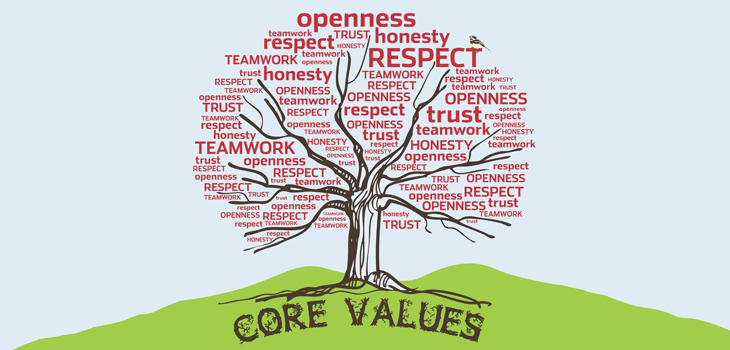
If we are looking for values that are exclusive to Sweden, the answer is no. If however we are looking for values that are prioritised in Sweden and function as a way to move society forward then, yes, they do exist. It is a matter of definition.  They may not apply to every Swede, but researchers have seen clear values in Swedish society that, while not unique to Sweden, are very strong. 

There has been a lot of talk about values of equality and tolerance. These values have been strong in Swedish society in the past and have enabled the welfare state, the laws and the political systems we enjoy today. 

According to the World Values Survey, which is a credible and extensive body of research that looks into what values drive society, there are two main value sets that separate Sweden from many other countries in the world. Those values are so-called secular/rational values and values of self expression/self actualisation.

Secular/rational values. In other words, the importance of the church and religion has deminished in Swedish society, religion and politics are separated, traditional family structures exist side by side with less traditional structures. Decisions are made ‘rationally’ and not based on scripture or a religious morality. This is very different from most places around the world.

Self expression/actualisation. The right and the need to say what one thinks is a strong driver in Swedish society. The right to your own opinion, your own perspective and to live the life of your own choice are considered undeniable human rights. This is different from many other places around the world. 

Many behaviours we see in society, in families and in the work place can be traced to these underlying driving values in Swedish society. 

The danger in discussing Swedish values lies in the belief that these are static and fixed. As society changes, so do the prevailing values. As the world around us changes, so do the values. As the environment is impacted, as war and crisis occur, values change. 

When political parties want to reinforce Swedish values, they are romanticising and simplifying. This is dangerous rhetoric as they are wilfully and deliberately using values to exclude. 

What do Shakespeare, the 1st of May and immigrants have in common?

Shakespeare_2888800b

Today is May 1st 2016, celebrated in Sweden as in many other countries, with demonstrations, political speeches and parades. Most political parties, including the fascist party, have rallies and gatherings. One of the hot topics this year is immigration and the large increase of asylum seekers that have arrived in Sweden during the recent months. For some people in Sweden, these immigrants are a positive addition to Swedish society. For others the influx of immigrants is unwelcome, a problem that is perceived to bring with it social and societal disruption.

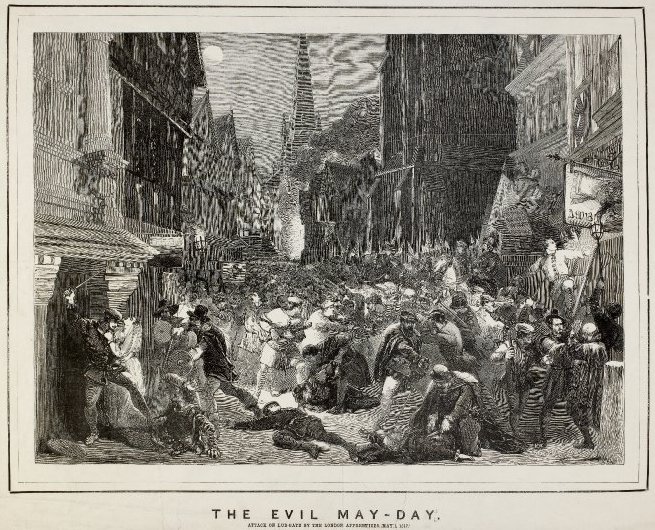
Reflecting over this situation, I hear echoes of something that happened in London on May 1st, 1517 – almost exactly 500 years ago – something known as ‘Evil May Day’.

During this period ín history, the reign of Henry the Eighth, Londoners were feeling unhappy with their situation. There was a great deal of misery, poverty and disease. As a consequence, they came to resent the presence of foreigners in the city, especially those seen to have money.  An inflammatory xenophobic speech had been made at Easter calling on all “Englishmen to cherish and defend themselves, and to hurt and grieve aliens for the common weal’.  Over the following two weeks there were sporadic attacks on foreigners and immigrants. On May Day 1517, it culminated, and a mob of thugs, liberated prisoners and others took to the streets and attacked foreigners and looted their homes. The under-sheriff at the time, the legendary Thomas More, tried unsuccessfully to dissuade them. Nobody was killed but several were arrested and charged with treason. Referring to the events of this day, William Shakespeare, many years later, wrote a text depicting the speech that Thomas More delivered to the rioters.

The voice of Shakespeare, who died 400 years ago last week, resonates through this text. The fascinating thing about it is that it is as relevant today as it was 400 years ago. This saddens me. The same forces at action centuries ago, are still in action today. This should be a reminder to all of us to be vigilant. Not everything, it seems, does change with time.

Here’s the text:

‘A Plea on behalf of Immigrants’ by William Shakespeare

Grant them removed, and grant that this your noise
Hath chid down all the majesty of England;
Imagine that you see the wretched strangers,
Their babies at their backs and their poor luggage,
Plodding to the ports and coasts for transportation,
And that you sit as kings in your desires,
Authority quite silent by your brawl,
And you in ruff of your opinions clothed;
What had you got? I’ll tell you: you had taught
How insolence and strong hand should prevail,
How order should be quelled; and by this pattern
Not one of you should live an aged man,
For other ruffians, as their fancies wrought,
With self same hand, self reasons, and self right,
Would shark on you, and men like ravenous fishes
Would feed on one another.

You’ll put down strangers,
Kill them, cut their throats, possess their houses,
And lead the majesty of law in line
To slip him like a hound.
Alas, alas! Say now the king
Should so much come too short of your great trespass
As but to banish you, whether would you go?
What country, by the nature of your error,
Should give you harbour? go you to France or Flanders,
To any German province, to Spain or Portugal,
Nay, any where that not adheres to England,
Why, you must needs be strangers: would you be pleased
To find a nation of such barbarous temper,
That, breaking out in hideous violence,
Would not afford you an abode on earth,
Whet their detested knives against your throats,
Spurn you like dogs, and like as if that God
Owed not nor made not you, nor that the claimants
Were not all appropriate to your comforts,
But chartered unto them, what would you think
To be thus used? this is the strangers case;
And this your mountainish inhumanity.


Evil%20May%20Day.jpg


The scandalous obsession with Swedish schlager

jag-aelskar-schlager

Sweden has proven itself to be a musical nation – topping pop, rock and dance music charts all over the world for decades. After the USA and the UK, Sweden is the world’s largest exporter of pop music, which says a lot for a country this size. But there’s one type of music we should be grateful for. And by that, I mean grateful that it generally doesn’t get exported outside the Nordic region and Germany. I am talking about the odd Swedish music style called Swedish ‘Schlager’. It is unfathomably and inexplicibly popular in Sweden.

What is Swedish schlager music you may wonder? Let me attempt to explain.

It is a style of popular music The style emerged in Europe after World War 2 as a backlash against American rock and roll. The style uses very simple patterns of music and they are either sweet, highly sentimental ballads with a simple, catchy melody or light pop ditties. Sometimes the songs integrate folk instruments. Often the lyrics are about love and relationships. Titles such as ‘Good Vibrations’, ‘Take me to your heaven’, ‘Captured by a storm wind’ give you an indication.

To get the idea of what schlager is, it’s best to think about the Eurovision Song Contest. It’s more or less that type of music. In fact, the competition and the selection trials are often referred to a ‘Schlagerfestivalen’ in Sweden – the festival of, yes you guessed it, Schlager.

Schlager music might not be intellectually challenging but it is disgustingly catchy. It is old fashioned, simplistic and annoying. But it immensely popular around the  country and is almost always the music that gets played at parties once people have had a few too many drinks and dare to approach the dance floor.

Tomorrow night the trials begin for who will represent Sweden in the international final in Stockholm in May. And Swedes take this very seriously. More people watch these trials than watch televised sporting events or royal weddings. And tomorrow’s trial is already making the headlines. Tragic schlager hasbeen, Anna Book, was disqualified as it turns out her song was involved in 2014 in Moldavia!! Shock! Horror! Poor Anna Book is devastated and the media is calling it a sensational and tragic scandal.

  • People dying in make-shift boats as they flee for their lives across the ocean is a scandal.
  • Gangs of masked men marauding through the streets of Stockholm and attacking immigrant children is a scandal.
  • That over 20% of Sweden’s population vote for a right-wing racist party is a scandal.
  • That young women get groped and physically abused when they are in public places is a scandal
  • That health care, elderly care and education are rapidly deteriorating in Sweden is a scandal

Anna Book being disqualified from a music competition is not a scandal.

Maybe some people are so obsessed with the inanity of schlager and Eurovision that they can’t lift their eyes and focus on more important issues. For me, that’s a sensational and tragic scandal.


Swedish women fight back

Strength-woman-arms

In response to the hoards of ‘Vikings’ roaming Stockholm’s streets to protect their ‘women’ from ‘muslim rapists’, the women of Sweden have spoken up. In a social media campaign called ‘inteerkvinna’ – ‘not your woman’ – they are fighting back.

‘Den rasistiska lynchmobben som drog fram i Stockholm i fredags (29/1) och misshandlade barn och andra som inte är vita, påstår, likt andra rasistiska och fascistiska grupperingar, att de vill “skydda” vita/”svenska” kvinnor. De talar inte för mig. Deras “skydd” är i själva verket en önskan om att dominera, kontrollera, stänga in och äga kvinnor samtidigt som de försöker skrämma, misshandla och till och med utrota andra människor. De talar inte för mig. Internationell solidaritet är grunden för jämlikhet, rättvisa och fred. ‪#‎inteerkvinna‬

‘The racist lynch mob that rampaged through Stockholm on Friday attacking children and other non-white people, claim, like other racist and fascist groups, that they they want to protect white/Swedish women. They do not speak for me. Their ‘protection’ is in actual fact a desire to dominate, control, imprison and possess women. At the same time, they try to scare, abuse and exterminate other people. They do not speak for me. International solidarity is the basis of equality, justice and peace. I am Not Your Woman.


Sweden’s disgrace! 

  
In the latest poll today, over one fifth of the Swedish voting population would vote for the nationalistic right wing party, putting the party into position of the second largest political party in Sweden. 

Let’s be clear what this means. One fifth of Swedes support a party that has its roots in the nazi party, that has verbally and physically attacked minority groups and that believes in Swedish racial superiority. It’s a disgrace for all Swedes who believe in tolerance, openness and solidarity. 

It’s time to act. To speak out. This is not going away. As the established parties bitch at each other, the Swedish population grows tired of their rhetoric. Consequently, they feel more disengaged and resentful and turn to a party that seems to talk straight to their concerns and promises protection of the Swedish identity. It is scarily reminiscent of the past. 

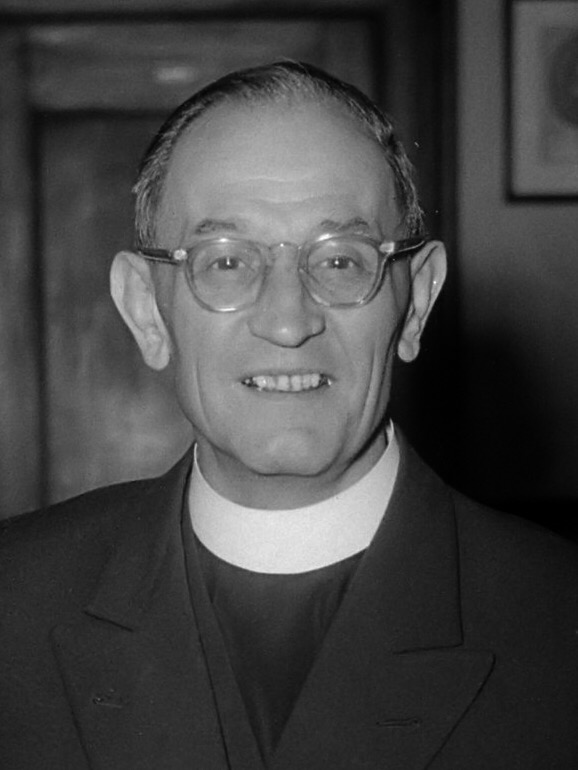
Pastor Martin Niemoller, pictured above, wrote a famous poem after he survived the concentration camps of the Second World War. His poem criticised the cowardice of German intellectuals after the Nazi’s rise to power and their subsequent purging of one group after another. It’s worth reflecting over his words. They are very relevant today. Right now. In Sweden. About us. 

‘First they came for the Socialists, and I did not speak out— Because I was not a Socialist.

Then they came for the Trade Unionists, and I did not speak out— Because I was not a Trade Unionist.

Then they came for the Jews, and I did not speak out—Because I was not a Jew.

Then they came for me—and there was no one left to speak for me.’

Do these words resonate with you? Are we the cowards he’s referring to? Are we so comfortable and complacent that we just sit back and watch it happen? 

If, like me, you believe in a multicultural society, it’s time to take a stance. Write to your MP. Talk to your colleagues, neighbours and friends. Get involved. Share this blog. Root out those one in five and challenge them. Demonstrate. Communicate. Educate. 

Speak out. While you can. Before it’s too late. 

Top 5 Rude Swedish Place Names 


In Britain, and Sweden, there are many places with funny or rude names. 

What’s in a name? Does the name of a place say anything about its residents? For example, are the people of Uppsala upwardly mobile people? Or are the people of Sundsvall very sound in their values and morals? Maybe. If the name of place represents the type of people who live there, what does it say about the residents of these top 5 rude place names in Sweden? 

5) In the town of Mora there is a place called Rövhålet, which translates as ‘butt hole’. 

4) Bögs gård, north of Stockholm, literally means ‘Gay’s farm’

3) Kattsjärten in the county of Värmland is the evocative ‘cat’s arse’ in English 

2) Way up in the north of Sweden, you will find Sexträsk, which is the exotic place of ‘sex swamp’

1) But the most embarrassing must be the place called Djupröven, which is just outside of Uppsala. It means ‘Deep Ass’ in English. Says it all. 

There’s also a suburb of Stockholm which I’m always embarrassed to say. The suburb of Fittja sounds very much like the offensive word for female genitalia. Best to avoid saying it if you’re a foreign speaker of Swedish. 

What other funny or rude place names in Sweden do you know? 

Please share this blog, if you enjoyed it. 

What Sweden’s New Year’s Eve has to do with Lord Tennyson 

New Year’s Eve in Sweden is like most other places in the world. Good food, fireworks, friends and alcohol frame in the event.

However, there is another tradition which is peculiarly English and particularly Swedish.

Almost every New Year’s Eve since 1896, a well-known person has stood on the stage at a Swedish open-air museum and recited the poem ‘Ring out Wild Bells’ by Lord Alfred Tennyson written in 1850. This may seem weird, but nowadays, the event is televised and attracts a large public. Translated into Swedish, the poem is called ‘Ring Klocka Ring’ and it has a very meaningful and deep content as we leave one year and enter into another. 

Various famous people, mostly actors, have had the honour of delievering this rousing poem throughout the years. Of the 20 narrators so far, only one has been a woman. However, this year the second female narrator – popular opera singer Malena Ehrman – will take the stage.

Below, you will find the text in English. ‘Ring out the old, ring in the new’ – and a Happy New Year to each of you!
In Memoriam, [Ring out, wild bells] – Lord Alfred Tennyson, 1809 – 1892
Ring out, wild bells, to the wild sky

The flying cloud, the frosty light:

The year is dying in the night;
Ring out, wild bells, and let him die.
Ring out the old, ring in the new,
Ring, happy bells, across the snow:
The year is going, let him go;
Ring out the false, ring in the true.
Ring out the grief that saps the mind
For those that here we see no more;
Ring out the feud of rich and poor,

Ring in redress to all mankind.

Ring out a slowly dying cause,
And ancient forms of party strife;
Ring in the nobler modes of life,

With sweeter manners, purer laws.

Ring out the want, the care, the sin,
The faithless coldness of the times;
Ring out, ring out my mournful rhymes

But ring the fuller minstrel in.

Ring out false pride in place and blood,
The civic slander and the spite;
Ring in the love of truth and right,
Ring in the common love of good.
Ring out old shapes of foul disease;
Ring out the narrowing lust of gold;
Ring out the thousand wars of old,
Ring in the thousand years of peace.
Ring in the valiant man and free,
The larger heart, the kindlier hand;
Ring out the darkness of the land,
Ring in the Christ that is to be