Swedish ways to die #1 In the lift

There is one thing that unites us all. We all die. That said, there are many ways in which we can shuffle off this mortal coil. Just like our lives are unique, so probably are our deaths.

Living in Sweden, I am often struck by the many ways one can die. Perhaps not specific to this country, but at least very cultural.

Here’s the first way: ‘the careless accident in the lift’ – a tragic way to pop your clogs.

Many Swedish lifts don’t have inner doors. As the lift descends, the floors slide by visibly. If you have a large article with you, for example, a wheely bin, it can fasten on the edge of the lift. The bin gets stuck, the lift keeps descending and voila, you are crushed to death or decapitated. A very Swedish way to die.

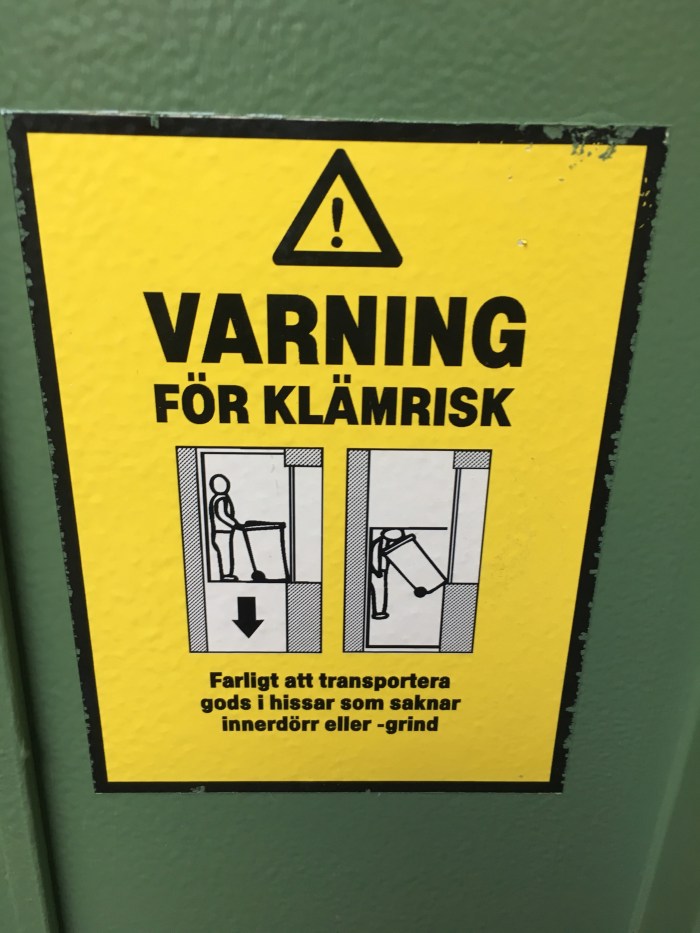
Below, you see a sign on the door to the lift in my apartment building. It says ‘warning – risk of crushing. It is dangerous to transport goods in lifts without inner doors or gates.’

15 Swedish words for getting married

With the UK, and probably the USA, in a Royal wedding frenzy at the moment, it made me think about Swedish words for getting married. In English, we have for example ‘tie the knot’, ‘take the leap’ and ‘get hitched’, so I did some research. And I found the following formal, and less formal expressions for getting wed.

  1. gifta sig – to get married
  2. ingå äktenskap – to enter into marriage
  3. äkta – to wed
  4. ingå giftermål – to enter into marriage
  5. Gå träda i brudstol – ‘step onto the bridal chair’ (tradition from the 1600’s)
  6. Ingå förmälning – enter into marriage
  7. Gå brud – ‘go bride’
  8. Vigas – get married
  9. Föra till altaret – lead to the alter
  10. Knyta hymens band – tie the wedding band
  11. Bygga hjonelag – ‘build a marriage’
  12. Slå sina påsar ihop – ‘join your bags’
  13. Förena sina öden – unite your destinies
  14. Gänga sig – get married
  15. Stadga sig – settle down

Interestingly, the most used word for married in Swedish is the same as the word for poison – ‘gift’!

The Nobel Prize of SHAME

SvAka_1_pms

In egalitarian Sweden, there is an elitist, powerful, elected-for-life committee called The Swedish Academy. This (royal) Academy is an appointed committee of 18 members whose purpose is to further the ‘purity, strength, and sublimity of the Swedish language.’ To this aim, they are guardians of the Swedish dictionary, and they award many prizes and scholarships to domestic authors. A mostly dusty, bourgeois old bunch, they also are responsible for awarding the prestigious Nobel Prize for Literature every year.

But not this year. Sex and shame has stopped them.

Today, the Academy announced they will not be awarding a 2018 prize. This has only happened 6 times since its beginnings in 1901  – during the world wars and in 1935, when no worthy winner was identified.

On its website, the academy writes ‘The present decision was arrived at in view of the currently diminished Academy and the reduced public confidence in the Academy.”

The ‘reduced confidence’ they are referring to is the rampaging sexual assault scandal that has engulfed the organisation. Several members of the academy have been slandered, scapegoated and forced out, or left at the own volition.

So no prize in literature this year, but most certainly a prize in shame.

It all started last November in regard to the husband of author Katarina Frostenson who is a member of the Academy. Her husband, photographer Jean-Claude Arnault, who ran a cultural project, with funding from the Swedish Academy itself, was accused by 18 women of sexual assault and harassment. Some of this allegedly happened in Academy premises. It has later been suggested that he even groped Sweden’s Crown Princess Victoria at a formal event.  Naturally, Mr Arnault denies the allegations.

This threw the Academy into turmoil. What unfolded in front of us was a drama of betrayal, sexism, power struggle, internal conflict, dishonesty and manipulation. It was like ‘Culture News’ meets ‘Downton Abbey’. Subsequently, a wave of resignations followed, including Ms Frostenson and the head of the academy, Sara Danius.

Today, there are only 11 members in place but the diminished academy requires a quorum of 12 to vote in any new members.

Since its beginning in 1786, the Academy has only ever allowed 9 women to sit in the committee. 9 women! It is clearly yet another example of a white, male-dominated, middle-class organisation. Can it change? Maybe the only way is to rip down this tower and build it up again in a more egalitarian spirit? Surely, the Academy should represent the population in ethnicity and gender at the very least?

The Academy’s slogan is ‘snille och smak’ – which translates as ‘talent and taste’.

Ironic isn’t it, that they are currently demonstrating neither of them.
Wondering about Sweden in the middle of the night

It’s 4am and I can’t sleep. One of those nights with a million thoughts churning around in my mind. Outside, the city of Stockholm is quiet. Daylight is starting to slowly break. As I lie here, a question about Sweden pops into my head. Something I’ve never thought of before.

Where does the English name ‘Sweden’ come from?

I should be sleeping, but I decide to google for the answer and I am catapulted into the world of historical research, language theory and ethno-cultural writing. And now I have the explanation and hopefully I can sleep.

Would you like to know? Here’s what I found:

The English name for Sweden was loaned from Dutch in the 17th century to refer to Sweden as an emerging power. Before Sweden’s imperial expansion, Early Modern English used Swedeland.

The Old English name of Sweden was Sweoland or Sweorice, land or realm of the Sweonas – the Germanic tribes of the Sviar. The name of the Sviar itself is derived from a proto-Norse Swihoniz, presumably a self-designation containing the Germanic reflexive ‘swe’ – one’s own, self”.

The modern English name Sweden

was loaned from Dutch. It is based on Zweden, the Dutch name of Sweden, and in origin the dative plural of Zwede. It has been in use in English from about 1600, first recorded in Scottish Swethin, Swadne.

So there you go. Perhaps I can now zleep. Zzzzzzz.

Death of a Swedish superstar

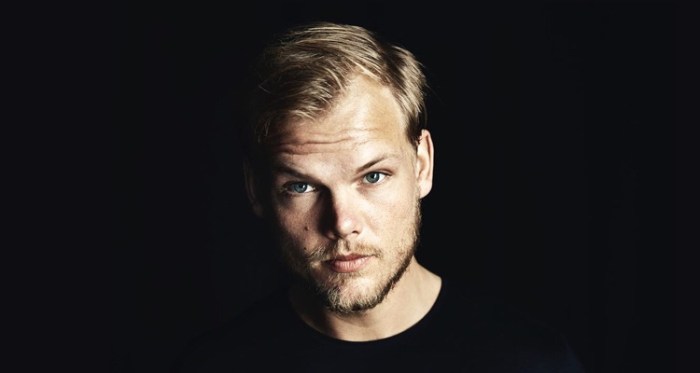
World-famous Swedish house DJ Avicii is dead, at 28 years old. I liked his music but other than that, I personally didn’t have much more of a connection to him, But of course his untimely death has been taken hard by his enormous amount of fans in Sweden, and in the rest of the world.

In Utrecht, the church bells in the Dom Tower, rang out the songs of Avicii over the town. On social media, condolences from celebrities and music stars flooded in. In a spontaneously-planned memorial ceremony yesterday, a huge mass of people gathered on a square in central Stockholm. After a minute’s silence, they danced together to Avicii’s greatest hits. Swedish tv is full of Avicii tributes and he topped iTunes and Spotify yet again.

One can’t deny the impact that this talented man had on electronic music and the inspiration he left behind for many new upcoming musicians. This young Swedish man, born in Stockholm, really did conquer the world.

A new album of tracks is set for release, and is said to be his best music ever.

This will be his epitaph and his legacy.

21 sexy Swedish words

There’s one stereotype of Swedes that seems like it will never go away – the stereotype that Swedes are sexually liberated. This impression started after the wave of Swedish films that came out in the 1960’s and which were considered erotic by the rest of the world. Equal gender rights, contraception, abortion rights and a relaxed attitude to nudity have reinforced this stereotype. Perpetuating it further over the decades is the regular supply of seductive and physically attractive Swedes in the media – Britt Ekland, Ulrika Jonsson, Anita Ekberg, Maud Adams, Dolph Lundgren, Victoria Silvstedt, Alexander Skarsgård to name a few.
I don’t know if Swedes are more sexually emancipated than other nations or if they indeed have more sex than anybody else.

One thing is for certain though, they do have lot of words and phrases for the sexual act. So, if they’re not doing it – they’re certainly talking about it!

Here are 21 words and phrases to expand your vocabulary. Any others you can think of?

  1. sex
  2. knulla
  3. göka
  4. ligga
  5. älskog
  6. nyp
  7. skjut
  8. samlag
  9. skaka lakan – ‘shake the sheets’
  10. pippa
  11. nuppa
  12. banka bäver
  13. doppa
  14. sätta på
  15. gömma korven – ‘hide the sausage’
  16. älska
  17. nuppilura
  18. pöka
  19. rajtan-tajtan
  20. fjuppa
  21. gänga

The Death of a Swedish Icon

Lill-Babs-2015

Today, the news of a death reached the Swedish people. The death of an icon. At the age of 80, popular singer Barbro ‘Lill-Babs’ Svensson passed away. Lill-Babs is little known outside of Sweden, but in Sweden she was an icon, a part of the soundtrack of many Swedes’ lives – she was Sweden. To get a grip on her status in the country, think the UK’s Cilla Black, and France’s France Gall – with that combination of untrained vocals and girl next door sex appeal – and you come part of the way.

When I moved to Sweden over 20 years ago, Lill-Babs was possibly one of the first Swedish celebrities that I got to hear of. She was constantly on the tv, on chat shows, in theatres, in concert halls, in the tabloids, in reality programs, in magazine articles and firmly positioned in the national memory. Her modest origins from a small village in rural Sweden contrasted intriguingly with her show-biz lifestyle, her many love affairs and bankruptcies and her glamorous media-trained daughters. She seemed to balance the ability of staying true to your roots with the bravery of a sexually liberated woman surviving decades in a man’s world. In older days, blonde hair, tanned skin, moist lips, bling and leopard print were her signum, along with her distinctive raspy deep voice. She impacted everybody it seems. Even the King of Sweden announced his condolences today saying he will remember her warmth and exuberance.

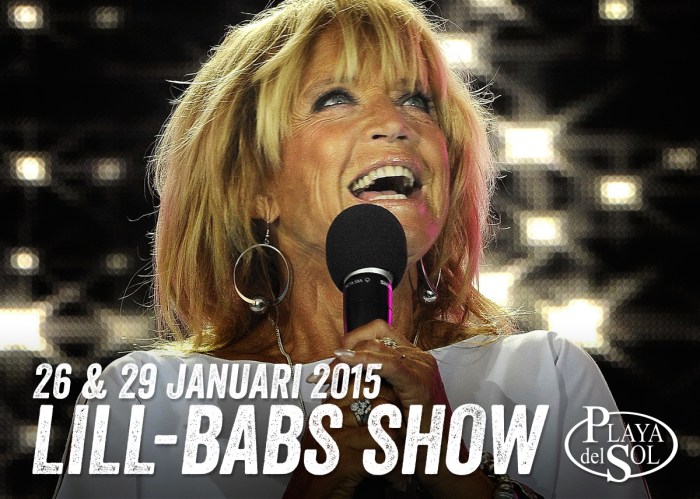
I had the pleasure of seeing the ‘Lill-Babs Show’ in 2015, when she was 76 years old. She gave annual dinner shows at the Swedish venue called Playa del Sol on Gran Canaria. As I happened to be there on holiday, I went with some friends to watch her perform. I admit I was a little sceptical going in, but I was blown away. There on the stage stood a woman, slightly ravaged by the years, but with a warmth and a humour that is rarely seen. Her energy and professionalism swept us all away and the crowd went wild – well as wild as they could given the average age was about 70. She sang her classics from the previous 6 decades and told cheeky, saucy jokes to the audience. I felt that I wasn’t just seeing a concert but I was having a thoroughly Swedish experience, somehow immersing myself into Swedish popular history and culture. There, on the stage, was not only a singer but a living legend.

April 3, 2018 Lill-Babs died after a short period of illness. She takes with her a piece of Swedish history, an echo of a Sweden long gone. Her legacy is the openness with which she invited the Swedish people into her life – warts and all. I am sure she will not be easily forgotten and that her voice will be echoing loudly through many a Swedish home this evening.

Why Swedes celebrate on the ‘afton’ (eve)

In the UK, we celebrate ‘Days’ such as Christmas Day & Easter Day. But in Sweden, it is always the Eve ( ‘afton’) that is the big celebration time. There’s påskafton, Valborgsmässoafton, Midsommarafton, pingstafton, nyårsafton, trettondagsafton. Why is this? Surely it can’t just be to get an extra day’s holiday?

Well, actually it originates from a time before the mechanical clock. In that period, a new day began at sunset rather than at midnight as it does now. In the Medieval times there was an expression – ‘vid kväll ska dag leva’ – which means something like ‘in the evening, shall the day live.’ Skandinavians held onto this tradition even after clocks were invented, and this is why they celebrated their important days the evening before. Now the evenings have, for practicalities sake, become day time activities. That’s why Swedes celebrate on the ‘Afton’. Oh yeah, and for the extra day’s holiday.

Sweden’s Easter tree – wiping, witching or whipping?

In Sweden, they don’t only have Christmas trees, they also have Easter trees.

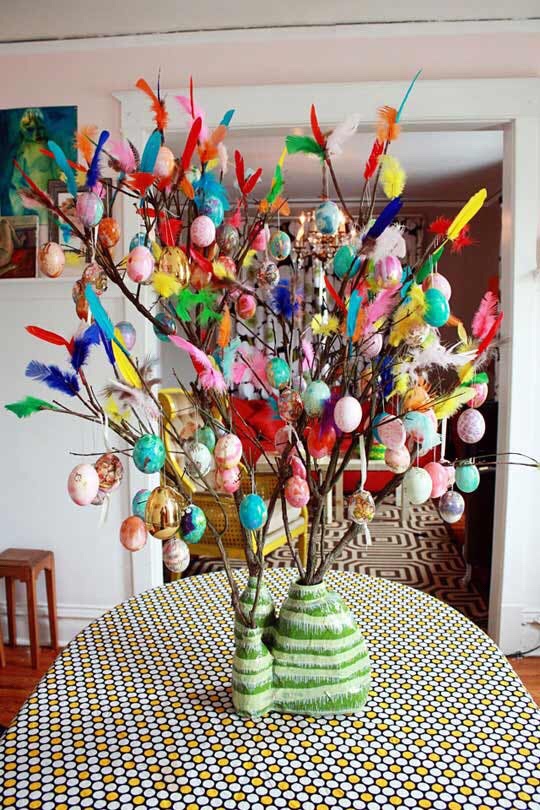
This Easter tree, known as ‘påskris’, is a handful of twigs and sticks (usually birch) installed in a vase with coloured feathers attached to the ends. People often hang painted eggs and other decorations such as chickens in their installation. The Easter tree can be seen all over the country at this time of year: outside shop entrances, in peoples’ living rooms, in gardens, in the middle of roundabouts.

The Easter tree is an interesting cultural phenomena – but where does it originate?

Wiping: Well, some Swedes say that it symbolises the wiping away of the winter. The twigs represent a broom and the feathers get caught in the broom as we sweep.

Witching: Others say that it represents witchcraft. The twigs represent a witch’s broomstick and the feathers indicate flight. This could also be why Swedish kids dress up as witches at Easter and do a kind of ‘trick or treating’ for Easter eggs.

Whipping: But, apparently the Easter tree has a completely different origin and symbolism. Swedish people, in the 1600’s, used to take twigs and sticks and beat each other with them on Good Friday to commemorate the suffering of Jesus. In the 1800’s and 1900’s, they started to be decorated and became a symbolic decoration for Easter.

So, wiping, witching or whipping. Who would have thought the colourful Easter tree would have such a colourful history?