Advent Calendar – Dec 14: Lussekatt

Window 14. Today’s word is ‘Lussekatt‘ which is a traditional saffron bun.
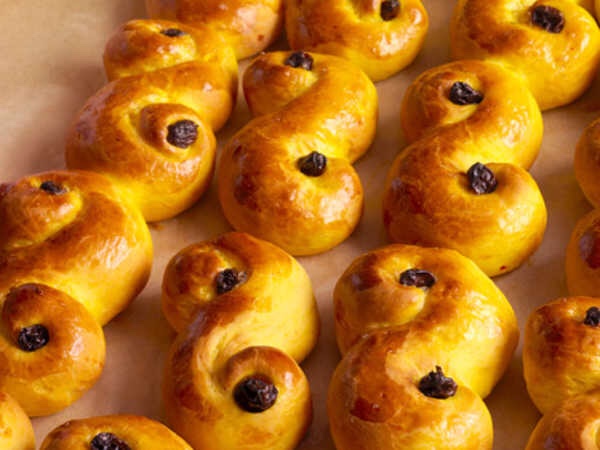
Generally, I love Swedish pastries but the lussekatt is not one of my favourites I’m sorry to say. I’m not a big fan of saffron. However, the sight and smell of the lussekatt screams Advent and Christmas in Sweden. The lussekatt, is a rich, spiced yeast-leavened sweet bun that is flavoured with saffron and usually contains raisins. In fact, saffron is a very popular ingredient at Christmas time with a whole cornucopia of baked goods being spiced with the expensive substance.

The lussekatt buns are baked into many shapes, of which the most common is a reversed S-shape. They are traditionally eaten during Advent, and especially on Saint Lucy’s Day, December 13. This could be the reason why it is called ‘lusse’ – a derivative of Lucy. However, there is a more sinister explanation.

In one theory, the lussekatt has its origins in Germany in the 1600’s. According to legend at that time, the devil used to appear as a cat, to torment children. To counteract this, people baked buns and colored them bright yellow to mimic the sun and scare away the devil. In West Sweden, the saffron buns were referred to as Devil’s buns (‘döbelskatt’) and the theory is that the name Lussekatt, comes from the word Lucifer. And the shape? Could it reflect a cat’s tail, or even the devil’s tongue?

Whatever the origin, the lussekatt remains a clear favourite in Sweden to eat at Christmas with pepparkaka and washed down with glögg.

If you’d like to bake your own lussekatt, you can find a recipe here
Advent Calendar – Dec 13: Lucia

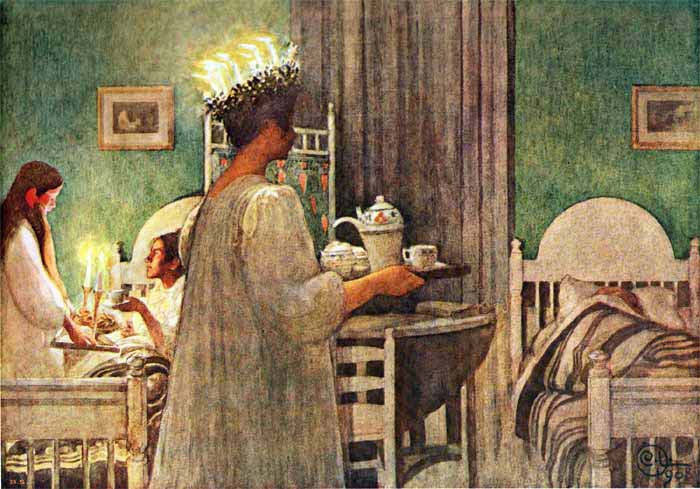
Window 13: Today’s word is ‘Lucia‘ – a light-bringing saint who is commemorated today.

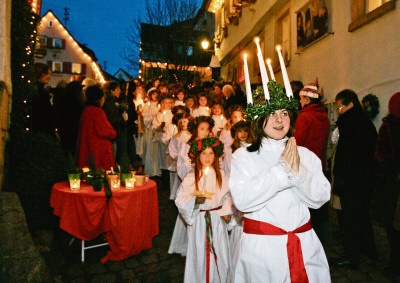
At the darkest time of the year, Santa Lucia (St Lucy) pays us a visit early in the morning. Lucia has candles in her hair and is surrounded by her handmaidens and boys, and shines light into the dark depths of our spirits. And slowly, slowly, the day awakens.

Santa Lucia is believed to have been a Sicilian saint who suffered a martyr’s death in Syracuse, Sicily around AD 310. She was seeking help for her mother’s long-term illness at the shrine of Saint Agnes, in her native Sicily, when an angel appeared to her in a dream beside the shrine. As a result of this, Lucia became a devout Christian and refused to compromise her virginity in marriage.

Officials threatened to drag her off to a brothel if she did not renounce her Christian beliefs, but were unable to move her, even with a thousand men and fifty oxen pulling. So they stacked materials for a fire around her instead and set light to it, but she would not stop speaking.

One of the soldiers stuck a spear through her throat to stop her, but to no effect. Soon afterwards, the Roman consulate in charge was hauled off to Rome on charges of theft from the state and beheaded. Lucia was able to die only when she was given the Christian sacrement.

The tradition of Santa Lucia is said to have been brought to Sweden via Italian merchants and the idea of lighting up the dark appealed so much that the tradition remained. The current tradition of having a white-dressed woman with candles in her hair appearing on the morning of the Lucia day started in the area around Lake Vänern in the late 18th century and spread slowly to other parts of the country during the 19th century.

The modern tradition of having public processions in the Swedish cities started in 1927 when a newspaper in Stockholm elected an official Lucia for Stockholm that year. The initiative was then followed around the country through the local press. Today most cities in Sweden appoint a Lucia every year. Schools elect a Lucia and her maids among the students. The regional Lucias will visit shopping malls, old people’s homes and churches, singing and handing out gingerbread.

So, it might be cold and dark outside, but remember – after darkness comes the light.

Advent Calendar – Dec 11: Nubbe

Window 11. Today’s word is ‘Nubbe‘ which is the colloquial word for an alcoholic shot known as snaps.

Nubbe, or snaps, is a really popular drink that Swedes enjoy at Christmas time. At its base, it is a strong spirit (30-38% alcohol content) called ‘brännvin’ which is distilled from potatoes or grain.

It can be plain and colourless, or flavoured with herbs and spices. Sometimes it can be sweet and infused with, for example blackcurrant, elderflower or raspberry. Others can be so bitter they make your toes curl – flavoured with for example aniseed, wort or wormwood. If it includes caraway or dill, it can according to EU patent protection be called akvavit.

A mouthful-size of ‘brännvin’ is called a snaps or a nubbe and it is drunk out of small glasses. Usually it is consumed when eating traditional food, and may also be accompanied by a ‘snapsvisa’ – a drinking song.

One popular drinking song at Christmas is called ‘Hej Tomtegubbar‘ which translates roughly as:

‘Hello goblins, fill your glasses and let’s be jolly together.

Hello goblins, fill your glasses and let’s be jolly together.

Our time is brief upon the earth, with many troubles and little mirth

Hello goblins, fill your glasses and let’s be jolly together.

After a few snapses, the party atmosphere usually begins – with more singing and speeches. For Swedes, snaps is such an important tradition that it is drunk not only at Christmas but at most festive times – such as Easter, Midsummer and autumn’s crayfish party.

According to The Swedish alcohol monopoly, Swedes have been flavouring their ‘brännvin’ since the 1500’s and the word ‘Nubbe’ as a slang word for snaps turned up first in 1892.

Advent Calendar – Dec 10: Nobeldagen

Window number 10. Today’s word is ‘Nobeldagen‘ which translates as ‘Nobel Day’.

Nobel Day is not actually anything to do with Christmas. However, it is a traditional part of the lead up to Christmas. Every year on 10 December, since 1901, the Nobel Prizes are awarded. The date commemorates the death of Alfred Nobel in 1896.

Nobel prizes are awarded in the 6 categories of Literature, Chemistry, Physics, Medicine or Physiology, Economics and Peace. All prizes are awarded in Stockholm, except the peace prize which is awarded in Oslo. Laureates receive a gold medal, a diploma and 10 million Swedish crowns.

Most laureates are happy to accept their prize and the accolade. However, Jean Paul Satre famously declined the Literature Prize in 1964, claiming he did not want to be institutionalized.

In 1974 he was joined by Le Duc Tbo who refused to accept the Peace Prize for his work to end the Vietnam War, saying ‘peace has not yet been established.’

In 1935, German journalist Carl von Ossietzky – a vocal critic of Hitler- won the Peace Prize. This led Hitler to bar all Germans from accepting a Nobel Prize. Three German laureates were subsequently forced to decline their awards. However, they later were presented with their diplomas and medals.

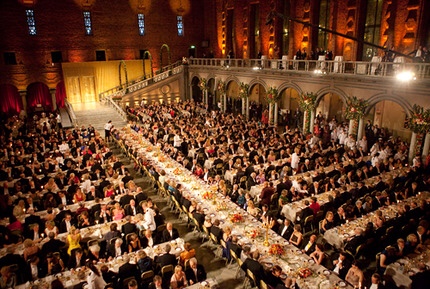
With celebratory lectures, conversations, ceremonies and concerts, Nobel Day culminates with a banquet in the Stockholm City Hall. The banquet lasts about 3 and a half hours and is televised. It is an extremely grand and formal occasion. Everything from the porcelain to the floral arrangements to the dresses, the entertainment and the menu are under scrutiny for the tv viewers.

The guests include not only the Nobel laureates and their families, but also Swedish royals and aristocrats, politicians, ministers, celebrities and other notable people. Even though there are 1300 guests, is virtually impossible for ordinary folk to get an invitation to the banquet. We have to enjoy it from afar, via the screens in our living rooms.

However exclusive the whole thing might be, it is still a welcome splash of glamour in the dark approach to Christmas. Stockholmers are also treated to the light festival called Nobel Lights, which takes place around the city.

Advent Calendar – Dec 9: Julbelysning

Every day, I will open a window containing a Swedish word that has something to do with Christmas and the festive season.

Today’s word is ‘Julbelysning‘ which translates as ‘Christmas lights’.

Like others around the world, Sweden’s cities and towns install public Christmas lights this time of the year. These decorations illuminate the dark December days and are an important part of building up the Christmas cheer at an otherwise miserable time of the year.

Currently Stockholm is populated with twinkling elk, reindeer, pine cones, angels, stars and fir trees. The same applies to Gothenburg, where there is also a giant red love heart on Lejontrappan. In Malmö, 500,000 lights have been switched on in a celebration called Winter in the City.

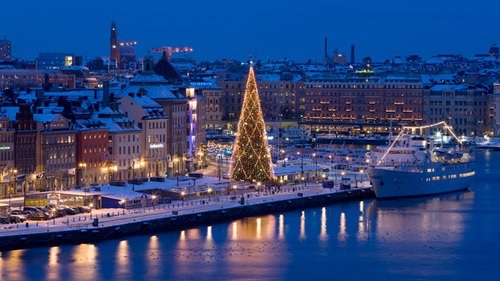
Since 1996, on Skeppsbron in Stockholm, the city’s largest Christmas tree has been positioned. An enormous, impressive tree that towers over the buildings of the Old Town and spreads its light over the harbour. The tree in actual fact isn’t a real tree – it is constructed over a central pole with branches attached to it. In doing so, the tree is pleasingly symmetrical.

If you’d like to walk around and see the lights in Stockholm, the city has produced a map which you can find on http://www.stockholmsjul.se

This week is also Nobel week in Stockholm and a light festival called Nobel Lights is taking place. Monuments and buildings around the city are decorated and transformed with projected light shows. The display on the City Hall is particularly spectacular. More information on http://www.nobelweeklights.se

Advent Calender Dec 6: Julmarknad

Window 6: Today’s word is ‘Julmarknad‘ which translates as ‘Christmas Market’

A popular recurring event during the weeks leading up to Christmas in Sweden is the Julmarknad – the Christmas Market.

Christmas markets are a very cosy affair. Here you can walk around and enjoy the smell of glögg and roasted chestnuts. You can listen to the sound of Christmas carols echoing through the air. You can bathe in the lights and decorations strewn around the marketplace. And you can see traditional handicrafts and locally produced goods on sale, such as scarves, hats, festive food and decorations. If you’re lucky, snow is tumbling down and crunching under foot. The whole thing feels like being momentarily caught in a giant snow globe.

Christmas markets have been around in Sweden since the 1800’s and take place up and down the country on town squares, in gardens, in museums, farms, barns, greenhouses, castles, garden centers and stately homes.

In Stockholm, the most popular markets are in Skansen and on the main square in the Old Town. The Royal Palace of Drottningholm and Taxinge Castle outside Stockholm are also popular, as is the small picture-postcard town of Sigtuna about an hour north of the capital.

In Gothenburg, the market at Liseberg is a popular experience and in Malmö head to the market on Gustav Adolf Square.

For information in Swedish about Christmas markets, check http://www.julmarknad.nu

Advent Calendar Dec 4: Julkalendern

Every day, I will open a window containing a Swedish word that has something to do with Christmas and the festive season.

Today’s word is ‘Julkalendern‘ which translates as ‘Christmas Calendar’

Julkalendern is a television series broadcast on Swedish TV every day in December leading up to Christmas Eve. It is a popular and heavily-anticipated program that children and adults traditionally watch at 7.15 in the morning (or on line). Typically each episode is 15 minutes long, and every year there is a new story.

The first Julkalendern was broadcast in 1960 and was called ‘Titteliture’. In 2016, a competition was held to vote for the all-time favourite Julkalendern. It was won by a series called ‘Sune’s Christmas’ (1991) followed by ‘The Mystery at Greveholm’ (1996), ‘Time of the Trolls’ (1979) and ‘The old woman who shrunk to the size of a teaspoon’ (1967).

This year, the series is a continuation of 1979’s ‘Time of the Trolls’ – ‘ Legend of the Mountain Troll. ‘

Advent Calendar Dec 3: Gävlebocken

Every day, I will open a window containing a Swedish word that has something to do with the festive season.

Today’s word is ‘Gävlebocken‘ which translates as ‘The Gävle Goat’.

This strange tradition takes place in the Swedish town of Gävle. Every year, since 1966, a giant handcrafted straw goat is built up. And almost every year, it gets burned to the ground by a pyromaniac.

One year, it was even burned down before its inauguration. Consequently, the local authority have increased security and have managed to prevent the burning for the last three years.

The symbol of the goat is a traditional Christmas decoration in Sweden, called a ‘julbock’ – a Christmas goat. Usually made of straw, a goat is placed under the Christmas tree or small goats are hung from the branches. The symbol of the goat has ancestry in Scandinavia far back in Nordic mythology and, up to the 1800’s, it was the goat who brought presents during the festive season. A kind of precursor to Santa Claus.

So although the Christmas goat has endured for centuries, it remains to be seen if the Gävle goat survives until the New Year.

You can see a live feed of the goat on https://www.visitgavle.se/sv/gavlebocken

Its inauguration ceremony takes place today.

Swedish soccer success!

The FIFA Women’s World Cup in Football (soccer) is currently taking place in Australia and New Zealand, and Sweden is doing really well. Next week, the Swedish team plays in the semifinal, and will hopefully qualify for the final, where a gold medal looks possible. Understandably, football fever is taking over in Sweden and Swedes are very proud of what the team has achieved.

Sweden is a strong football nation. Together with ice hockey, football is probably the favourite spectator sport in the country. The biggest arena in Sweden – Friends Arena – in Solna, Stockholm, can hold over 52,000 spectators at a match.

The sport was brought to Sweden from England in the 1800’s and the first match between two Swedish teams took place in Gothenburg in 1892 between Örgryte and Lyckans Soldater. The Swedish Football Association was founded in 1904.

In Sweden, there are roughly 240,000 licensed players (approximately 56,000 women and 184,000 men) with another 240,000 youth players. There are around 3,200 active clubs fielding over 8,500 teams, which are playing on the 7,900 pitches available in the country.

The world’s largest and most international youth football tournament – the Gothia Cup – takes place in Gothenburg, Sweden. Each year, around 1700 teams from 80 nations take part and they play 4500 games on 110 pitches. One year, my nephew actually came over from London with his team and participated.

Sweden has its own domestic league and has achieved some international success of the years, despite being a relatively small country. These include, for the men’s team, one World Cup silver and two bronzes, as well as an Olympic gold medal in 1948.

The women’s team have also succeeded in taking, amongst others, World Cup silver in 2003, European gold in 1984, and Olympic silver in 2016 and 2020. They are eagerly trying to top this with a gold in 2023!

So, fingers crossed that Sweden can make it the whole way next week! ‘Heja Sverige!’

Why does Sweden still need Pride?

This week is Stockholm Pride. It culminates on Saturday with a huge parade. The event celebrates 25 years this year, and some people question if it is still needed or relevant.

The answer, unfortunately, is more than ever.

But we’ll come to that later.

Currently there are 73 Pride festivals in Sweden during the year. From Arctic Pride way up in the north to Malmö Pride in the south, it is possible to celebrate throughout the year.

This indicates that many Swedes seem to have embraced the concept of Pride with open arms. There is, of course, a commercial benefit but the main reason seems to be that LGBT+ Pride resonates well with the societal Swedish values of equality, tolerance and acceptance.

However, like everything, it has its opponents.

Sweden’s current conservative government is in power, solely with the support of a right-wing populistic party. This party has consistently attacked LGBT people and the Pride movement. For example, this week, one of their politicians tweeted that Pride legitimizes pedophilia.

It is comments like this that plant the seeds of aggressive counter demonstrations, homophobic, anti-Pride propaganda and personal physical attacks. LGBT+ people are still regularly abused, discriminated against and attacked in Sweden. And if we lift our eyes to the broader world, we see examples of LGBT + rights being restricted or removed, and same sex relations being criminalized and punishable with the death penalty.

This is why Pride is still needed, not only as a celebration, but as a political manifestation of human rights.

If you’d like to know where a Pride is near you, go to http://www.svenskapride.se which collects all the Swedish events in one place.