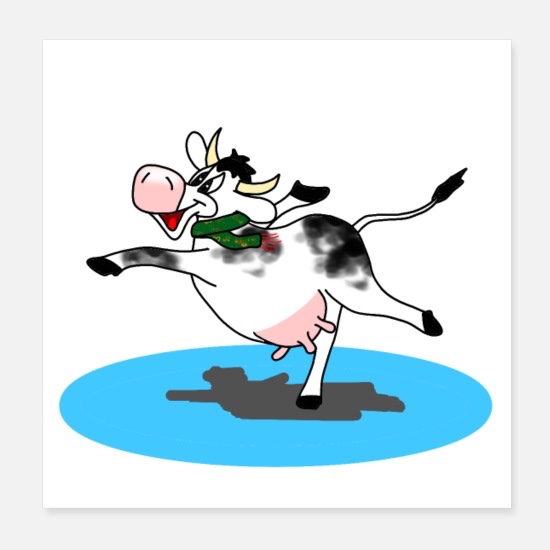
Swedish expression: ’There is no cow on the ice’.

With all the frozen lakes at the moment, I am reminded of the Swedish expression ‘Det är ingen ko på isen’ or ’there’s no cow on the ice’. This expression is used to mean there is ‘ no need for worry’ or ‘don’t be concerned’. So, where does the expression originate?

Well, like many Swedish expressions, this one also has a rural origin.

In the old days, farmers that had no running water would take their cows down to the lake to drink. As long as the cows stayed on land, and didn’t venture onto the frozen waters, there was no risk of them falling through the ice and drowning.

In fact, the expression is an abbreviation of the longer saying ‘there’s no cow on the ice as long as their rear end is on land’. (Det är ingen ko på isen så länge stjärten är i land.) As long as they had a firm footing, they could rescue themselves if the ice broke around the periphery of the lake.

So it would seem that the original meaning of the saying might have been ‘there is no need for worry as long as you take precautions.’

Swedish expression: ’There is no cow on the ice’.

With all the frozen lakes at the moment, I am reminded of the Swedish expression ‘Det är ingen ko på isen’ or ’there’s no cow on the ice’. This expression is used to mean there is ‘ no need for worry’ or ‘don’t be concerned’. So, where does the expression originate?

Well, like many Swedish expressions, this one also has a rural origin.

In the old days, farmers that had no running water would take their cows down to the lake to drink. As long as the cows stayed on land, and didn’t venture onto the frozen waters, there was no risk of them falling through the ice and drowning.

In fact, the expression is an abbreviation of the longer saying ‘there’s no cow on the ice as long as their rear end is on land’. (Det är ingen ko på isen så länge stjärten är i land.) As long as they had a firm footing, they could rescue themselves if the ice broke around the periphery of the lake.

So it would seem that the original meaning of the saying might have been ‘there is no need for worry as long as you take precautions.’

Swedish expression: ‘to suspect owls in the moss’

In English, when we suspect something isn’t quite right we ‘smell a rat’ or say something is ‘fishy’. In Swedish, they suspect ‘owls in the moss’.

The expression – ‘att ana ugglor i mossen’ – has a Danish origin. The original saying dates to the 1600’s and was ‘det är ulve i mosen’ which translates as ‘there’s a wolf in the moss’. The expression makes sense and was used when a dangerous situation was suspected.

So, how did a wolf turn into an owl? There are two theories. One theory is that it happened as a mistake. The sound of the Danish word for wolf ‘ulve’ was misheard as ‘uggla’ the word for owl – and the creature hiding in the moss became a wise bird rather than a viscous predator.

Another theory is that the saying was consciously changed when wolves disappeared from Denmark. The wolf was replaced by an owl because it hoots a warning at the presence of danger.

Thirteenth Day in Sweden

Today, 6 January, is a national holiday in Sweden and in many places around the world. In Sweden, not a lot happens on this day – it is just another day off. If it lands on a weekend, as it does this year, the bank holiday is forfeited, unlike in many other countries where the following Monday is taken off in lieu.

So what does the 6 January celebrate?

In orthodox churches, the 6 January is celebrated as the day of Jesus’ birth.

In western Christianity, the 6 January notes the arrival of the three wise men (the magi) to Bethlehem to visit the baby Jesus in his cradle. These wise men are said to represent the three continents of Europe, Africa and Asia.

In Eastern Christianity, today celebrates the baptism of Jesus in the Jordan river and his manifestation to the world as the son of God.

January 6 also commemorates the legend of the Wedding at Cana, where Jesus exercised his divinity by turning water into wine.

Epiphany

In English, today is called Epiphany – which comes from the Greek word ἐπιφάνεια, epipháneia, meaning ‘manifestation’ or ‘appearance’. It is derived from the verb φαίνειν, phainein, meaning “to appear”. It signifies the day when Jesus first appeared to the Gentiles, in his cradle.

In the practical language of Swedish, there is no reference to manifesting or appearing. Today is given the practical name of Trettondag Jul (Thirteenth Day Yule) – literally thirteen days after Christmas Eve.

Swedish New Year’s pizza – with cabbage! 


Today, January 1st, is the most popular day to eat take-away pizza in Sweden. Partly it’s easy to order but also its greasiness acts as a great remedy for sore heads and tired bodies.

The Vesuvio and the Capricciosa are very popular pizzas in Sweden. However, the number 1 ‘national pizza’ is the Kebab pizza – a greasy pizza with kebab meat (and sometimes fries) dumped on the top.

When you order a pizza in Sweden, you will also experience a very strange bedfellow.

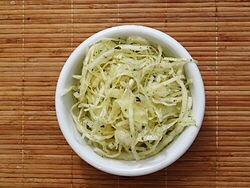
In Sweden, pizza is served with complimentary salad, in both restaurants and take aways. This salad is called creatively –  ‘pizza salad’ and is made of cabbage. It is a kind of coleslaw with white wine vinegar, salt, pepper and oil. It’s fresh, crispy and a bit weird. 

This odd combination is, as far as I know, only offered in the Nordic countries and its origin is a bit unclear.

One theory is that when the first pizzerias opened in Sweden, the traditional tomato salad wasn’t an option due to the climate in the winter. So, subsequently the pizza baker decided to use a more available, local vegetable – the cabbage – inspired by the Croatian salad ‘kupus salata’. 

Whatever it’s origin, the pizza salad is so ingrained in the Swedish mentality, it’s become a cultural ‘classic’.  In fact, it’s hard to imagine a pizza without cabbage salad in Sweden. Especially on New Year’s Day!

Advent Calendar – Dec 24: Kalle Anka

Window 24. As I am following the Swedish system of advent calendars, today is the last window, not the 25th as in the UK. So here is the final word: Kalle Anka. This is the Swedish name for Donald Duck – a Disney character with a strong, and unexpected, connection to Swedish Christmas.

Traditional Christmas celebrations on Christmas Eve in Sweden get off to a slow start usually. It all begins with a Christmas breakfast, consisting of rice porridge, wort bread, ham and Christmas cheese, amongst other things. After breakfast, some people go for a walk, some go to church, others begin the preparation for the Christmas julbord (buffet).

When to eat julbord differs from family to family. For some, it’s at lunch time, for others it more towards late afternoon. One surprising time marker is Kalle Anka (Donald Duck).

Every Christmas Eve since 1960, the Disney show ‘From All of Us to All of You’ featuring Donald Duck and his friends has been broadcasted on Swedish television at 3pm (now 3.05pm). Every single year. A very weird tradition for someone like me who grew up listening to the Queen’s speech on Christmas Day at 3pm. In the UK we have the monarch. In Sweden, Donald Duck.

So the discussion in Swedish homes is ‘should we eat before or after Kalle?’.
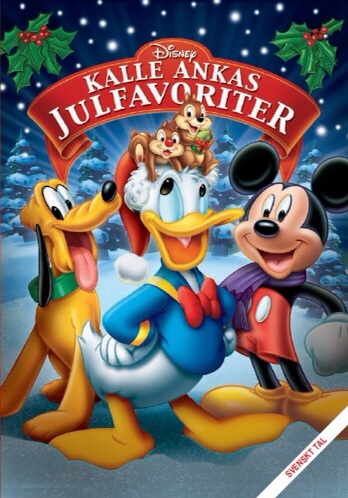
Today, Kalle Anka is watched as a sentimental tradition, or as background noise on Christmas Eve. But in the 1960’s when it began, it was the only time of the year that cartoons were shown on tv, so it was a Christmas treat. Since it’s been broadcast for almost 60 years, it is an integral part of what many Swedes associate with Christmas.

After Kalle Anka och julbord, it’s time for a visit from Tomten with gift-giving. This is followed usually by more food and drink. Some people conclude the day with a Midnight service at their local church.

Christmas is, like many places around the world, a time of overconsumption. Enormous amounts of food are left over and eaten during the following days.

In Sweden, Christmas Day and Boxing Day are both Public holidays – and the official end of Christmas is January 13th. Then it is time to traditionally throw out the Christmas tree. The lights in the windows have usually disappeared by February.

And as the daylight slowly returns to Sweden, people start planning for the lighter and warmer time of the year. And Christmas fades into memory…until next December.
Advent Calendar – Dec 23: Dan före dopparedan

Window 23. Today’s words are ‘Dan före dopparedan‘ – which translate somewhat curiously as ‘the day before dipping day’. Or, the day before Christmas.

I always thought that the name ‘dopparedan’ (dipping day) for Christmas Eve was somehow a reference to John the Baptist.

But I was wrong.

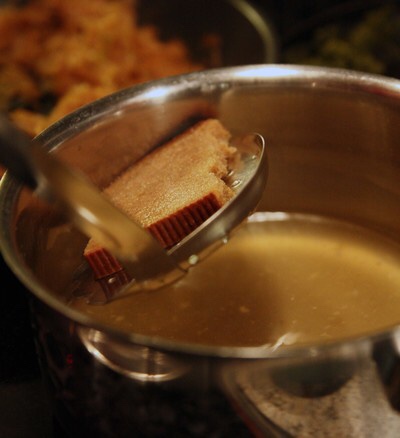
It actually comes from the Medieval Swedish tradition of dipping and drenching bread in the stock juices in which the Christmas ham has cooked, and eating it.

This traditional practice is called ‘dopp i grytan’ and originated in agricultural communities. People dipped their bread as a little snack while they made final preparations for the celebrations later in the evening. Some people still do this today.

Because Christmas Eve was called ‘dopparedagen’, the 23rd Dec became known as ‘dan före dopparedan’ – the day before the day of dipping bread.

Today’s ‘dan före dopparedan’ is more to do with making the final stressful arrangements for tomorrow. Final baking is done, last-minute Christmas presents are bought, a visit to Systembolaget (alcohol shop) is made. Long queues are to be expected.

And then, darkness and calmness descends over houses and homes all around the country. The evening before Christmas Eve is called ‘uppersittarkväll’ and Swedish families traditionally gather to wrap presents, play tv bingo, play games and write Christmas present rhymes.

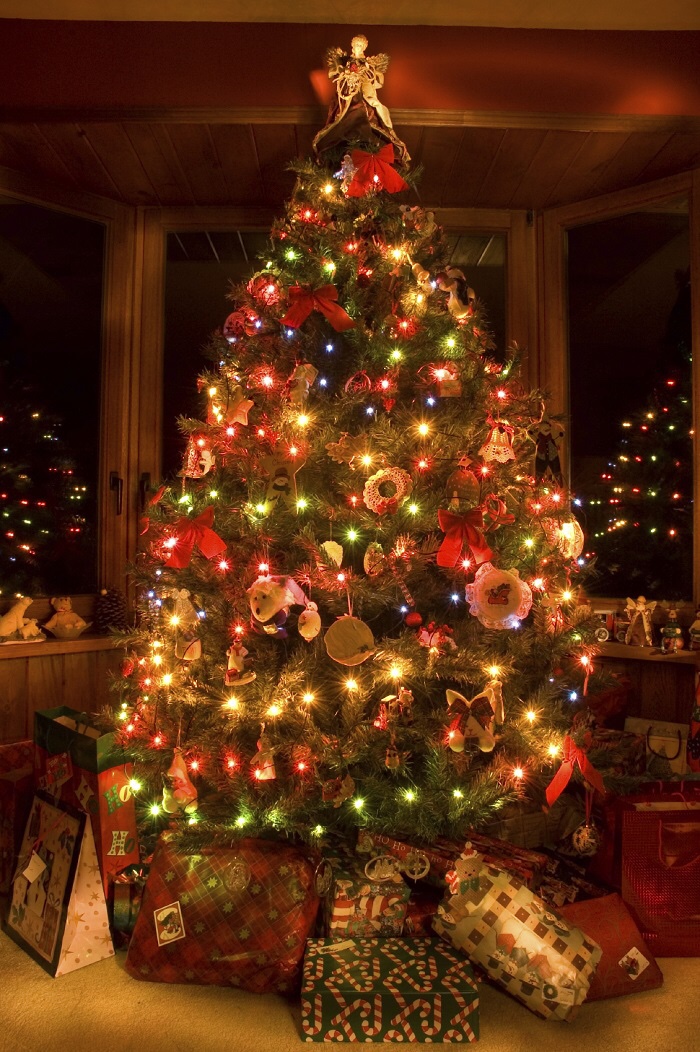
It is also the evening when traditionally people put up final decorations and dress the Christmas tree, although this happens earlier for many families.

Once everything is finalized, hopefully there is a moment of relaxation to be had with a glass of warm glögg and a pepparkaka.

And then, it’s time to head off to bed in anticipation for the big day tomorrow – dipping day!

Advent Calendar – Dec 22: Tomten

Window 22. Today’s word is ‘Tomten‘ – who is the Swedish equivalent of Santa Claus.

Around the world, Santa is based on the mythology of St Nikolas – the Greek/Turkish patron saint who’s legend morphed in the USA from the Dutch immigrants’ Sinterklaas to the jolly figure who rewards good children that we see today.

The Swedish symbol of Tomten is partially based on St Niklas and the American depiction of Santa Claus. However, he is also based on a goat and a mythical sprite.

Let’s travel back to rural Sweden hundreds of years ago. Here, in the countryside, Tomten was a kind of sprite (hob, gnome, pixie) who lived on the farm and made sure that the farm had good luck.

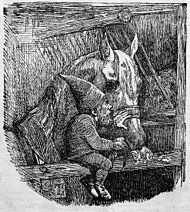
Tomten was described as a little man, dressed in sackcloth and with a beard. He usually lived in the barn and was shy, mischievous, and irritable – and also vengeful. To keep Tomten happy, the farmer would leave out rice porridge for him to eat – a food that became known as ‘tomtegröt’ and that is still eaten for Christmas breakfast in Sweden today.

With industrialization in the late 1800’s, Sweden started to become inspired by the German St Nicholas, and in modern minds he merged with the rural sprite to become ‘jultomte’ – the gift-bearing sprite.

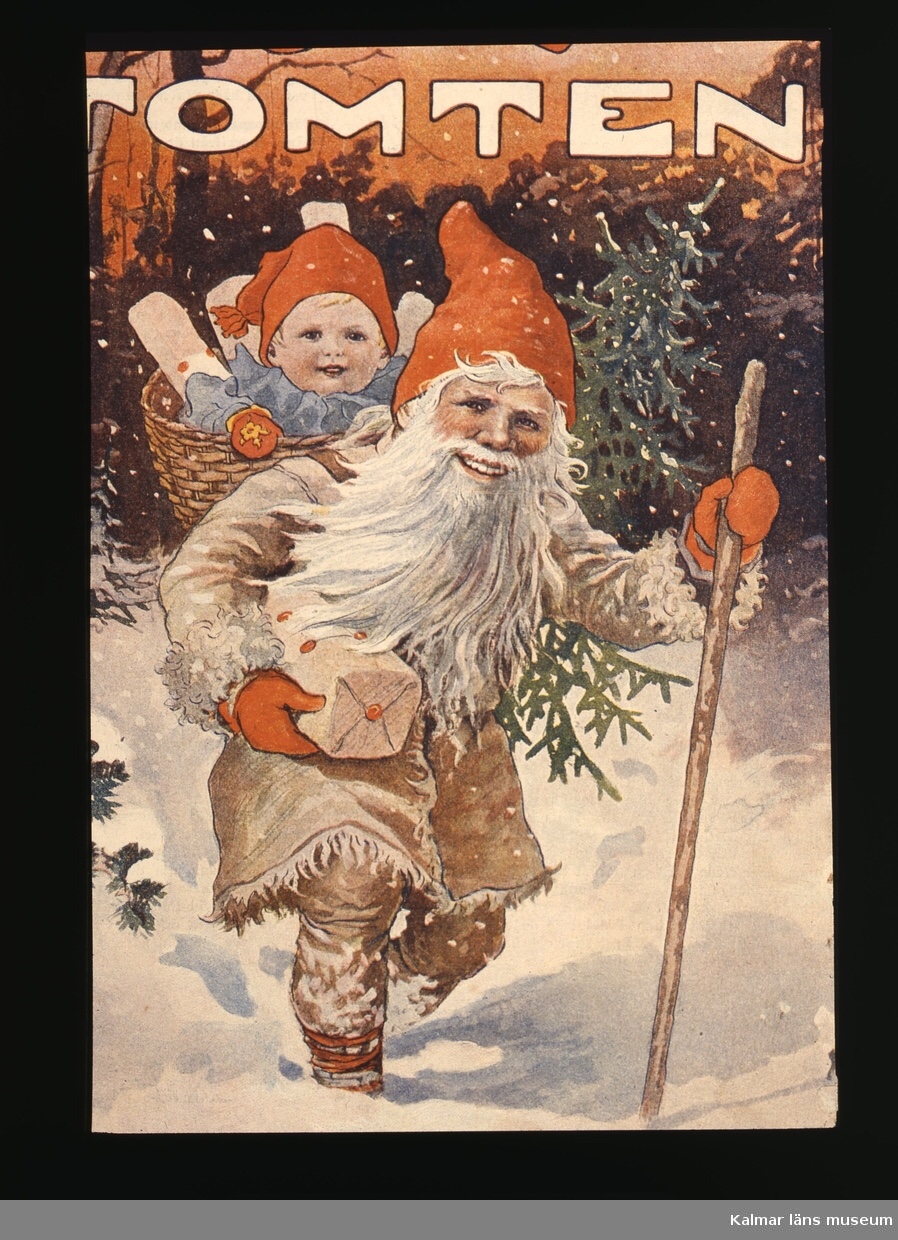
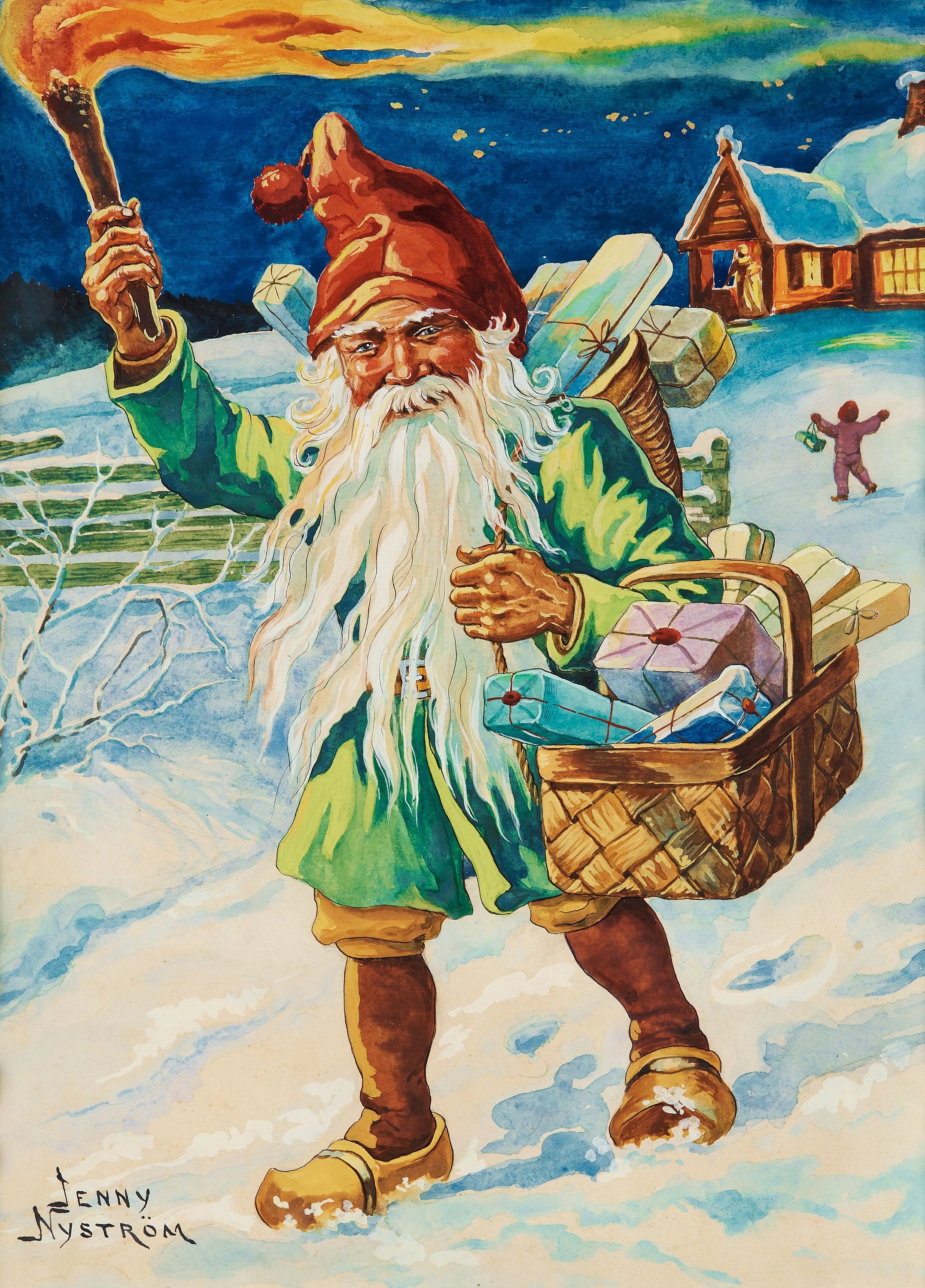
Popular Christmas cards by Swedish artist Jenny Nyström depicted this new version of Tomten in 1874 and strongly influenced the Swedish way of seeing jultomte. He was dressed in red hat, with a fluffy white beard. He is also seen to have many little helpers – known as ‘tomtenissar’ (a kind of elf).

And in 1881, a poem by Viktor Rydberg called ‘Tomten’ strongly cemented his transformation and associated the figure with mid-winter and Christmas time.

Prior to this concept of Jultomte/Tomten, gifts were brought in Sweden by the Christmas goat. Straw goats are still a part of Christmas decorations in Sweden and can be found hanging in Christmas trees or standing at the foot of the tree.

In Sweden today, Tomten arrives on Christmas Eve, usually in the late afternoon. He delivers gifts to families, usually with the introduction of ‘Ho, Ho, Ho are there any good children here?’

Strangely, he always seems to arrive just when a member of the family (often dad) has gone out to the shops or gone for a walk.

Advent Calendar – Dec 21: Julvärd

Window 21. Today’s word is ‘Julvärd‘ which translates as Christmas host.

The term Christmas host is not referring to the religious bread that represents the body of Christ. Although you’d be forgiven for thinking so at this time of the year.

No, the Christmas host is a personality on tv who guides the viewers through the proceedings on Christmas Eve.

For 27 years the ‘julvärd’ was the same person – a man called Arne Weise – and he is, for many Swedes, eternally associated with Christmas Eve.

But since 2003, a new host is announced every year and it is considered a great honour to be given the role. This year the ‘julvärd’ is popular comedian and actor David Batra.

While the role of ‘julvärd’ might seem trivial, it is actually very important. The Christmas host is present throughout the whole day and introduces the programs. He or she also talks about the value of Christmas and what it means. And not least, the ‘julvärd’ keeps lonely people company by inviting themselves into living rooms up and down the country.

The ‘Julvärd’ can be seen on SVT – Sweden’s Public Service Television – and is usually broadcast live.