Advent Calendar – Dec 15: Musikhjälpen

Window 15. Today’s word is ‘Musikhjälpen‘ which translates as Music Aid.

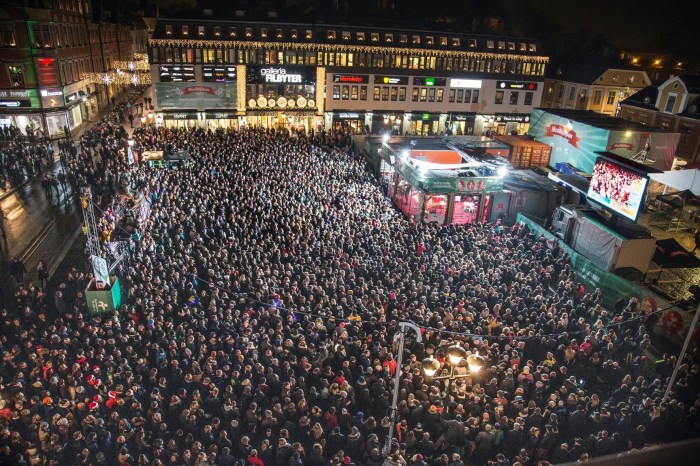
Since 2008, the radio/tv program ‘Musikhjälpen’ has become a traditional part of the lead up to Christmas.

In this program, 3 presenters are locked into a glass ‘cage’ on a town square somewhere in small town Sweden – this year from the town of Växjö in county Småland. They are sleep deprived and only allowed to eat liquids.

From the cage, they broadcast radio and tv round the clock until they are released a week later.

The program is a fund-raising event for Sweden’s international aid organization Radiohjälpen. People up and down the country request songs and make donations, or carry out fund-raising activities. Live music performed in the ‘cage’ has also become an important part of the event. At most, the event has raised a staggering 74,410,363 SEK in 2017 when the theme was fighting against child prostitution.

Every year the theme is different; this year the theme is ‘nobody should die from hunger’.

Throughout the years, many of Sweden’s music and media celebrities have taken on the challenge of incarceration, such as singers Sara Dawn Finer, Daniel Adams-Ray, Molly Sandén, Miriam Bryant and Linnea Henriksson, and rappers Petter and Timbuktu. This year, singer Oscar Zia is locked in together with radio profile Linnea Wikblad and comedian Sofia Dalén.

The program is based on an original format called Serious Request from Holland and is an amazing display of charity just a couple of weeks before Christmas.

Advent Calendar – Dec 13: Lucia

Window 13: Today’s word is ‘Lucia‘ – a light-bringing saint who is commemorated today.

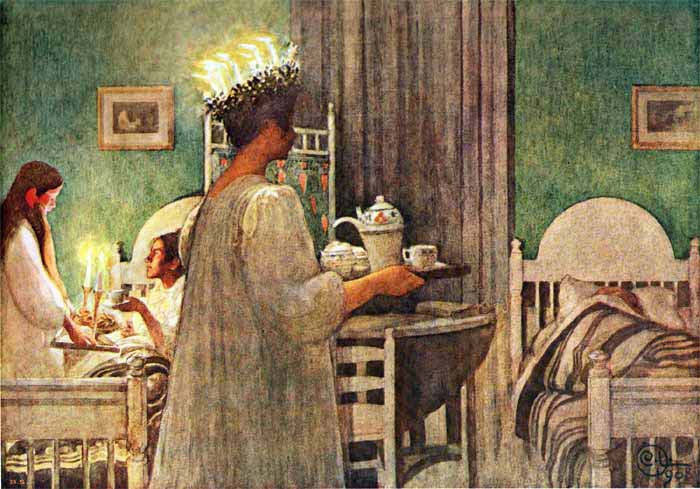
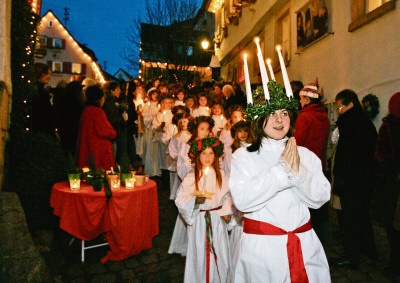
At the darkest time of the year, Santa Lucia (St Lucy) pays us a visit early in the morning. Lucia has candles in her hair and is surrounded by her handmaidens and boys, and shines light into the dark depths of our spirits. And slowly, slowly, the day awakens.

Santa Lucia is believed to have been a Sicilian saint who suffered a martyr’s death in Syracuse, Sicily around AD 310. She was seeking help for her mother’s long-term illness at the shrine of Saint Agnes, in her native Sicily, when an angel appeared to her in a dream beside the shrine. As a result of this, Lucia became a devout Christian and refused to compromise her virginity in marriage.

Officials threatened to drag her off to a brothel if she did not renounce her Christian beliefs, but were unable to move her, even with a thousand men and fifty oxen pulling. So they stacked materials for a fire around her instead and set light to it, but she would not stop speaking.

One of the soldiers stuck a spear through her throat to stop her, but to no effect. Soon afterwards, the Roman consulate in charge was hauled off to Rome on charges of theft from the state and beheaded. Lucia was able to die only when she was given the Christian sacrement.

The tradition of Santa Lucia is said to have been brought to Sweden via Italian merchants and the idea of lighting up the dark appealed so much that the tradition remained. The current tradition of having a white-dressed woman with candles in her hair appearing on the morning of the Lucia day started in the area around Lake Vänern in the late 18th century and spread slowly to other parts of the country during the 19th century.

The modern tradition of having public processions in the Swedish cities started in 1927 when a newspaper in Stockholm elected an official Lucia for Stockholm that year. The initiative was then followed around the country through the local press. Today most cities in Sweden appoint a Lucia every year. Schools elect a Lucia and her maids among the students. The regional Lucias will visit shopping malls, old people’s homes and churches, singing and handing out gingerbread.

So, it might be cold and dark outside, but remember – after darkness comes the light.

Advent Calendar – Dec 11: Nubbe

Window 11. Today’s word is ‘Nubbe‘ which is the colloquial word for an alcoholic shot known as snaps.

Nubbe, or snaps, is a really popular drink that Swedes enjoy at Christmas time. At its base, it is a strong spirit (30-38% alcohol content) called ‘brännvin’ which is distilled from potatoes or grain.

It can be plain and colourless, or flavoured with herbs and spices. Sometimes it can be sweet and infused with, for example blackcurrant, elderflower or raspberry. Others can be so bitter they make your toes curl – flavoured with for example aniseed, wort or wormwood. If it includes caraway or dill, it can according to EU patent protection be called akvavit.

A mouthful-size of ‘brännvin’ is called a snaps or a nubbe and it is drunk out of small glasses. Usually it is consumed when eating traditional food, and may also be accompanied by a ‘snapsvisa’ – a drinking song.

One popular drinking song at Christmas is called ‘Hej Tomtegubbar‘ which translates roughly as:

‘Hello goblins, fill your glasses and let’s be jolly together.

Hello goblins, fill your glasses and let’s be jolly together.

Our time is brief upon the earth, with many troubles and little mirth

Hello goblins, fill your glasses and let’s be jolly together.

After a few snapses, the party atmosphere usually begins – with more singing and speeches. For Swedes, snaps is such an important tradition that it is drunk not only at Christmas but at most festive times – such as Easter, Midsummer and autumn’s crayfish party.

According to The Swedish alcohol monopoly, Swedes have been flavouring their ‘brännvin’ since the 1500’s and the word ‘Nubbe’ as a slang word for snaps turned up first in 1892.

Advent Calendar – Dec 8: Ernst

December 8th window: ‘Ernst‘ which translates as, well… Ernst.

What on earth is an Ernst you might wonder? Well, the question should rather be ‘who’ is Ernst.

Ernst Kirschsteiger is a person who, by many, is considered to be Mr Christmas in Sweden. He is a very popular interior designer. After a hiatus, the 65-year old is back this year with his TV program called Ernst’s Christmas.

In his program he simply explodes festive spirit. He decorates and bakes and creates. He wallpapers and chisels and hammers. He sews and paints and he crafts. I would describe his design ethic as a nature-oriented retro scandi chic. He has a poetic, philosophical attitude to interior design coupled with practical solutions.

One week he made, for example, Christmas decorations out of mandarin peel and wire and inspired us with a wreath of dried garden flowers, moss and brussel sprouts.

Some people find him very cheesy and goofy but he has definitely cornered the market on Christmas coziness. Many viewers see him as the idea of male perfection – a sensitive man who cooks, builds and decorates the home – all wrapped up in one sweet Christmas treat.

Since his tv debut in 2000, Ernst Kirschsteiger has grown to be a phenomena who only needs referring to by his first name, like Cher, Madonna and Prince. So popular is he that a book of his quotes and poetic wisdoms called ‘Ernstologi’ was released in 2006 and became a popular Christmas present that year.

If you want to witness the phenomena (in Swedish however), watch this YouTube clip and enjoy!

Advent Calendar Dec 5: Julmust

Every day, I will open a window containing a Swedish word that has something to do with Christmas and the festive season.

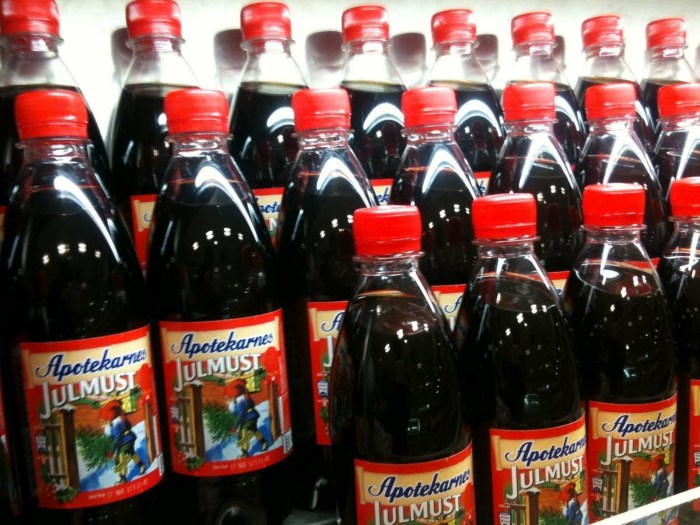
Today’s word is ‘Julmust‘ which is a fizzy Christmas beverage.

I would venture to say every Swede likes to drink at least one glass of julmust at Christmas. However, according to statistics it is even more!

Apparently, Swedes drink an average of 5 litres per person of the fizzy drink during December. The alcohol-free bottled soft drink comes in different sizes, fully sugared and also in diet form.

Said to include over 30 ingredients, its actual recipe is top secret, only known to three people. Despite all the cloak and dagger stuff, the connoisseur can detect the flavour of hops and malt. The taste is reminiscent of the old-fashioned ‘Dandelion and Burdock’ drink for those of you that understand that British reference.

Julmust was invented by a teetotaler and sales began in 1910 as an alternative to ale and port. Although intended to be alcohol-free, the drink can be mixed with gin, vodka, rum or Jägermeister to make Christmassy cocktails. When blended with porter or stout and other ingredients, it creates a classic Christmas drink called Mumma.

I have even drunk julmust mixed with red wine – a so called Kalimusto. I recommend trying the experience – although it actually is a fairly unpleasant one!

If you live outside of Sweden and want to try julmust, head to your nearest Ikea! Called Vintersaga, they sell the beverage in 500ml bottles.

And so it is Advent – Swedish style


Today, the first of Advent, the light shines strong in the darkness.

Since the 1930’s Swedes have decorated their homes with lights from the first of Advent. The tradition was inspired from Germany, where the Advent star had been a popular decoration since the 1880’s. The star symbolizes the star of Bethlehem that guided the three wise men to the stable, where the baby Jesus lay in a manger.

Today, the star has lost most of its religious symbolism. In Sweden, illuminated advent stars are hung in windows. On window ledges, electric advent candles are placed. Gardens and balconies are decorated with fairy lights. On tables, four candles are positioned and one is lit every Sunday up until Christmas. Small candles, often red, are dotted about the home. Some people change curtains and populate their homes with small gnomes and fragrant flowers.

Since November is often a grim month, the collective advent decoration is a welcome arrival as light is spread into the murky places. From the dark street, it is lovely to see windows lit up in every apartment.

This weekend is also the starting signal for the Swedish ‘glöggfest’. People go to each other’s homes and drink ‘glögg’ (mulled wine), eat gingerbread and saffron buns. It is a very cosy time of year.

Advent Calendar Dec 3: Gävlebocken

Every day, I will open a window containing a Swedish word that has something to do with the festive season.

Today’s word is ‘Gävlebocken‘ which translates as ‘The Gävle Goat’.

This strange tradition takes place in the Swedish town of Gävle. Every year, since 1966, a giant handcrafted straw goat is built up. And almost every year, it gets burned to the ground by a pyromaniac.

One year, it was even burned down before its inauguration. Consequently, the local authority have increased security and have managed to prevent the burning for the last three years.

The symbol of the goat is a traditional Christmas decoration in Sweden, called a ‘julbock’ – a Christmas goat. Usually made of straw, a goat is placed under the Christmas tree or small goats are hung from the branches. The symbol of the goat has ancestry in Scandinavia far back in Nordic mythology and, up to the 1800’s, it was the goat who brought presents during the festive season. A kind of precursor to Santa Claus.

So although the Christmas goat has endured for centuries, it remains to be seen if the Gävle goat survives until the New Year.

You can see a live feed of the goat on https://www.visitgavle.se/sv/gavlebocken

Its inauguration ceremony takes place today.

April, April! You stupid herring!

april-fools-day-2015

Playing April Fool’s jokes on each other on the first of April is a tradition in many countries – Sweden included. In fact it is an old tradition – the oldest written reference being in 1392 in Chaucer’s ‘The Cantebury Tales’.

In Sweden, when someone is tricked, the tradition is to say ‘April, April din dumma sill!‘. This translates as ‘April, April you stupid herring!’. This is however not as weird as it might sound. In many countries, such as Italy, France and Holland, April 1st is known as “April fish”. On this day, people try to attach paper fish onto the backs of their victims.

April Fool’s pranks are common in newspapers, with classics such as:

  • IKEA is getting into the airline business. Furnishing all the flights with Ikea furniture, the name of the airline is FLYKEA.
  • Swedish supermarket chain ICA introduced toothpaste with the taste of chocolate. It might be brown, but it makes your teeth white.
  • Burger King introduced a new burger for left-handed people where ingredients were rotated 180 degrees.

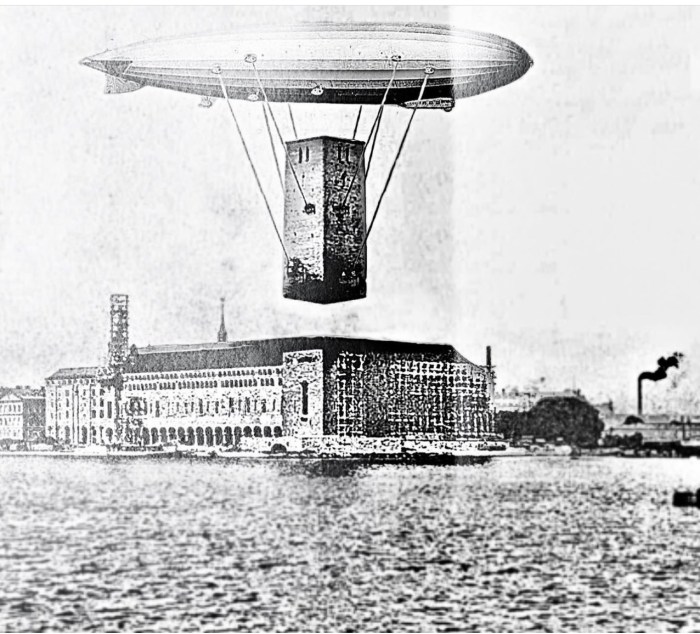
I had a look this morning to see if I could identify any April Fools tricks and I found one! The tower of Stockholm’s City Hall was apparently flown in from the far east under a blimp. This is a nod to the new Golden Bridge in Stockholm that was manufactured and shipped in one huge piece from China.

If you manage to find another one, please share here!


50 Swedish words for snow

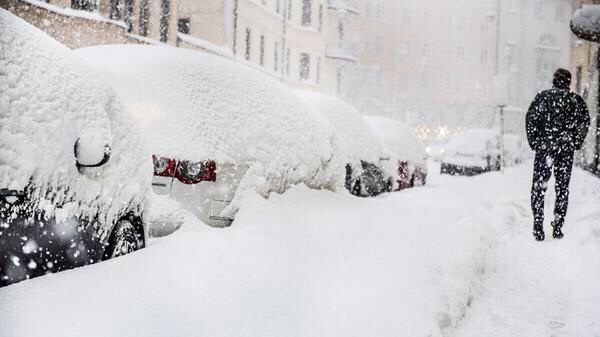
A massive amount of snow has landed on Stockholm overnight – and it is still tumbling down. So, I thought it’s worth sharing this list again.

Not surprisingly when living in a country where it snows a lot, people start to see differences and nuances in the type of snow, whereas in English the word might just be an unsatisfactory ‘snow’.

The Swedish language makes it easy to join words together to describe these nuances.

Here is a list of 50 Swedish words related to snow.

1) Blötsnö – wet, slushy snow
2) Drivsnö – snow that is blown into troublesome snow drifts
3) Aprilsnö – snow in April, according to superstition, signifies plenty of food for the coming season
4) Hårdsnö – compacted hard snow
5) Konstsnö – artificial snow
6) Kramsnö – squeezy snow, perfect for making snowballs
7) Julesnö – snow at Christmas
8) Klabbsnö – wet, warm snow for building snowmen
9) Kolsyresnö – frozen carbondioxide
10) Kornsnö – small white snow breadcrumbs
11) Lappvante – thick, falling snow
12) Lössnö – snow that can loosen and be dangerous
13) Majsnö – surprising and unwelcome snow in May
14) Modd – snow that has partly melted due to salt
15) Natursnö – real snow (as opposed to artificial)
16) Nysnö – fresh snow, crisp and white
17) Pudersnö – powder snow
18) Rekordsnö – an unusual amount of snow, breaking previous snow records
19) Slask – slushy snow mixed with rain and dirt on the ground
20) Snö – snow
21) Snöblandat regn – snow mixed with rain
22) Muohta – the Sami word for snow (it is said the Sami actually have 200 words for snow!)
23) Snörök – faint particles of snow that look like smoke
24) Yrsnö – snow being whipped around by the wind in all directions
25) Åsksnö – snow that pours down during a thunder storm

26) Snökanon – the word for the snow canon that creates artificial snow on ski slopes has also come to mean a sudden blast of snow that suddenly hits a place, and feels like snow has been dumped on you.

27) Jungfrusnö – virgin snow

28) Snösmocka – a huge amount of snow

29) Snötäcke – snow on the ground

30) Sjösnö – snow over the sea that can roll in over land

31) Snöfall – snow in the air

32) Flingsnö – snow with larger crystals

33) Skarsnö – a crispy surface on a blanket of snow

34) Packsnö – thickly packed snow

35) Pärlsnö – snow like small pearls that hurts when it hits your face

36) Snöglopp – wet snow mixed with rain

37) Spårsnö – snow that allows footprints to be formed

38) Fjöcksnö – a light, fluffy snow

39) Flister – snow the consistency of salt that stings the face when it falls

40) Flaksnö – a sheet of snow

41) Upplega – snow on the upper side of a tree branch

42) Firn – liquid-like snow that can initiate an avalanche

43) Fimmel – sandy snow that falls at low temperatures

44) Själja – a thin layer of ice on top of the snow that resembles glass

45) Knarrsnö – crispy snow that creaks when you walk on it

46) Snöfyk – wet snow

47) Torrsnö – dry snow

48) Månsilver – a poetic word to describe the dusting of snow

49) Snöis – snow on cold water that forms an icy solid surface

50) Stöp – a mixture of snow and ice resembling porridge that forms on top of cold water

So, let it snow! Let it snow! Let it snow!
Vasaloppet in Sweden – the world’s longest cross country ski race


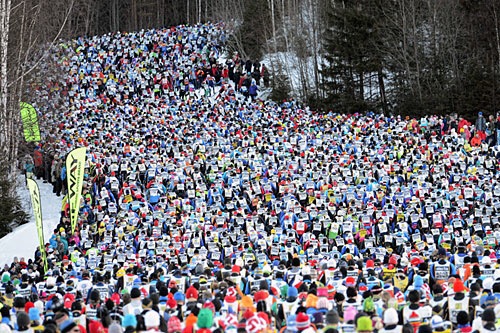
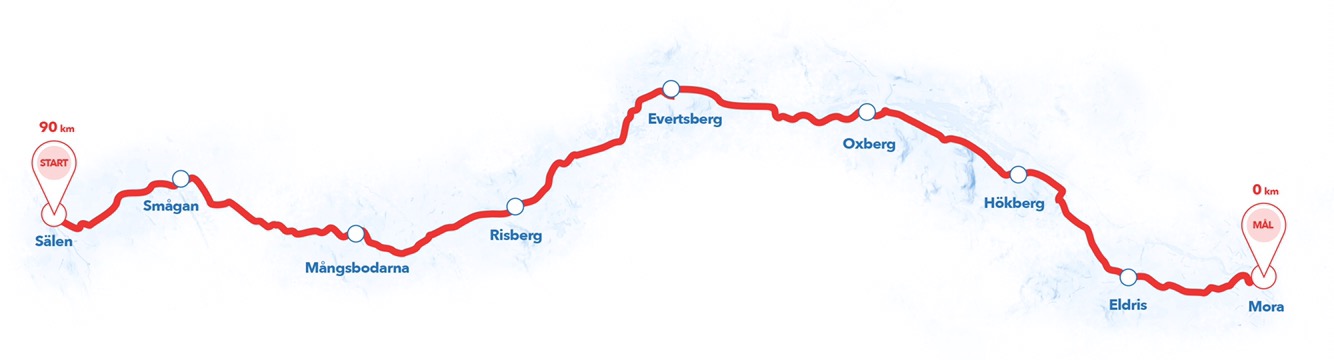
Today, the world’s longest cross country ski race takes place in Sweden. Called Vasaloppet, it entails the approximately 15,000 participants skiing 90 kilometers from start to finish. It’s an extremely popular international race which is broadcast live on tv. When tickets to participate are released, they usually sell out in 15 minutes – it’s that popular.

This year is the 99th occasion. The first Vasalopp was in 1922 and takes place annually, the first Sunday in March and it is a first sign of spring.  Normal participants can take up to 12 hours to complete the gruelling course, but the elite athletes do it in a comparatively speedy time of around 4 hours.

So why is this race called ‘Vasaloppet’? Well, it takes its name from a Swedish king. The race commemorates the escape to Norway, through the forest, of King Gustav Vasa in 1521. Legend has it that he carried out the long journey on skis, but experts believe he more likely completed this escape on snow shoes. Nevertheless, out of this legend sprung the race which is so popular today. ‘Vasa’ after the king, and ‘loppet’ meaning ‘the race’.

Modern day skiers don’t see the experience as an escape, they see it as a challenge and for many of them it’s a rite of passage.

And as you sit watching the TV comfortably from the sofa, with tea and toast, you take vicarious pleasure in this long, amazing Swedish race.

It is broadcast today from 7.30 on SVT ( Swedish TV). You can also check it out on the internet in the streaming service SVT Play.