Spectacular Swedish serenity on All Saints’ Day

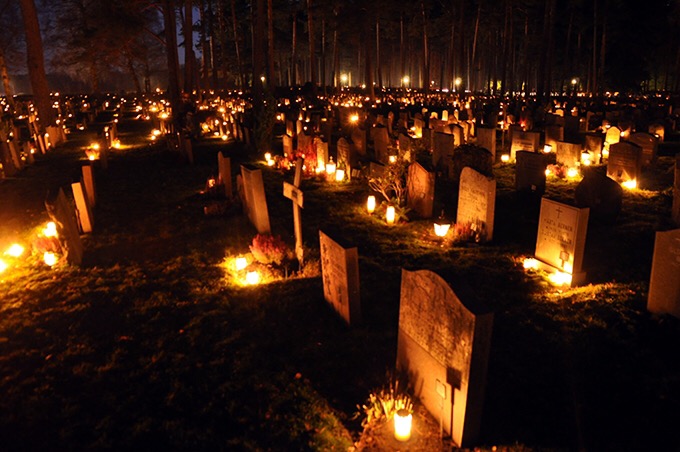
I remember walking around Stockholm when I had recently moved here. It was a pitch black Saturday evening in November, cold and crisp. As I approached a majestic church, I noticed that it was shimmering from the grave yard. This yellow and white light slowly flickered and cast shadows on the gravestones and the church wall. As if drawn by a magic spell, I walked up to the church and looked over the wall. The sight that met my eyes was spectacular and serene at the same time. Hundreds of candles were spread around the cemetery, decorating each of the graves. In the memory grove a bright blazing blanket of candles lit up the area. It was as if the spirits of the dead had come out to play.

In Sweden, the first Saturday in November is All Saints’ Day (the Sunday after All Saints’ Day is called All Souls’ Day to separate between the saints and the dead).

Since the 1800’s Swedes have, during this weekend, made pilgrimage to graveyards up and down the country to decorate the graves with candle light and to pay respect to the dead. It is a much more elegant and atmospheric tradition than the typical Halloween parties that otherwise have become very popular in Sweden.

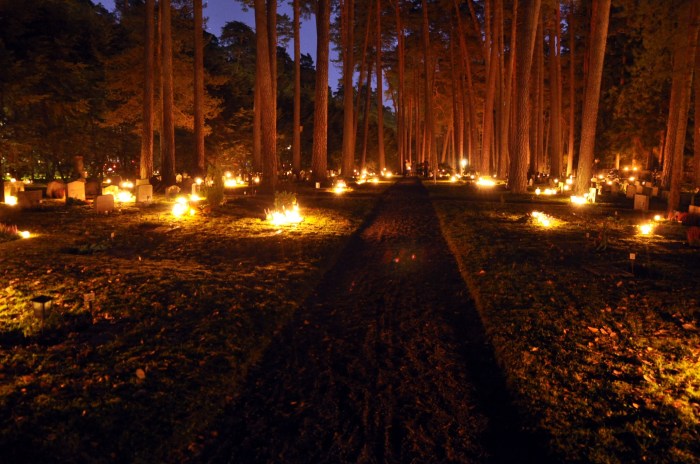
It is a truly beautiful experience to walk through the churchyards this weekend. In the pitch black November Nordic darkness, it is a peaceful reminder of those who have gone before us. So head for your nearest cemetery this weekend and, if you happen to be in Stockholm, go to the Forest graveyard (Skogskyrkogården) for a specifically spectacular experience (pictured below).

Swedish expressions – ‘more stupid than the train’


prins albert

The Swedish train system is notorious for its lack of reliability and continuous delays. Anybody who travels by train in Sweden has probably called it stupid, or worse, in anger or frustration. However, this is not where the Swedish expression (you are) ‘more stupid than the train’ comes from.

To understand the origin of this expression, we have to travel to my home country of England and to the end of the Industrial Revolution. In the 1800’s the rail industry was booming and in 1856 Sweden imported a train from the UK, pictured above.

A Swedish tradition is to give names to trains, and this particular train was christened ‘Prince August’ after King Oskar I’s youngest son. Prince August was well-known across the country for not being the brightest light in the Christmas tree. His weak intellect was well referred to in stories of the time. This was a period in history, however, when open criticism of the Royal family borded upon treason. So, the people created an expression – more stupid than the train – to describe somebody’s idiocy while at the same time referring ‘discretely’ to the royal fool by referencing the train of the same name.

This tradition of naming trains, and train carriages, still exists in Sweden today. Only this morning I travelled in a carriage called Pippi, but I’m afraid it wasn’t much of an adventure. Here is a list of all the carriage names on the Stockholm underground – see if your is there!

Swedish expressions: to shit in the blue cupboard

In Swedish, when you have landed yourself in trouble, or made a fool of yourself, you can use the delightful expression ‘shit in the blue cupboard’.

Example: ‘oh no, Edward really has shit in the blue cupboard now’.

So where does this originate? After some exploration, I have discovered what is recognised as the most likely explanation.

Centuries ago in Sweden, furniture was painted red and okra as this colour was cheap and easy to produce. Around the 1800’s new production methods enabled the production of blue paint – Berlin blue – and this was more expensive and seen as more exclusive. Consequently, people used this colour to paint the cupboard where they kept their finer pieces of porcelain, silver and linens.

In these times, the population used potties to go to the toilet in. Putting the potty into the blue cupboard, amongst the finer articles, was seen as a really stupid thing to do. And so the expression developed in relation to foolish acts.

The Death of a Swedish Icon

Lill-Babs-2015

Today, the news of a death reached the Swedish people. The death of an icon. At the age of 80, popular singer Barbro ‘Lill-Babs’ Svensson passed away. Lill-Babs is little known outside of Sweden, but in Sweden she was an icon, a part of the soundtrack of many Swedes’ lives – she was Sweden. To get a grip on her status in the country, think the UK’s Cilla Black, and France’s France Gall – with that combination of untrained vocals and girl next door sex appeal – and you come part of the way.

When I moved to Sweden over 20 years ago, Lill-Babs was possibly one of the first Swedish celebrities that I got to hear of. She was constantly on the tv, on chat shows, in theatres, in concert halls, in the tabloids, in reality programs, in magazine articles and firmly positioned in the national memory. Her modest origins from a small village in rural Sweden contrasted intriguingly with her show-biz lifestyle, her many love affairs and bankruptcies and her glamorous media-trained daughters. She seemed to balance the ability of staying true to your roots with the bravery of a sexually liberated woman surviving decades in a man’s world. In older days, blonde hair, tanned skin, moist lips, bling and leopard print were her signum, along with her distinctive raspy deep voice. She impacted everybody it seems. Even the King of Sweden announced his condolences today saying he will remember her warmth and exuberance.

I had the pleasure of seeing the ‘Lill-Babs Show’ in 2015, when she was 76 years old. She gave annual dinner shows at the Swedish venue called Playa del Sol on Gran Canaria. As I happened to be there on holiday, I went with some friends to watch her perform. I admit I was a little sceptical going in, but I was blown away. There on the stage stood a woman, slightly ravaged by the years, but with a warmth and a humour that is rarely seen. Her energy and professionalism swept us all away and the crowd went wild – well as wild as they could given the average age was about 70. She sang her classics from the previous 6 decades and told cheeky, saucy jokes to the audience. I felt that I wasn’t just seeing a concert but I was having a thoroughly Swedish experience, somehow immersing myself into Swedish popular history and culture. There, on the stage, was not only a singer but a living legend.

April 3, 2018 Lill-Babs died after a short period of illness. She takes with her a piece of Swedish history, an echo of a Sweden long gone. Her legacy is the openness with which she invited the Swedish people into her life – warts and all. I am sure she will not be easily forgotten and that her voice will be echoing loudly through many a Swedish home this evening.

Why Swedes celebrate on the ‘afton’ (eve)

In the UK, we celebrate ‘Days’ such as Christmas Day & Easter Day. But in Sweden, it is always the Eve ( ‘afton’) that is the big celebration time. There’s påskafton, Valborgsmässoafton, Midsommarafton, pingstafton, nyårsafton, trettondagsafton. Why is this? Surely it can’t just be to get an extra day’s holiday?

Well, actually it originates from a time before the mechanical clock. In that period, a new day began at sunset rather than at midnight as it does now. In the Medieval times there was an expression – ‘vid kväll ska dag leva’ – which means something like ‘in the evening, shall the day live.’ Skandinavians held onto this tradition even after clocks were invented, and this is why they celebrated their important days the evening before. Now the evenings have, for practicalities sake, become day time activities. That’s why Swedes celebrate on the ‘Afton’. Oh yeah, and for the extra day’s holiday.

Sweden’s pink Thursday

jesus-washing-apostles-feet-39588-gallery.jpg

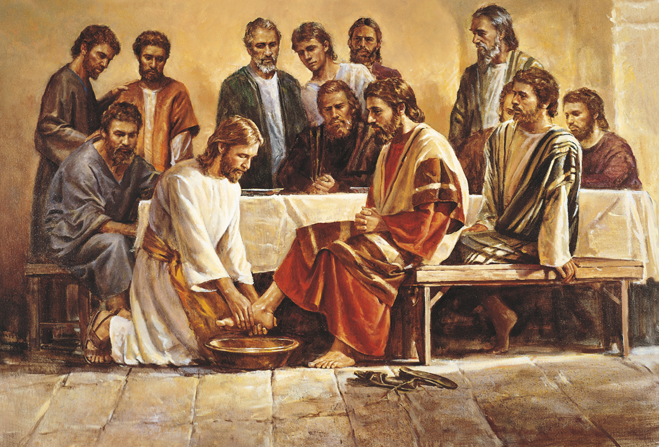
Today, the Thursday before Easter is called ‘Skärtorsdag’ in Swedish. As the word ‘skär’ translates as a shocking pink colour, many people joke that today is ‘pink Thursday’. But the word ‘skär’ in this case relates to something else – something far more biblical.

The word ‘skär’ is an early Nordic word meaning clean and pure. And here, we see a parallel to the English word for ‘Skärtorsdag’. In English, today is called ‘Maundy Thursday’ and it relates to the religious rite known as ‘the maundy’ which involved the ritualistic cleaning of feet. According to Christian belief, today was the day that Jesus performed this act until the recipients had clean and pure feet. It also is the day of the infamous Last Supper.

However, in Sweden today, ‘Skärtorsdag’ is not celebrated in any great religious fashion but in a pagan manner. A old pagan belief in Sweden was that on this day witches would mount their broomsticks to fly away to the legendary mountain known as Blåkulla. At Blåkulla it was believed that the devil held his earthly court. There the witches celebrated their sabbath and danced with the devil.

In modern day Sweden, we see this reflected in the many children who dress up as witches. These kids paint Easter cards and walk around the neighbourhood knocking on doors to wish everybody a happy Easter. In exchange, they hope to receive Easter sweets.

5000 years of Sweden’s first people

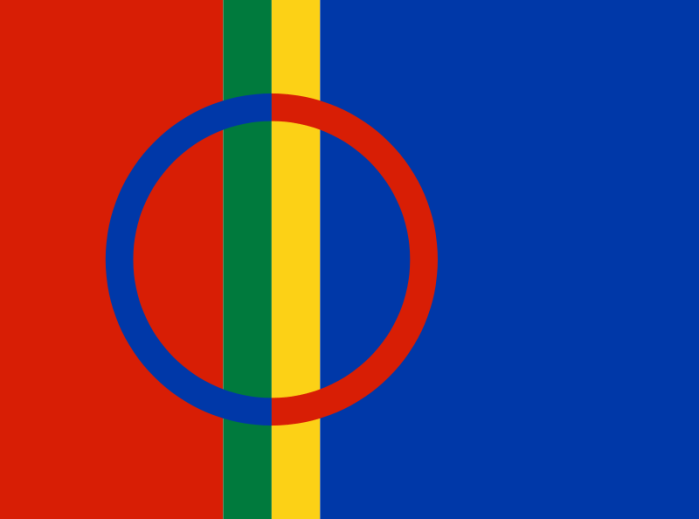
sapmi-flagsapmi

Did you know that Sweden has an indigenous people? I know, isn’t that cool?!

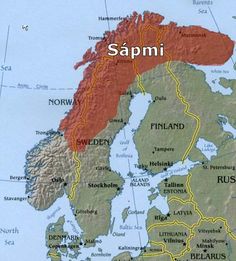
Just like Australia has the Aborigine and China has the Pamiri – Sweden has the Sami. For about 5000 years, the Sami people have lived way up in the arctic north of Sweden in the homeland they call ‘Sapmi’. Today Sapmi actually covers not only Sweden, but also Norway, Finland and Russia. Historically, the Sami were referred to as Lapps, but today this is deemed a derogatory term.

Today, February 6th, is the National Day of the Sami. Today, the Sami flag should be flown and the Sami national anthem is sung in the local Sami language.  The first time this day was celebrated was in 1993 in Jokkmokk, Sweden.

The Sami are the only indigenous people in Scandinavia that are recognised and protected by international convention. The United Nations estimates that there are over 370 million indigenous people living in over 70 countries worldwide. This is roughly 6% of the global population.

Today, around 10% of the Sami population of approximately 70,000 work within the traditional work of reindeer herding. Most of the rest of the indigenous Sami population is urbanised. Like many indigenous people around the world, the Sami have also been treated very badly by the colonising inhabitants of their country. Scandinavia has a legacy of law and assimilation that denied Sami their rights, and an state-sanctioned history of the removal of generations of children for placement in boarding schools and missions. A recent film called ‘Sameblod’ depicted this shameful era of Swedish history.

It took until 1989 for Sweden to recognise the ‘Sami nation’. Sami pupils are entitled to be taught in their native language, although a loophole enables this right to be sometimes bypassed. In 1998, Sweden apologized for their wrongs against the Sami. To make up for past suppression, the authorities of Norway, Sweden and Finland now make an effort to build up Sami cultural institutions and promote Sami culture and language.

However, it is far from rosy in the arctic north. Conflict over land rights, herding rights, exploitation rights are still raging on across Sapmi. Today, the Sami are experiencing cultural and environmental threats, including unwelcome oil exploration, mining, dam building, climate change, military bombing ranges, and exploitative tourism.

Apart from through activism, it is in the Sami parliaments that the main conflicts are debated.  There are three, unconnected Sami parliaments spanning the region – Sweden founded in 1993, Finland in 1973 and Norway in 1989. Russia has not recognized the Sami as a minority and, therefore there is no official Sami parliament (an unrecognised one exists). These democratic parliaments stand up for Sami heritage but have very weak political influence.

Like many nations around the world, Sweden and their neighbours have to balance the ghost of a shameful past with the conflicts of the present and the hope of the future. Without doubt, discrimination against the Sami people still exists.

This is why today, February 6th, is so important as a day of celebration and recognition but also as a day of atonement.

 

Sweden’s badass king

Today, 30th November is an important day in Swedish history.

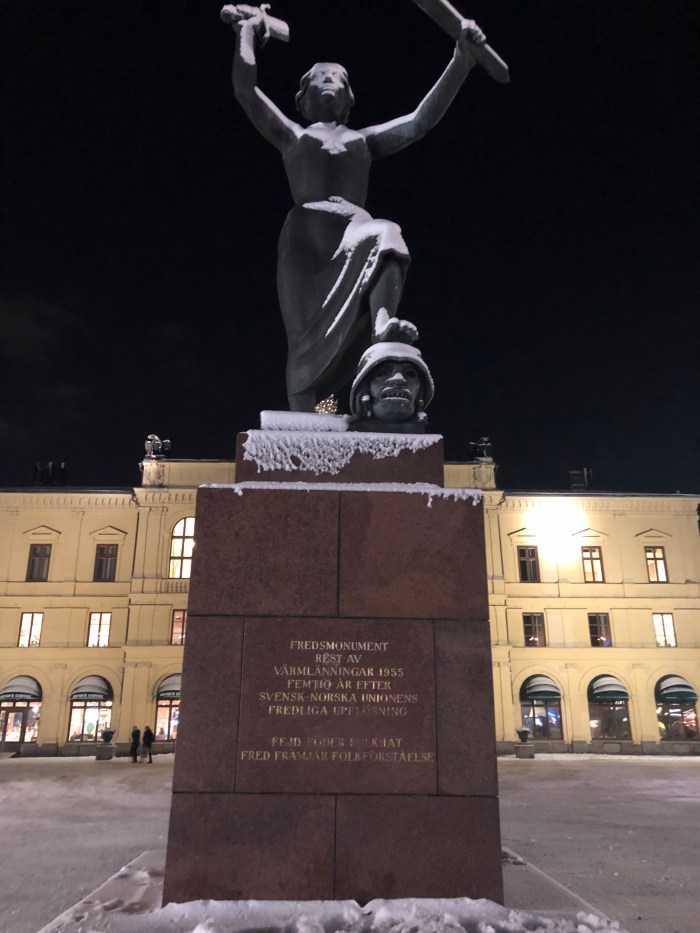
And it all revolves around a stoical King, whose statue can be seen in Stockholm’s Kungsträdgården Park.

Today, Sweden is a peaceful country and hasn’t been at war for over 200 years. But it wasn’t always so. Once upon a time, Sweden was a great power, a military giant with a much larger territory than it has today. And the King of the statue – Charles XII – had a lot to do with it. If you see the statue, he is pointing his finger east. And there is a good explanation for this.

Charles (Karl) was king in Sweden 1697-1718 and a bit of a badass. Apparently never registering physical pain, in the space of a few years, he transformed the small nation of Sweden into a formidable power, crushing his enemies under him. And then he lost it all. At this time, Sweden covered modern day Norway, Finland and other Baltic regions such as Lavonia.

Charles ascended to the throne age 15 and his youth was subsequently exploited by neighbours Denmark, Poland and Lithuania who decided to snatch land from him. In retaliation, he quashed Denmark’s invasion of Sweden and put an ally on the throne. Then, he responded to Russia’s attempt to occupy Livonia and Estonia, and won a sweeping victory at the battle of Narva, under the cover of a blizzard.

After later defeating Poland and Lithuania, he then turned his sights again on Russia. Like his statue, he pointed East. This was a mistake. Up until now, it seems like he just retaliated but this time he waged a war. Hubris perhaps? It was to be his downfall.

Unfortunately for Charles, Peter the Great had regrouped and, in a grueling cold battle, the Russians beat the shit out of the Swedes. Rather like what happens on the ice hockey rink today. Charles fled to the Ottoman Empire but made himself unpopular there so fled back to Sweden, riding across Europe on horseback in just 14 days. Obviously not on the same horse.

Back in Sweden, he saw his nation crumble. Russia took Finland. Denmark took other Baltic regions.

On Nov 30th, 1718 he was shot and killed in modern day Norway, thus marking the short period of Sweden as a great European power. The ‘Swedish empire’ crumbled and territory was taken.

In modern day democratic, peaceful Sweden, Charles XII is sometimes criticized as a blood thirsty tyrant. His war-mongering contradicts strongly with the Swedish Brand of today. But history is history. Rewritten, retold and reinterpreted.

Whatever Charles was, there is no doubt he was a hard core ass kicker. On a historical website I found, the writer describes Charles XII in the following way:

‘Charles was pretty badass.  He completely abstained from alcohol and sex and was pretty much uncomfortable doing anything other than leading his troops to victory or being stoic as fuck.  He lived fast, died young and when he went down he took the entire fucking country of Sweden with him.  What more can you ask for from a historical badass?’

So that’s what ‘Dackefejden’ means

As recently as today, I heard the Swedish expression ‘sedan Dackefejden’ (since the Dacke feud). It is used, often ironically, to describe something very old. ‘I haven’t heard this song since ‘dackefejden’, for example. Or ‘that car looks like something from dackefejden’.

I became curious to learn about this Dacke feud that everybody’s referring to. So I checked it out.

It happened 1542-1543, and was the biggest peasant uprising in Nordic history. It happened in the rural county of Småland in southern Sweden and was against King Gustav Vasa. The leader of the uprising was peasant Nils Dacke, and he was angry that the king had raised taxes and forbidden the sale of cattle and butter to the neighboring county of Blekinge, which at the time belonged to Denmark. Additionally, the king had plundered all the silver from their churches and wanted them to renounce their catholic faith.

So they rebelled, and took control of large parts of Småland and Östergötland. Such was their control, that Nils Dacke celebrated Christmas in Kronberg Castle outside of the town of Växjö.

Of course king Gustav Vasa wasn’t too happy about this feud and made various attempts to undermine the leaders. He offered sanctuary for those who surrendered, he slandered Nils Dacke as a false and unreliable person. And in 1543, he attacked – totally defeating and quashing the rebellion.

Nils Dacke was killed by the king’s soldiers. The people of Småland were punished with high taxes, the insurgents were banished to Finland, the leaders were executed and the whole of Dacke’s family was completely eradicated. So it really seemed to be a bad idea to argue with King Gustav Vasa.

And you literally won’t have met a member of the Dacke family ‘sedan dackefejden’.

What a discovery in a grave tells us about Swedish equality

female viking

Outside of Stockholm, there is an island called Björkö. On this island is a former Viking settlement called Birka. It is well worth a visit and is an active, on-going archeological site where new discoveries are constantly being made.  The area contains 3000 Viking graves, many containing high ranking warriors. Until recently, the presumption has been that these hold male remains but Swedish scientists have now revealed that the body of a warrior long presumed to be male is, in fact, female.

Scientists have assumed the skeleton to be male due to the status symbols buried along side it. However, after carrying out a DNA analysis, researchers from Stockholm University announced that the 10th Century skeleton is the first confirmed female high-ranking Viking warrior.

According to the researchers, this finding  “provides a new understanding of the Viking society, the social constructions and also norms in the Viking Age.”

“Our results – that the high-status grave on Birka was the burial of a high ranking female Viking warrior – suggest that women, indeed, were able to be full members of male dominated spheres.”

So it seems that gender equality in Sweden is not a new-found invention. It is something that stretches back, in its way, over many decades. Today, Sweden is amongst the top countries in the world to lead the Gender Equality Report. All cultural behaviour we see today stems from history and often from how we needed to survive as a society. Maybe today’s gender equality in Sweden started with the Vikings?