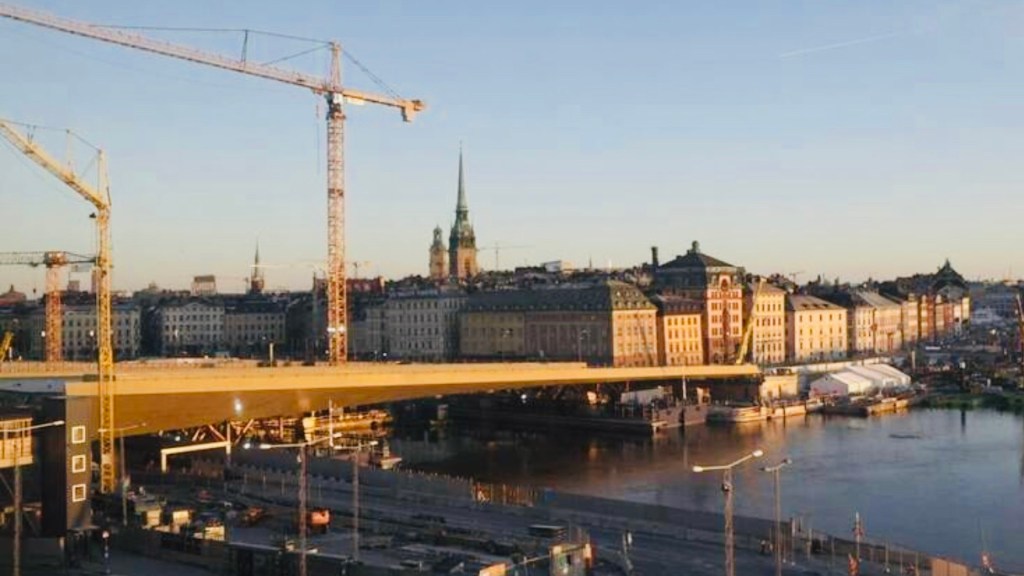
In the center of Stockholm, a large building project is starting to take shape. The Slussen Project started 5 years ago and is an enormous feat of engineering that aims to replace a current structure connecting the southern island of Södermalm to the Old Town. The current concrete structure has been in place since the 1930’s and is literally crumbling. The entire structure needs to be demolished and constructed from scratch.
Ever since 1642, there has been a lock between Södermalm and the Old Town in Stockholm. It has been rebuilt four times. This is the fifth, and it is not without controversy.
Today, an important milestone in the project was reached. An enormous new bridge, known colloquially as the Golden Bridge (although it is in fact ockra), was inaugurated by the Swedish King. The bridge connects the two parts of the city, but divides the residents of Stockholm. Some think it’s very effective and attractive, others think it is a monstrous metal clump.
It really doesn’t matter what people think, the Golden Bridge (correct name Slussbron) is now in place and opens tomorrow at 5am for traffic. Then, the demolishing of the rest of the old structure will begin. The whole project is due to be completed in 2025, assuming no delays.
In the meantime, Stockholmers can walk, cycle and drive over the Golden Bridge knowing they are an integral part of the city’s urban history.
In English, we have the expression ‘cool as a cucumber’. It was first recorded in a poem by John Gay in 1732. The Swedish version of this is ‘cool/calm as a bowl of fermented milk’, or ‘lugn som en filbunke’ in Swedish.
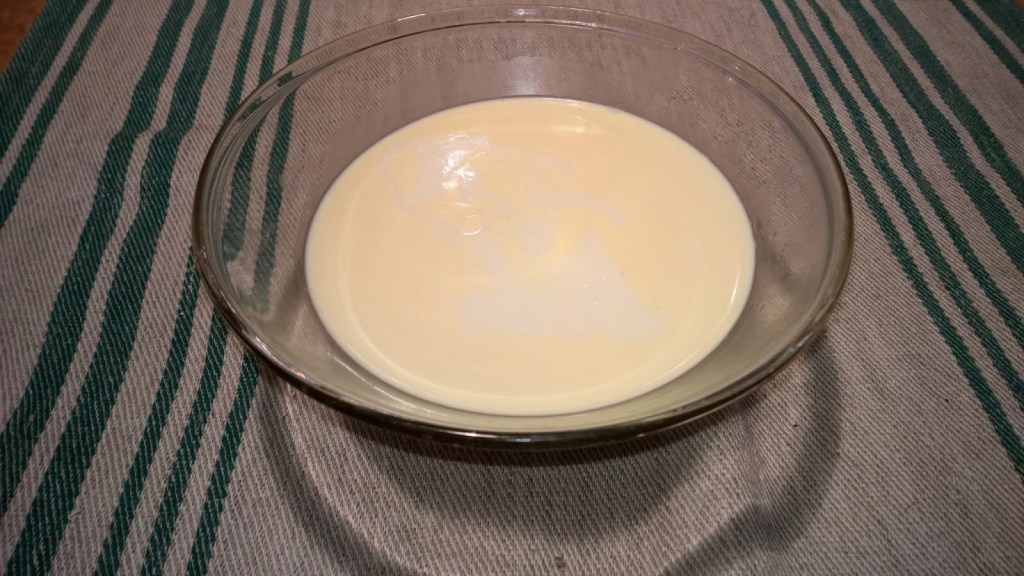
What, you might be asking, is a filbunke? Well, according to the dictionary it is ‘milk that has fermented, unstirred, in small bowls. Has a pudding-like consistency. Traditionally made in small bowls from (unpasteurized and unhomogenized) raw milk, which normally contains some cream. The cream forms a yellowish layer of sour cream on top. Comes unflavoured and flavoured.’
We don’t have an equivalent dish in English as far as I know.
Although the dish has been around since the 1600’s, the expression ‘cool as a filbunke’ entered the Swedish language in 1845. Playwright Johan Jolin wrote in his play ‘A Comedy’ – ‘I’m cool, cool as a filbunke’. It was met with much hilarity. I guess he thought there was something chilled out about a bowl of fermented milk.
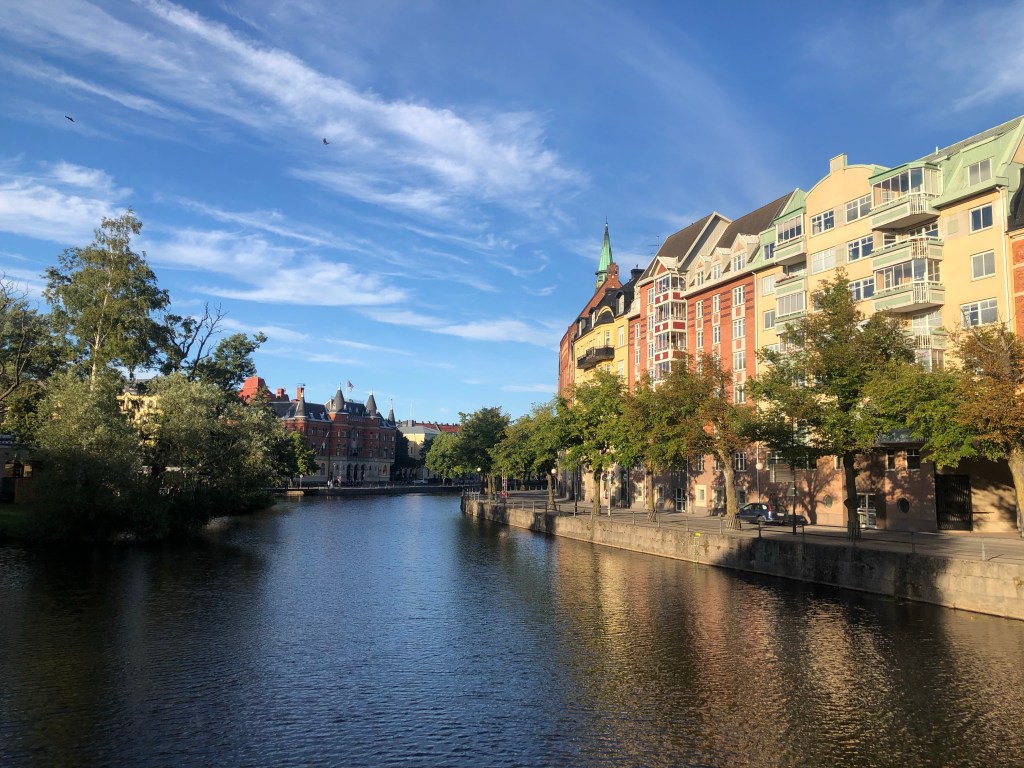
Sweden is rich with history and historical places. One such place is the city of Örebro. This city is built on the Black River that flows into the Lake Hjälmaren, in the southern third of this long, narrow country. From Stockholm, it takes about 2 hours in a car.
Örebro became an official town in the 1200’s but a settlement pre-dates this by a few hundred years. The name Örebro means ’bridge over a gravel bank’. ’Öre’ is a deviation of ‘eyrr’ which is a old Norse word for gravel bank. At this point, the Black river was shallow and it made sense to build a bridge, so that passers-by didn’t have to wade through the water to cross it.
The position of Örebro in time became very strategic and was a junction between 7 different ancient roadways. These roadways are still preserved today. Because of the usefulness of this geographic position, King Magnus Eriksson built a fortress in 1350 in an attempt to defend the site. Over time, this site has been involved in a great many conflicts and wars. In 1573, the fortress was then transformed into a magnificent Renaissance castle, similar to the one that we see today. The Castle of Örebro is one of the city’s most famous and recognisable landmarks and it certainly is a proud building towering up in the middle of the city. For more information about the castle, go to http://www.orebroslott.se
Today, the Örebro area has about 160,000 residents, making it Sweden’s 7th largest city.
If you, like me, are on a road trip in this area of the country, it is well worth a stop over.
Anyone who’s watched ‘Big Bang Theory’ has seen character Sheldon Cooper’s banal video series ‘Fun with Flags’. Nerdy it might be, but it inspired me to do a Swedish version. So here goes…
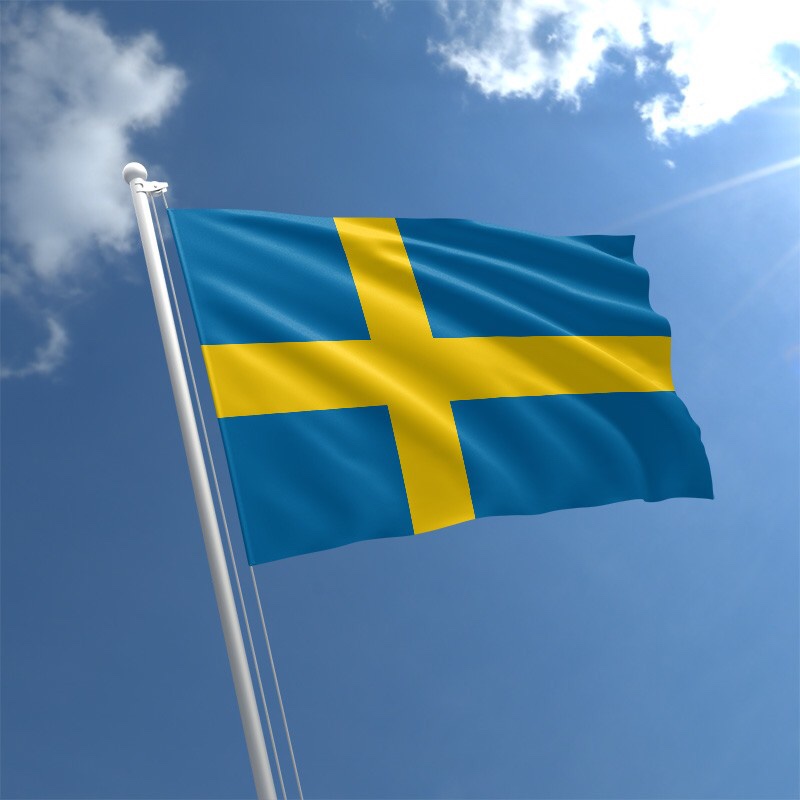
The Swedish flag is a well-known yellow cross on a blue background. It is modelled on the Danish flag – the Dannebrogen – which is thought to be the oldest official flag in the world. The cross represents Christianity and forms the basis of all the Nordic flags. The Swedish flag was initiated in the early 1500’s and the yellow is said to represent gold and blue represent the sea. Sweden depicted itself as a wealthy sea-faring realm.
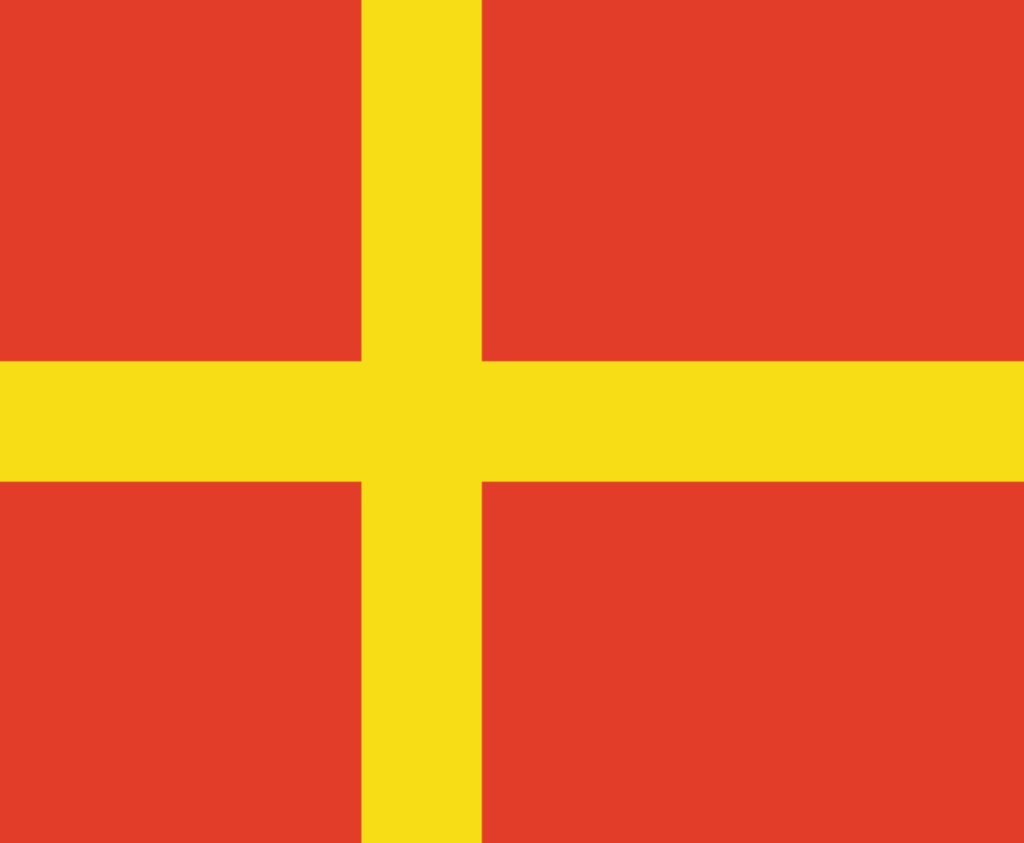
Within Sweden, there are 25 counties and each county has its official flag, some even have an unofficial but well-used flag. An example of this is the southern-most county of Skåne. The unofficial flag is the most commonly used. It depicts a yellow cross on a red background, a combination of Sweden and Denmark. The official flag has actually a red background and a coronated griffin.
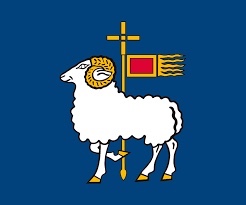
Sweden’s islands of Gotland and Öland have their own flags. Gotland’s flag depicts a sheep and Öland’s flag depicts a deer. Öland also has a flag that is a yellow cross on a green background.
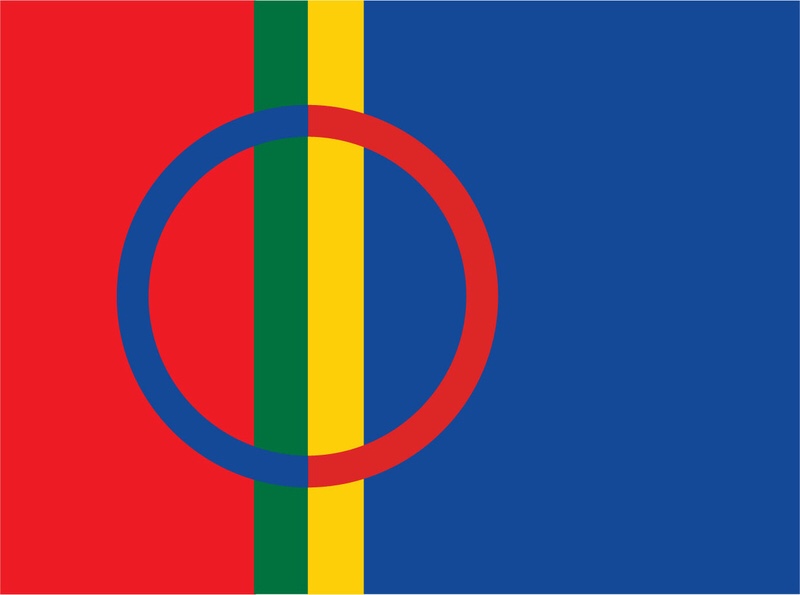
There are so many flags in Sweden. Counties, regions, cities, towns all have their own flag, it’s impossible to describe them all. So, as my final flag, I will reference one of my favourites. The Sami population of Arctic Sweden have their own flag. Firmly embedded in Sami mythology it is colourful and beautiful.
In Sweden, there is a population of ten million, with two million residing in the greater Stockholm region. Of the overall population, around half of the citizens live in flats.
In a recent survey of flat dwellers in Stockholm, 80% said that they don’t know the name of any of their neighbours. That figure is surprisingly high. I have lived in my flat since October and I can rattle off the first names of at least five of the neighbours. 80% surprises me. And I wonder if this is typically Swedish? If you asked the same question in London or New York or Madrid would you get the same result?
One aspect that might affect this lack of neighbourly knowledge is the type of flat that people live in.
In Sweden, flats are typically either rental flats or resident-owned flats.
Resident-owned flats. When you buy a flat in Sweden, you also buy a percentage of the building which you own together with your neighbours. In these resident-owned flats, the building is run as a private cooperative, governed by an elected tenant board. This means that you are forced to work together with your neighbours to operate and maintain the building. For example, once a year there is a ‘shareholder annual meeting’ and twice a year there might be clean-up parties for the communal spaces. This means you meet and interact with your neighbours. In Sweden, resident-owned flats make up about 21% of the total housing stock.
Rental flats. In rental accommodation, a private company owns the building and takes care of all the communal areas such as gardens, laundry room and stairwells. This means tenants in theory have to never interact with their neighbours. Rental accommodation is about 28% of the total housing stock.
Finding a flat is extremely difficult in Sweden’s cities. To buy is expensive and waiting lists for rentals can be over 10 years. This creates another market for ‘second hand’ rental, where people sub-let their apartments out to others. This creates even further anonymity as the renter is often only there for short periods. In this case, there is probably no necessity to get to know the neighbours. In research from Sweden’s Ministry of Housing, an estimated 200,000 people live in this form of housing in Stockholm.
So, on reflection, maybe it isn’t so unexpected that 80% say they do not know the name of a neighbour in their building.
Statistics aside, one can wonder what impact this has on local communities and Swedish society as a whole. While this encourages the Swedish qualities of privacy, respect and integrity, it surely also contributes to loneliness, unfriendliness and alienation?
Every summer in Sweden, there is a wonderful tradition. This tradition began in 1959.
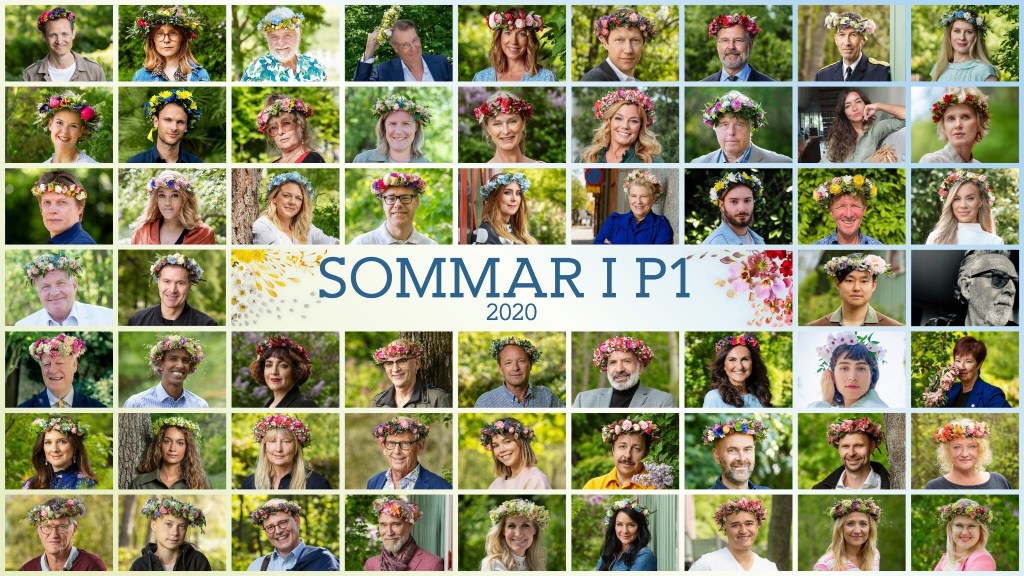
Every day for 6 weeks or so, at 1pm, there is a summer talk on Swedish radio channel 1. This might sound mundane, but it is, in fact, an integral part of the Swedish summer.
Each day, a different person is responsible for the talk. This person shares their life stories, perspectives, life lessons, experiences and sometimes their tragedies. They play music of their choice. It is 90 minutes of pure relaxation, with a big dash of voyeurism. Some of the talkers are celebrities, some are politicians, or authors or activists, or influencers, or actors or philosophers or soldiers or priests or even ordinary people.
The talks are in Swedish, although the speakers can originate from outside of Sweden. It is considered an honour to be asked to hold a talk. I would love to do one. I’d share by life story and my perspectives on Swedish culture from my outside perspective. Oh and I’d play music by Kate Bush and The Smiths! What a self indulgent treat!
This year so far we have heard State Epidemiologist Anders Tegnell share his story. We also heard climate activist Greta Thunberg. She actually did her talk twice – both in Swedish and English. It is a really inspiring, and somewhat frightening talk about the climate crisis we are in. If you’d like to listen to it, and I urge you to do so, here is the link:
So listen and enjoy a piece of Swedish summer tradition.
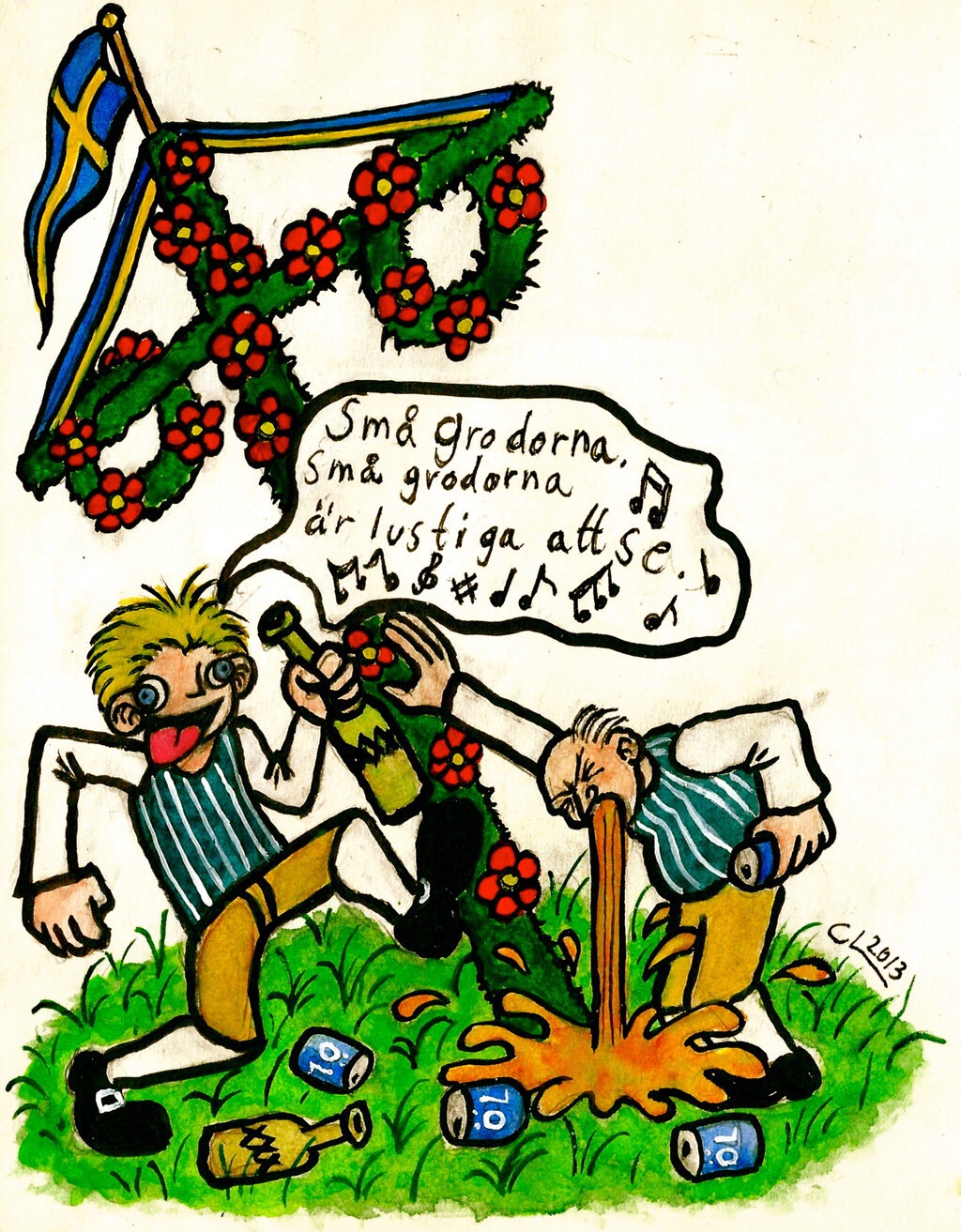
With Midsummer arriving tomorrow, it is time to start planning for your survival. Midsummer’s Eve is the craziest custom in the Swedish calender and the time of the year when Swedes go a little bonkers. As a non-Swede, get ready to brace yourself.
Since we are not fully out of the pandemic, it is important to wash hands regularly and keep a physical distance. Apart from these guidelines, here are a few more hacks to make sure you make it to Midsummer’s Day in one piece.
Greet like a Swede. In Sweden it is considered polite to greet everybody individually, even if you plan to never speak to them again or remember their name. The appropriate way is to stand 1-2 meters away, look directly in their eyes, say ‘hej’ followed by your name. They will do the same. You might even give a small wave or shake hands if you are comfortable doing so. If you are feeling adventurous, follow up your ‘Hej’ with a ‘trevligt’ or even a ‘Glad Midsommar’. Job done. Now you can hit the booze.
Snaps is not the same as a shot. A lot of alcohol gets drunk on Midsummer’s Eve, especially beer and snaps With the popularity of shots in recent years, it’s easy to make the mistake that Swedish snaps is the same thing. Believe me, it is not. Snaps can be up to 40% proof, considerably more than your normal shot. So, go easy and sip the snaps or see yourself slipping sideways off your chair before the strawberry dessert has even been put on the table.
Take tissue. Midsummer’s Eve is a looong day and you probably will need the loo at some point. The trouble is, so will everybody else – to the detriment of the supply of toilet paper. There’s a big chance you will be seeking relief in the woods so come equipped with the appropriate amounts of paper for your needs.
If shy, bring swimwear. Bathing in the icy June waters is a common activity at Midsummer. Swedes generally are not afraid of skinny dipping when they do this. If you are, then come prepared with swimwear and a towel.
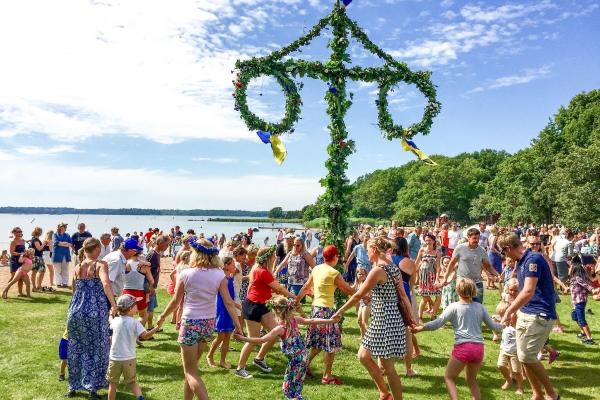
Shelve your maturity. Part of Midsummer is dancing around the maypole, playing silly games, pretending to be a frog, participating in competitions. To survive these activities, it helps to conjour up your inner child and forget you are an adult for a while.
Protect yourself. Given the amount of alcohol consumed at Midsummer, it is no surprise that the many babies in Sweden are made on this day. It you don’t want to join the ranks of parents, remember to put it on before you put it in.
Throw in the thermals. It looks like it might be super sunny and warm this Midsummer’s Eve. One of the warmest ever! But it is good to be prepared. It is not unusual that temperatures fall into single figures and that pesky rain pours down onto the smorgasbord. So bring a jumper, a rain jacket and even thermals to enhance your experience.
Don’t expect culinary miracles on Midsummer’s Eve. The food is exactly the same as is eaten at Christmas and Easter, with a few small summery exceptions – strawberries, cream, dill and new potatoes. Remember to use hand disinfectant before you attack the buffet.
Learn a drinking song. On Midsummer’s Eve, food and alcohol is accompanied by Swedish drinking songs. Learn one in advance and shine at the table. Even better sing one in your own language and you are guaranteed to use those rubbers you packed just for the occasion. For me, ‘what shall we do with the drunken sailor’ works every time.
Argue over the rules. At Midsummer a popular Swedish garden game is called kubb. Involving the throwing of sticks, everybody seems to have their own understanding of the way to play. If you want to feel really Swedish, make sure you start an argument about the rules.
Take pills. Of varying types. Allergy pills are good because there are flowers everywhere: on the table, in the maypole, on peoples’ heads. Pain killers are good as a lot of snaps is consumed. Indigestion pills are good as the food is oily, fatty, acidic, smoky and rich. The after day pill is good, well… because…
That’s it! Follow this guide and you are sure to have a wonderous Midsummer’s Eve in Sweden.
Glad Midsommar!
Please share this post to help others get ready for the big day!
Midsummer’s Eve is possibly the biggest public celebration in Sweden, and it’s happening this week on Friday. Swedes gather to eat, drink and be merry together.
So, what are the origins of Midsummer and why is it celebrated? Well, according to authors Po Tidholm and Agneta Lilja, the origins of Midsummer date back as far as the 6th century:
‘In agrarian times, Midsummer celebrations in Sweden were held to welcome summertime and the season of fertility. In some areas people dressed up as ‘green men’, clad in ferns. They also decorated their houses and farm tools with foliage, and raised tall, leafy maypoles to dance around, probably as early as the 1500s.
Midsummer was primarily an occasion for young people, but it was also celebrated in the industrial communities of central Sweden, where all mill employees were given a feast of pickled herring, beer and schnapps. It was not until the 1900s, however, that this became the most Swedish of all traditional festivities.
Ever since the 6th century AD, Midsummer bonfires have been lit around Europe. In Sweden, they were mainly found in the southern part of the country. Young people also liked to visit holy springs, where they drank the healing water and amused themselves with games and dancing. These visits were a reminder of how John the Baptist baptised Christ in the River Jordan.
Midsummer Night is the lightest of the year and was long considered a magical night, as it was the best time for telling people’s futures. Girls ate salted porridge so that their future husbands might bring water to them in their dreams, to quench their thirst. You could also discover treasures, for example by studying how moonbeams fell.
Also that night, it was said, water was turned into wine and ferns into flowers. Many plants acquired healing powers on that one night of the year.’
There is still an element of magic in the otherwise well-organised Midsummer celebrations of today. One example is the erection of a large phallic flower-clad maypole, and the dancing around of said pole. This is an ancient fertility rite. Related to this, is the association of love to the festivities of Midsummer. In fact many Swedish babies are made around this weekend.
Another example is the gathering of 7 types of summer flower to place under your pillow at night. It is said if you do this, then your future husband will appear to you in your dreams.
And then there’s the light. On Midsummer’s Eve is doesn’t really get dark. Depending on where you are in Sweden, it ranges from a dim glow in the south to full on daylight in the north. In Stockholm, where I live, it is a magical dusky twilight that conjures up associations of witchcraft, druids and paganism.
So while today’s Midsummer might be a well-orchestrated gathering of friends and family, there is still some magic to be found if you look hard enough.
Today is Sweden’s National Day. It was declared in 1983, and was first celebrated as a public holiday in 2005. Prior to that, the 6th June was known as Swedish Flag Day to commemorate that Sweden has its own flag – a celebration introduced in 1916 after the dissolution of the union with Norway in 1905.
Swedes celebrate National Day on 6 June in honour of two historical events: Gustav Vasa being elected king (6 June 1523) and the adoption of a new constitution (6 June 1809).
Normally, the King and Queen of Sweden take part in a televised ceremony at Skansen, Stockholm’s open-air museum, on National Day. The yellow and blue Swedish flag is run up the mast, and children in traditional peasant costume present the royal couple with bouquets of summer flowers.
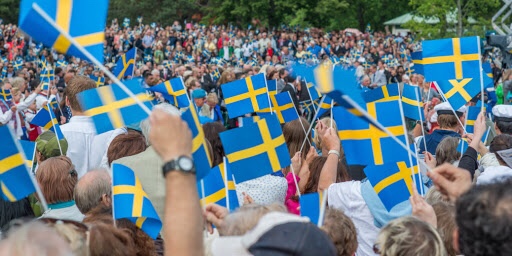
Otherwise, it’s a bit of a weird day, National Day. It’s celebrated with organised events in parks and squares. Buses fly the flag on their rooves, people hang up the flag on poles and people gather in large crowds to wave the flag. Other than this, many people don’t really know what to do. There is no collective memory around the 6th June, such as independence or winning a war, to pull people together. No sense of achievement. Or historical pride. So, the day is usually appreciated as a day off work to, for example, meet friends, or play golf, or day drink or sunbathe or go to Ikea.
One interesting event that happens on this day is the Citizen Ceremony. All new citizens up and down the country are invited to their town hall to participate in a ceremony to welcome them to Sweden as new Swedes. Usually, the mayor proceeds over the event and it’s followed by the most Swedish thing of all – Fika (coffee and cinnamon buns). When I participated 9 years ago, Crown Princess Victoria was actually there also. It did feel very official, with participants from all over the world dressed in their best clothes such as elegant saris, busutis and kanzus. Personally, I wore a blue jacket with a yellow handkerchief poking out of the breast pocket.
Due to the current pandemic, lots of celebrations are cancelled this year. As a replacement http://www.sweden.se are carrying out a digital event. This is what they write:
‘Sweden live: National Day @ home
Make yourself comfortable and join us as we celebrate Sweden’s National Day. In this 24-hour livestream Swedish artists will play for you from their living rooms, chefs will cook with you, museums will dazzle you with their exhibits – and you might also get the chance to spot some moose… Enjoy! Here’s the link!
Today, 17 May, is National Day in Norway. Known as ‘Syttende mai’, it is the day on which Norwegians celebrate the signing of their constitution in 1814. The constitution was signed in an attempt to declare independence and avoid ratification with Sweden. But it failed. Norway was forced into an unwilling union with Sweden and ruled under the same monarch with two capitals – Stockholm and Christiania (Oslo). It wasn’t until 1905 that Norway finally gained independence and the forced union with Sweden was peacefully dissolved.
Since then, Norway is fiercely and proudly their own. 17 May is a huge, patriotic party consisting of concerts, parades and parties.
Today, the relationship between Sweden and Norway is very friendly. The Kings of each country are second cousins. Free trade and transportation exists across the seamless border. The main rivalry between the countries appears to come in the competitive world of cross country skiing, where Norwegian athletes dominate.
As a hangover from the times when Sweden saw Norway as their country cousins, there are a lot of jokes mocking Norwegians. In all of these jokes, Norwegians come off as stupid and simple. When I looked further into it, I discovered that the same exists the other way round. In many Norwegian jokes, known as ‘svenskevitser’, Swedes are depicted as stupid or as spectacular failures. It is not untypical that these kinds of jokes exist between neighbouring countries – English jokes about the Irish, Welsh and Scottish being another example.
Equivalent to the ‘Englishman, Irishman and Scotsman’ jokes, Norway also has its ‘the Swede, the Dane and the Norwegian’ jokes. In these jokes, the Dane is usually drunk, the Swede stupid and the Norwegian smart. Here’s an example:
‘ A Swede, a Norwegian and a Dane were arrested in France during the French revolution. They each got to choose which way they would die. The Norwegian chose the guillotine, because he saw it as the latest fashion. His head went under, but the blade stopped 1 inch from his neck. The French saw this as a sign from God or something and decided to let him go. The same thing happened to the Dane who ran off into the nearest tavern to celebrate. Then they asked the Swede how he wanted to die. “I think I’ll die by hanging, that guillotine doesn’t work anyway,” he said.’
So, regardless of who might be considered stupid, today is a day to celebrate Norway! May you have a long and prosperous existence, and may you continue to live in peaceful, slightly ridiculing, co-existence with your neighbours.