Let the light in – Lucia morning in Sweden

A Chinese proverb says this,

‘It’s better to light a candle than to curse the darkness’.

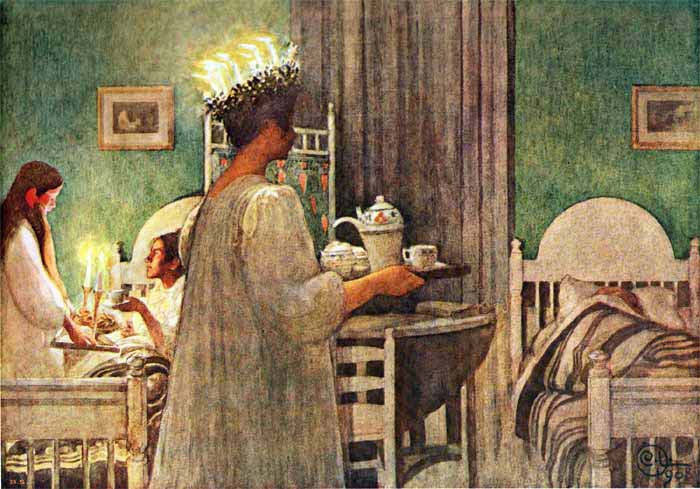
Never was this more true than today. Lucia day. At the darkest time of the year, when we all are drained by the black mornings and afternoons in Sweden, Lucia pays us a visit. With candles in her hair and surrounded by her handmaidens and boys in a procession, Lucia shines light into the dark depths of our spirits. And slowly, slowly, the day awakens.

I love Lucia. Long live Lucia!

Lucia traditions are celebrated in Sweden, Norway, Denmark, Italy, Latvia, Estonia, Finland, Hungary, Malta, Bosnia, Bavaria, Croatia, Slovakia and St. Lucia, West Indies. But where does she come from and why is she one of the few Saint’s days celebrated in Sweden?

Santa Lucia is believed to have been a Sicilian saint who suffered a martyr’s death in Syracuse, Sicily around AD 310. She was seeking help for her mother’s long-term illness at the shrine of Saint Agnes, in her native Sicily, when an angel appeared to her in a dream beside the shrine. As a result of this, Lucia became a devout Christian and refused to compromise her virginity in marriage. Officials threatened to drag her off to a brothel if she did not renounce her Christian beliefs, but were unable to move her, even with a thousand men and fifty oxen pulling. So they stacked materials for a fire around her instead and set light to it, but she would not stop speaking. One of the soldiers stuck a spear through her throat to stop her, but to no effect. Soon afterwards, the Roman consulate in charge was hauled off to Rome on charges of theft from the state and beheaded. Lucia was able to die only when she was given the Christian sacrement.

The tradition of Santa Lucia is said to have been brough to Sweden via Italian merchants and the idea of lighting up the dark appealed so much that the tradition remained. The current tradition of having a white-dressed woman with candles in her hair appearing on the morning of the Lucia day started in the area around Lake Vänern in the late 18th century and spread slowly to other parts of the country during the 19th century.

The modern tradition of having public processions in the Swedish cities started in 1927 when a newspaper in Stockholm elected an official Lucia for Stockholm that year. The initiative was then followed around the country through the local press. Today most cities in Sweden appoint a Lucia every year. Schools elect a Lucia and her maids among the students. The regional Lucias will visit shopping malls, old people’s homes and churches, singing and handing out gingerbread.

So, it might be cold and dark outside, but inside it’s light. And the light is always stronger than the darkness. Keep your light lit, and you will never feel the darkness.

Groan-worthy Swedish humour in the city of Gothenburg

Humour is one of the things that often doesn’t translate too well interculturally. Sarcastic, ironic humour is one example – which can be perceived as rude by other cultures. The British style of self-deprecating humour is often seen as incomprehensible by others who take it literally.

But the biggest type of humour that doesn’t translate is the pun. Because it is language based, it simply doesn’t translate linguistically.

In Sweden, the west coast city of Gothenburg is known for its puns. The humour is based on witty plays with words, the more groan-worthy the better. In English, we refer to these as Dad jokes – pun-filled quips that make every child’s eyes roll and every father’s heart fill with pride and accomplishment. No matter how bad they are, these jokes always manage to get at least a chuckle out of us. Maybe deep down we actually think they’re funny, or maybe we just love to see our dads smile because they made us laugh. Here are a couple of Gothenburg jokes, which simply don’t translate…

Which country has the cheapest meat?’

‘Ko-rea’ (Cow sale)

‘What noise comes out of a court?’

‘Rättsväsendet’ (Word for judicial system, but also translates as justice hiss’)

So, as these didn’t translate. Let me present you with some of the best English dad jokes that would make any Gothenburger proud.

1. ‘Why don’t crabs give to charity?’

‘Because they’re shellfish’

2. ‘I got hit in the head with a can of Diet Coke today. But don’t worry, it was a soft drink.’

3. ‘A ham sandwich walks into a bar. Sorry, says the bar tender, we don’t serve food here.’

4. ‘How do you make an octopus laugh?’

‘With ten tickles’

5. ‘My wife asked me to sync her phone. So I threw it in the ocean.’

And my own dad’s favourite joke that he used to say every time we went past a cemetery –

‘You know that’s the dead centre of town. People are dying to get in there.’

Do you know any Gothenburg puns? Please share them!

Have yourself a Merry Gay Swedish Christmas

With gay men being hunted down and ‘punished’ in Uganda, Tanzania, Russia and many other countries around the world, it is easy to blame religion for the persecution.

And the evidence to back this up is fairly compelling. Countries that have a strong foot in religion are often countries that have strong anti-LGBT policies and attitudes. Not always, but often. Fanatical interpretation of the scripture can be one explanation, as can the crushing concept of sin, and the devouring need to uphold traditional ‘family structures and values’. For example, in a recent comment, the Pope said a lot can be done for LGBT people through psychiatry.

Sweden is a country that separates the church from politics. It is a country where almost 90% of the population identify as atheist or agnostic. It is a place where religious morality does not usually dictate the behaviours and choices of individual citizens. Of course there is organized religion in Sweden, there are churches and there are priests. Of course there are minority religions in Sweden such as Islam, Hinduism and Judaism. Of course there are casual believers, devout followers and extremists. But compared to many other organized religions in the world, the Swedish Church is very liberal.

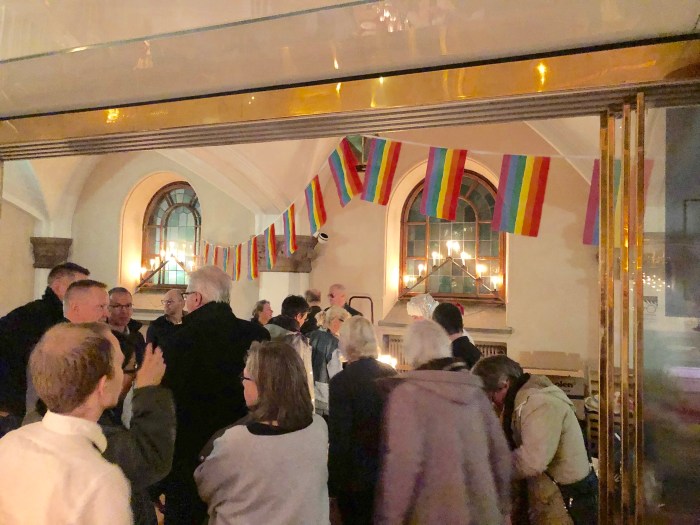
This was manifested in the recent service at a church in Stockholm, a service called Gay Jul (Gay Christmas). The slogan for the event was ‘come in as you are, come out as you want to be’. As I sat in attendance at this service, I witnessed a welcoming space, filled with members of the LGBT community, the church decorated in rainbow flags, and the words ‘Gay Jul’ emblazoned on the pulpit. I was moved by the openness of the church to welcome the minority group that is so often demonized and persecuted by the Faithful. It was an escape, and embrace, a sanctuary.

However, I was also struck by a sadness as I sat there in that echoing church. I realized the experience was a uniquely Swedish one, occurring in a small city in a small outpost of Europe and an unlikely sight in other churches, mosques, temples and tabernacles around the world.

In that church, amongst the rainbow flags, we were far far away from Uganda, and Tanzania, and Russia.

The relief of Swedish Advent


So it’s the first of Advent this weekend and this year it comes as a major relief for those of us in Stockholm.

You see at Advent, Swedes decorate their houses, apartments and windows with lights. From ceilings, illuminated stars are hung. On window ledges, electric advent candles are placed. On tables, four candles are positioned and one is lit every Sunday up until Christmas. Small candles, often red, are dotted about the home.

Some years, there is already deepish snow at the first of Advent, but this year in Stockholm, there isn’t. So it is very, very, very dark. The collective advent decoration is a definite reprieve from this darkness as light is spread into these murky places.

The word ‘advent’ comes from the Latin ‘adventus’ which means ‘arrival’ and is traditionally the start of the period where we wait for the arrival of nativity, or Christmas. Some religions also see it as waiting for the second coming of Christ. But in this secular society that is Sweden, the waiting is probably for the snow to come, the cold to hit, the water to freeze to ice and for winter to clasp its fingers firmly around us.

Do Swedes have no heart?

Working recently in India, one question I received was ‘why don’t Swedes greet us with heart?’ This was referring to when Indians visit colleagues in Sweden, or when they start working together in new constellations.

It is an interesting perception, and maybe not a new one. The experience of Swedes as cold, unfriendly and disengaged seems common, and genuinely baffles a lot of non-Swedish people.

Firstly, I would like to say that in general this is not true. It is just a perception. Many of the Swedes I know are kind, generous and affectionate. However, I do have a few theories as to why this perception prevails.

Expressiveness – how much it is appropriate to express emotion is something that we are trained in from childhood. Some cultures train their children to use their entire bodies when they communicate, others train their children to be more reserved. Generally Swedes are trained to be emotionally inexpressive. What they mean is clearly in their words, and not so much their bodies or faces. And this can lead more physically expressive cultures to presume they are cold. So it is important to understand that lack of expression should not be confused with lack of feeling.

Importance of relationships. Swedes do have many close friendships and family ties. However, this doesn’t necessarily extend to neighbors or colleagues. While in other cultures, strong close relationships with colleagues are essential for getting the job done, in Sweden isn’t the case. Relationships help, but they are not essential for carrying out the task. This means Swedes can go to work and be friendly towards each other, but don’t necessarily need to make friends or show a great deal if interest in each others private lives. This can be frustrating for people who come from strongly relationship-oriented cultures.

Independence. Swedish culture is amongst the most individualistic cultures in the world. In Swedish society, this manifests itself in the attitude that every able-bodied person can take care of themselves. This means that the Swedish attitude is generally if you want help you will ask for it. And you usually get it. The fact that help is rarely offered was a hard lesson for me to learn when moving to ‘unhelpful’ Sweden.

The peach and the coconut. Some cultures are like peaches – soft on the outside, easy to get into, open in communication, overtly friendly. Other cultures are like coconuts – hard shelled, difficult to get into and less open to people outside the group. Typically, but not exclusively, Swedish culture is ‘coconutty’ and Indian is peachy. This can mean it’s a challenge for people from peachy cultures to break into Swedish society and easy for them to form the perception that Swedes are cold and unwelcoming. My experience tells me, however, that once you break through the shell, the friendships that you make are very close and lasting. It is easy to assume when you meet a Swede that he or she is shy or introvert. This might be the case, but not necessarily. He or she might just be a coconut.

Spectacular Swedish serenity on All Saints’ Day

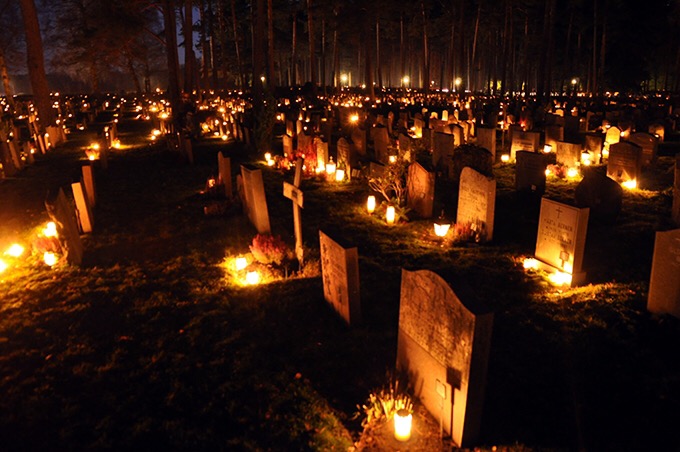
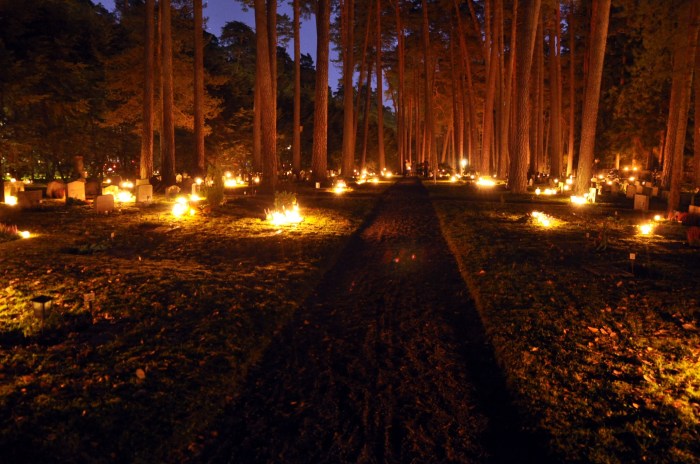
I remember walking around Stockholm when I had recently moved here. It was a pitch black Saturday evening in November, cold and crisp. As I approached a majestic church, I noticed that it was shimmering from the grave yard. This yellow and white light slowly flickered and cast shadows on the gravestones and the church wall. As if drawn by a magic spell, I walked up to the church and looked over the wall. The sight that met my eyes was spectacular and serene at the same time. Hundreds of candles were spread around the cemetery, decorating each of the graves. In the memory grove a bright blazing blanket of candles lit up the area. It was as if the spirits of the dead had come out to play.

In Sweden, the first Saturday in November is All Saints’ Day (the Sunday after All Saints’ Day is called All Souls’ Day to separate between the saints and the dead).

Since the 1800’s Swedes have, during this weekend, made pilgrimage to graveyards up and down the country to decorate the graves with candle light and to pay respect to the dead. It is a much more elegant and atmospheric tradition than the typical Halloween parties that otherwise have become very popular in Sweden.

It is a truly beautiful experience to walk through the churchyards this weekend. In the pitch black November Nordic darkness, it is a peaceful reminder of those who have gone before us. So head for your nearest cemetery this weekend and, if you happen to be in Stockholm, go to the Forest graveyard (Skogskyrkogården) for a specifically spectacular experience (pictured below).

Swedish expressions – ‘more stupid than the train’


prins albert

The Swedish train system is notorious for its lack of reliability and continuous delays. Anybody who travels by train in Sweden has probably called it stupid, or worse, in anger or frustration. However, this is not where the Swedish expression (you are) ‘more stupid than the train’ comes from.

To understand the origin of this expression, we have to travel to my home country of England and to the end of the Industrial Revolution. In the 1800’s the rail industry was booming and in 1856 Sweden imported a train from the UK, pictured above.

A Swedish tradition is to give names to trains, and this particular train was christened ‘Prince August’ after King Oskar I’s youngest son. Prince August was well-known across the country for not being the brightest light in the Christmas tree. His weak intellect was well referred to in stories of the time. This was a period in history, however, when open criticism of the Royal family borded upon treason. So, the people created an expression – more stupid than the train – to describe somebody’s idiocy while at the same time referring ‘discretely’ to the royal fool by referencing the train of the same name.

This tradition of naming trains, and train carriages, still exists in Sweden today. Only this morning I travelled in a carriage called Pippi, but I’m afraid it wasn’t much of an adventure. Here is a list of all the carriage names on the Stockholm underground – see if your is there!

Have you been wondering who votes for Sweden Democrats?

I was at an interesting lecture this week with researchers Kirsti Jylhä, Jens Ryding and Pontus Strimling. They were presenting the results from their research at the Institute of Future Studies into who are the Sweden Democrat’s (SD) voters, why do they vote for SD and where are they from? It’s taken me a while to mentally process and summarise what they said, but here is my take on it.

The research was carried out in the form of questionnaires on several thousand voters. The research tried to look at attitudes, origins, demographics and world views.

Fluid voters

The majority of the SD voters have moved from Socialdemocratic party (S) and conservative Moderates (M). 62% of the supporters are more likely to vote M in the future, if they don’t vote SD.

Critical to immigration

The majority of SD supporters have immigration as their main issue. They are critical of immigration in general and see immigration as a threat to society. Some of the voters, but far from all, have a deeper resentment or dislike for foreigners. The main driver is fear and criticism of a ‘failed’ immigration system. Almost 100% of SD voters believe immigration costs too much. Over 80% believe that immigrants weaken the Swedish culture. Over 90% believe that immigrants are responsible for increased crime rates.

Trust Swedes

The SD voter has a higher level of trust towards other Swedes than to those born outside of Europe with almost 70% saying they would prefer a native Swede as a neighbour rather than a foreigner. This was 19% for S voters and 37% for M voters.

Skeptics

The vast majority of the participants in this research were highly skeptical towards the government and other authorities. They have an innate, higher suspicion of politicians, media and the legal system than M or S voters. They also have a larger tendency to believe in conspiracy theories.

Feeling good

Previous research suggests that supporters of populist parties tend to be dissatisfied and marginalised by society. This research does not support that. Quite the opposite, SD voters are satisfied with their lives and their current situations and they do not perceive their quality of life has been reduced during the last four years. However, a common concern they have is that their standard of living with get worse in the future due to costly changes in society. In comparison to S or M voters, they have a much weaker optimism about the future.

Tolerance and respect not important

In comparison to S and M voters, SD voters tend to think tolerance and respect are not important qualities. In the raising of children, obedience is seen as a more important quality. However, the research could not prove a larger lack of empathy amongst SD voters compared to others.

Lower education

37% of SD voters in the research had a higher education (eg university). Amongst S voters this is 44% and 57% amongst M. The majority of SD voters are working class.

Conservative and authoritarian

SD voters in much higher numbers have a conservative and authoritarian view of society. For example, over 70% think that feminism has gone too far and it is the role of the man to support the family. Over 60% believed that a strong leader is necessary to control unwelcome behaviours in a society.

So, are SD voters stupid, racist and irrational? Judging by this research the answer is no. They are skeptical, critical and fearful.

And they are highly rational. It makes rational sense for them to navigate towards a party that resonates most with their attitudes.

Today is Election Day and soon we will see the result. What will win in Sweden? Will it be skepticism, criticism and fear? Or will it be pragmatism, openness and optimism?

To see the full report, go to http://www.iffs.se and look under publications.

How SD is seducing you

sd affisch

Standing on the train platform this morning I was confronted by a huge poster from nationalistic party the Sweden Democrats, asking me to vote for them in the approaching election. The poster consisted of men and women, all white, smiling down at me in a welcoming unthreatening manner. ‘SD 2018’ – the simple slogan emblazoned across the poster – intended to show me that those who support SD today are not nazis, criminals, sexists or homophobes (as proven time and time again in the press). On the contrary they are presented as ordinary, happy people who just want a change of government.

As I stood there, I understood how clever SD’s PR and Marketing people are. They have a strong understanding of influencing techniques – and they’re not afraid to use them to seduce the unsuspecting general public.

Psychologist Robert Cialdini is considered the guru of influencing skills. In his ground-breaking book, ‘Influence’, he introduced six key principles on which influence is based. Based on his extensive research, he found that if we apply these principles, we are able to persuade others more easily. Used positively, they can help move us towards agreement with each other, used negatively they can be applied to manipulate and even coerce people into making decisions that might be bad for them.

As I stood on the platform and absorbed SD’s poster, I realised how artfully they are using two of Cialdini’s principles. The principle called ‘Social Proof’ and the principle called ‘Liking’.

Social Proof
This principle relies on people’s sense of “safety in numbers.” If we see that others are doing something, we are more likely to do the same. It somehow feels validated. For example, we’re more likely to work late if others in our team are doing the same, put a tip in a jar if it already contains money, or eat in a restaurant if it’s full of guests. We assume that if lots of other people are doing something, then it must be OK. We’re particularly susceptible to this principle when we’re feeling uncertain, and we’re even more likely to be influenced if the people we see seem to be similar to us. That’s why commercials often use parents to advertise household products and why SD uses smiling, happy Nordic people.

Liking
Cialdini says that we’re more likely to be influenced by people we like. Likability comes in many forms – people might be familiar to us, we might just simply trust them or they might physically look like us. We have an inherent feeling of liking when we see them. Companies that use sales agents from within the community employ this principle with huge success. People are more likely to buy from people like themselves, from friends, and from people they know and respect. Facebook, for example, builds its business model on ‘liking’. SD uses this principle to manipulate us into thinking they are just like us. They think like us. They would never do anything to harm us. We can trust them.

As in previous posts, I am trying to shine a light on how SD is manipulating us, society and the election. They are masters of manipulation – spreading fear and uncertainty in the minds of the susceptible electorate, when in fact Sweden is currently booming and economically very stable. There are problems in society, no doubt, but these are not best solved by giving power to a party that we know is manipulative and devious. Judging by the level of scheming we see when they are trying to gain favour, just imagine how this will escalate if they have power.

A vote for SD is not a vote for a better Sweden.

Do not be duped into falling for the deceit.

You are being manipulated.

Do not be seduced.


Swedish expressions – take it piano

If a Swede says to you ‘ta det piano’ – take it piano – what they mean is take it easy, go slow often to avoid any mistakes. They can also say ‘it’s piano’ which means everything is cool, calm, ok.

Researching the origin of this expression led me, not surprisingly, to the world of music.

The word ‘piano’ has two meanings – firstly the string instrument with its variety of keys.

Secondly, it is a musical term for ‘weak’ or ‘soft’. In sheet music, the letter ‘p’ indicates piano and tells the musician to play their instrument softly. Double ‘pp’ means pianissimo and indicates to play very softly.

The term ‘piano’ originates in Italian and has been in use in Sweden since the 1600’s.