Today is called Long Friday in Swedish – ‘Långfredag’. It commemorates the long day and the long suffering that Jesus endured on the cross, according to Christian teachings. It is a public holiday, and for many years, everything was closed in Sweden making the day long and boring for many people. Now, most things are open, even the middle of a flaming, raging pandemic.
Good Friday is a day of cooking, shopping and going for walks. Some people attend church services. Tomorrow, Easter Saturday, is the normal day of celebration when Swedes gather to eat from a bulging smörgåsbord. Typical food includes variations of salmon, egg, herring and lamb. Dark Easter beer is consumed and snaps is knocked back.
In English, this day used to be called Long Friday also, but at some point in history it changed to Good Friday. Good in this context means Holy. According to the Daily Mash this is ‘still stupid. You don’t get much worse days than being flogged, nailed to a cross, then stabbed. And that includes your annual performance review. It’s like calling funerals ‘Happy Burying Nana Day’.
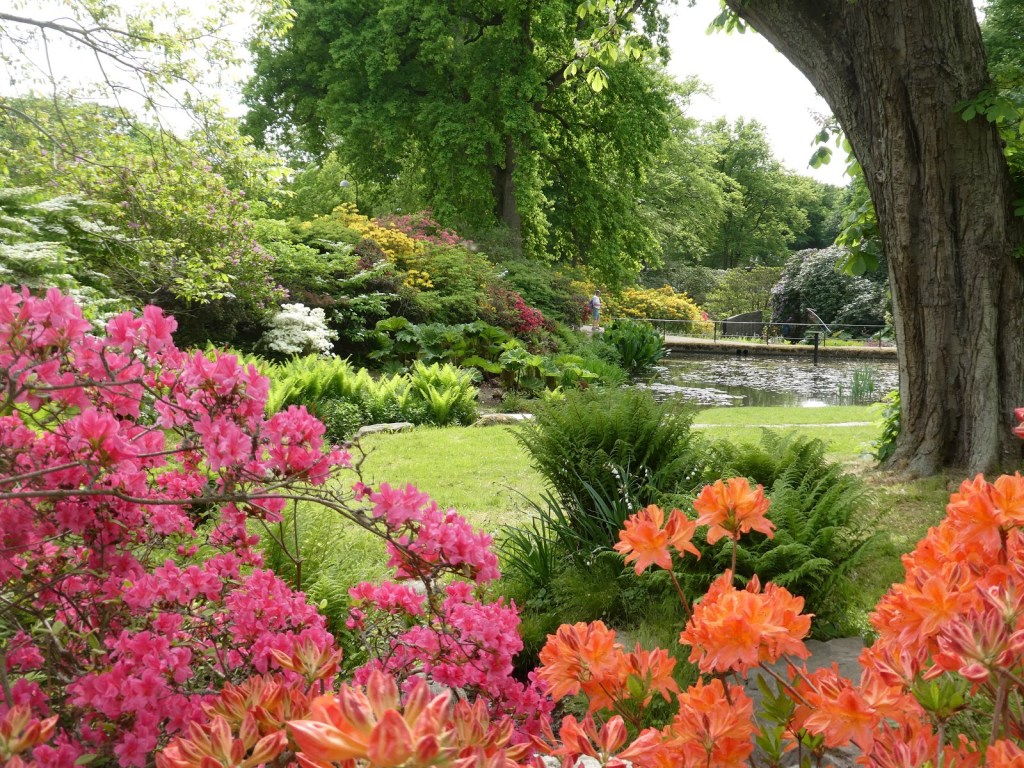
Today, 30 March, is International ‘Take a walk in the park’ Day. While some residents in some locked down countries might not appreciate the irony of it, here in Sweden it is fully possible to celebrate today by stepping out into one of the many green areas.
Take a Walk in the Park Day was founded to celebrate small excursions and the difference they can make to our mental, physical and emotional health.
In Sweden, there are thousands of parks and 30 official National Parks. What kind of park you prefer is of course a matter of taste. However, according to our friends on the internet, the three most beautiful parks in the country are Sofiero slottsträdgårdar in Helsingborg, Hagaparken in Stockholm and Boulognerskogen in Gävle. I’m sure there are a lot of people with other opinions.
Sweden also has a tradition of the ‘Folkpark’ which is a place for entertainment, cabaret, theatre, relaxation and enjoying the great outdoors. Folkpark’s had their heydey in the 1940’s-1960’s where artists would play on the stages and there would be party party and dance. The first Folkpark was built in Hällefors in 1796. Today they still exist, but have faced a lot of competition from festivals, arenas and other outdoor entertainment spaces.
For most urban dwellers around the world, the parks are the lungs of the city. And it’s the same in Sweden’s built up regions. Living in Stockholm, I am so lucky to have many parks and green areas within easy walking distance.
So, depending on where you live, and your time zone, it might not be too late. Put on your shoes and step out into your street, and go take a walk in the park. After all, today is ‘Take a Walk in the Park Day’.
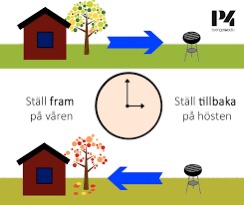
Tonight the clocks go forward in many countries, Sweden included. In English, we say ‘spring forward, fall back.’ It’s a handy way of remembering that the clocks go forward one hour in spring, and back one hour again in autumn.
This pun doesn’t work in Swedish though. Instead they use a metaphor of a barbecue, or garden furniture. In the spring you ‘ställa fram grillen’ (literally put forward the barbecue, also meaning put out the barbecue.) And in the autumn you ‘ställa tillbaka grillen’ (put the grill back, meaning put it away.)
In several countries, I would not be allowed to freely write what I want in this blog. Many nations are fighting for press freedom and against censorship – some of them not very far away. Thankfully, Sweden has solved this issue of media independence. Everyone is free to express themselves in writing, provided they do not publicly defame another person or commit an illegal act.
Obviously, Sweden didn’t always have freedom of the press. In the early days of print, Swedes fought many battles against censorship and limitations on the printed word. However, things changed when, on 2 December 1766, Sweden became the first country in the world to write freedom of the press into the constitution. The Swedish Freedom of the Press Act also allowed public access to information, which made it legal to publish and read public documents.
The Act that applies today actually came into effect in 1949. Today, laws cover press ethics, disputes, freedom of expression over digital media and protection of the individual and of whistleblowers.
Compared with other countries in the EU, Sweden is the 3rd best country in terms of media independence, preceded by Finland and Denmark. Sweden holds the 4th position on a global scale, the number one country being Norway.
According to Reporters without Borders, one reason that Sweden isn’t ranked higher is that over 50% of local media is owned only by five major companies. These control the editorial line and job security.
Additionally, one third of Swedish journalists claim they self censor due to threats and harassment from trolls, violent groups, heads of overseas states and security forces. Very few perpetrators are sentenced.
Yesterday was St Patrick’s Day! I hope you remembered to wear something green, even if you didn’t leave your living room. Normally St Patrick’s Day is celebrated in Sweden, like many places around the world, with noisy, boozy parties. This year of course was different. Public gatherings in Sweden are limited to 8 people, which makes a somewhat subdued party, not up to the standards of a real St Patrick’s Day bash.
The relationship between Sweden and Ireland is a good one. According to Sweden’s Central Bureau of Statistics, there are 2892 Irish people living in Sweden. Ireland has an embassy on Blasieholmen in Stockholm. Sweden has a consulate in Dublin, and honorary consulates in Limerick and Galway. There is a Swedish-Irish society that was founded in 1949 by a group of Swedish friends interested in Ireland. According to their website, ‘the society has been building friendships between the two countries, promoting Irish culture in Sweden and has gradually also become a hub for Irish and Swedish-Irish in Sweden. We organise events throughout the year and membership is open to everyone who shares our interests!’
For the purposes of doing business, there is a Swedish-Irish Chamber of Commerce. This is a not-for-profit organisation dedicated to building a professional community to promote and strengthen commercial collaboration, development and exchange between Swedish and Irish businesses.
Classic Irish pubs in Stockholm include The Liffey, The Auld Dub and O’Connells. In Gothenburg there’s the Dubliner and the Irish Embassy, and Malmö has Fagan’s and The Shamrock. Normally these places would be packed to bursting, and rocking to the sound of the fiddle on St Patrick’s Day. Hopefully next year will see a return to normal.
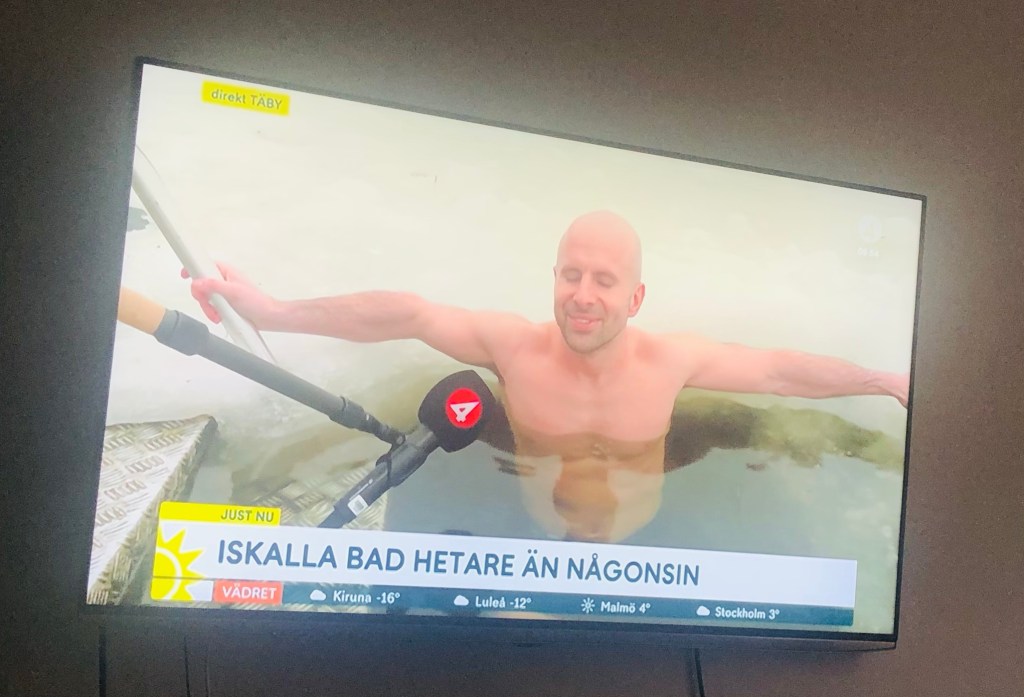
This winter, taking an outdoor ice bath has become very fashionable in Sweden. Disrobing and lowering yourself into frozen lakes at below zero temperatures is considered very healthy for the body and its ability to repair itself.
Spring has now arrived and the ice is melting but die hards are still squeezing the last out of the ice batheing season. Like this guy featured on TV, who regularly sits in the frozen lake – for 20 minutes at a time!
This may seem like a long time, but actually it is nothing compared to the world record. The world record for ice submersion is held by Austrian Josef Koerbel who, in 2020, held himself under ice for 2 hours and 30 minutes. In his case, it was in an ice box on a public square in the town of Melk.
Brrrr.
So, what about you? Do you feel enticed by the concept of plunging into the chilly depths to take an ice bath? Or would you rather keep yourself wrapped up warm and toasty on the bank of the lake?
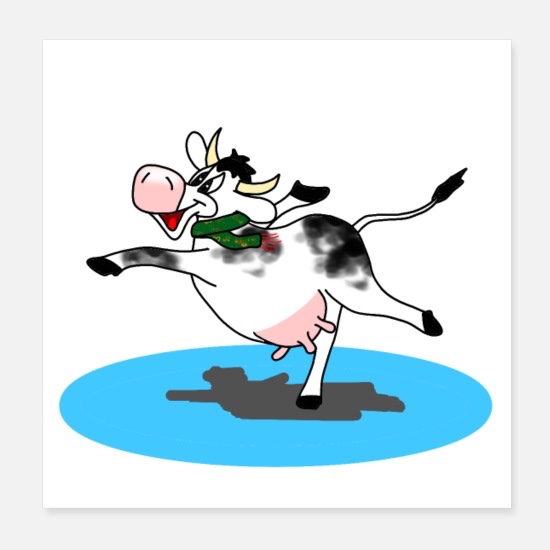
With all the open air ice skating going on at the moment, I am reminded of the Swedish expression ‘Det är ingen ko på isen’ or ’there’s no cow on the ice’. This expression is used to mean there is ‘ no need for worry’ or ‘don’t be concerned’. So, where does the expression originate?
Well, like many Swedish expressions, this one also has a rural origin. In the old days, farmers that had no running water would take their cows down to the lake to drink. As long as the cows stayed on land, and didn’t venture onto the frozen waters, there was no risk of them falling through the ice and drowning. In fact, the expression is an abbreviation of the longer saying ‘there’s no cow on the ice as long as their rear end is on land’. (Det är ingen ko på isen så länge stjärten är i land.) As long as they had a firm footing, they could rescue themselves if the ice broke around the periphery of the lake.
Like many places around the world, Swedes celebrate Valentine’s Day on February 14th. Called ‘Alla Hjärtans Dag’ – All Hearts’ Day – it is a newish tradition that started around 50 years ago, but didn’t really gain traction until the 1990’s. American influence and commercialization are often cited as the reasons for this. I also think that it’s a timing issue – the month of February is an otherwise boring time of year in Sweden. A little celebration is a small distraction from the tedium.
In Sweden, Valentine’s wishes are not only limited to love interests, but also extended to children, friends and even school teachers.
Romantically, the most common Valentine’s gifts are flowers, and treating your loved one to a nice dinner, in a restaurant or at home. Approximately 10 million red roses are sold around this day, which is huge considering the population is also 10 million.
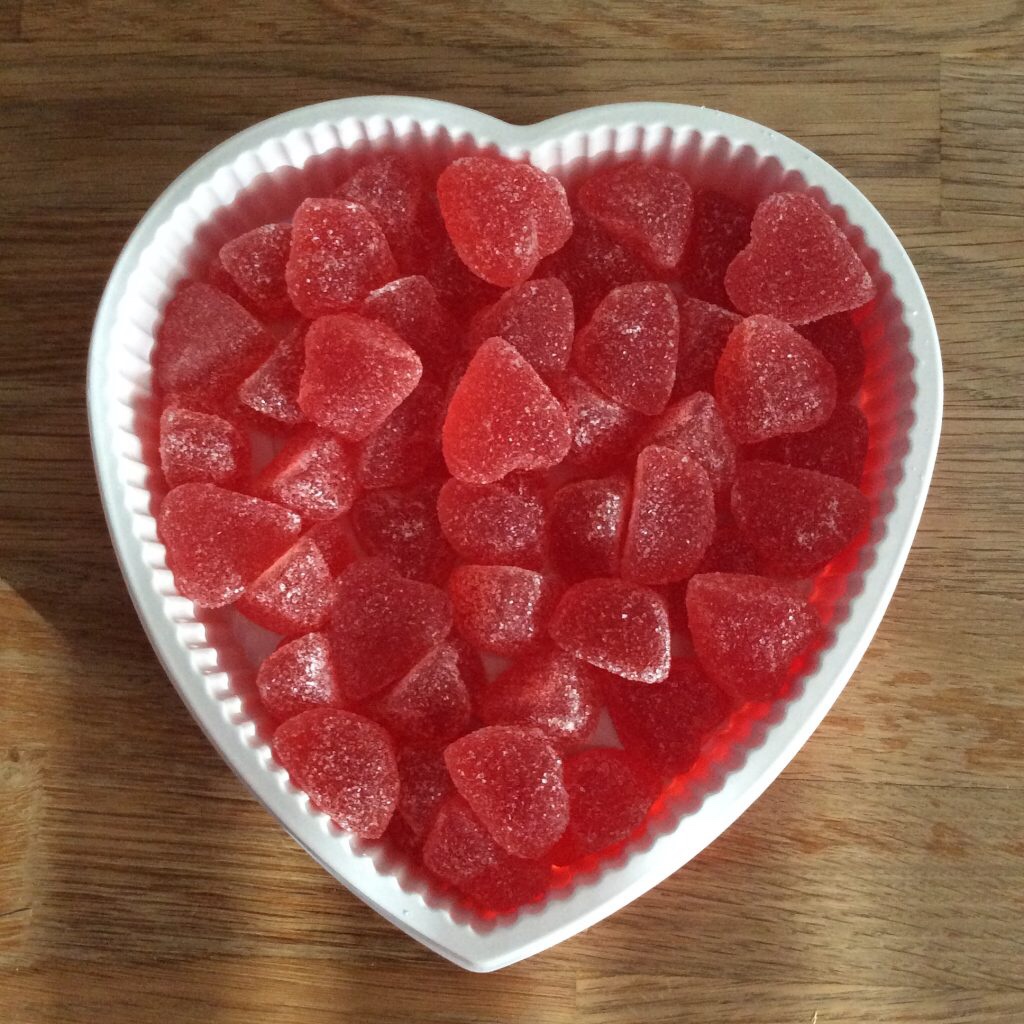
Heart-shaped candy is also popular, and in Sweden the most common is ‘jelly hearts’. Sales of chocolate and candy apparently increase by 90% every year around Valentine’s Day.
So, I might not have flowers or chocolates to give you, but I’d like to wish each of you a Happy Valentine’s Day. I appreciate that you want to read my writing, and in return I send you some loving energy. I hope you have love and affection in your life and that, when the day comes, you can celebrate with a long, warm hug!
I’ve written previously about the cream bun called a semla that is eaten around this time of year in Sweden. Traditionally consumed on Shrove Tuesday, this is a sweet, wheat bun filled with whipped cream and almond paste. And it is de-lish-us.
However, there is a way to eat it that I have never got on board with. A traditional method called the ‘hetvägg’, which translates literally a ‘hot wall.’ This is when the semla is placed into a bowl of warm milk, and eaten with a spoon. The result is a sugary, creamy slop.
The ‘hetvägg’ has a long history, going way back to the 1700’s when a warm, wedge-shaped spiced bun was served in a bowl of warm milk. This was eaten around Europe. In fact, the name ‘hetvägg’ has nothing to do with ‘hot wall’, but comes from the German for ‘hot wedge’ – “heisse wecke”. The top of today’s semla is often wedge-shaped as a historical nod to the original bun.
It is said that King Adolf Fredrik died from eating too many ‘hetvägg’ in 1771, but in fact it was a heart attack. Granted, he was a gluttonous man, and eating ‘hetvägg’ was indeed part of his questionable diet. After his death, there was a call to ban the sugary treat, as it was rumoured to have murdered the king.
The ‘hetvägg’ wasn’t banned and today it is still a popular way to consume the semla. I personally prefer mine dry and fluffy. But, hey, as they say in Swedish – ‘taste is like the backside – divided!’
Today is my birthday, but it’s not the first time I’m celebrating in Sweden. I must have had at least 20 birthdays here. This year is a bit special since big parties are not allowed, so it got me thinking what is typical about celebrating birthdays in Sweden?
1) Wake up call – Swedes who do not live in a single household are usually woken up early in the morning by friends or family coming into the bedroom with bubbly, breakfast, and gifts. The breakfast tray is often adorned with a candle. This is a lovely way to wake up, unless you’re not a morning person that is.
2) Singing – Swedes love to sing, in general, and they usually sing when they carry out the morning wake up call. The Swedish birthday song is a cheerful melody entitled ‘ja, må han/hon leva’. This translates as ‘yes, may he/she live (for a hundred years)..’ Curiously, there’s no mention of birthday in the Swedish song, unlike the English ‘Happy Birthday to You.’ After the singing, there is traditionally a ‘hurra’ at the end of the song. In most of Sweden, there are four ‘hurras’ but in the county of Skåne only three – hurra, hurra, hurra!
3) Green cake. A popular birthday cake is a green, marzipan clad cake called a ’Princesstårta’. Full of whipped cream, it’s a sickly treat. It seems ungracious but in Sweden, the celebrant themselves is responsible for bringing their own cake with them if they want to be celebrated in the work place.
4) Gift giving is usual in Sweden when somebody has their birthday. Usually, gifts are unostentatious such as flowers, chocolates, wine or something small and meaningful. Gifts for children tend to be more plentiful. A common group gift is to take the celebrant out to a restaurant. At some point during the dinner, a slightly self-conscious ‘Ja, må hon/han leva’ is sung.
5) The round number. Birthdays that end with a ‘0’ tend to be celebrated larger than others in Sweden as they are seen as a milestone. Swedes will often have a big party or will travel away with friends and family to warmer climes. Since neither are currently permitted in the shadow of the pandemic, birthdays with round numbers are celebrated in a smaller fashion or postponed to a later year.
Celebrating birthdays in Sweden became popular during the 1600’s in the Royal Court. Towards the end of the 1800’s it made its way into the general population. Important birthdays that are celebrated a little extra are 18, when a person comes of age, 20 when a person can legally buy alcohol and 65, when they retire. At the age of 100, Swedes receive a telegram from the monarch. According to Sweden’s Statistic Agency, the most common birthday in Sweden is 15 April. The least common, other than 29 February, is the 21 November.





 Watching the Swedes