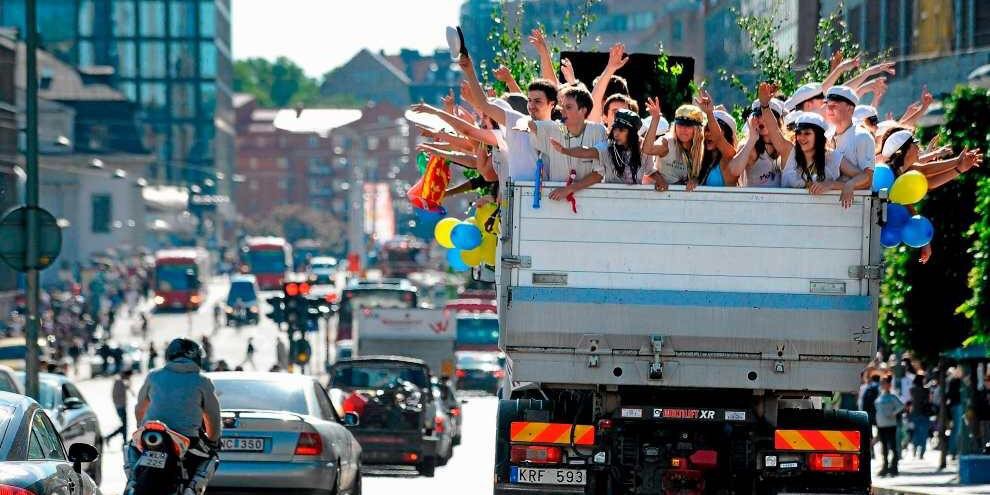
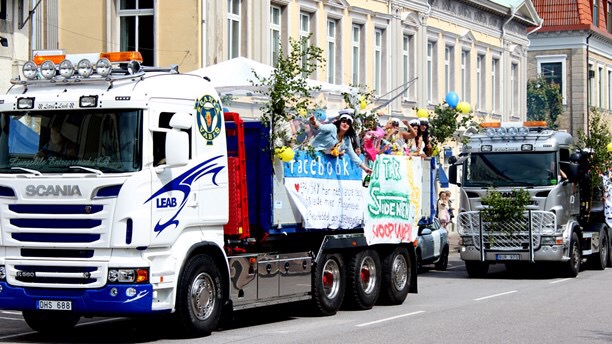
Swedish students on a truck 


This time of the year, a common sight on the streets of Sweden is students on trucks. Dressed in traditional white caps, and bolstered with alcohol, the students jump up and down to the booming music from loud speakers concealed in the vehicle. They scream and shout and spray beer on each other and sometimes unsuspecting pedestrians. They are celebrating the end of their school career. Most of them are 19 years old and have just graduated from Sixth Form College/High School. 
Every year the media reports accidents and injuries, which is not entirely unexpected. And trucks have been banned from certain roads and areas in the towns. 

In Sweden, doing ‘studenten’, as it’s called in Swedish, is a major rite of passage into adult life. The youngsters finish their last day at school, come running out of the building to be greeted by waiting parents and families. They then climb aboard their trucks for their lap of honour. After that they go around to each other’s homes where each family usually arranges a reception to honour the newly-graduated student. 

It is a common sight on the streets of Sweden and a refreshing reminder of the hopefulness of youth. 

What kind of streets does Sweden want?

majority-rule--1

Yesterday, hundreds of people gathered for a peaceful manifestation in the centre of Stockholm. They listened to live music and speeches and they sang and danced. The manifestation was being held to shine a light on the rights of unaccompanied refugee children in Sweden.

About 30 people from a right-wing group decided to attack the demonstrators with verbal abuse, threats, kicks and punches. Many of the victims were teenagers who were left shocked, scared and even more isolated from the society that is hosting them.

Is this what we want the streets of Sweden to be like? Groups of thugs attacking peaceful demonstrators and youngsters? In my world, this is totally unacceptable.

Democracy in Sweden is about having the right to express your opinion, whatever the political colour. It is about creating change through dialogue and activism. It is about getting involved and giving your opinion. It is not about employeeing violent methods to subdue and placate contradicting points of view. It is not about threatening and trolling and spewing hate. It is not about spreading fear in others just because I am fearful myself.

As members of an open, democratic country, each and every one of us should verbally and actively condemn what happened yesterday in Stockholm. A few short weeks after the love manifestation that filled the streets of the capital, we should not accept this attempt to drag our democracy into the shadows. This is not what we want on our streets, in our homes or in our society.

Yesterday, after the attack was over, people stayed behind to console and comfort the teenagers who has been brutally attacked. According to a witness, one of the teenagers found a thread of strength from within. He stood up and held a heartfelt, dignified speech – in Swedish. And he finished with a song – ‘Sverige’ (Sweden) by pop group Kent. One of the lines goes something like this:

‘Welcome, welcome here. Whoever you are, wherever you are.’

In that one song, this teenager showed us all what is means to be dignified and strong in the face of adversity. Violence and hate is not welcome here.


Terror on the streets of Stockholm 


At 2.30pm yesterday, a masked man stole a delivery truck from outside of a restaurant. The delivery man tried to stop the thief by standing in front of his truck.  However, the thief pushed over the driver, picked up speed and proceeded to drive zig zag down Stockholm’s main pedestrian shopping street, ploughing into people as he went. The truck’s final destination was one of Sweden’s largest department stores, into which it smashed in a billowing cloud of smoke. 

Like everybody else I was really shaken up by this act of violence.  I, and my nearest and dearest, were all in safety and my phone rang and beeped frenetically as we contacted and reassured each other. 

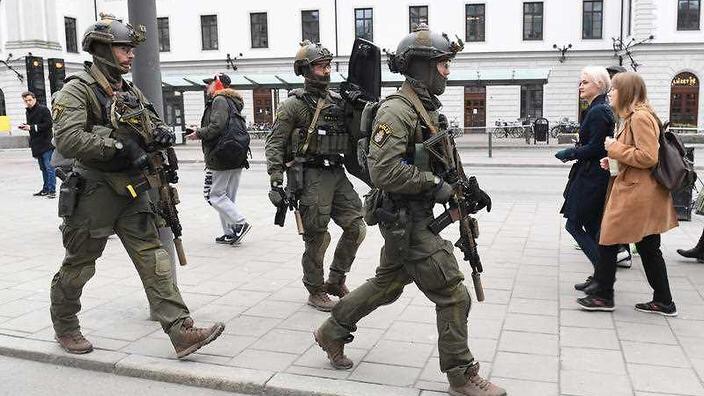
Stories reached me about friends being locked into their offices or hiding out in shops and restaurants. The streets were awash with armed police, and the whole city was shut down within 20 minutes – trains, buses and the underground were all stopped and roads were cordoned off as residents and tourists were rapidly ushered out of the city center. 

In the midst of the chaos, Stockholmers reached out to each other in support. People opened their homes to provide sanctuary to each other, cafes provided food and beverages, social media was flooded with people offering to help and offering protection. In this emergency, love prevailed – which was moving and heart-warming. I myself was in a gym, and the doors were locked. The staff went straight to action providing us with support and offering food and drink and unscheduled training classes for those who wanted a distraction. 

The latest news at time of writing this blog is that 4 people and 1 dog were killed, and 15 seriously injured. The driver has been arrested.  Another person is in custody believed to have some connection to the driver. Border control has been tightened up and there are still disturbances in local traffic. 

Stockholm now joins the long line of cities such as London, Berlin, St Petersburg, Paris and Nice, who have suffered under terrorist attack. 

No matter who is responsible for this act of violence, be it an organisation or an individual, we must never give into them.  The nature of terrorism is to spread fear by using intentionally indiscriminate acts of violence. It’s its indiscriminate approach that makes it difficult to predict and we are often powerless to influence it. Therefore we should do what we do best – not bow down to it but stand up and keep going. It is by living our lives in our open, democratic societies that we win.

I sincerely hope that Stockholm does not become a fearful, suspicious, closed city. This place that I love is a target because of its freedom and that is a freedom we should protect by continuing to live our lives. 

Terror will never win. It is designed to exploit our human fear. It is the ultimate act of intimidation. We must not let it win. My heart goes out to the victims and their families. Yesterday, we showed love to each other. Let’s continue to do that. We do not need more hate. 

We must prevail. 

Segregation on a Swedish school bus

school bus

In Sweden, the school system contains many independant schools run with a specific focus such as music, sport, art or specific religions. They should all follow the national curriculum and, in the case of religious schools, they should teach but not preach.

Yesterday, it was revealed that a Stockholm junior school with an islamic orientation has been segregating children on the school bus – boys go through the front entrance and sit at the front, girls go in the rear entrance and sit at the back of the bus. The headmaster of the school has claimed to be unaware of this. This act of segregation has caused a hot debate in Sweden about the ‘islamifying of Sweden’, ‘gender apartheid’ and comments such as it being ‘unSwedish’.

The Swedish Schools Inspectorate are planning on investigating the school further to see if any other ‘undemocratic activities’ are taking place. The Inspectorate has previously allowed segregated classrooms and gender-separated sport lessons.

What can we learn from this?

When this kind of occurance happens in society, it is a great opportunity to reflect on what we learn from it. What is our immediate reaction when we hear examples like this?

  • Do we run straight to the barracades and start defending our cultural heritage?
  • Do we condemn the occurance as, for example, undemocratic or unacceptable?
  • Do we weigh up the pros and cons and try to arrive at a balanced conclusion?
  • Do we think people are allowed to do whatever they want, so anything goes?

All of these are perfectly normal reactions, and one is not better than the other. Obviously, we react in different ways.

I think that these occurances in society provide us with a great opportunity to discuss intercultural competence. Being interculturally competent is generally defined as having an open mindset and the cultural sensitivity to see different perspectives so that one is able to flexibly adapt ones behaviours accordingly. But that doesn’t necessarily mean it’s about accepting that anything is ok. Intercultural competence can also mean balancing up the various perspectives and standing up for what one thinks is acceptable.

Intercultural competence differs significantly from racism and nationalism. Racism and nationalism focus on others being of lower value than myself or the place I come from. Intercultural competence is about accepting everybody’s perspectives are equally as valid – no matter how tough they are and even if I personally don’t agree with some of them.

So how do we arrive at this place of understanding that all perspectives are equally as valid? We can ask ourselves a simple, but complex, question:

‘What do they think is good about segregating boys and girls on a school bus?’

If we can arrive at the answer(s) to that question, we are becoming more interculturally aware and more interculturally competent. We are seeing the situation from their perspective and not only our own. We are presuming they have a good reason, from their perspective, for their behaviour, rather than immediately judging or condemning it.

Once we have reflected over that, we can decide what we personally think. Does it change our point of view? Can we accept their behaviour more easily? Or does it make me hold my view even more stongly? In that situation, we can say something like:

‘I understand why you think it’s good to segregate boys and girls. I understand your perspective. However, I disagree with it. And here in Sweden, we believe in equal treatment of all regardless of their gender, which is why that behaviour is not something we as a society can accept.’

Compared this to the more reactionary ‘the Islamists are trying to take over Sweden!’ and ‘this country is going down the drain’, you see how the ability to perspectives-take creates a more open, less fearful debate.

It is my belief that if we approach occurances like this in a more interculturally competent way, and try to perspectives-take, we can create a society built on mutual understanding and respect for prevailing values rather than a society built on fear and suspicion.

And that has to be a good thing moving forward, doesn’t it?


How Swedes indoctrinate their children

tittamaxgrav

A friend of mine was visiting at the weekend with her small child, and she forgot one of her books when she left. I looked through it and was struck by how the story book reflected Swedish society and lifestyle: a picture book designed to groom children in the Swedish way.

The book is called ‘Titta Max grav’‘Look, Max’s grave!‘ – and it was first published in 1991 and written by Barbro Lindgren and Eva Eriksson. The book is a fascinating account of the life of a little boy called Max from the cradle to the grave. He is born, learns to walk and talk, gets a dog, goes to school, becomes a banker, finds a woman (unclear if they are married), has a child. But then it all goes downhill for Max. He watches too much television, so his woman gets sick of him and leaves. He gets sick, wants to consume Swedish ‘snus’ (snuff), gets sicker and eventually dies alone. And the final picture – look, Max’s grave.

The ‘simple’ story promotes many Swedish values which guide Swedish society: all children receive an education, men and women don’t have to be married to have children, women are empowered to leave useless men, everybody receives healthcare, many people die alone.

There’s nothing specifically unique about this particular book. All cultures pass on their values to their children via stories. Sometimes these are verbal stories told by grandparents as they entertain their grandchildren. Sometimes these are communicated via tv or other screens to curious minds.

Very often they are transmitted via ‘simple’ books full of pictures and easy words by parents at bedtime. But these books are actually not simple at all: they are cultural mechanisms designed to pass on values and ethics and indoctrinate children into the prevailing sense of morality.

So those of you with small children. Have you refelcted over what the stories are teaching your children? How are you indoctrinating them?


And today Sweden celebrates……?

tranafton


I was looking through a paper today and I read that today it is Transafton (‘afton’ means ‘Eve’ in Swedish) in Southern Sweden.

‘Wow’, I thought, ‘isn’t that great that they have a special Eve to celebrate transgender people in the South of Sweden. Very impressive

However, upon closer inspection, I realised my error – it didn’t say ‘transafton’.

It actually said ‘tranafton’.

After my bubble was burst, my curiosity became aroused.

Tranafton? What is that? After over 20 years of living in Sweden, I have never heard of Tranafton. I know that a  ‘tran’ in Swedish is the bird called ‘crane’ in English. But why a ‘Crane Eve’?

So I looked it up.

The 24th of March is known as Tranafton in Southern and mid Sweden and has been documented since the 1500’s.  . It was said that the crane returned on this day after its winter migration. This was seen as a sign of spring as it brought the light with it. Now it was so light outside that people did not need to light candles inside their houses. On Tranafton it was important to go to bed while it was still light, otherwise you might be subjected to tricks and name-calling.

On Tranafton, children ran outside barefoot – often three laps around the house. The supersition was that this would build up their immune system and make them strong and resilient. In the Swedish counties of Värmland and Dalsland, this was done dressed in bird costumes – a ritual known as ‘running crane’. In West Sweden, children hung stockings infront of the fire and the crane would come and fill them with gifts. This tradition has mostly died out today, but still exists in a handful of villages in Småland, Värmland and on Öland.

So if you are at a loss for what to do this evening – go out and run the crane to celebrate the arrival of the light. But remember, just to be safe, go to bed before it’s dark.


Swedish art – a new world?

karin-mamma-andersson
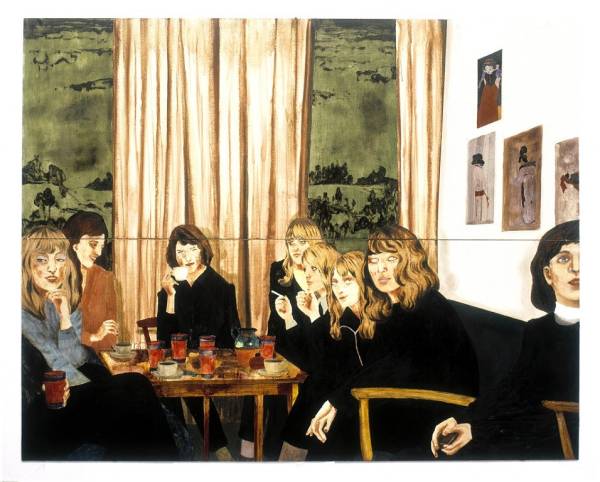
Karin Mamma Andersson – About a girl, (2005)


Going to the supermarket this weekend? Well, maybe not in the way you think….

This weekend, in Stockholm, is an art fair called Supermarket, which is an international artist-run fair that showcases artists from Sweden and all over the world. If you’re in Stockholm, it could be worth a visit. Here’s the link:SupermarketArtFair2017

Sweden and Art – is that a natural connection for you? How much do you know about Swedish art? If you are an art lover, then Sweden may very well be an undiscovered treasure trove for you.

Sweden has a strong artistic tradition and the art that is produced here often reflects the time and place in which it’s created. Art is good at that – at being the window to our souls, a kind of visual temperature check on how we as a society are feeling at that precise moment.

Let’s take the art form of painting as an example.

Looking back through history, there are many Swedish painters who became giants in their field. Very famous here, maybe not so famous outside of Sweden to those other than the die hards.

Ask somebody to name an artist and names such as Picasso, Rembrandt, Monet, Van Gogh, Kahlo probably come up. Probably names such as Larsson, Zorn, Bauer, Brate, Nyström, Jolin don’t come up in the first pass.

But maybe this is exactly what makes it so exciting. If you know nothing about Swedish artists, a whole world is waiting for you to discover.

Maybe you’re interested in discovering new Romantic art? Then check out traditionalists Carl Larsson and Anders Zorn. They were contemporaries and painted delightful pictures of Swedish pastoral life in the 1800’s, early 1900’s.

Or what if expressionism is more your cup of tea? Then check out Einar Jolin’s and Isaac Grunewald’s fabulous interpretations of Swedish society around the 1920’s. Or look up the post-impressionist Nils Dardel and his renound painting ‘The Dying Dandy’ painted in 1918.

Or is it contemporary art that rings your bell? Current painters who are worth looking into are Karin Mamma Andersson, Lars Lerin, Marie Louise Ekman, Linn Fernström, Peter Dahl and Sara-Vide Ericsson. And there are many more.

Or perhaps you want to buy some art, or make some connections? Then get yourself along to Supermarket and get inspired!

Your Swedish money’s  worth nothing 


Go through your pockets. Empty your piggy bank. Clean out your drawers. Start using up your money now, because from June 30th 2017, much of your Swedish currency will be invalid. 
Recently, Sweden introduced a new range of bank notes featuring Swedish celebrities: writer Astrid Lindgren, Hollywood actress Greta Garbo, troubadour Evert Taube, opera singer Birgit Nilsson, politician Dag Hammarsköld and film director Ingemar Bergman. In line with this, old bank notes and coins are being successively phased out. 

From June 30th this year, the older 100 and 500 krona notes and the 1, 2 & 5 krona coins will become invalid. The only old coin left in circulation will be the 10 krona coin. 

So start rummaging through your private areas, you might have a small fortune hidden there! 

How Swedes have sex

sea-of-nudity

One of the major stereotypes of Swedes is that they are sexually liberated.

Twenty years ago, a large research project on 2800 people was carried out looking into how Swedes view sex. Participants were between 18-74 years old. In comparison to many other countries, Sweden was consequently seen as a place that has a liberal view on sex. Now this research is about to be carried out again, to see what, if anything, has changed in the last two decades. The suspicion is that a lot has changed in the last twenty years.

So what did the results look like 20 years ago?

Here’s a summary, courtesy of daily newspaper DN.

In 1996,

  • Sexual debut was on average 16 years old
  • The average woman had 4,6 sexual partners
  • The average man had had sex with 7,1 people on average
  • Swedes between 26-55 had the most sex
  • Sexual activity had increased since the previous study in 1967, except between the ages 31-50 were there was a decrease, probably due to work pressure
  • The top 10% were called ‘superactives’ and the men had slept with 29-560 people and the women had slept with 15-100 people
  • 38% of the Swedes had experience of sexual relations outside of their committed relationship
  • The average amount of penetrative sex was 65 times per year
  • 15-20% of women had same-sex fantasies, 3% of men.
  • Women more frequently reported a diminshing interest in sex. Difficulty to achieve orgasm was the most common reason. Amongst the men who claimed the same reduced desire, premature ejaculation was the most common reason.

 The last time they had sex,

  • 95% had had vaginal sex
  • 59-72% had carressed eachother’s genitals
  • 25% had oral sex
  • 1% had anal sex
  • 71% of men orgasmed, 62% of women acheived orgasm
  • 80% had sex with their husband, wife, partner
  • 5-6% had sex with a friend or casual partner
  • 1% had met via a contact ad


In the last twenty years, a lot has happened in Sweden. Easy sexual contacts via aps such as Grindr and Tinder makes sex more accessible. Young people who experiment with their sexualities, and refuse to identify as hetero or homo, is more common than twenty years ago. On the other hand, Sweden is a more multi-cultural society than before and attitudes to sexuality may well be influenced by religion, culture and a new restrictive morality. It will be interesting to read what the results of the new survey reveal.

What do you think? How have things changed?

Let me know in the comments below.