Advent Calendar – Dec 10: Nobeldagen

Window number 10. Today’s word is ‘Nobeldagen‘ which translates as ‘Nobel Day’.

Nobel Day is not actually anything to do with Christmas. However, it is a traditional part of the lead up to Christmas. Every year on 10 December, since 1901, the Nobel Prizes are awarded. The date commemorates the death of Alfred Nobel in 1896.

Nobel prizes are awarded in the 6 categories of Literature, Chemistry, Physics, Medicine or Physiology, Economics and Peace. All prizes are awarded in Stockholm, except the peace prize which is awarded in Oslo. Laureates receive a gold medal, a diploma and 10 million Swedish crowns.

Most laureates are happy to accept their prize and the accolade. However, Jean Paul Satre famously declined the Literature Prize in 1964, claiming he did not want to be institutionalized.

In 1974 he was joined by Le Duc Tbo who refused to accept the Peace Prize for his work to end the Vietnam War, saying ‘peace has not yet been established.’

In 1935, German journalist Carl von Ossietzky – a vocal critic of Hitler- won the Peace Prize. This led Hitler to bar all Germans from accepting a Nobel Prize. Three German laureates were subsequently forced to decline their awards. However, they later were presented with their diplomas and medals.

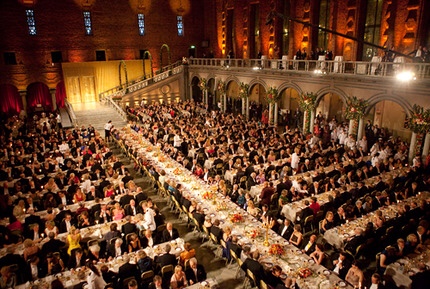
With celebratory lectures, conversations, ceremonies and concerts, Nobel Day culminates with a banquet in the Stockholm City Hall. The banquet lasts about 3 and a half hours and is televised. It is an extremely grand and formal occasion. Everything from the porcelain to the floral arrangements to the dresses, the entertainment and the menu are under scrutiny for the tv viewers.

The guests include not only the Nobel laureates and their families, but also Swedish royals and aristocrats, politicians, ministers, celebrities and other notable people. Even though there are 1300 guests, is virtually impossible for ordinary folk to get an invitation to the banquet. We have to enjoy it from afar, via the screens in our living rooms.

However exclusive the whole thing might be, it is still a welcome splash of glamour in the dark approach to Christmas. Stockholmers are also treated to the light festival called Nobel Lights, which takes place around the city.

Advent Calendar – Dec 9: Julbelysning

Every day, I will open a window containing a Swedish word that has something to do with Christmas and the festive season.

Today’s word is ‘Julbelysning‘ which translates as ‘Christmas lights’.

Like others around the world, Sweden’s cities and towns install public Christmas lights this time of the year. These decorations illuminate the dark December days and are an important part of building up the Christmas cheer at an otherwise miserable time of the year.

Currently Stockholm is populated with twinkling elk, reindeer, pine cones, angels, stars and fir trees. The same applies to Gothenburg, where there is also a giant red love heart on Lejontrappan. In Malmö, 500,000 lights have been switched on in a celebration called Winter in the City.

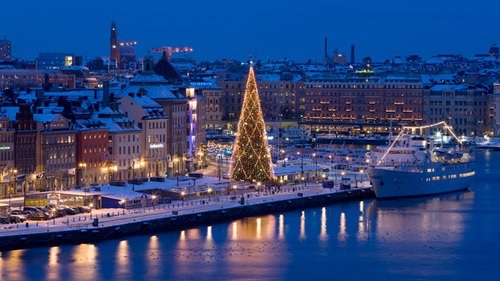
Since 1996, on Skeppsbron in Stockholm, the city’s largest Christmas tree has been positioned. An enormous, impressive tree that towers over the buildings of the Old Town and spreads its light over the harbour. The tree in actual fact isn’t a real tree – it is constructed over a central pole with branches attached to it. In doing so, the tree is pleasingly symmetrical.

If you’d like to walk around and see the lights in Stockholm, the city has produced a map which you can find on http://www.stockholmsjul.se

This week is also Nobel week in Stockholm and a light festival called Nobel Lights is taking place. Monuments and buildings around the city are decorated and transformed with projected light shows. The display on the City Hall is particularly spectacular. More information on http://www.nobelweeklights.se

Advent Calendar – Dec 8: Ernst

December 8th window: ‘Ernst‘ which translates as, well… Ernst.

What on earth is an Ernst you might wonder? Well, the question should rather be ‘who’ is Ernst.

Ernst Kirschsteiger is a person who, by many, is considered to be Mr Christmas in Sweden. He is a very popular interior designer. After a hiatus, the 65-year old is back this year with his TV program called Ernst’s Christmas.

In his program he simply explodes festive spirit. He decorates and bakes and creates. He wallpapers and chisels and hammers. He sews and paints and he crafts. I would describe his design ethic as a nature-oriented retro scandi chic. He has a poetic, philosophical attitude to interior design coupled with practical solutions.

One week he made, for example, Christmas decorations out of mandarin peel and wire and inspired us with a wreath of dried garden flowers, moss and brussel sprouts.

Some people find him very cheesy and goofy but he has definitely cornered the market on Christmas coziness. Many viewers see him as the idea of male perfection – a sensitive man who cooks, builds and decorates the home – all wrapped up in one sweet Christmas treat.

Since his tv debut in 2000, Ernst Kirschsteiger has grown to be a phenomena who only needs referring to by his first name, like Cher, Madonna and Prince. So popular is he that a book of his quotes and poetic wisdoms called ‘Ernstologi’ was released in 2006 and became a popular Christmas present that year.

If you want to witness the phenomena (in Swedish however), watch this YouTube clip and enjoy!

Advent Calender Dec 6: Julmarknad

Window 6: Today’s word is ‘Julmarknad‘ which translates as ‘Christmas Market’

A popular recurring event during the weeks leading up to Christmas in Sweden is the Julmarknad – the Christmas Market.

Christmas markets are a very cosy affair. Here you can walk around and enjoy the smell of glögg and roasted chestnuts. You can listen to the sound of Christmas carols echoing through the air. You can bathe in the lights and decorations strewn around the marketplace. And you can see traditional handicrafts and locally produced goods on sale, such as scarves, hats, festive food and decorations. If you’re lucky, snow is tumbling down and crunching under foot. The whole thing feels like being momentarily caught in a giant snow globe.

Christmas markets have been around in Sweden since the 1800’s and take place up and down the country on town squares, in gardens, in museums, farms, barns, greenhouses, castles, garden centers and stately homes.

In Stockholm, the most popular markets are in Skansen and on the main square in the Old Town. The Royal Palace of Drottningholm and Taxinge Castle outside Stockholm are also popular, as is the small picture-postcard town of Sigtuna about an hour north of the capital.

In Gothenburg, the market at Liseberg is a popular experience and in Malmö head to the market on Gustav Adolf Square.

For information in Swedish about Christmas markets, check http://www.julmarknad.nu

Advent Calendar Dec 5: Julmust

Every day, I will open a window containing a Swedish word that has something to do with Christmas and the festive season.

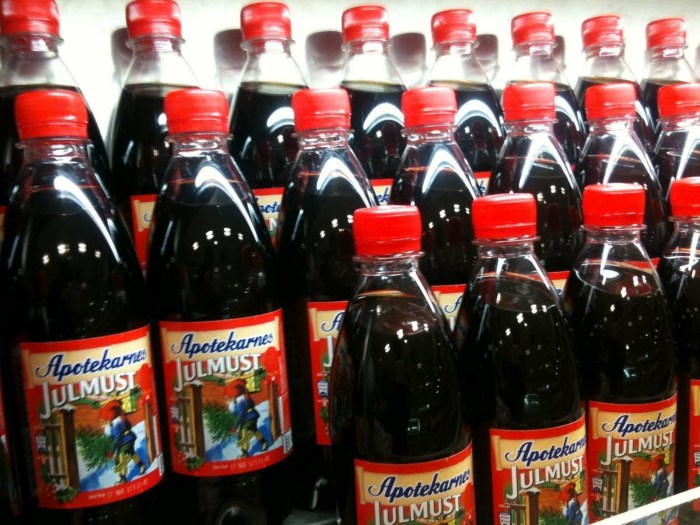
Today’s word is ‘Julmust‘ which is a fizzy Christmas beverage.

I would venture to say every Swede likes to drink at least one glass of julmust at Christmas. However, according to statistics it is even more!

Apparently, Swedes drink an average of 5 litres per person of the fizzy drink during December. The alcohol-free bottled soft drink comes in different sizes, fully sugared and also in diet form.

Said to include over 30 ingredients, its actual recipe is top secret, only known to three people. Despite all the cloak and dagger stuff, the connoisseur can detect the flavour of hops and malt. The taste is reminiscent of the old-fashioned ‘Dandelion and Burdock’ drink for those of you that understand that British reference.

Julmust was invented by a teetotaler and sales began in 1910 as an alternative to ale and port. Although intended to be alcohol-free, the drink can be mixed with gin, vodka, rum or Jägermeister to make Christmassy cocktails. When blended with porter or stout and other ingredients, it creates a classic Christmas drink called Mumma.

I have even drunk julmust mixed with red wine – a so called Kalimusto. I recommend trying the experience – although it actually is a fairly unpleasant one!

If you live outside of Sweden and want to try julmust, head to your nearest Ikea! Called Vintersaga, they sell the beverage in 500ml bottles.

Advent Calendar Dec 4: Julkalendern

Every day, I will open a window containing a Swedish word that has something to do with Christmas and the festive season.

Today’s word is ‘Julkalendern‘ which translates as ‘Christmas Calendar’

Julkalendern is a television series broadcast on Swedish TV every day in December leading up to Christmas Eve. It is a popular and heavily-anticipated program that children and adults traditionally watch at 7.15 in the morning (or on line). Typically each episode is 15 minutes long, and every year there is a new story.

The first Julkalendern was broadcast in 1960 and was called ‘Titteliture’. In 2016, a competition was held to vote for the all-time favourite Julkalendern. It was won by a series called ‘Sune’s Christmas’ (1991) followed by ‘The Mystery at Greveholm’ (1996), ‘Time of the Trolls’ (1979) and ‘The old woman who shrunk to the size of a teaspoon’ (1967).

This year, the series is a continuation of 1979’s ‘Time of the Trolls’ – ‘ Legend of the Mountain Troll. ‘

And so it is Advent – Swedish style


Today, the first of Advent, the light shines strong in the darkness.

Since the 1930’s Swedes have decorated their homes with lights from the first of Advent. The tradition was inspired from Germany, where the Advent star had been a popular decoration since the 1880’s. The star symbolizes the star of Bethlehem that guided the three wise men to the stable, where the baby Jesus lay in a manger.

Today, the star has lost most of its religious symbolism. In Sweden, illuminated advent stars are hung in windows. On window ledges, electric advent candles are placed. Gardens and balconies are decorated with fairy lights. On tables, four candles are positioned and one is lit every Sunday up until Christmas. Small candles, often red, are dotted about the home. Some people change curtains and populate their homes with small gnomes and fragrant flowers.

Since November is often a grim month, the collective advent decoration is a welcome arrival as light is spread into the murky places. From the dark street, it is lovely to see windows lit up in every apartment.

This weekend is also the starting signal for the Swedish ‘glöggfest’. People go to each other’s homes and drink ‘glögg’ (mulled wine), eat gingerbread and saffron buns. It is a very cosy time of year.

Advent Calendar Dec 3: Gävlebocken

Every day, I will open a window containing a Swedish word that has something to do with the festive season.

Today’s word is ‘Gävlebocken‘ which translates as ‘The Gävle Goat’.

This strange tradition takes place in the Swedish town of Gävle. Every year, since 1966, a giant handcrafted straw goat is built up. And almost every year, it gets burned to the ground by a pyromaniac.

One year, it was even burned down before its inauguration. Consequently, the local authority have increased security and have managed to prevent the burning for the last three years.

The symbol of the goat is a traditional Christmas decoration in Sweden, called a ‘julbock’ – a Christmas goat. Usually made of straw, a goat is placed under the Christmas tree or small goats are hung from the branches. The symbol of the goat has ancestry in Scandinavia far back in Nordic mythology and, up to the 1800’s, it was the goat who brought presents during the festive season. A kind of precursor to Santa Claus.

So although the Christmas goat has endured for centuries, it remains to be seen if the Gävle goat survives until the New Year.

You can see a live feed of the goat on https://www.visitgavle.se/sv/gavlebocken

Its inauguration ceremony takes place today.

The Koran burnings in Sweden – legal, but unethical?

More than 90,000 articles have been written about the Koran burnings that are occurring in Sweden. The burnings have led to an escalated terrorist threat, international public protests, storming of embassies, burning of the Swedish flag, and condemnation from everyone from Turkey’s Erdogan to the Pope.

For many people outside Sweden it is hard to understand why the burnings are being permitted. The bottom line is that it is not against the law. The question is why is it not against the law.

It all boils down to understanding Sweden’s version of freedom of speech, expression and demonstration. In Sweden, you are allowed to publicly comment on, demonstrate against and criticize anything. Sweden’s centuries-old democracy is built on this.

Powers such as the royal family, industry giants or organized religions cannot legally stop or influence this. In secular Sweden, religion has no influence over politics. However, you are free to follow any religion you want, and this right is protected by law. Likewise you are free to criticize any religion you want.

With this understanding, you can see how the burning of books, including any religious scripture is allowed and not, per se, limited only to the Koran.

So you have to separate the law from ethics. Is it ethical? Maybe not. Is it illegal? No. This is why the Swedish government condemns the action but at the same time defends the right to self expression.

That said, there are other laws in Sweden that restrict public speech. For example, if it is considered hate speech, or incitement to violence, or against the interests of national security.

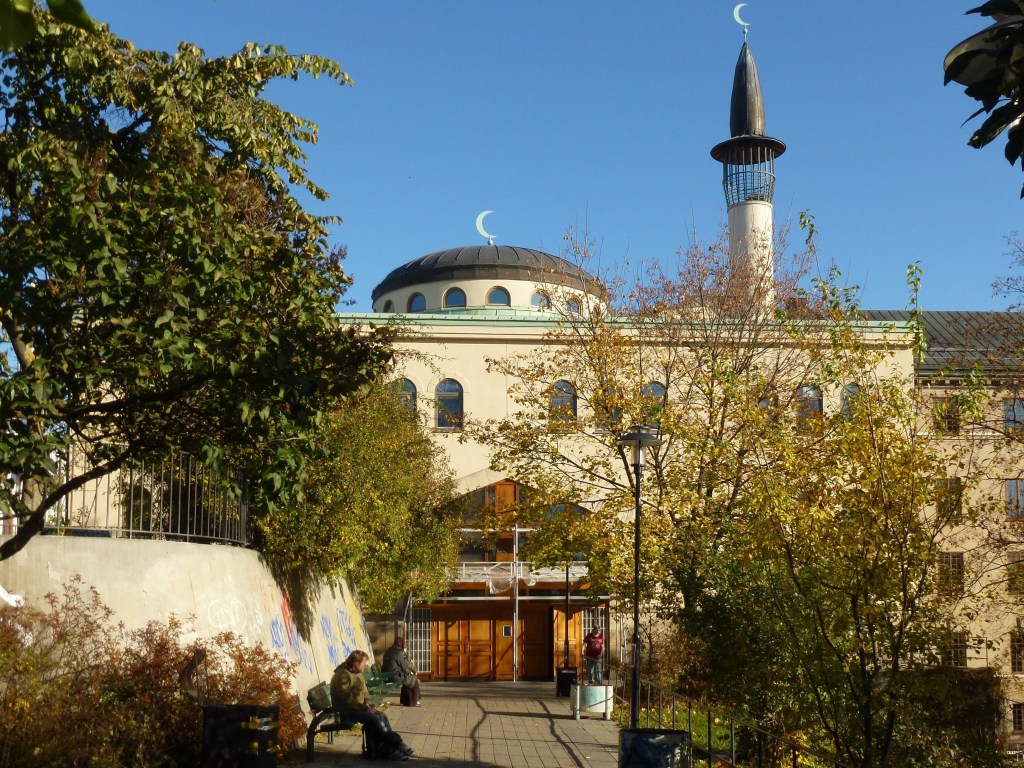
In the case of recent Koran burnings, outside a mosque on the first day of Eid, or outside the embassies of Muslim countries, and with today’s political instability, one can seriously question the police’s choice to allow such demonstrations to occur. Many Swedes say that it shows a poor sense of judgement and disregard for public safety and national security. But it isn’t illegal, and is fully in line with freedom of speech and demonstration.

Swedish law often looks at intent. At this could be the case with the Koran burnings moving forward. What is the intent of the demonstrators? Personally, I see it as a obvious provocation, an attempt to destabilize Swedish society and a direct insult to all the Swedish Muslims residing in the country.

Denmark has recently suggested a law change, based on the fact that the intent behind the action is malicious. The legislation will prohibit the inappropriate handling of objects with essential religious significance for a religious community. The Minister of Justice says ‘I fundamentally believe there are more civilised ways to express one’s views than burning things.’ I’m sure he is right. Changing the law isn’t about bowing down to the extremist demands of other nations, but showing respect for the diverse citizens of one’s own country.

Maybe it is time for Sweden to follow suit?

What are your thoughts on this current debate?

Why does Sweden still need Pride?

This week is Stockholm Pride. It culminates on Saturday with a huge parade. The event celebrates 25 years this year, and some people question if it is still needed or relevant.

The answer, unfortunately, is more than ever.

But we’ll come to that later.

Currently there are 73 Pride festivals in Sweden during the year. From Arctic Pride way up in the north to Malmö Pride in the south, it is possible to celebrate throughout the year.

This indicates that many Swedes seem to have embraced the concept of Pride with open arms. There is, of course, a commercial benefit but the main reason seems to be that LGBT+ Pride resonates well with the societal Swedish values of equality, tolerance and acceptance.

However, like everything, it has its opponents.

Sweden’s current conservative government is in power, solely with the support of a right-wing populistic party. This party has consistently attacked LGBT people and the Pride movement. For example, this week, one of their politicians tweeted that Pride legitimizes pedophilia.

It is comments like this that plant the seeds of aggressive counter demonstrations, homophobic, anti-Pride propaganda and personal physical attacks. LGBT+ people are still regularly abused, discriminated against and attacked in Sweden. And if we lift our eyes to the broader world, we see examples of LGBT + rights being restricted or removed, and same sex relations being criminalized and punishable with the death penalty.

This is why Pride is still needed, not only as a celebration, but as a political manifestation of human rights.

If you’d like to know where a Pride is near you, go to http://www.svenskapride.se which collects all the Swedish events in one place.