Watching the Swedes Advent Calendar – Dec 11: Nubbe

Welcome to the Watching the Swedes Advent Calendar. Every day, I will open a window containing a Swedish word that has something to do with Christmas and its approaching weeks.

Today’s word is ‘Nubbe‘ which is the colloquial word for an alcoholic shot known as snaps.

Nubbe, or snaps, is a really popular drink that Swedes enjoy at Christmas time. At its base, it is a strong spirit (30-38% alcohol content) called ‘brännvin’ which is distilled from potatoes or grain.

It can be plain and colourless, or flavoured with herbs and spices. Sometimes it can be sweet and infused with, for example blackcurrant, elderflower or raspberry. Others can be so bitter they make your toes curl – flavoured with for example aniseed, wort or wormwood. If it includes caraway or dill, it can according to EU patent protection be called akvavit.

A mouthful-size of ‘brännvin’ is called a snaps or a nubbe and it is drunk out of small glasses. Usually it is consumed when eating traditional food, and may also be accompanied by a ‘snapsvisa’ – a drinking song.

One popular drinking song at Christmas is called ‘Hej Tomtegubbar‘ which translates roughly as:

‘Hello goblins, fill your glasses and let’s be jolly together.

Hello goblins, fill your glasses and let’s be jolly together.

Our time is brief upon the earth, with many troubles and little mirth

Hello goblins, fill your glasses and let’s be jolly together.

After a few snapses, the party atmosphere usually begins – with more singing, speeches and maybe even some dancing. For Swedes, snaps is such an important tradition that it is drunk not only at Christmas but at most festive times – such as Easter, Midsummer and autumn’s crayfish party.

According to The Swedish alcohol monopoly, Swedes have been flavouring their ‘brännvin’ since the 1500’s and the word ‘Nubbe’ as a slang word for snaps turned up first in 1892.
Watching the Swedes Advent Calendar – Dec 10: Nobeldagen

Welcome to the Watching the Swedes Advent Calendar. Every day, I will open a window containing a Swedish word that has something to do with Christmas and its approaching weeks.

Today’s word is ‘Nobeldagen‘ which translates as ‘Nobel Day’.

Nobel Day is not actually anything to do with Christmas. However, it is a traditional part of the lead up to Christmas. Every year on 10 December, since 1901, the Nobel Prizes are awarded. The date commemorates the death of Alfred Nobel in 1896.

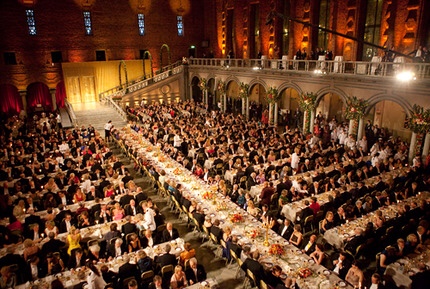
With celebratory lectures, ceremonies and concerts, the day culminates with a banquet in the City Hall. The banquet lasts about 3 and a half hours and is televised. It is an extremely grand and formal occasion. Everything from the porcelain to the floral arrangements to the dresses, the entertainment and the menu are under scrutiny for the tv viewers.

The guests include not only the Nobel laureates and their families, but also Swedish royals and aristocrats, politicians, ministers, celebrities and other notable people. Even though there are 1300 guests, is virtually impossible for ordinary folk to get an invitation to the banquet. We have to enjoy it from afar, via the flat screens in our living rooms.

However exclusive the whole thing might be, it is still a welcome splash of glamour in the dark approach to Christmas.

Watching the Swedes Advent Calendar – Dec 7: Julskinka

Welcome to the Watching the Swedes Advent Calendar. Every day, I will open a window containing a Swedish word that has something to do with Christmas and the festive season.

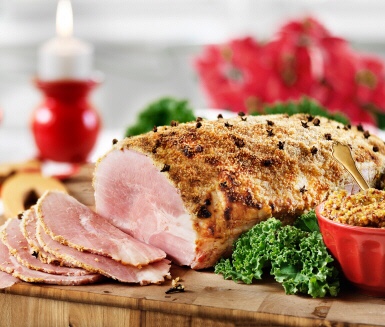
Today’s word is ‘Julskinka‘ which translates as ‘Christmas ham’ and is pronounced yule-hwinka (ish).

In the UK, I grew up eating roast turkey at Christmas. But in Sweden, it’s the ham that counts!

Swedes have been eating Christmas ham during the festive season since the 1800’s and many people consider it an obligatory part of the Christmas meal. Traditionally the cured ham is oven baked or boiled before it is coated in mustard and breadcrumbs and grill roasted. Here is a recipe.

The ham is often eaten with mustard and apple sauce. And the cold leftovers are eaten for days afterwards.

Many people these days don’t eat meat, and there are plenty of veggie alternatives to the julskinka from soya and Quorn hams to roasted cauliflower heads.

WtS Advent Calendar Dec 5: Julmust

Welcome to the Watching the Swedes (WtS) Advent Calendar. Every day, I will open a window containing a Swedish word that has something to do with Christmas and the festive season.

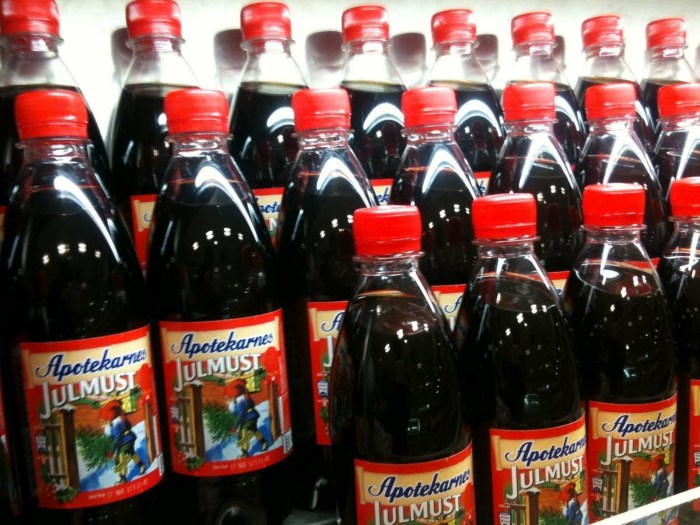
Today’s word is ‘Julmust‘ which is a fizzy Christmas beverage.

I would venture to say every Swede likes to drink at least one glass of julmust at Christmas. However, according to statistics it is even more! Apparently Swedes drink an average of 5 litres per person of the fizzy drink during December. The alcohol-free soft drink is bought in bottles at the supermarket and comes in different sizes, fully sugared and also in a diet form.

Said to include over 30 ingredients, its actual recipe is top secret, only known to three people. Despite all the cloak and dagger stuff, the connoisseur can detect the flavour of hops and malt. The taste is reminiscent of the old-fashioned ‘Dandelion and Burdock’ drink for those of you that understand that British reference.

Julmust was invented by a teetotaler and sales began in 1910 as an alternative to ale and port. Although intended to be alcohol-free, the drink is often blended into Christmassy cocktails or mixed with porter or stout and other ingredients to create a Christmas drink called Mumma.

I have even drunk it mixed with red wine – a so called Kalimusto. I recommend trying the experience – although it actually is a fairly unpleasant one!

WtS Advent Calender Dec 2 – Pepparkaka

Welcome to the Watching the Swedes (WtS) Advent Calendar

Every day leading up to Christmas, I will open a window containing a Swedish word that has something to do with Christmas and the festive season.

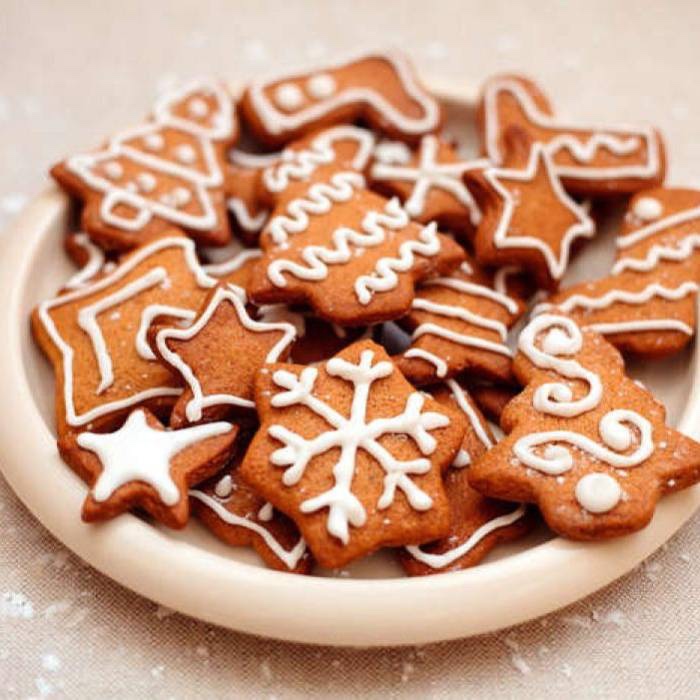
Today’s word is ‘pepparkaka‘, which translates as gingerbread.

Other than glögg, nothing else is more synonymous with the Swedish festive season than pepparkaka (gingerbread). The Swedish version of gingerbread comes in the form of thin crispy biscuits flavoured with cinnamon, cardamon, ginger and cloves. Formed in different shapes such as hearts, trees, and stars, gingerbread is eaten plain or decorated with icing. Many people buy squeezy blue cheese in a tube and squirt it onto the biscuit before consumption. Some people build gingerbread houses as part of their Christmas decorations.

Making your own pepparkaka is a cosy a Christmas tradition – here is a typical recipe. However, most people buy their gingerbread ready-made.

Pepparkaka has been associated with Christmas in Sweden since the 1800’s but was eaten much earlier than that. The first documented record of pepparkaka in Sweden is from 1335 for a royal wedding. In a recipe from the 1400’s, gingerbread included pepper, which could be why it has the name pepparkaka. But nobody is really sure.

Ever wondered why Swedish people are so nice? Well, the answer lies in an old myth – apparently the very eating of pepparkaka is what makes you nice.

WtS Advent Calendar Dec 1 – Glögg

Welcome to the Watching the Swedes (WtS) Advent Calendar

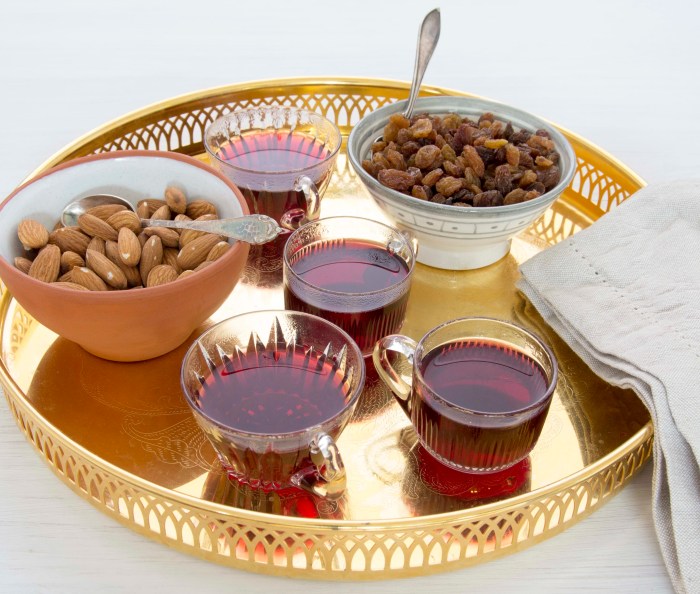
Every day leading up to Christmas, I will open a window containing a Swedish word that has something to do with Christmas and the festive season. Today’s word is the fantastic-to-say ‘glögg‘. (Pronounced ‘glugg’)

Glögg is festive Swedish mulled wine: heated wine, most commonly red, with spices. It is drunk together with almonds and raisins added in. And it is delicious! Glögg is very popular, having been drunk in Sweden around Christmas since the 1890’s. However, the earliest record of drinking heated wine dates back to the 1500’s. The word glögg comes from the Old Swedish word ‘glödg’, and the verb ‘glögda’ – to heat up. This, in turn, has its origins in the verb glöder (to glow).

Some make their own glögg, here is a typical recipe.

But most people buy their glögg ready-made in a bottle. In addition to the traditional flavours, each year a new flavour of the nectar is released and there’s always a debate regarding its success. This year’s glögg (2019) is called Aloha and is an infusion of passion fruit, hibiscus, coconut and coffee. Yummy!

161 years old today!

If Selma Ottilia Lovisa Lagerlöf was alive today, she would be celebrating her 161st birthday.

Born 20 November 1858, Selma Lagerlöf was a Swedish author, publishing her first novel, ‘Gösta Berling’s Saga’, at the age of 33. She is considered to be one of Sweden’s most significant writers throughout history.

She was a woman of firsts. She was the first female writer to win the Nobel Prize in Literature, which she was awarded in 1909.

Additionally, she was the first female to be granted a membership in The Swedish Academy in 1914 – the famous literary committee that selects the Nobel prize laureate amongst other things.

She wrote prolifically – mostly novels, religious texts and short stories. Other than ‘Gösta Björlings Saga’, her most famous works are probably ‘Jerusalem’, ‘The Treasure’ and ‘The Wonderful Adventures of Nils Holgersson’. The latter has been translated into over 30 languages.

Selma was a politically active woman – involved as a speaker for the Swedish Suffragette movement, and herself living in a controversial same sex relationship. She was also a vocal anti-nazi.

The house where Selma Lagerlöf was born on 20 Nov 1958, grew up and later lived is today open to the public as a museum. If you’d like to visit, it’s in the county of Värmland and can be checked out at Mårbacka

20 Swedish words for rain

It feels like it has rained for ever in Stockholm. We awaken to rain, we walk in the rain, we come home in the rain, and we go to bed to the sound of the rain.

I guess the wetness is positive as it is replenishing the water magazines that have dried out, and soaking the forest beds to extinguish any lingering embers from the forest fires.

But it is so boring and a bit depressing. In English, we have lots of words for rain, with some fun ones such as drizzle, mizzle, sleet, spit and ‘ache and pain’.

So I became curious about how many Swedish words there are. Here are 20 that I found:

  1. Regn – rain
  2. Duggregn – a light rain, spit
  3. Dusk – drizzle
  4. Snöblandad regn – rain mixed with snow, sleet
  5. Hällregn – heavy rain, pouring down
  6. Ösregn – torrential rain
  7. Skyfall – sudden heavy rain, a cloud burst
  8. Skur – shower
  9. Störtregn – heavy rain, a downpour
  10. Skval – constant, uninterrupted rain
  11. Sommarregn – light, summer rain
  12. Regnby – rain shower
  13. Slagregn – heavy rain, a deluge
  14. Glopp – rain with large snow flakes in
  15. Arlaregn – refreshing morning rain
  16. Strilregn – steady rain
  17. Nederbörd – precipitation
  18. Dagsregn – precipitation
  19. Regndroppe – rain drop
  20. Rotblöta – a large amount of rain, usually in the summer

So the next time, look out of the window and see what word best describes the rain outside. It might at least give you a few seconds of distraction in this November drudge.

Sweden’s most common surnames

Surprisingly there are 9 people in Sweden who have the same surname as me. I’m very curious to know who they are.

According to the Swedish Statistics Bureau, which surnames are then the most common in Sweden? Any guesses?

Here is the latest top 10 list from 2018:

  1. Andersson
  2. Johansson
  3. Karlsson
  4. Nilsson
  5. Eriksson
  6. Larsson
  7. Olsson
  8. Persson
  9. Svensson
  10. Gustafsson

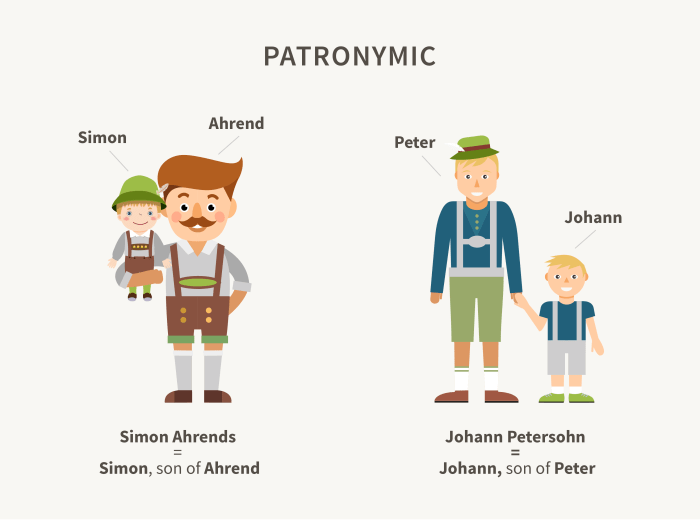
Notice a pattern?! In fact, the first name that doesn’t end in the patronymic ‘son’ is the name Lindberg which lands in 17th position.

Interestingly there are a few more ‘sons’ after that and then Lindström, Lindqvist and Lindgren are the next ones. So ‘Lind’, which is a small tree, is also very common.

The first ‘non-Swedish’ name on the list is Ali, which lands in 44th position.

If you’re interesting in knowing about your name, go to scb and check it out under ‘namnstatistik’.

How Swedes agree

Most anthropologists agree that the origin of language is its social function. Language developed as a way of binding together people and cultures in order to better survive. And the words that helped people bond together were the positive words of acknowledgement and agreement, such as ‘sure’, ‘absolutely’ and ‘that’s right’.

These types of words go in and out of fashion of course. Sweden’s current popular one seems to be ‘men verkligen’.

What are some other ways to concur in Swedish?

  • Absolut
  • Precis
  • Visst
  • Jajamensan
  • Jovars
  • Klockers
  • Super
  • Jag instämmer
  • Jag håller med
  • Du har så rätt
  • Jomenvisst
  • Visserligen
  • Förvisso
  • Sant

Why does Swedish seem to have so many phrases of agreement? Is it these that have helped develop the neutral, respectful, non confrontational communication style we traditionally connect with Swedes?