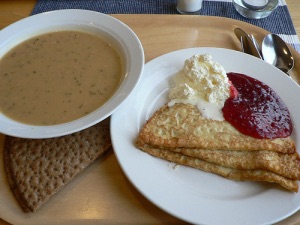
Pea Soup and Pancakes

In all cultures, there is an element of predicatability. Some things that you can feel will always happen. Things that give you a sense of security because you can depend on them.

In Sweden, it’s pea soup and pancakes.

Today is Thursday. In most lunch restaurants and every staff canteen that sells Swedish food, pancakes are on the menu. You can rely on it. It feels dependable. The pancakes are served in a particular way – with whipped cream and jam – and always, always served together with a bowl of steaming pea soup and bread.

Pea soup and pancakes have been consumed in Sweden since the 1200’s. It’s believed that because Friday was a day of fasting, people ate as much filling food as possible on the Thursday before. And that’s how the tradition was born.

It’s fun to watch Swedes on Thursdays. In the staff canteen, grown men queue up to ladle their soup into their bowls and pile pancake after pancake onto a plate like a Scooby snack. Then they gleefully paste on the jam and smother it with whipped cream. It’s like watching a jelly and ice cream party for 10-year olds.

Pancakes on Thursdays is especially interesting for us Brits. Traditionally, we only get to eat pancakes once a year – on ‘Pancake Day’ – Shrove Tuesday. On this day, when Swedes traditionally tuck into the Lent bun called ‘semla’, we Brits make pancakes and cover them with sugar, lemon juice and chocolate sauce.
Swedish New Year’s pizza – with cabbage! 


Today, January 1st, is the most popular day to eat take-away pizza in Sweden. Partly it’s easy to order but also its greasiness acts as a great remedy for sore heads and tired bodies.

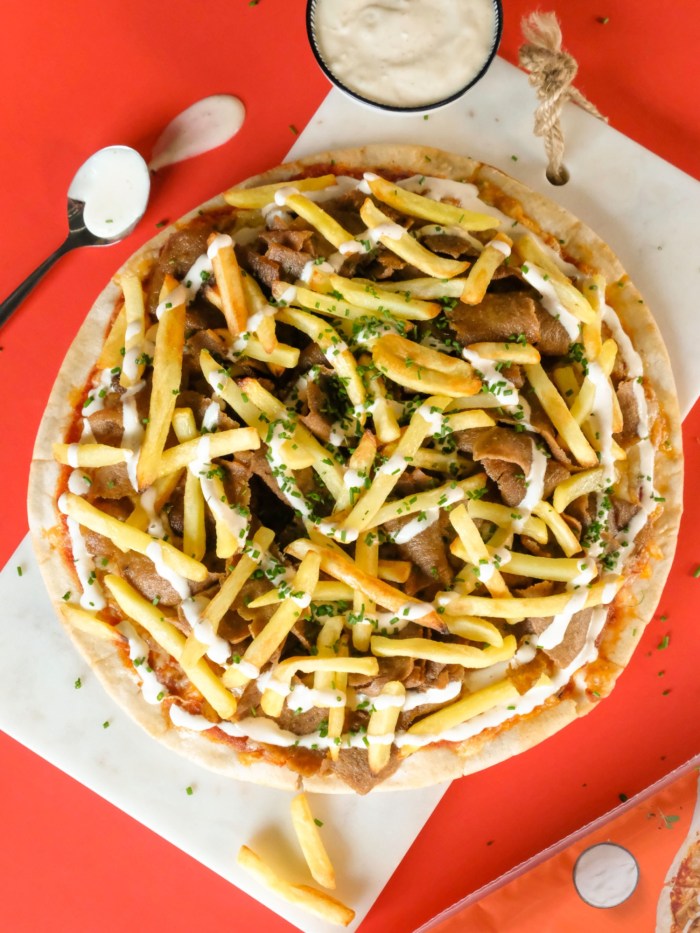
The Vesuvio and the Capricciosa are very popular pizzas in Sweden. However, the number 1 ‘national pizza’ is the Kebab pizza – a greasy pizza with kebab meat (and sometimes fries) dumped on the top.

When you order a pizza in Sweden, you will also experience a very strange bedfellow.

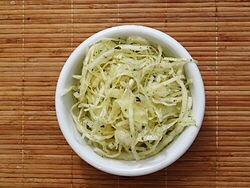
In Sweden, pizza is served with complimentary salad, in both restaurants and take aways. This salad is called creatively –  ‘pizza salad’ and is made of cabbage. It is a kind of coleslaw with white wine vinegar, salt, pepper and oil. It’s fresh, crispy and a bit weird. 

This odd combination is, as far as I know, only offered in the Nordic countries and its origin is a bit unclear.

One theory is that when the first pizzerias opened in Sweden, the traditional tomato salad wasn’t an option due to the climate in the winter. So, subsequently the pizza baker decided to use a more available, local vegetable – the cabbage – inspired by the Croatian salad ‘kupus salata’. 

Whatever it’s origin, the pizza salad is so ingrained in the Swedish mentality, it’s become a cultural ‘classic’.  In fact, it’s hard to imagine a pizza without cabbage salad in Sweden. Especially on New Year’s Day!

Advent Calendar – Dec 18: Skumtomte

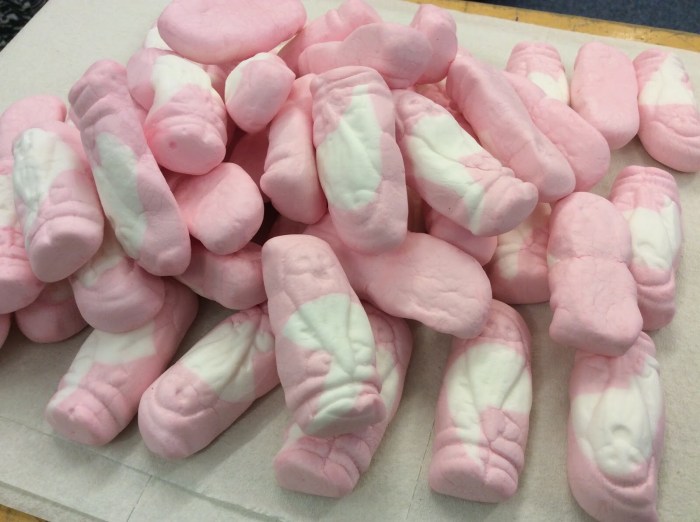
Window 18. Today’s word is ‘Skumtomte‘ which translates as ‘Marshmallow Santa’.

January is a month when it is often jam-packed at gyms up and down Sweden. This is usually due to the amount of food, snacks, and alcohol consumed over the Christmas and New Year period. The festive season is also one of the times of year when a lot of sugar and sweets are consumed.

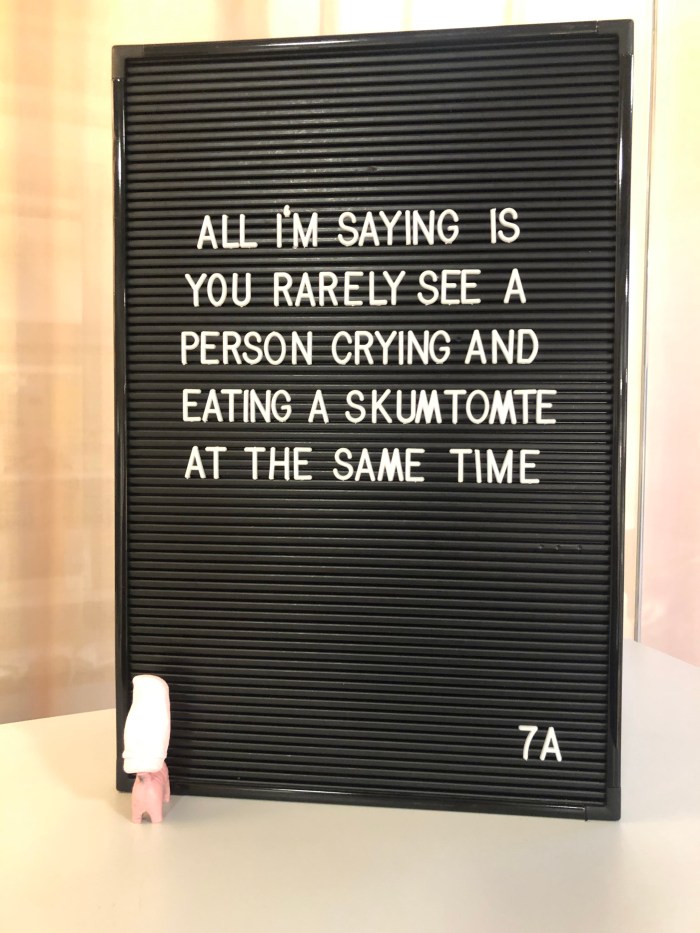
One of the most popular sweets in yuletide Sweden is the ‘skumtomte’ – the marshmallow Santa. The skumtomte is traditionally pink and white and strawberry flavoured.

Thanks to the wonders of product development, new limited flavours have appeared in recent years: apple and cinnamon, blueberry, mint and gingerbread being some examples.

They have been manufactured since 1934, and every year over 194,000,000 are consumed in Sweden and Finland. It seems like it wouldn’t be Christmas without a jultomte.

Other sweet things that Swedes eat around Christmas are:

  • Ischoklad – ‘ice chocolate’ – chocolate with coconut fat in tiny cupcake forms
  • Ris a la Malta – a cold rice dessert with cream, vanilla and mandarines
  • Risgrynsgröt – rice porridge with sugar, cinnamon and milk
  • Knäck – butterscotch
  • Kola – toffee
  • Fudge – fudge
  • Marsipangris – marzipan pig
  • Lussekatt – saffron bun
  • Polkagris – Candy cane
  • Chokladtryffel – chocolate truffle
  • Dadlar – dates
  • Fikon – figs
  • Pepparkaka – ginger biscuits
  • Gröna kulor – marmalade balls
  • Aladdin and/or Paradis – popular boxes of chocolates

So, get eating – the gym can wait until 2024!

Advent Calendar – Dec 16: Julbord

Window 16. Today’s word is ‘Julbord‘ which literally translates as Christmas table.

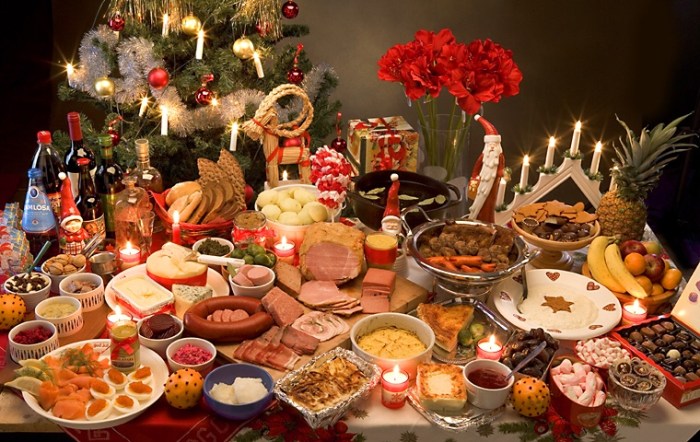
The word ‘smörgåsbord’ (buffet) is one of the words from the Swedish language to have the biggest international reach. The ‘julbord’ or Christmas table is the ‘smörgåsbord’ that is traditionally eaten in homes and restaurants on Christmas Eve – the day Swedes celebrate Christmas.

In the lead up to Christmas, organisationens often take their employees out somewhere for a ‘julbord’.

The ‘julbord’ is an interesting concept – a potpourri of dishes, hot and cold. Not all Swedes enjoy everything on the table, but the dishes still have to be present in the name of tradition.

So, what’s on the Swedish ‘julbord’? Here are some common savoury dishes:

  • Julskinka – Christmas ham
  • Inlagd sill – pickled herring of various sorts
  • Köttbullar – Swedish meatballs
  • Prinskorvar – cocktail sausages
  • Janssons frestelse – potato and anchovy gratin called Jansson’s temptation
  • Gravad lax – cured spiced salmon
  • Kallrökt lax – cold-smoked salmon
  • Varmrökt lax – warm-smoked salmon
  • Kalvsylta – jellied veal
  • Knäckebröd och ost – crispbread and cheese
  • Sillsallad – herring salad
  • Lutfisk – whitefish in lye
  • Dopp i grytan – ‘dip in the pot’ – bread dipped in the broth that the meat is cooked in
  • Cabbage of various colours – most commonly red
  • Vörtbröd – Christmas bread flavoured with wort
  • Revbensspjäll – spare ribs
  • Ägghalvor – halved boiled eggs topped with shrimp or caviar

The ‘julbord’ is a banquet, and its history dates back hundreds of years. Around the country there are regional variants to the standard dishes. For example, in county Skåne, they often add eel, and in Bohuslän they add ‘äggost’ – egg cheese! Many regions around Sweden have brown beans and different local sausages on the their Christmas buffet.

All of this food is traditionally washed down with beer, julmust, and snaps.

You have to be careful not to overindulge, if possible because afterwards comes coffee and dessert. A traditional dessert is called Ris a la Malta, which is fluffy rice in whipped cream and tangerines. At Christmas tables organised in restaurants, they normally have a ‘gottebord’ which is another smörgåsbord consisting solely of sweets and desserts. Common contents are toffee, fudge, gingerbread biscuits, marzipan, ‘lussekatter’, dried fruits, cheese, and chocolates.

Advent Calendar – Dec 15: Musikhjälpen

Window 15. Today’s word is ‘Musikhjälpen‘ which translates as Music Aid.

Since 2008, the radio/tv program ‘Musikhjälpen’ has become a traditional part of the lead up to Christmas.

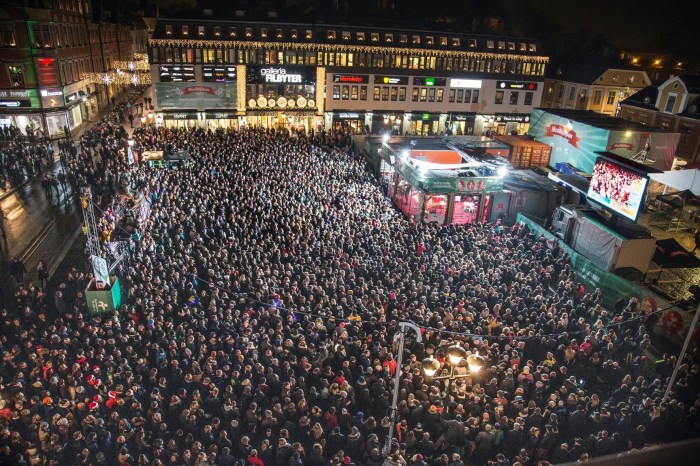
In this program, 3 presenters are locked into a glass ‘cage’ on a town square somewhere in small town Sweden – this year from the town of Växjö in county Småland. They are sleep deprived and only allowed to eat liquids.

From the cage, they broadcast radio and tv round the clock until they are released a week later.

The program is a fund-raising event for Sweden’s international aid organization Radiohjälpen. People up and down the country request songs and make donations, or carry out fund-raising activities. Live music performed in the ‘cage’ has also become an important part of the event. At most, the event has raised a staggering 74,410,363 SEK in 2017 when the theme was fighting against child prostitution.

Every year the theme is different; this year the theme is ‘nobody should die from hunger’.

Throughout the years, many of Sweden’s music and media celebrities have taken on the challenge of incarceration, such as singers Sara Dawn Finer, Daniel Adams-Ray, Molly Sandén, Miriam Bryant and Linnea Henriksson, and rappers Petter and Timbuktu. This year, singer Oscar Zia is locked in together with radio profile Linnea Wikblad and comedian Sofia Dalén.

The program is based on an original format called Serious Request from Holland and is an amazing display of charity just a couple of weeks before Christmas.

Advent Calendar – Dec 14: Lussekatt

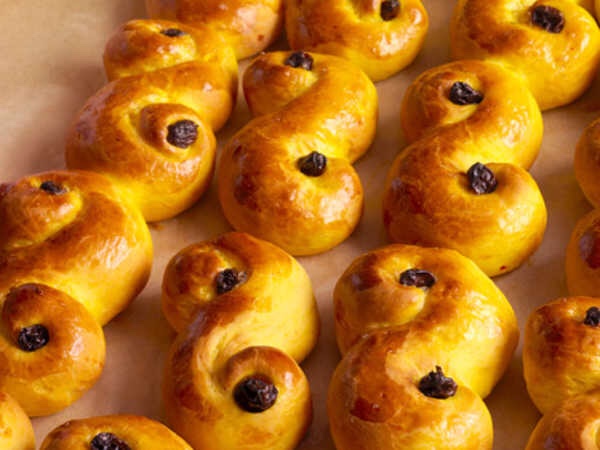
Window 14. Today’s word is ‘Lussekatt‘ which is a traditional saffron bun.

Generally, I love Swedish pastries but the lussekatt is not one of my favourites I’m sorry to say. I’m not a big fan of saffron. However, the sight and smell of the lussekatt screams Advent and Christmas in Sweden. The lussekatt, is a rich, spiced yeast-leavened sweet bun that is flavoured with saffron and usually contains raisins. In fact, saffron is a very popular ingredient at Christmas time with a whole cornucopia of baked goods being spiced with the expensive substance.

The lussekatt buns are baked into many shapes, of which the most common is a reversed S-shape. They are traditionally eaten during Advent, and especially on Saint Lucy’s Day, December 13. This could be the reason why it is called ‘lusse’ – a derivative of Lucy. However, there is a more sinister explanation.

In one theory, the lussekatt has its origins in Germany in the 1600’s. According to legend at that time, the devil used to appear as a cat, to torment children. To counteract this, people baked buns and colored them bright yellow to mimic the sun and scare away the devil. In West Sweden, the saffron buns were referred to as Devil’s buns (‘döbelskatt’) and the theory is that the name Lussekatt, comes from the word Lucifer. And the shape? Could it reflect a cat’s tail, or even the devil’s tongue?

Whatever the origin, the lussekatt remains a clear favourite in Sweden to eat at Christmas with pepparkaka and washed down with glögg.

If you’d like to bake your own lussekatt, you can find a recipe here

Advent Calendar – Dec 11: Nubbe

Window 11. Today’s word is ‘Nubbe‘ which is the colloquial word for an alcoholic shot known as snaps.

Nubbe, or snaps, is a really popular drink that Swedes enjoy at Christmas time. At its base, it is a strong spirit (30-38% alcohol content) called ‘brännvin’ which is distilled from potatoes or grain.

It can be plain and colourless, or flavoured with herbs and spices. Sometimes it can be sweet and infused with, for example blackcurrant, elderflower or raspberry. Others can be so bitter they make your toes curl – flavoured with for example aniseed, wort or wormwood. If it includes caraway or dill, it can according to EU patent protection be called akvavit.

A mouthful-size of ‘brännvin’ is called a snaps or a nubbe and it is drunk out of small glasses. Usually it is consumed when eating traditional food, and may also be accompanied by a ‘snapsvisa’ – a drinking song.

One popular drinking song at Christmas is called ‘Hej Tomtegubbar‘ which translates roughly as:

‘Hello goblins, fill your glasses and let’s be jolly together.

Hello goblins, fill your glasses and let’s be jolly together.

Our time is brief upon the earth, with many troubles and little mirth

Hello goblins, fill your glasses and let’s be jolly together.

After a few snapses, the party atmosphere usually begins – with more singing and speeches. For Swedes, snaps is such an important tradition that it is drunk not only at Christmas but at most festive times – such as Easter, Midsummer and autumn’s crayfish party.

According to The Swedish alcohol monopoly, Swedes have been flavouring their ‘brännvin’ since the 1500’s and the word ‘Nubbe’ as a slang word for snaps turned up first in 1892.

Advent Calendar – Dec 7: Julskinka

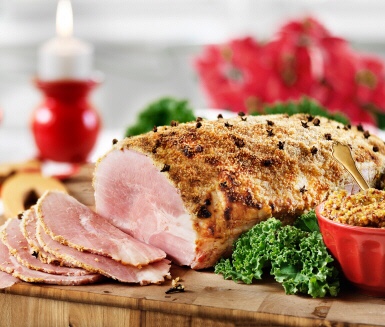
Window 7: Today’s word is ‘Julskinka‘ which translates as ‘Christmas ham’ and is pronounced yule-hwinka (ish).

In the UK, I grew up eating roast turkey at Christmas. But in Sweden, it’s the ham that counts!

Swedes have been eating Christmas ham during the festive season since the 1600’s and many people consider it an obligatory part of the Christmas meal.

Originally it was a dish eaten only by the upper classes and rich farmers, but somewhere in the 1800’s in made it onto the tables of the general public.

The tradition of eating ham is thought to have evolved from the German pagan ritual of sacrificing a wild boar known as a sonargöltr to Frey, the Norse god of fertility, during the harvest festival. This was later adapted by the Christians and aligned with St Stephen’s Day which falls on December 26th.

Traditionally the cured ham is oven baked or boiled before it is coated in mustard and breadcrumbs and grill roasted. Here is a recipe.

The ham is mostly eaten with mustard and apple sauce. And the cold leftovers are eaten for days afterwards, often on crisp bread.

The Christmas ham is traditional in many other Northern European countries such as Finland, Estonia and Poland and even some parts of the USA and Australia.

Many people these days don’t eat meat, and therefore reject ham. However, to mimic the Christmas tradition, there are plenty of veggie centerpieces available including roasts made of soya, Quorn and other plant-based ingredients.

Advent Calendar Dec 5: Julmust

Every day, I will open a window containing a Swedish word that has something to do with Christmas and the festive season.

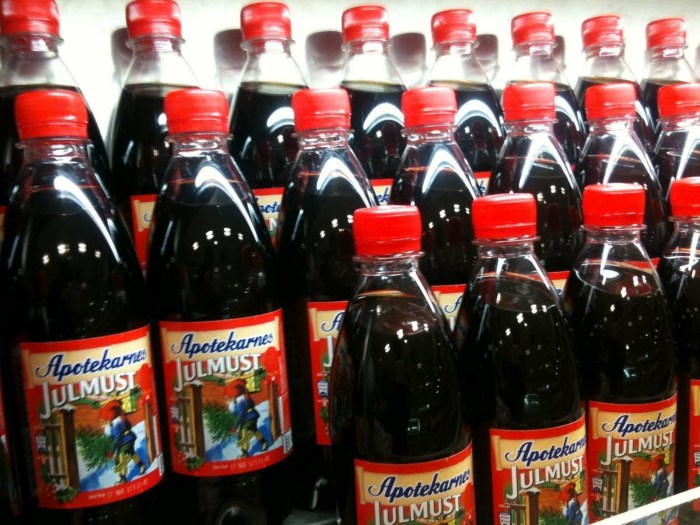
Today’s word is ‘Julmust‘ which is a fizzy Christmas beverage.

I would venture to say every Swede likes to drink at least one glass of julmust at Christmas. However, according to statistics it is even more!

Apparently, Swedes drink an average of 5 litres per person of the fizzy drink during December. The alcohol-free bottled soft drink comes in different sizes, fully sugared and also in diet form.

Said to include over 30 ingredients, its actual recipe is top secret, only known to three people. Despite all the cloak and dagger stuff, the connoisseur can detect the flavour of hops and malt. The taste is reminiscent of the old-fashioned ‘Dandelion and Burdock’ drink for those of you that understand that British reference.

Julmust was invented by a teetotaler and sales began in 1910 as an alternative to ale and port. Although intended to be alcohol-free, the drink can be mixed with gin, vodka, rum or Jägermeister to make Christmassy cocktails. When blended with porter or stout and other ingredients, it creates a classic Christmas drink called Mumma.

I have even drunk julmust mixed with red wine – a so called Kalimusto. I recommend trying the experience – although it actually is a fairly unpleasant one!

If you live outside of Sweden and want to try julmust, head to your nearest Ikea! Called Vintersaga, they sell the beverage in 500ml bottles.

Advent Calender Dec 2 – Pepparkaka

Every day leading up to Christmas, I will open a window containing a Swedish word that has something to do with the festive season.

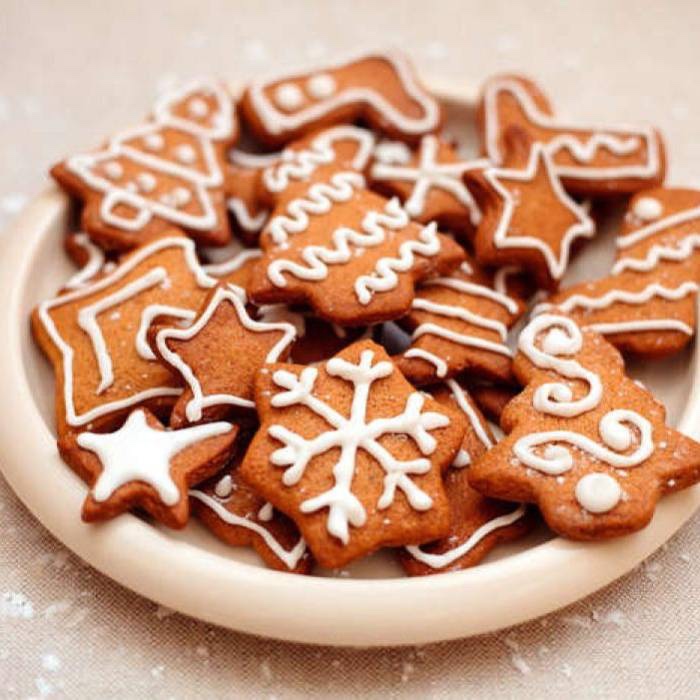
Today’s word is ‘pepparkaka‘, which translates as gingerbread.

Other than glögg, nothing else is more synonymous with the Swedish festive season than pepparkaka (gingerbread).

The Swedish version of gingerbread comes in the form of thin crispy biscuits flavoured with cinnamon, cardamon, ginger and cloves. Formed in different shapes such as hearts, trees, and stars, gingerbread is eaten plain or decorated with icing. Many people buy squeezy blue cheese in a tube and squirt it onto the biscuit before consumption. Some people build gingerbread houses as part of their Christmas decorations.

Making your own pepparkaka is a cosy a Christmas tradition – here is a typical recipe. However, most people buy their gingerbread ready-made.

Pepparkaka has been associated with Christmas in Sweden since the 1800’s but was eaten much earlier than that. The first documented record of pepparkaka in Sweden is from 1335 for a royal wedding. In a recipe from the 1400’s, gingerbread included pepper, which could be why it has the name pepparkaka. But nobody is really sure.

Ever wondered why Swedish people are so nice? Well, the answer lies in an old myth – apparently the very eating of pepparkaka is what makes you nice.