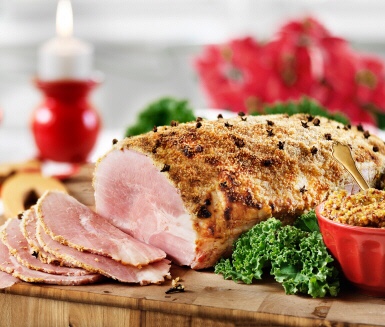
Window 7: Today’s word is ‘Julskinka‘ which translates as ‘Christmas ham’ and is pronounced yule-hwinka (ish).
In the UK, I grew up eating roast turkey at Christmas. But in Sweden, it’s the ham that counts!
Swedes have been eating Christmas ham during the festive season since the 1600’s and many people consider it an obligatory part of the Christmas meal.
Originally it was a dish eaten only by the upper classes and rich farmers, but somewhere in the 1800’s in made it onto the tables of the general public.
The tradition of eating ham is thought to have evolved from theGerman pagan ritual of sacrificing awild boar known as asonargöltr to Frey, the Norse god of fertility, during the harvest festival. This was later adapted by the Christians and aligned with St Stephen’s Day which falls on December 26th.
Traditionally the cured ham is oven baked or boiled before it is coated in mustard and breadcrumbs and grill roasted. Here is a recipe.
The ham is mostly eaten with mustard and apple sauce. And the cold leftovers are eaten for days afterwards, often on crisp bread.
The Christmas ham is traditional in many other Northern European countries such as Finland, Estonia and Poland and even some parts of the USA and Australia.
Many people these days don’t eat meat, and therefore reject ham. However, to mimic the Christmas tradition, there are plenty of veggie centerpieces available including roasts made of soya, Quorn and other plant-based ingredients.
Window 6: Today’s word is ‘Julmarknad‘ which translates as ‘Christmas Market’
A popular recurring event during the weeks leading up to Christmas in Sweden is the Julmarknad – the Christmas Market.
Christmas markets are a very cosy affair. Here you can walk around and enjoy the smell of glögg and roasted chestnuts. You can listen to the sound of Christmas carols echoing through the air. You can bathe in the lights and decorations strewn around the marketplace. And you can see traditional handicrafts and locally produced goods on sale, such as scarves, hats, festive food and decorations. If you’re lucky, snow is tumbling down and crunching under foot. The whole thing feels like being momentarily caught in a giant snow globe.
Christmas markets have been around in Sweden since the 1800’s and take place up and down the country on town squares, in gardens, in museums, farms, barns, greenhouses, castles, garden centers and stately homes.
This year, Christmas markets are back with a vengeance after last year’s Covid restrictions. But remember, even if you are outdoors and even if it’s cold – keep your distance.
In Stockholm, the most popular markets are in Skansen and on the main square in the Old Town. The Royal Palace of Drottningholm and Taxinge Castle outside Stockholm are also popular, as is the small picture-postcard town of Sigtuna about an hour north of the capital.
In Gothenburg, the market at Liseberg is a popular experience and in Malmö head to the market on Gustav Adolf Square.
Every day, I will open a window containing a Swedish word that has something to do with Christmas and the festive season.
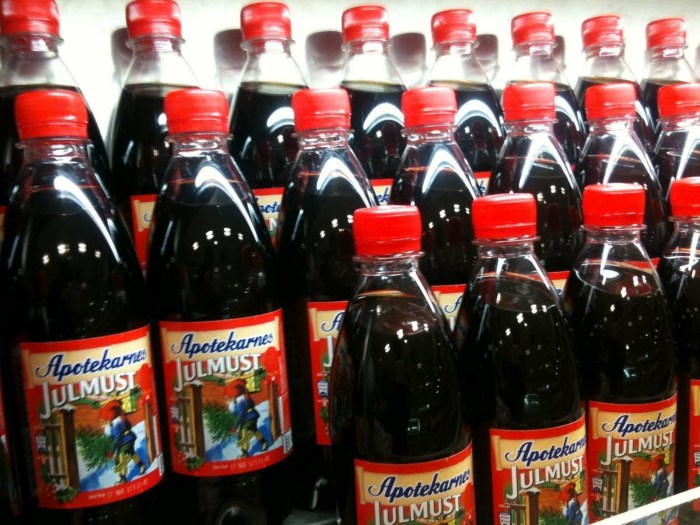
Today’s word is ‘Julmust‘ which is a fizzy Christmas beverage.
I would venture to say every Swede likes to drink at least one glass of julmust at Christmas. However, according to statistics it is even more!
Apparently, Swedes drink an average of 5 litres per person of the fizzy drink during December. The alcohol-free bottled soft drink comes in different sizes, fully sugared and also in diet form.
Said to include over 30 ingredients, its actual recipe is top secret, only known to three people. Despite all the cloak and dagger stuff, the connoisseur can detect the flavour of hops and malt. The taste is reminiscent of the old-fashioned ‘Dandelion and Burdock’ drink for those of you that understand that British reference.
Julmust was invented by a teetotaler and sales began in 1910 as an alternative to ale and port. Although intended to be alcohol-free, the drink can be mixed with gin, vodka, rum or Jägermeister to make Christmassy cocktails. When blended with porter or stout and other ingredients, it creates a classic Christmas drink called Mumma.
I have even drunk julmust mixed with red wine – a so called Kalimusto. I recommend trying the experience – although it actually is a fairly unpleasant one!
If you live outside of Sweden and want to try julmust, head to your nearest Ikea! Called Vintersaga, they sell the beverage in 500ml bottles.
Today, the first of Advent, the light shines strong in the darkness.
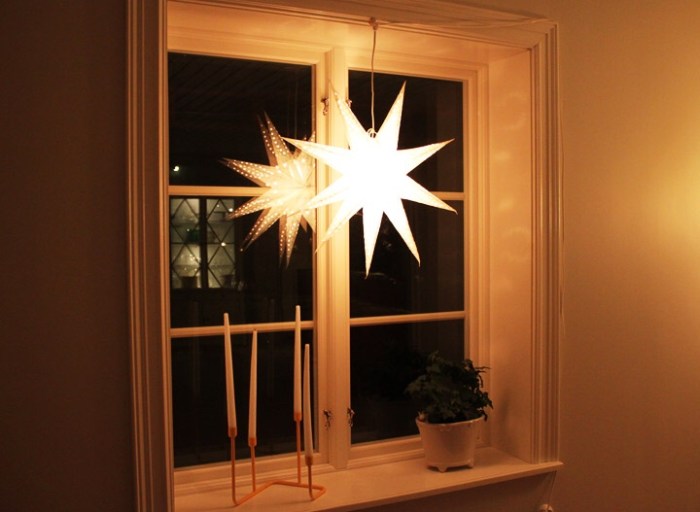
Swedes decorate their houses, apartments and windows with lights. From ceilings, illuminated stars are hung. On window ledges, electric advent candles are placed. On tables, four candles are positioned and one is lit every Sunday up until Christmas. Small candles, often red, are dotted about the home. Some people change curtains and populate their homes with small gnomes and flowers.
Since November is a grim month, the collective advent decoration is a welcome arrival as light is spread into the murky places. From the dark street, it is lovely to see windows lit up in every apartment.
This weekend is also the starting signal for the Swedish ‘glöggfest’. People go to each other’s homes and drink ‘glögg’ (mulled wine), eat gingerbread and saffron buns. It is a very cosy time of year.
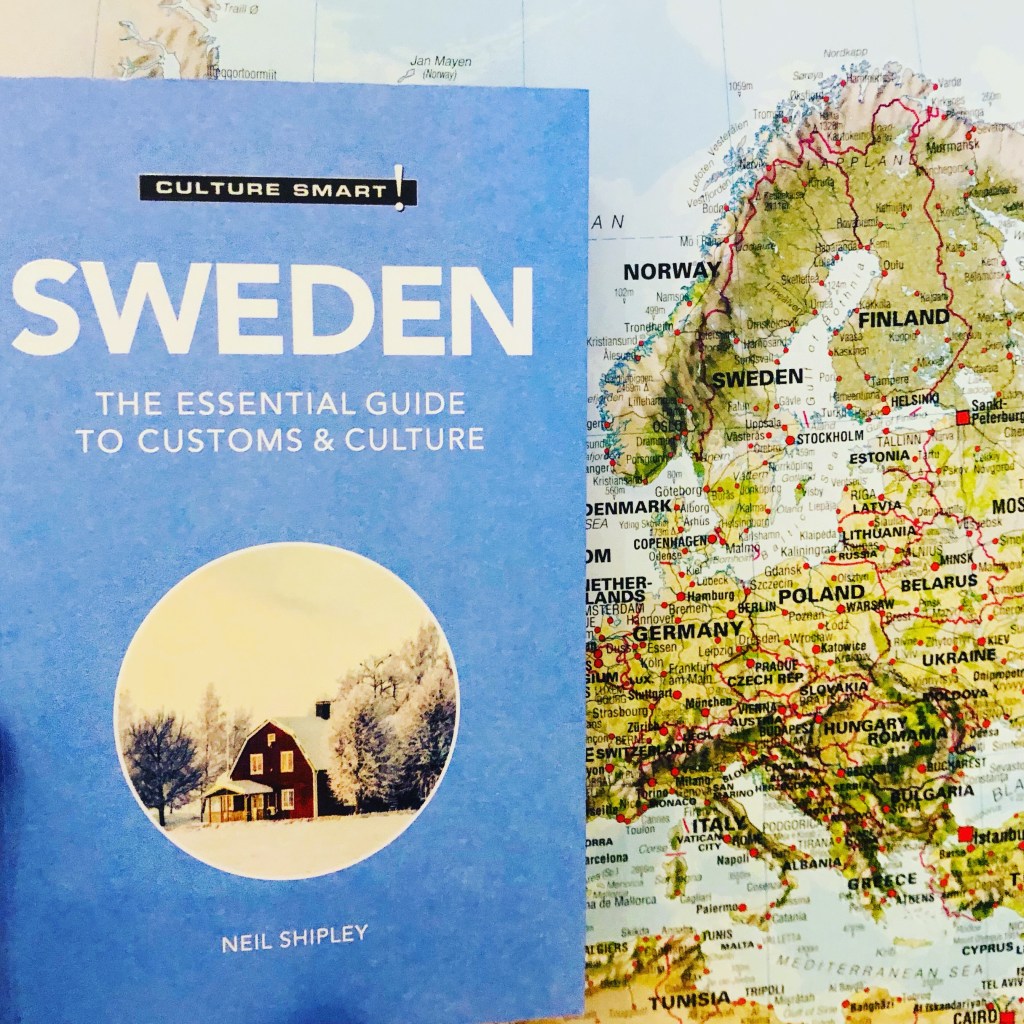
My book is doing really well, which I’m very proud of. You can buy it on Amazon, Bokus, Akademibokhandeln and Adlibris amongst other online stores. Sweden, by Neil Shipley, published by Kuperard 2021.
I still have a few copies left, so if you’d like to buy a signed copy, just let me know!
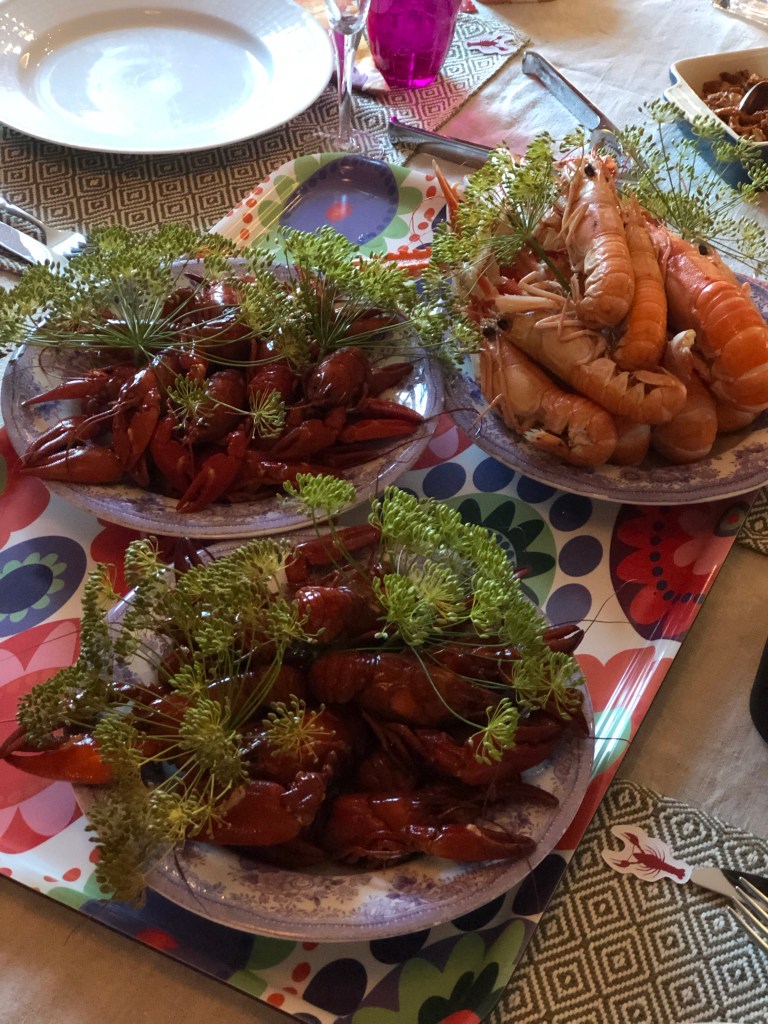
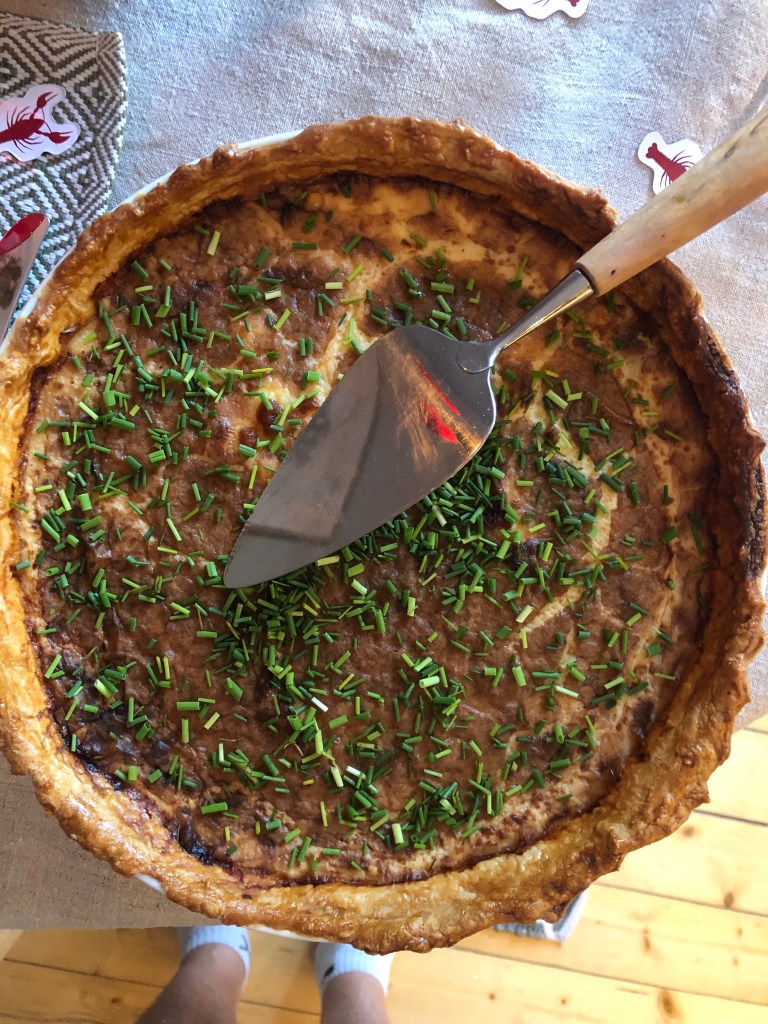
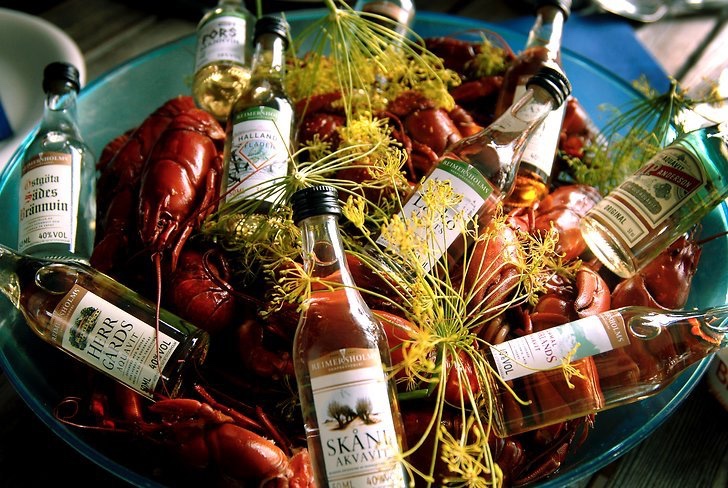
This time of the year is the traditional crayfish party in Sweden. These small red crustaceans are usually eaten with Västerbottens cheese pie. Of course, crayfish parties don’t have to involve alcohol, but the traditional approach is to wash it all down with copious amounts of snaps and beer.
Throughout the years, I’ve been to my fair share of crayfish parties. I was at one last night. The bon ami, the snaps songs, the silly paper hats and the noisy, messy slurping make it, for me, one of the best festivities in the Swedish calendar.
One thing is certain though. The day after a crayfish party, one feels a little….delicate. After snaps cometh headache.
A snaps is a small glass of ‘burnt wine’ – or brännvin in Swedish. Brännvin is a spirit distilled from potatoes or grain with a high alcohol contented at least 37.5%. So it is not the same as a shot! It can be plain and colourless, or flavoured with herbs and spices. Brännvin includes vodka and akvavit, but akvavit is always flavoured with caraway and dill.
Brännvin has been in Sweden since around the late 1400’s and is an integral part of Swedish custom. It has been given many different names throughout history. Some synonyms are: ‘eldvatten’ (fire water), ‘jodlarsaft’ (yodel juice), ‘hojtarolja’ (shouting oil), ‘polarvätska’ (polar liquid), and ’spånken’ (originating in the Latin and Greek word for mushroom – spongia).
If you’re ever here, you should try it. But take it carefully!
These days, Midsummer Day is a flexible holiday practically celebrated on a Saturday sometime between 20 and 26 June. This means that Midsummer Eve, one of the biggest festivities in the Swedish calendar, is always on a Friday. In the case of 2021, that’s tomorrow.
Bit did you know that this has only been since 1953? Prior to 1952, Midsummer Day was always celebrated today – the 24th June – coinciding with John the Baptist’s birthday. This was regardless of the day of the week it landed on. So today’s strong association with Midsummer being a long weekend is actually only around 70 years old
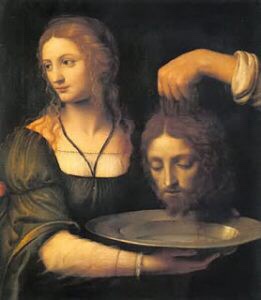
John the Baptist was a person who foresaw the birth of Jesus. He is considered a prophet in several of the world’s religions. He was a prolific preacher whose severed head was notoriously presented on a silver platter to Salome. His birthday has been celebrated since 300 AD on June 24 in many countries around the world.
An interesting fact is that Midsummer Day is still associated with John the Baptist in the other Scandinavian countries. For example, in Finland it is not called Midsummer but Juhannus. In Iceland, it is Jònsmessa. And in Denmark and Norway – Sankt Hans.
Today is my birthday, but it’s not the first time I’m celebrating in Sweden. I must have had at least 20 birthdays here. This year is a bit special since big parties are not allowed, so it got me thinking what is typical about celebrating birthdays in Sweden?
1) Wake up call – Swedes who do not live in a single household are usually woken up early in the morning by friends or family coming into the bedroom with bubbly, breakfast, and gifts. The breakfast tray is often adorned with a candle. This is a lovely way to wake up, unless you’re not a morning person that is.
2) Singing – Swedes love to sing, in general, and they usually sing when they carry out the morning wake up call. The Swedish birthday song is a cheerful melody entitled ‘ja, må han/hon leva’. This translates as ‘yes, may he/she live (for a hundred years)..’ Curiously, there’s no mention of birthday in the Swedish song, unlike the English ‘Happy Birthday to You.’ After the singing, there is traditionally a ‘hurra’ at the end of the song. In most of Sweden, there are four ‘hurras’ but in the county of Skåne only three – hurra, hurra, hurra!
3) Green cake. A popular birthday cake is a green, marzipan clad cake called a ’Princesstårta’. Full of whipped cream, it’s a sickly treat. It seems ungracious but in Sweden, the celebrant themselves is responsible for bringing their own cake with them if they want to be celebrated in the work place.
4) Gift giving is usual in Sweden when somebody has their birthday. Usually, gifts are unostentatious such as flowers, chocolates, wine or something small and meaningful. Gifts for children tend to be more plentiful. A common group gift is to take the celebrant out to a restaurant. At some point during the dinner, a slightly self-conscious ‘Ja, må hon/han leva’ is sung.
5) The round number. Birthdays that end with a ‘0’ tend to be celebrated larger than others in Sweden as they are seen as a milestone. Swedes will often have a big party or will travel away with friends and family to warmer climes. Since neither are currently permitted in the shadow of the pandemic, birthdays with round numbers are celebrated in a smaller fashion or postponed to a later year.
Celebrating birthdays in Sweden became popular during the 1600’s in the Royal Court. Towards the end of the 1800’s it made its way into the general population. Important birthdays that are celebrated a little extra are 18, when a person comes of age, 20 when a person can legally buy alcohol and 65, when they retire. At the age of 100, Swedes receive a telegram from the monarch. According to Sweden’s Statistic Agency, the most common birthday in Sweden is 15 April. The least common, other than 29 February, is the 21 November.
Today is typically the day that the LGBT Pride parade takes place in Stockholm. Up to 500,000 fill the streets making it the largest event in Scandinavia. However, this year it has been cancelled due to the pandemic. Instead it is being carried out digitally, with an opening speech by Crown Princess Victoria. If you are interested, you can view the live stream here: http://www.stockholmpride.org
It runs 12.00-14.00.
The whole concept of LGBT Pride has taken strong root in Sweden. LGBT Pride resonates well with the societal Swedish values of equality, tolerance and acceptance.
Sweden’s history of LGBT rights is a comparatively progressive story. Changes didn’t happen automatically however. Thanks to the hard work of campaigners, lobbyists, and politicians, society can enjoy one of the most egalitarian legislations in the world.
According to wiki: ‘ Same-sex sexual activity was legalized in 1944 and the age of consent was equalized in 1972. Homosexuality was declassified as a mental illness in 1979. Sweden also became the first country in the world to allow transgender persons to change their legal gender post-surgery in 1972 whilst transvestism was declassified as an illness. Transgenderism was declassified as a mental illness in 2008 and legislation allowing gender change legally without hormone replacement therapy and sex reassignment surgery was passed in 2013.
After allowing same-sex couples to register for partnership in 1995, Sweden became the seventh country in the world to legalize same-sex marriage countrywide in 2009. Discrimination on the basis of sexual orientation and gender identity and expression has been banned since 1987. Also, since 2003, gay and lesbian couples can adopt children, and lesbian couples have had equal access to IVF and assisted insemination since 2005.
Sweden has been recognized as one of the most socially liberal countries in Europe and in the world, with recent polls indicating that a large majority of Swedes support LGBT rights and same-sex marriage.’
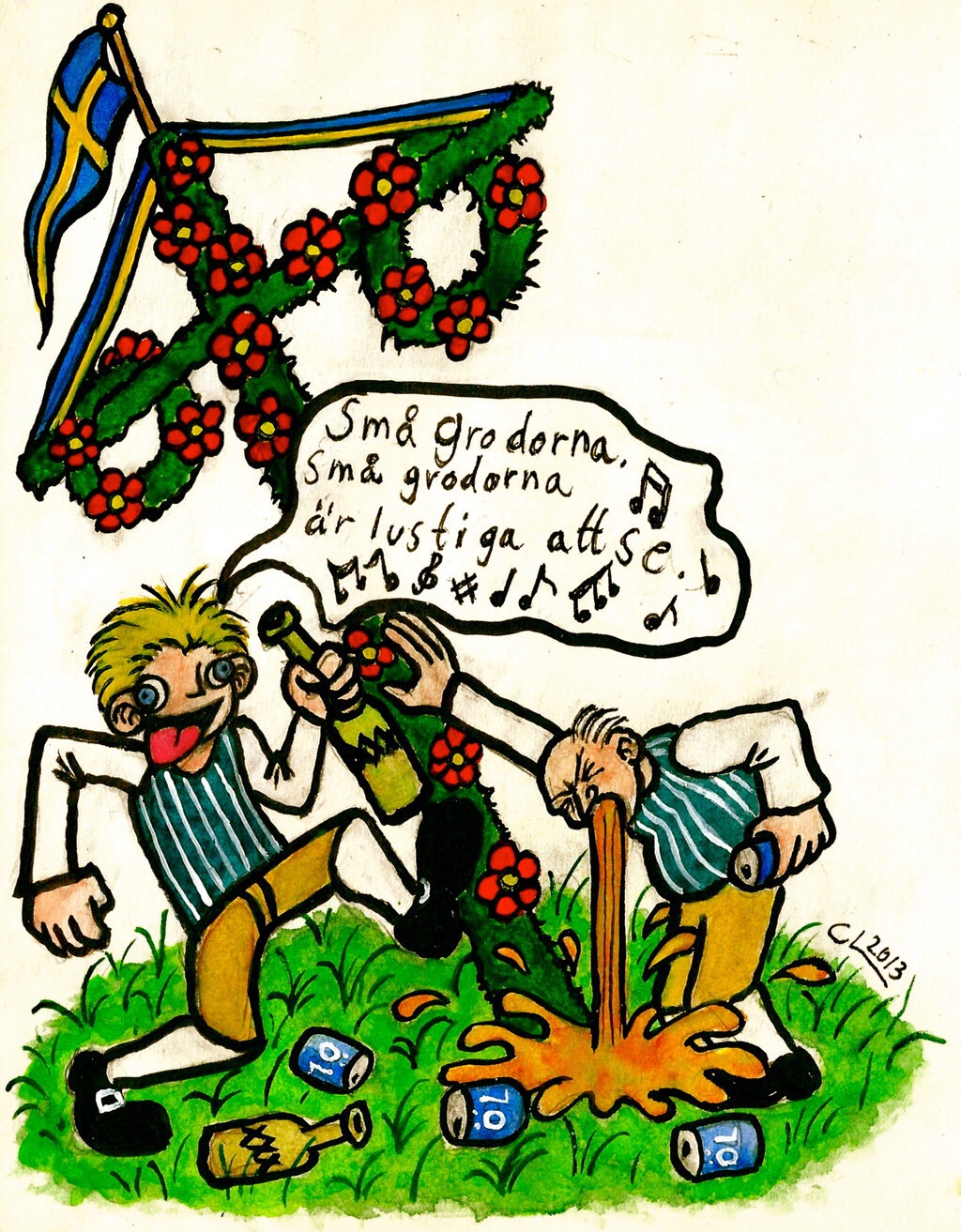
With Midsummer arriving tomorrow, it is time to start planning for your survival. Midsummer’s Eve is the craziest custom in the Swedish calender and the time of the year when Swedes go a little bonkers. As a non-Swede, get ready to brace yourself.
Since we are not fully out of the pandemic, it is important to wash hands regularly and keep a physical distance. Apart from these guidelines, here are a few more hacks to make sure you make it to Midsummer’s Day in one piece.
Greet like a Swede. In Sweden it is considered polite to greet everybody individually, even if you plan to never speak to them again or remember their name. The appropriate way is to stand 1-2 meters away, look directly in their eyes, say ‘hej’ followed by your name. They will do the same. You might even give a small wave or shake hands if you are comfortable doing so. If you are feeling adventurous, follow up your ‘Hej’ with a ‘trevligt’ or even a ‘Glad Midsommar’. Job done. Now you can hit the booze.
Snaps is not the same as a shot. A lot of alcohol gets drunk on Midsummer’s Eve, especially beer and snaps With the popularity of shots in recent years, it’s easy to make the mistake that Swedish snaps is the same thing. Believe me, it is not. Snaps can be up to 40% proof, considerably more than your normal shot. So, go easy and sip the snaps or see yourself slipping sideways off your chair before the strawberry dessert has even been put on the table.
Take tissue. Midsummer’s Eve is a looong day and you probably will need the loo at some point. The trouble is, so will everybody else – to the detriment of the supply of toilet paper. There’s a big chance you will be seeking relief in the woods so come equipped with the appropriate amounts of paper for your needs.
If shy, bring swimwear. Bathing in the icy June waters is a common activity at Midsummer. Swedes generally are not afraid of skinny dipping when they do this. If you are, then come prepared with swimwear and a towel.
Shelve your maturity. Part of Midsummer is dancing around the maypole, playing silly games, pretending to be a frog, participating in competitions. To survive these activities, it helps to conjour up your inner child and forget you are an adult for a while.
Protect yourself. Given the amount of alcohol consumed at Midsummer, it is no surprise that the many babies in Sweden are made on this day. It you don’t want to join the ranks of parents, remember to put it on before you put it in.
Throw in the thermals. It looks like it might be super sunny and warm this Midsummer’s Eve. One of the warmest ever! But it is good to be prepared. It is not unusual that temperatures fall into single figures and that pesky rain pours down onto the smorgasbord. So bring a jumper, a rain jacket and even thermals to enhance your experience.
Don’t expect culinary miracles on Midsummer’s Eve. The food is exactly the same as is eaten at Christmas and Easter, with a few small summery exceptions – strawberries, cream, dill and new potatoes. Remember to use hand disinfectant before you attack the buffet.
Learn a drinking song. On Midsummer’s Eve, food and alcohol is accompanied by Swedish drinking songs. Learn one in advance and shine at the table. Even better sing one in your own language and you are guaranteed to use those rubbers you packed just for the occasion. For me, ‘what shall we do with the drunken sailor’ works every time.
Argue over the rules. At Midsummer a popular Swedish garden game is called kubb. Involving the throwing of sticks, everybody seems to have their own understanding of the way to play. If you want to feel really Swedish, make sure you start an argument about the rules.
Take pills. Of varying types. Allergy pills are good because there are flowers everywhere: on the table, in the maypole, on peoples’ heads. Pain killers are good as a lot of snaps is consumed. Indigestion pills are good as the food is oily, fatty, acidic, smoky and rich. The after day pill is good, well… because…
That’s it! Follow this guide and you are sure to have a wonderous Midsummer’s Eve in Sweden.
Glad Midsommar!
Please share this post to help others get ready for the big day!




 Watching the Swedes