Great Swedish Women Part 6 – The Feminist

Since March 8th was International Women’s Day, I  am writing a series on Great Swedish Women, past and present: women with strength and passion, women who create change. For seven days, I am writing about these women, one per day. I hope you want to join me in celebrating them.

wallstrom

Part 6 – Swedish Foreign Minister and Feminist Champion – Margot Wahlström

Like all Cabinet Ministers, Margot Wahlström has come under fire for questionable decisions. This aside, I would like to focus on her acheivements as a politician in Sweden, Europe and the world. Margot Wahlström is a woman who works tirelessly for the rights of women and champions Sweden’s ‘feminist foreign policy.’

Born in the north of Sweden, Margot Wahlström has had an impressive career, working both in Swedish and European politics. A Social Democrat politician, one of her significant roles has been at the United Nations where in 31 January 2010, she was nominated the first ever Special Representative on Sexual Violence in Conflict. She was dispatched to the Democratic Republic of Congo to investigate claims that rebel fighters raped more than 150 women and baby boys over four days within miles of a UN base. She later addressed the UN Security Council on the use of sexual violence as a weapon by both rebel and government soldiers. In her speech, she demonstrated that the rapes “were not an isolated incident but part of a broader pattern of widespread systematic rape and pillage.”

In 2014, Margot Wallström was appointed to the Swedish government as Minister of Foreign Affairs. In this role, she has not been afraid to say what she thinks, something which is often not appreciated from a woman. But she does not let this prejudice dissuade her. She was the first EU Foreign Minster to acknowledge the state of Palestine, leading to Israel removing their ambassador in Sweden. On another occasion, she summoned the Russian ambassador to criticize them regarding questionable flights in the Nordic region and threats over Sweden possibly joining NATO. Recently, she commented on Saudia Arabia’s flogging of a human rights blogger calling it a “cruel attempt to silence modern forms of expression”.

Sweden’s Feminist Foreign Policy

As Foreign Minister, Margot Wahlström leads Sweden’s ‘feminist foreign policy’. She describes it in the following way:

Sweden’s feminist foreign policy aims at ensuring women’s rights and participation in central decision-making processes. Gender equality is not just the right thing to do. As research is consistently telling us, it is the necessary and smart thing to do if we want to achieve our wider security and foreign policy objectives. We know for a fact that increasing gender equality has a positive impact on food security, extremism, health, education and various other key global concerns.

Feminist foreign policy is an integral part of the activities of the Swedish Foreign Service. Our methodology can be summarised in four words, all beginning with the letter “R.”

Reality check is about getting the facts right from the outset. If we look to the needs and aspirations of 100 percent of the population, what is the situation on the ground? How should we then prioritize?

Rights. The fact is that human rights are also women’s rights. Here, two fundamental tracks must be followed when pursuing a feminist foreign policy. Firstly, there are areas where we must aim for prohibition, such as gender-based discrimination, domestic violence and forced marriages. Secondly, there are areas where the aim is progress, for example equal rights to inheritance and access to education, employment and health, including sexual and reproductive health and rights. These areas are key to women’s empowerment.

Representation, which includes influence over agenda-setting and starts by asking a simple question: who conducts policy? Whether it regards foreign or domestic policy, whether in Sweden or Tunisia, we see that women are still under-represented in influential positions in all areas of society. I am proud that the Swedish Ministry for Foreign Affairs might be an exception: five top positions – all three ministers and two out of three state secretaries – are held by women.

Resources refers to Sweden’s ambitious international work, for example in development cooperation. The starting-point here is the need to apply a gender perspective when distributing aid and resources. To give an example: today, only one per cent of spending in security sector reform is allocated to initiatives which consider gender equality a significant objective. This is unacceptable. Global gender equality goals must have financial backing.

Sweden’s feminist foreign policy aims to respond to one of the greatest challenges of this century: the continued violations of women’s and girls’ human. Regardless of whether we struggle for gender equality at home – or in a context of conflict like Libya – let’s remember how the Swedish feminist and author Elin Wägner compared values and ideals to old-fashioned bicycle lights: they don’t light up until you pedal forwards.

In our work for global gender equality, we can do a great deal together. I am confident that many of you will join in pedalling forward.

Margot Wahlström’s feminist perspective is notable, and not always popular, on the international political agenda. She continues to fight for what she believes in and to strengthen women’s rights and empowerment around the world.


The debate over Swedish values


Every summer in Sweden, there is a politics week held on the Baltic island of Gotland. Over 8 days, each of the main political parties gets a chance to promote their agenda. This year, there has been a lot of talk about Swedish values, which in turn has started a debate about what are Swedish values and if they even exist. 

If we are looking for values that are exclusive to Sweden, the answer is no. If however we are looking for values that are prioritised in Sweden and function as a way to move society forward then, yes, they do exist. It is a matter of definition.  They may not apply to every Swede, but researchers have seen clear values in Swedish society that, while not unique to Sweden, are very strong. 

There has been a lot of talk about values of equality and tolerance. These values have been strong in Swedish society in the past and have enabled the welfare state, the laws and the political systems we enjoy today. 

According to the World Values Survey, which is a credible and extensive body of research that looks into what values drive society, there are two main value sets that separate Sweden from many other countries in the world. Those values are so-called secular/rational values and values of self expression/self actualisation.

Secular/rational values. In other words, the importance of the church and religion has deminished in Swedish society, religion and politics are separated, traditional family structures exist side by side with less traditional structures. Decisions are made ‘rationally’ and not based on scripture or a religious morality. This is very different from most places around the world.

Self expression/actualisation. The right and the need to say what one thinks is a strong driver in Swedish society. The right to your own opinion, your own perspective and to live the life of your own choice are considered undeniable human rights. This is different from many other places around the world. 

Many behaviours we see in society, in families and in the work place can be traced to these underlying driving values in Swedish society. 

The danger in discussing Swedish values lies in the belief that these are static and fixed. As society changes, so do the prevailing values. As the world around us changes, so do the values. As the environment is impacted, as war and crisis occur, values change. 

When political parties want to reinforce Swedish values, they are romanticising and simplifying. This is dangerous rhetoric as they are wilfully and deliberately using values to exclude. 

Swedish women fight back

Strength-woman-arms

In response to the hoards of ‘Vikings’ roaming Stockholm’s streets to protect their ‘women’ from ‘muslim rapists’, the women of Sweden have spoken up. In a social media campaign called ‘inteerkvinna’ – ‘not your woman’ – they are fighting back.

‘Den rasistiska lynchmobben som drog fram i Stockholm i fredags (29/1) och misshandlade barn och andra som inte är vita, påstår, likt andra rasistiska och fascistiska grupperingar, att de vill “skydda” vita/”svenska” kvinnor. De talar inte för mig. Deras “skydd” är i själva verket en önskan om att dominera, kontrollera, stänga in och äga kvinnor samtidigt som de försöker skrämma, misshandla och till och med utrota andra människor. De talar inte för mig. Internationell solidaritet är grunden för jämlikhet, rättvisa och fred. ‪#‎inteerkvinna‬

‘The racist lynch mob that rampaged through Stockholm on Friday attacking children and other non-white people, claim, like other racist and fascist groups, that they they want to protect white/Swedish women. They do not speak for me. Their ‘protection’ is in actual fact a desire to dominate, control, imprison and possess women. At the same time, they try to scare, abuse and exterminate other people. They do not speak for me. International solidarity is the basis of equality, justice and peace. I am Not Your Woman.


Panic on the streets of Stockholm 

  
To quote the Smiths in their song ‘Panic’ – ‘Panic on the streets of London, panic on the streets of Birmingham, I wonder to myself, could life ever be sane again?’ 
This song resonates around my head as I reflect over the recent happenings on the streets of the Swedish capital – masked vigilantes, street brawls, police attacks. 

A group of masked men gathered in central Stockholm with the motivation of protecting Swedes by attacking immigrant street children. Flyers have been handed out around town with the message that ‘enough is enough’. A Facebook invitation has also been sent out asking for ‘Vikings’ to start patrolling the streets in gangs to protect Swedish women from ‘Muslim rapists’.

What is this? What the hell is this? 

I don’t know what the solution is. But while we must remember it is illegal behaviour by a minority, we also must realise that it’s a symptom of a deeper panic. We can’t keep living in a bubble.

1) More resources must be directed to the law enforcement agencies. Tax income or small tax increases could be redirected to enable this. 

2) Racist groups must be strongly counteracted. The consequences of their actions should be felt by them. 

3) An education program for Swedes in schools must be instigated. Schools should talk about values, integrity and the benefits of diversity and pluralism. People are not born racist. 

4) A huge media campaign on the positive aspects of diversity must be instigated – not least on the TV. 

5) Refugees must be humanised and not marginalised. Tell us their stories. Who are these people? What have the faced? What are their dreams, hopes, wishes? 

6) Traumatised street children must be cared for. Resources must be directed to this. Small increase in tax could easily finance it. We all gain from this investment. 

I know none of this is simple, but it must be done. 

Sweden is changing. Right now it is changing for the worse, developing out of fear and paranoia. 

This can be turned around – Swedes need to be reminded of what makes them proud to be Swedish. And that’s not gangs punishing street kids in the name of Viking culture. It’s the way that this country has welcomed people in need with open arms – more than any other country per capita.  It’s the way this country has respected the right to seek asylum. That is Swedish. That is something for Sweden to be proud of. 

Sweden’s disgrace! 

  
In the latest poll today, over one fifth of the Swedish voting population would vote for the nationalistic right wing party, putting the party into position of the second largest political party in Sweden. 

Let’s be clear what this means. One fifth of Swedes support a party that has its roots in the nazi party, that has verbally and physically attacked minority groups and that believes in Swedish racial superiority. It’s a disgrace for all Swedes who believe in tolerance, openness and solidarity. 

It’s time to act. To speak out. This is not going away. As the established parties bitch at each other, the Swedish population grows tired of their rhetoric. Consequently, they feel more disengaged and resentful and turn to a party that seems to talk straight to their concerns and promises protection of the Swedish identity. It is scarily reminiscent of the past. 

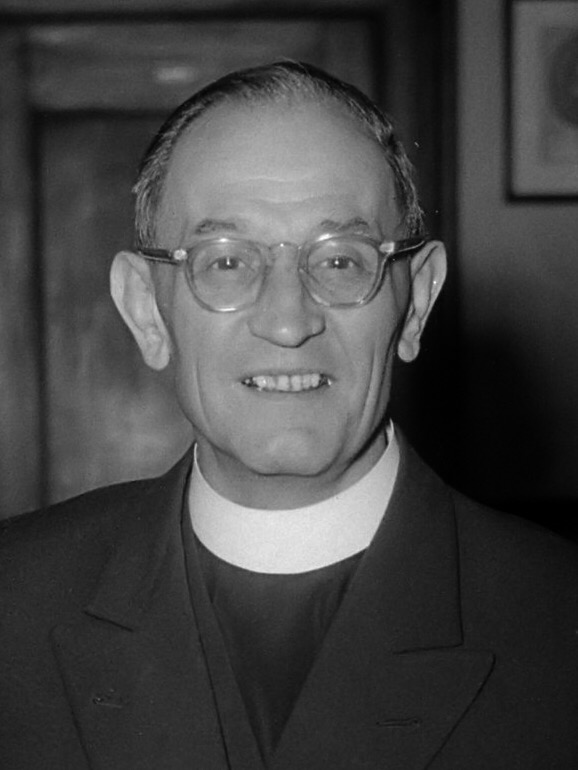
Pastor Martin Niemoller, pictured above, wrote a famous poem after he survived the concentration camps of the Second World War. His poem criticised the cowardice of German intellectuals after the Nazi’s rise to power and their subsequent purging of one group after another. It’s worth reflecting over his words. They are very relevant today. Right now. In Sweden. About us. 

‘First they came for the Socialists, and I did not speak out— Because I was not a Socialist.

Then they came for the Trade Unionists, and I did not speak out— Because I was not a Trade Unionist.

Then they came for the Jews, and I did not speak out—Because I was not a Jew.

Then they came for me—and there was no one left to speak for me.’

Do these words resonate with you? Are we the cowards he’s referring to? Are we so comfortable and complacent that we just sit back and watch it happen? 

If, like me, you believe in a multicultural society, it’s time to take a stance. Write to your MP. Talk to your colleagues, neighbours and friends. Get involved. Share this blog. Root out those one in five and challenge them. Demonstrate. Communicate. Educate. 

Speak out. While you can. Before it’s too late. 

The Gentle Minister

Anders_Ygeman

Reading on social media recently, I am struck by the amount of praise given to Sweden’s Home Secretary, Anders Ygeman. The minister is appearing a lot in newspapers and on the TV at the moment commenting on the tragic events of Paris and the impact terrorism has on the increasing security levels on Swedish soil. He also regularly informs the public on the refugee situation and the political reasons behind the government’s actions to reintroduce border controls.

On the face of it, Anders Ygeman should not be considered a good communicator. He has a very gentle, apologetic manner. He avoids eye contact at times. He speaks with a very quiet voice and a very flat tone. He is, in fact, the opposite of everything that a leader is said to be – inspiring, charismatic and energetic.  In the USA, or the UK, he would probably be ridiculed. But in Sweden, it seems to work.

From a cultural perspective, this is really interesting. What is it about Anders Ygeman that works so well in Sweden? Maybe it is a case of content over packaging. Often how we say something has more impact than what we say, but in Anders Ygeman’s case, it’s the opposite. He might not be charismatic, but he is clear and very direct. And is this an approach that Swede’s prefer in times of crisis – a no frills, humble and direct communication?

Sweden – get some perspective!!

60 million is a massive number. So big that it’s impossible to imagine. Difficult to relate to. 60 million is roughly 6 times the population of the whole of Sweden. And it’s the estimated number of people who are currently on the run in the world today. These people are running from war, from oppression, violence and starvation. They are running to escape persecution, to save their lives, and the lives of their children.

As we sit here in our comfortable homes, drinking coffee and eating our cinnamon buns, we watch these people on our flat screen televisions and switch them off when it gets too repetitive. 60 million people is an impossible number to digest, so it’s better just to put those images somewhere to the back of our minds and complain about the weather instead.

But just because it’s not happening here, doesn’t mean it’s not happening. 

A comparative handful of these 60 million people, against all odds, make it to Sweden. Housed in camps or living homeless on the streets, they break our illusion of our rich society. These people see Sweden as a temporary sanctuary. Here they are safe from war, famine and disease. They are safe from persecution and attack. But some Swedes see them as vermin, as parasites who are here to suck freely at the teet of the tax payer. 

We are told in political rhetoric that Sweden is being ‘swarmed’ by refugees, that our comfortable society is at risk. And people are scared that the self righteous baracades that have been built are creaking under the pressure of a world outside. 

Get some perspective Sweden! 

According to statistics released by the UN, the actual number of refugees and immigrants seeking asylum in Europe last year was round 600 000 – a mere 1%. 

Other statistics from Forbes show the following: 

  
Per thousand people, Sweden took in 15 refugees during 2014 which means around 135000 people. Out of 60 million people who are currently on the move. 

We need to have a reality check in Sweden and not believe the political arguments that some parties would have us believe. 

In the big picture, the number of people who make it to Sweden is tiny. These people have endured more than we can imagine just to get here. They have suffered mentally and emotionally and probably experienced indignities beyond our comprehension. 

The question becomes how do we treat these people who break through our flat screen complacency when they become living examples of what we fear? 

I suggest we welcome them with pride and with humanity. And treat them with the dignity they deserve. These are people, not parasites.  

And they are desperate to receive our protection. 


If you like this blog, please share it and spread it. 

Segregation in Sweden – us and them

residential segregation

When I was in the UK a few weeks ago, somebody told me that he follows Swedish news and politics with interest. He talked about how he always held Sweden up to be a good example of a humane society and how it seemed like the Swedes had succeeded – especially when compared to the UK. But the rapid rise of the right, and the increasing racism in Swedish society concerned him, and the increasing segregation between people was a disappointment. He saw Sweden as a society based on equality, but it was proving to be otherwise.

A disappointment. That was the word he used. Sweden is a disappointment.

According to DN’s recent study presented today, segregation has been increasing in Sweden during the last 20 years. Rich areas get richer and more ‘Swedish’. And the less fortunate areas, often where ethnic minorities lives, get poorer.

On average, 46  percent of all immigrants in Stockholm have immigrants as their nearest 400 neighbours. This can be compared to 24 percent of Stockholmers with Swedish background who have immigrants as their nearest 400 neighbours. In other words, the so-called ‘segregration differential’ is 22 percent (46-22). In 1991, this differential was 14 percent in Stockholm, so the segregration in the capital city has almost doubled over this period.

In Sweden’s other two largest cities, Gothenburg and Malmö, the segregation differential has gone, in the same period of time, from 14 to 25 percent and 16 to 22 percent respectively.

The Southern town of Kristianstad can ‘boast’ the fastest change in segregation – since 1991, segregation has increased from 6 percent to 27 percent. ould it be a coincidence that Sweden’s right wing political party have a stronghold in this area of the country? I think not.

But is this necessarily a bad thing? Well, like everything, it depends on the perspective that you take. Looking at it negatively, with increased immigration, there is a real risk that society cannot keep up – accomodation isn’t built quickly enough, schools are not able to take in children, health systems do not have the capicity to process larger numbers. And with this lack of ability to handle increased pressure, society develops even more into a ‘haves’ and have nots’ and segregation increases.

But from a positive perspective, there are clear benefits for minority groups to live together with others who already have a  foot in Swedish society. Immigrants who are already integrated can help minimise a feeling of total isolation, can help with with work contacts, social issues, language and knowledge about Swedish culture.

This is obviously a complicated issue. And it’s an issue that’s not going away. Immigration is inevitable for a country like Sweden. Apart from the humanitarian perspective, Sweden needs new citizens to pay tax and support the social welfare systems.

It seems like the continuing challenge for Sweden isn’t immigration – it’s integration. And if we also are disappointed with the way politicians handle it, it’s up to us to act.

Say ‘Welcome to Sweden’ – and mean it!

Unemploymentcopy

Last night, I was thinking about my working career and realised that I have always had a job. I have never been unemployed more than a few days. When I lived in the UK, I hopped from employment to employment. When I moved to Sweden 20 years ago I got a job teaching English within a week.  Working in Sweden is probably one of the main contributors to my successful integration into society. Through working, I met Swedes, I learned the language and developed an understanding of the culture. I became participative in Swedish life, I paid taxes and I felt a strong sense of involvement and motivation to contribute.

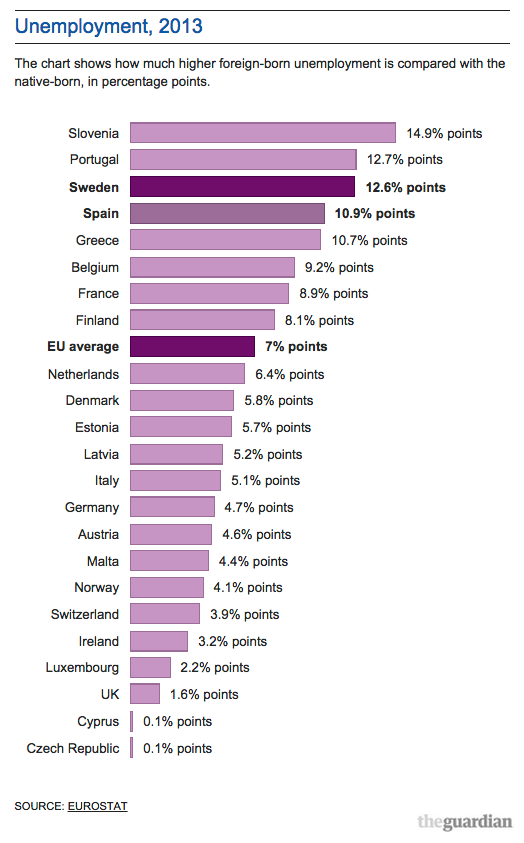
I know I am one of the privileged ones. The latest statistics from Eurostat compares unemployment amongst foreign-born and native-born residents in various European countries. In Sweden during 2013, unemployment was 12.3% higher for foreigners than for natives. This percentage is only higher in Portugal and Slovenia. According to the research, ‘immigrants in Sweden are now more than twice as likely to be unemployed as their native counterparts. In part this is explained by the integration challenge, but in many cases the children of immigrants of certain ethnic backgrounds need to send twice the number of CV’s compared to native-born job applicants before landing a job interview – alongside the challenge, there is also a hint of discrimination.’

This is serious. On the one hand, Sweden is an open and tolerant country. On the other hand, we see the rise of nationalism and the focus on immigration and integration. I strongly believe that what is required are jobs. But not just McJobs. Qualified, relevant jobs. As in my case, through work comes involvement and integration. In Sweden, the foreign-born population is actually more likely to have a higher education compared to the native Swedes. But Sweden has failed to leverage on this. This leads to doctors, lawyers and engineers working as cab drivers and cleaners, something that is corroborated in the OECD International Migration Outlook report which shows that Sweden’s over-qualification rates are among the worst when compared to other advanced economies.

It is no surprise that a failure to integrate foreign born population into Swedish society creates frustration and anger on both sides of the equation. This can be allievated through broad, far-reaching employment initiatives which Sweden has been so good at historically, So be shocked by the statistics and shout this out to the politicians! When we say ‘Welcome to Sweden’, we should mean it.

Is it a fish, is it a whale, is it a submarine?

IMG_4443.JPG

In Stockholm’s archipelago, a military operation is ongoing. Reports/suspicions of underwater activity in Swedish territory have led to this. Residents claim to have sighted a surface submarine and the general finger is pointing towards Russian involvement – not surprising given their recent actions.

But the thing is, no submarine is found. Now in the 6th day of hunting, the insufficient Swedish navy ships keep drawing blanks. Does this mean there is no submarine? Maybe. But it definitely puts the spotlight on Sweden’s inadequate military power and it’s subsequently inability to defend itself in an armed conflict.

So is this a wake up call? It’s definitely a dilemma for pacifistic Sweden.

Time to build up Sweden’s military defence that was politically dismantled during the last decade? Or time to invest more into diplomatic dialogue to avoid potential territorial confrontation?

What side of the fence do you land?