My helpful guide to how you can survive Midsummer in Sweden.

With Midsummer rapidly approaching tomorrow, it is worth planning for your survival.

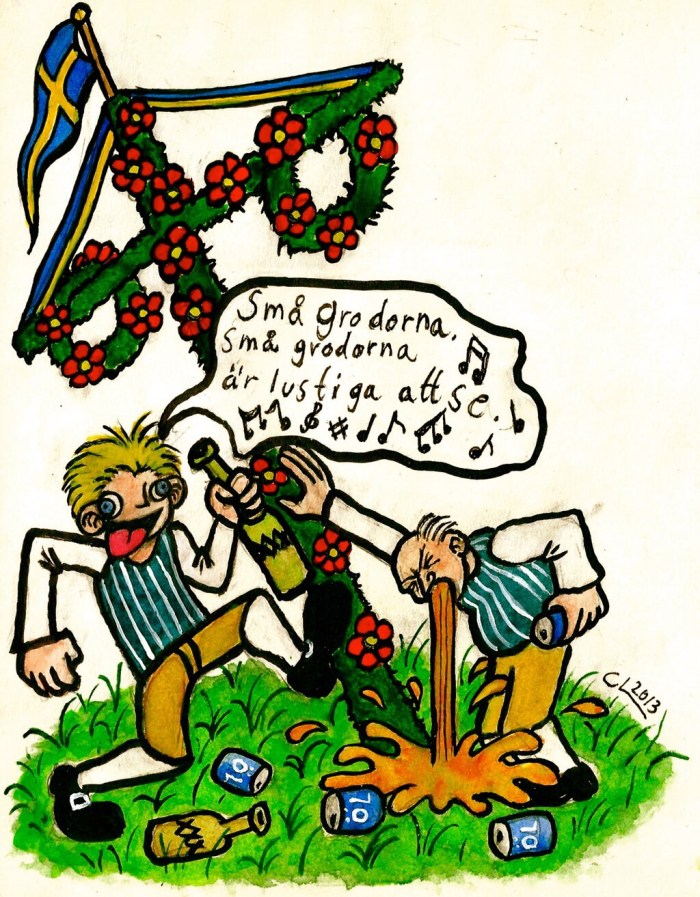
Midsummer’s Eve is the craziest custom in the Swedish calender and the time of the year when Swedes go a little bonkers.

As a non-Swede, get ready to brace yourself. And follow this simple survival guide to make sure you make it to Midsummer’s Day in one piece.

Greet like a Swede. In Sweden it is considered polite to greet everybody individually, even if you plan to never speak to them again or remember their name. The appropriate way is as follows, shake hands and look direct in eyes, say ‘hej’ followed by your name. They will do the same. If you are feeling adventurous, follow it up with a ‘trevligt’ or even a ‘Glad Midsommar’. Job done. Now you can hit the booze.

Snaps is not the same as a shot. A lot of alcohol gets drunk on Midsummer’s Eve, especially beer and snaps  With the popularity of shots in recent years, it’s easy to make the mistake that Swedish snaps is the same thing. Believe me, it is not. Snaps can be up to 40% proof, considerably more than your normal shot. So, go easy and sip the snaps or see yourself slipping sideways off your chair before the dessert has even been put on the table.

Take tissue. Midsummer’s Eve is a looong day and you probably will need the loo at some point. The trouble is, so will everybody else – to the detriment of the supply of toilet paper. There’s a big chance you will be seeking relief in the woods so come equipped with the appropriate amounts of paper for your needs

If shy, bring swimwear. Bathing in the icy June waters is a common activity at Midsummer. Swedes generally are not afraid of showing a bit of genital when they do this. If you are, then come prepared with swimwear and a towel.

Shelve your maturity. Part of Midsummer is dancing around the maypole, playing silly games, pretending to be a frog, participating in competitions. To survive this, it helps to conjour up your inner child and forget you are an adult for a while.

Rubbers will save the day. Given the amount of alcohol consumed at Midsummer, it is no surprise that the most babies in Sweden are made on this day. If you don’t want to join the ranks of parents, remember to put it on before you put it in.

Throw in the thermals. Perhaps you think it’s going to be sunny and warm on Midsummer’s Eve? Well, think again. It is not unusual that temperatures fall into single figures and that pesky rain pours down onto the smorgasbord. So bring a jumper, a rain jacket and even thermals to enhance your experience.

Same, but different. Don’t expect culinary excesses on Midsummer’s Eve. The food is exactly the same as is eaten at Christmas and Easter, with a few small exceptions – strawberries and new potatoes.

Learn a drinking song. On Midsummer’s Eve, food and alcohol is accompanied by Swedish drinking songs.  Learn one in advance and shine at the table. Even better sing one in your own language and you are guaranteed to use those rubbers you packed just for the occasion. For me, ‘what shall we do with the drunken sailor’ works every time

Argue over the rules. At Midsummer a popular Swedish garden game is called kubb. Involving the throwing of sticks, everybody seems to have their own understanding of the way to play. If you want to feel really Swedish, make sure you start an argument about the rules.

Take pills. Of varying types. Allergy pills are good because there are flowers everywhere: on the table, in the maypole, on peoples’ heads. Pain killers are good as a lot of snaps is consumed. Indigestion pills are good as the food is oily, fatty, acidic, smoky and rich. The after day pill is good, well… because…

That’s it! Follow this guide and you are sure to have a wonderous Midsummer’s Eve in Sweden. Glad Midsommar!

Your helpful guide to surviving Midsummer in Sweden

With Midsummer rapidly approaching, it is worth planning for your survival.

Midsummer’s Eve is the craziest custom in the Swedish calender and the time of the year when Swedes go a little bonkers.

As a non-Swede, get ready to brace yourself. And follow this simple survival guide to make sure you make it to Midsummer’s Day in one piece.

  1. Greet like a Swede. In Sweden it is considered polite to greet everybody individually, even if you plan to never speak to them again or remember their name. The appropriate way is as follows, shake hands and look direct in eyes, say ‘hej’ followed by your name. They will do the same. If you are feeling adventurous, follow it up with a ‘trevligt’ or even a ‘Glad Midsommar’. Job done. Now you can hit the booze.
  2. Snaps is not the same as a shot. A lot of alcohol gets drunk on Midsummer’s Eve, especially beer and snaps  With the popularity of shots in recent years, it’s easy to make the mistake that Swedish snaps is the same thing. Believe me, it is not. Snaps can be up to 40% proof, considerably more than your normal shot. So, go easy and sip the snaps or see yourself slipping sideways off your chair before the dessert has even been put on the table.
  3. Take tissue. Midsummer’s Eve is a looong day and you probably will need the loo at some point. The trouble is, so will everybody else – to the detriment of the supply of toilet paper. There’s a big chance you will be seeking relief in the woods so come equipped with the appropriate amounts of paper for your needs.
  4. If shy, bring swimwear. Bathing in the icy June waters is a common activity at Midsummer. Swedes generally are not afraid of showing a bit of genital when they do this. If you are, then come prepared with swimwear and a towel.
  5. Shelve your maturity. Part of Midsummer is dancing around the maypole, playing silly games, pretending to be a frog, participating in competitions. To survive this, it helps to conjour up your inner child and forget you are an adult for a while.
  6. Rubbers will save the day. Given the amount of alcohol consumed at Midsummer, it is no surprise that the most babies in Sweden are made on this day. If you don’t want to join the ranks of parents, remember to put it on before you put it in.
  7. Throw in the thermals. Perhaps you think it’s going to be sunny and warm on Midsummer’s Eve? Well, think again. It is not unusual that temperatures fall into single figures and that pesky rain pours down onto the smorgasbord. So bring a jumper, a rain jacket and even thermals to enhance your experience.
  8. Same, but different. Don’t expect culinary excesses on Midsummer’s Eve. The food is exactly the same as is eaten at Christmas and Easter, with a few small exceptions – strawberries and new potatoes.
  9. Learn a drinking song. On Midsummer’s Eve, food and alcohol is accompanied by Swedish drinking songs.  Learn one in advance and shine at the table. Even better sing one in your own language and you are guaranteed to use those rubbers you packed just for the occasion. For me, ‘what shall we do with the drunken sailor’ works every time.
  10. Argue over the rules. At Midsummer a popular Swedish garden game is called kubb. Involving the throwing of sticks, everybody seems to have their own understanding of the way to play. If you want to feel really Swedish, make sure you start an argument about the rules.

That’s it! Follow this guide and you are sure to have a wonderous Midsummer’s Eve in Sweden. Glad Midsommar!
Swedish ways to die #4 Death by Ice

I am continuing my look into Swedish death and have come to Part 4 – Death by Ice.

Although it’s hard to imagine when the sun is shining, and we are baking in summer temperatures, Sweden is often covered in snow and ice. This slippery, freezing covering often leads to many a treacherous way to come to a sticky end.

1. Ice bombs. Walking the streets of any town in Sweden is often a dangerous pastime. The snow and ice that forms on the roofs loosens as the weather improves or the ice gets too heavy. This leads to an avalanche of snow which plummets to the street beneath. For any unfortunate walking along the street this can mean a rendezvous with death. As the snow and the ice rushes down, it hits the walker on the head. In best case, a concussion. In worst case, a permanent surprise.

2. Ice rafts. As the frozen lakes of Sweden break up, they form sheets of ice floating on the surface. These rafts of ice occur suddenly leaving any unsuspecting person or animal trapped afloat. In best case, you are rescued. In worse case, you drown in the frozen waters.

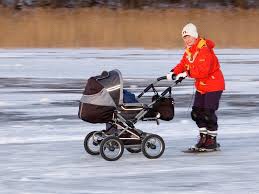
3. Skating. A safe sport when contained to a rink, the danger increases when Swedes take their skates out onto open sea. The notion of skating close to the edge where the ice becomes water is the main thrill. But if you’ve eaten one too many cinnamon buns the ice may break beneath you, and you plunge, in worse case, to a watery grave.

4. Pavement runs. Did you know that pavements kill? Well they do in Sweden. Black ice, shifting temperatures and substandard street-cleaning combine to turn the pavements into to bobsleigh runs. Many a broken bone occurs on the lethal streets of Swedish cities. And in worse case, broken necks.

So there you have it – four very Swedish icy ways to perish.

15 Swedish words for getting married

With the UK, and probably the USA, in a Royal wedding frenzy at the moment, it made me think about Swedish words for getting married. In English, we have for example ‘tie the knot’, ‘take the leap’ and ‘get hitched’, so I did some research. And I found the following formal, and less formal expressions for getting wed.

  1. gifta sig – to get married
  2. ingå äktenskap – to enter into marriage
  3. äkta – to wed
  4. ingå giftermål – to enter into marriage
  5. Gå träda i brudstol – ‘step onto the bridal chair’ (tradition from the 1600’s)
  6. Ingå förmälning – enter into marriage
  7. Gå brud – ‘go bride’
  8. Vigas – get married
  9. Föra till altaret – lead to the alter
  10. Knyta hymens band – tie the wedding band
  11. Bygga hjonelag – ‘build a marriage’
  12. Slå sina påsar ihop – ‘join your bags’
  13. Förena sina öden – unite your destinies
  14. Gänga sig – get married
  15. Stadga sig – settle down

Interestingly, the most used word for married in Swedish is the same as the word for poison – ‘gift’!

Why Swedes celebrate on the ‘afton’ (eve)

In the UK, we celebrate ‘Days’ such as Christmas Day & Easter Day. But in Sweden, it is always the Eve ( ‘afton’) that is the big celebration time. There’s påskafton, Valborgsmässoafton, Midsommarafton, pingstafton, nyårsafton, trettondagsafton. Why is this? Surely it can’t just be to get an extra day’s holiday?

Well, actually it originates from a time before the mechanical clock. In that period, a new day began at sunset rather than at midnight as it does now. In the Medieval times there was an expression – ‘vid kväll ska dag leva’ – which means something like ‘in the evening, shall the day live.’ Skandinavians held onto this tradition even after clocks were invented, and this is why they celebrated their important days the evening before. Now the evenings have, for practicalities sake, become day time activities. That’s why Swedes celebrate on the ‘Afton’. Oh yeah, and for the extra day’s holiday.

Sweden’s Easter tree – wiping, witching or whipping?

In Sweden, they don’t only have Christmas trees, they also have Easter trees.

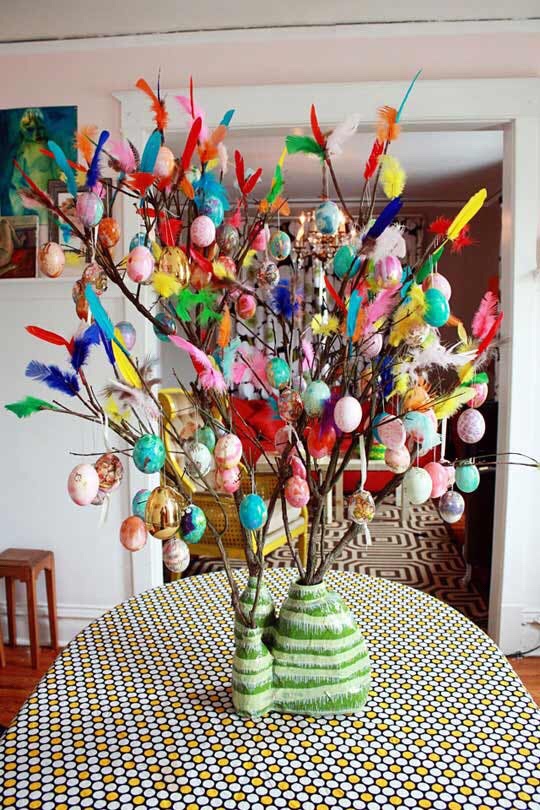
This Easter tree, known as ‘påskris’, is a handful of twigs and sticks (usually birch) installed in a vase with coloured feathers attached to the ends. People often hang painted eggs and other decorations such as chickens in their installation. The Easter tree can be seen all over the country at this time of year: outside shop entrances, in peoples’ living rooms, in gardens, in the middle of roundabouts.

The Easter tree is an interesting cultural phenomena – but where does it originate?

Wiping: Well, some Swedes say that it symbolises the wiping away of the winter. The twigs represent a broom and the feathers get caught in the broom as we sweep.

Witching: Others say that it represents witchcraft. The twigs represent a witch’s broomstick and the feathers indicate flight. This could also be why Swedish kids dress up as witches at Easter and do a kind of ‘trick or treating’ for Easter eggs.

Whipping: But, apparently the Easter tree has a completely different origin and symbolism. Swedish people, in the 1600’s, used to take twigs and sticks and beat each other with them on Good Friday to commemorate the suffering of Jesus. In the 1800’s and 1900’s, they started to be decorated and became a symbolic decoration for Easter.

So, wiping, witching or whipping. Who would have thought the colourful Easter tree would have such a colourful history?

Sweden’s pink Thursday

jesus-washing-apostles-feet-39588-gallery.jpg

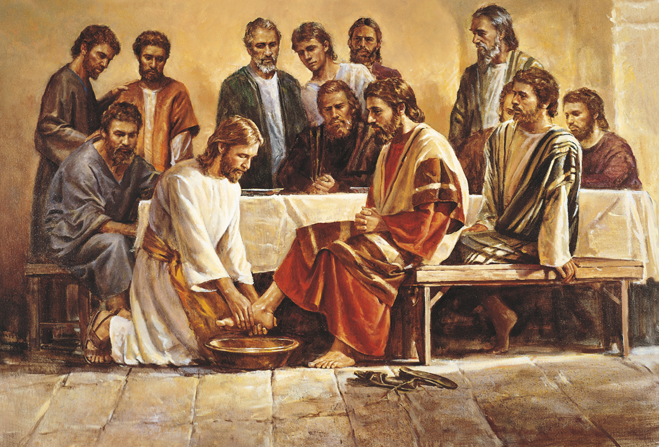
Today, the Thursday before Easter is called ‘Skärtorsdag’ in Swedish. As the word ‘skär’ translates as a shocking pink colour, many people joke that today is ‘pink Thursday’. But the word ‘skär’ in this case relates to something else – something far more biblical.

The word ‘skär’ is an early Nordic word meaning clean and pure. And here, we see a parallel to the English word for ‘Skärtorsdag’. In English, today is called ‘Maundy Thursday’ and it relates to the religious rite known as ‘the maundy’ which involved the ritualistic cleaning of feet. According to Christian belief, today was the day that Jesus performed this act until the recipients had clean and pure feet. It also is the day of the infamous Last Supper.

However, in Sweden today, ‘Skärtorsdag’ is not celebrated in any great religious fashion but in a pagan manner. A old pagan belief in Sweden was that on this day witches would mount their broomsticks to fly away to the legendary mountain known as Blåkulla. At Blåkulla it was believed that the devil held his earthly court. There the witches celebrated their sabbath and danced with the devil.

In modern day Sweden, we see this reflected in the many children who dress up as witches. These kids paint Easter cards and walk around the neighbourhood knocking on doors to wish everybody a happy Easter. In exchange, they hope to receive Easter sweets.

Demolishing Swedish treats

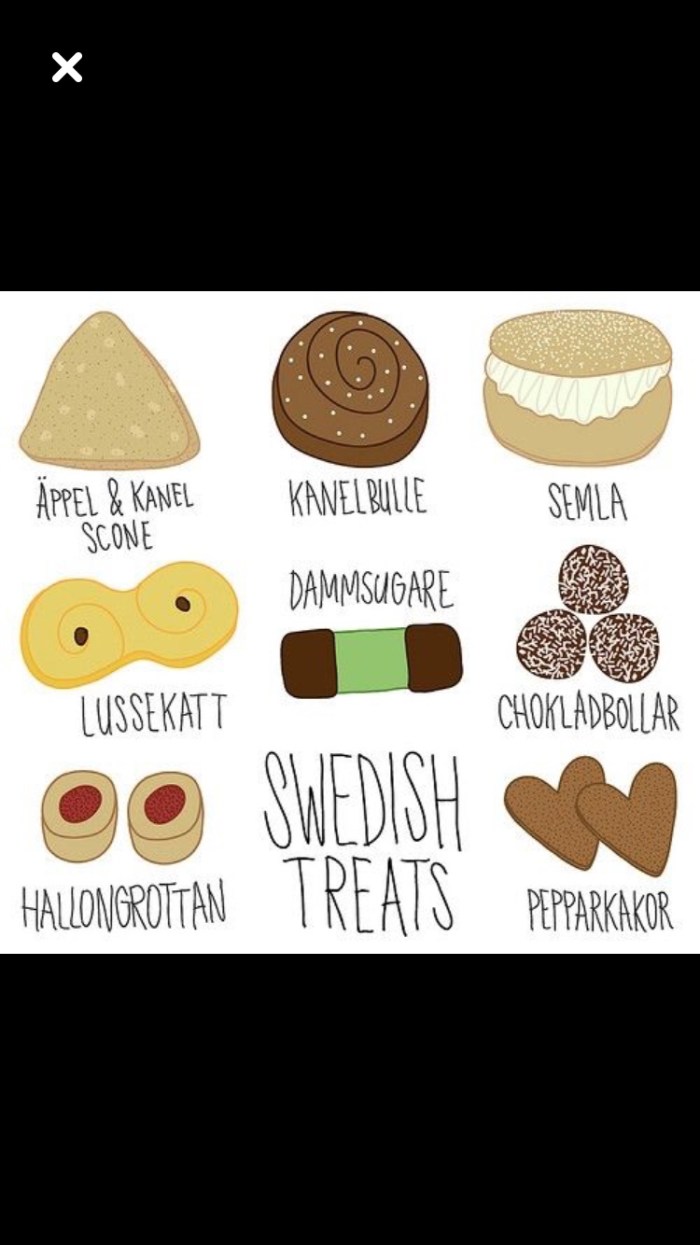
Many Swedes love to ‘fika’ – the tradition of drinking coffee and eating a cake. So much so that somebody decided to create the graphic above about popular Swedish treats. While the drawing is nice, the picture rather shows the meagreness of a Swede’s cake options. What then are some of the terrible choices depicted?

In a previous blog I’ve talked about the creamy bun known as semla, which I happen to think is delicious. In my opinion the semla is the best of them all. It is the king of Swedish treats reigning large over the other, to be honest, rather underwhelming alternatives.

The apple and cinnamon scone – as a British person I would not call this a scone. I don’t know what it is. Some kind of triangular bit of plaster. So, no further comment.

Probably the most popular dry-as-a-bone pastry associated with Sweden is the ‘kanelbulle’ or the cinnamon bun. Sold predictably in every bakery and cafe in Sweden and in their millions at Ikea, the cinnamon bun is only redeemed when drenched in melted, oozing butter.

Then there’s the ‘lussekatt’ – a disgusting saffron bun baked and sold in December. If you like bland, yellow bakes that give you indigestion for hours then this is the one for you.

The ‘dammsugare’ – or vacuum cleaner – is a marzipan roll dipped in chocolate. They can contain a bit of Swedish liqueur ‘punsch’ to take the edge off their otherwise plasticky taste. Altogether pointless and unsatisfying.

‘Chokladboll’ or chocolate ball is a linguistically dubious treat. Traditionally given a racist title, they are basically cocoa balls rolled in coconut. An unpleasant eating experience, these balls tend to ‘grow in your mouth’ as they say in Swedish….

‘Hallongrotta’, literally means raspberry cave. These are vanilla biscuits filled with raspberry jam that melt in the mouth. Unless they’re rock hard. They are a traditional biscuit which seem to evoke memories of grandmas and hot kitchens for many Swedes.

‘Pepparkakor’ are crisp gingerbread biscuits eaten around Christmas time. A ubiquitous classic eaten with Swedish mulled wine – ‘glögg’. They are a must during the festive season in homes, offices and often served covered in bacteria in shops. They come in many sizes and shapes, such as love-hearts, stars, people and goats. Yes, you read that correctly – goats.

So none of the above have a patch on the creamy, gooey, airy, almondy delight that is the semla. I know what I’m ordering with my coffee!

Any other Swedish treats that you think rival the almighty semla?

It’s Fatty Tuesday – Swedish style!

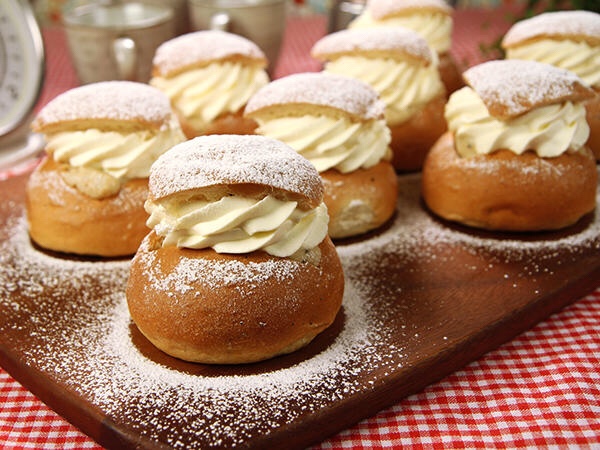
Today it’s ‘Fat Tuesday’ in Sweden, known as Shrove Tuesday or Mardi Gras around the world. While in the UK we eat pancakes and in Latin America they scoff down fried bread, Swedes celebrate by eating the traditional cream Lent bun – the ‘semla’. I’m also clearly going to indulge. In fact, my mouth is watering just writing this blog.

The semla is a creamy bun filled with delicious almond paste. They were eaten traditionally in Sweden to commemorate the start of Lent and the great Fast. In the south of Sweden, they still refer to them as ‘fastlagsbullar’ – Shrovetide buns. Nowadays however, semlas are usually sold anytime between Christmas and Easter.

I just love them. I could eat a barrel load. But I’d end up looking like a barrel if I did. I love the taste of them, and the feeling of luxurious indulgence. I also love the knowledge that as you take a bite into a creamy semla, you are biting into over 500 years’ history of Scandinavian baking.

The word ‘semla’ comes from the Latin ‘simila’ which means fine flour and originally referred just to the bun without any filling. As long ago as the 1500’s, bakers started to hollow out the middle of the bun and fill it with cream and butter. As ingredients became more available, bakers started adding almond and cardemon and the type of semla that we know today developed towards the end of the 1800’s. After rationing of sugar and dairy products ceased at the end of WW2, the semla took off and became very popular.

Nowadays the semla trend has reached new heights. Every year bakers around the country try to launch new types of semla, with their own spin on it -for example, the semla wrap, the semla burger, the semla layer cake, the semla cocktail, the chocolate semla, the vanilla semla, the lactose-free, gluten-free vegan semla.

All delicious I’m sure, but I’m a traditionalist in this matter. Give me a round fluffy cardemon-scented wheat bun brimming over with whipped cream and almond paste.

And give it to me NOOOOWWW!!!