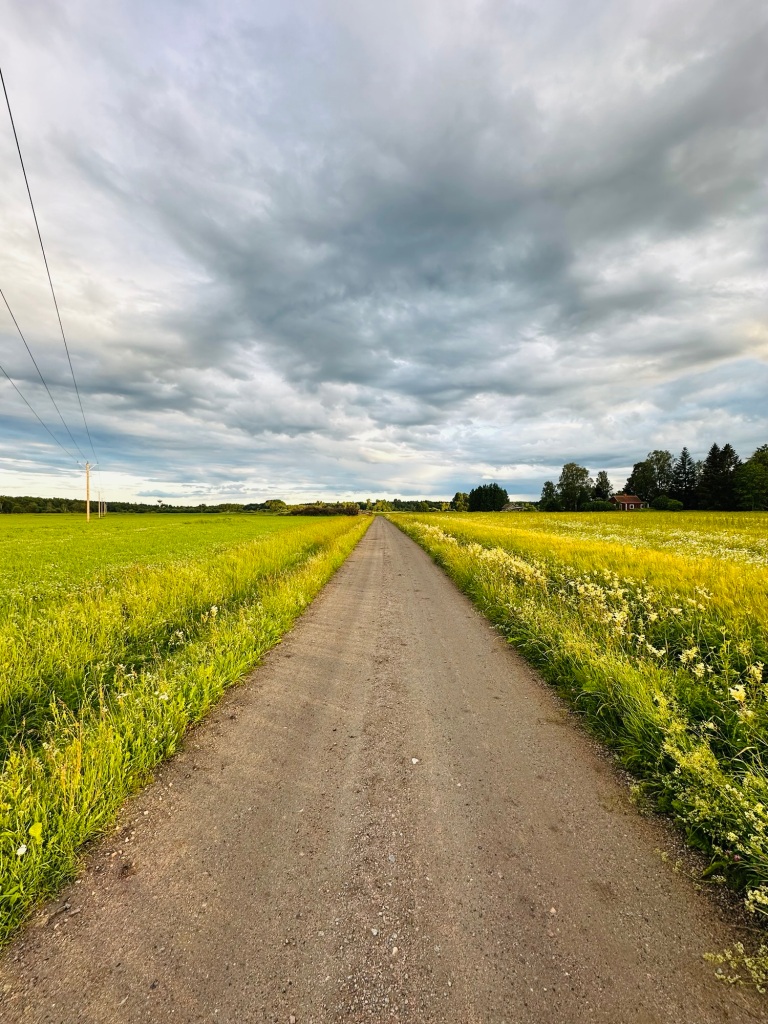
While Southern Europe is experiencing temperatures over 30-40 degrees, Sweden is undergoing a cold, rainy summer. The sun is forecast to arrive tomorrow to many parts of the country for a few days, followed by more rain.
I guess we shouldn’t be surprised. Rain is a characteristic of a typical Swedish summer. In fact, the two rainiest months of the year across much of the country are July and August. (February being the driest).
Ironically, these are also the months that most Swedes take their holidays – because of the warmer temperatures, the lighter days and the school system.
So there’s nothing to do but lie on the sofa and read books, or play card games around the kitchen table while the rain smatters the windows. Alternatively, put on your wellies and go for a wet walk. Or go to IKEA, or for a coffee somewhere nearby. And wait until the sun shows its face, albeit temporarily, in the Swedish summer sky.
The long Midsummer weekend is drawing to a close in Sweden. Known as “Midsommar”, it is one of the most significant and widely celebrated holidays in the country. Its history blends ancient pagan traditions with later Christian influences and remains a vital part of Swedish cultural identity.
The origins of Midsummer in Sweden are rooted in pre-Christian solstice celebrations. Ancient peoples marked the summer solstice, the longest day of the year, with rituals to honour nature, fertility, and the sun. These rituals often involved dancing, feasting, and the lighting of bonfires, believed to ward off evil spirits and ensure a good harvest.
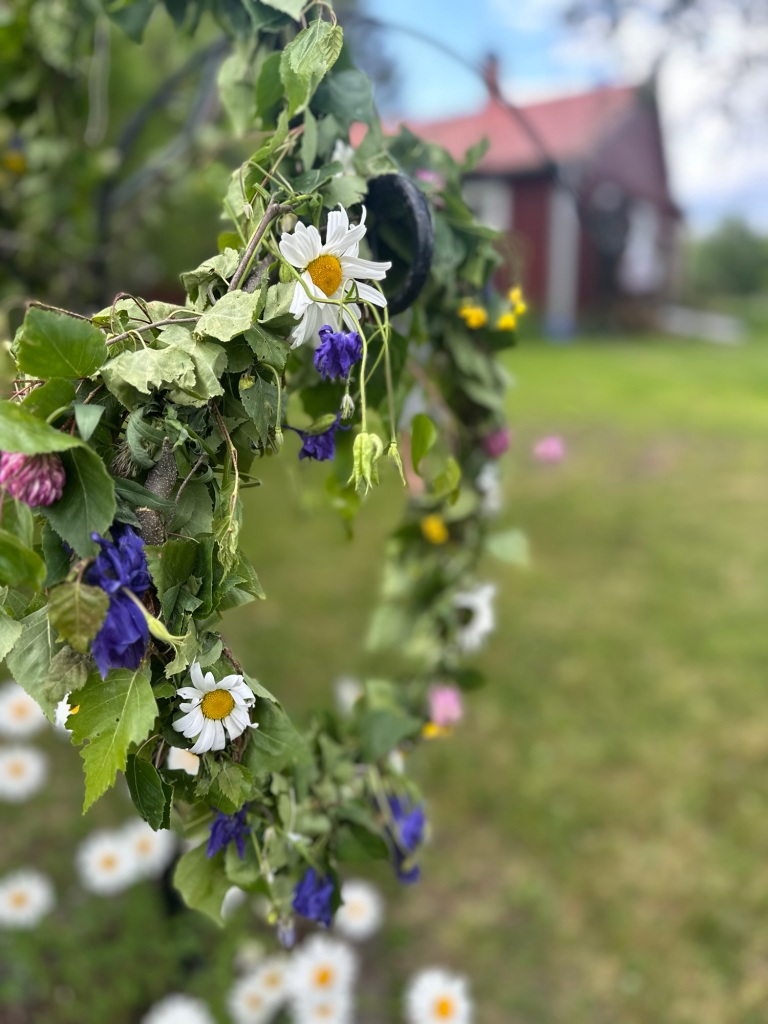
Flowers and greenery played an important role, symbolising fertility and the power of nature at its peak. It was also a time associated with magic and love, when people believed that plants had healing powers and that dreams could foretell the future—especially for young women seeking to glimpse their future husbands.
With the spread of Christianity in Scandinavia during the early Middle Ages, many pagan customs were adapted into the Christian calendar. The Church linked Midsummer celebrations to the feast of St John the Baptist, celebrated on 24 June. As a result, Swedish Midsummer traditionally falls around this date, although in modern times it is observed on the Friday between 19 and 25 June, followed by Midsummer Day on the Saturday.
Despite this Christian connection, the festival retained much of its pagan character, particularly the focus on nature and fertility, rather than religious observance.
Today, Midsummer remains the major secular celebration in Sweden. It marks the unofficial start of the summer holidays, when many Swedes leave cities for the countryside or their summer cottages (sommarstugor).
The festival is a strong symbol of national identity, with its emphasis on community, connection to nature, and timeless traditions. It is a day when Swedes of all ages participate in shared customs that span generations.
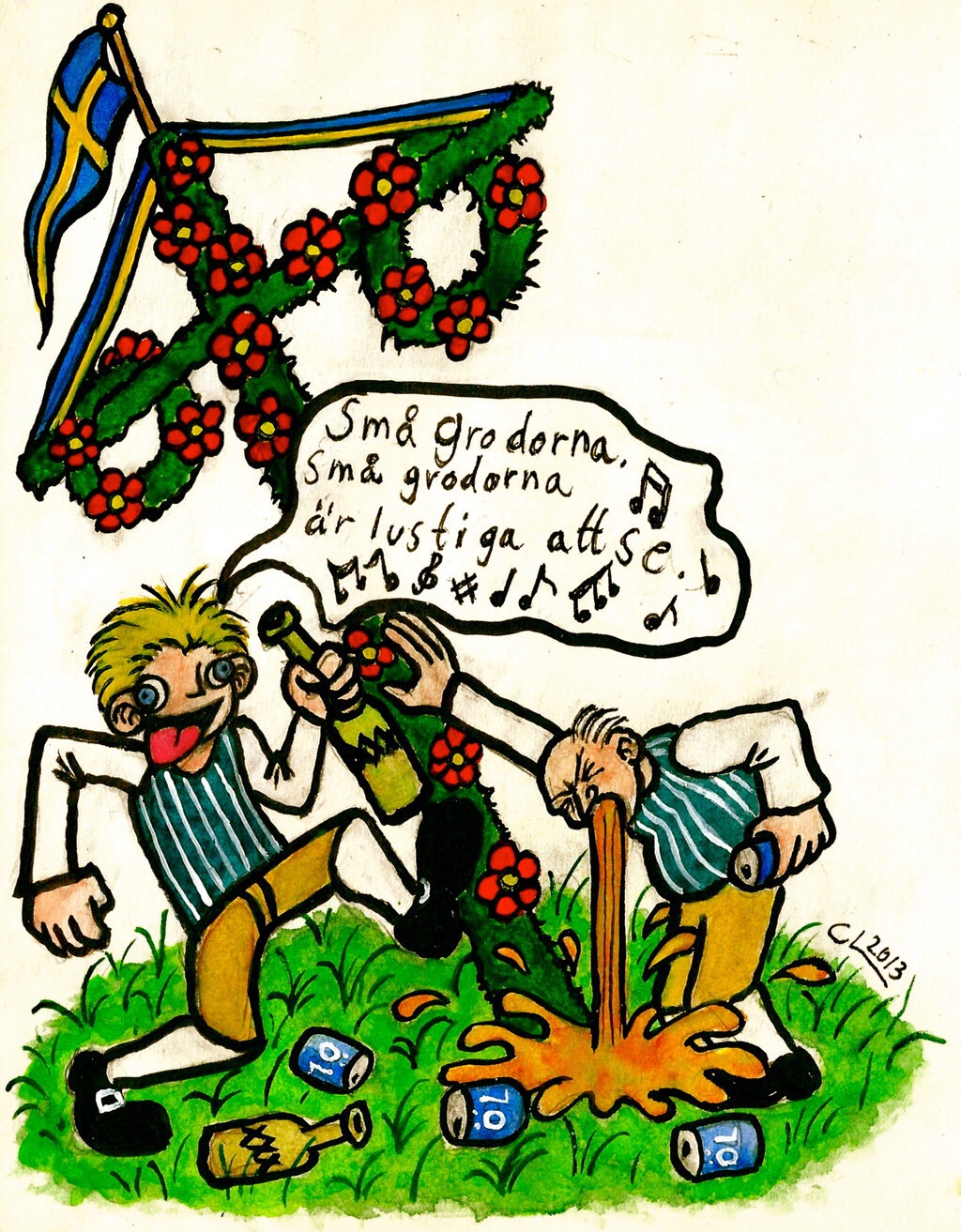
Swedish Midsummer celebrates abundance and as such, a great deal of food and drink is consumed. After guests arrive and have their first drink(s), the wreaths start to get made, the potatoes peeled, strawberries topped and the maypole gets decorated with flowers and leaves. Once erected, and danced around, it’s time for lunch.
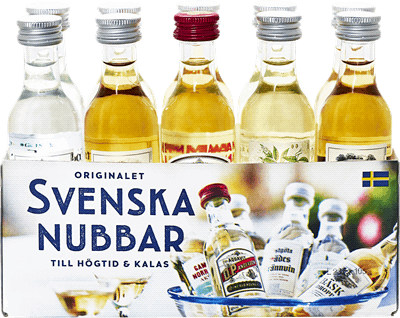
As far as drinking goes, ‘nubbe’, or snaps, is a common tipple accompanied by traditional drinking songs and washed down with beer. A popular brand of snaps is OP Anderson which is flavored with aniseed and fennel and is 40% proof. The drink has been around for 130 years on the market – the first snaps being sold in 1891! Another popular nubbe , the Danish Jubileums, is 40% proof and tastes of dill, coriander and bitter orange. There are also small-sized bottles than can be bought in fun packages that have a mixture of flavorings.
When it comes to the food, in the evening it has become popular in recent years to have a barbecue. But it is at lunch time when the traditional food is consumed, with a Midsummer smorgasbord (buffet).
On this buffet, it is common to find various types of pickled herring, soused herring, boiled new potatoes, gravlax with ‘hovmästare’ sauce, smoked salmon, Västerbotten cheese pie, crisp bread and mature cheese, chopped herbs, red onion, egg halves, ‘silltårta’ (herring cake), various sauces and mixes, fresh and smoked shrimps, fish roe.
As you can imagine, this food is very rich and fatty, which is why it is usually eaten together with the alcoholic snaps.
For dessert, the only thing to eat are Swedish strawberries and cream or a home-made strawberry cake. Anything else would be sacrilege. Some families also eat rhubarb pie.
After lunch, bolstered by the snaps, it’s usually time for garden games, a walk in the woods or a quick dip in the not-quite-yet-warm-enough lake or sea.
If the party lasts really late into the night, then there can also be a ‘vickning’. This is a ‘midnight meal’ designed to sober up drunk guests. It often includes some leftovers from the day, or can also be a very welcome hot dog. 🌭
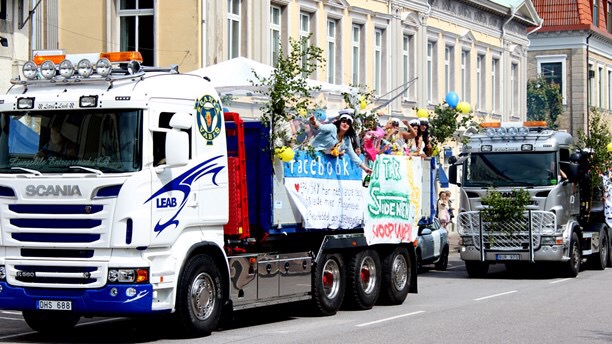
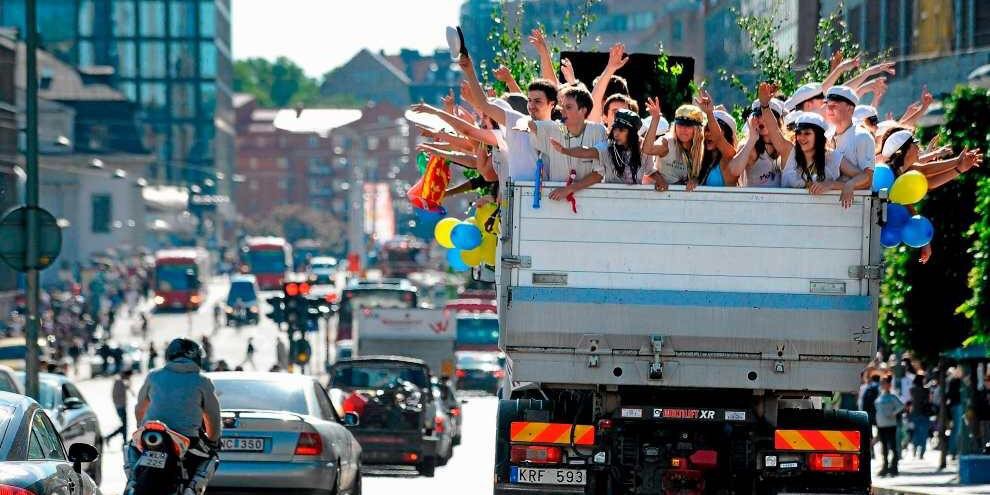
This time of the year, a common sight and sound on the streets of Sweden is 19-year old students on trucks.
Dressed in traditional white caps, and often bolstered with alcohol, the students jump up and down to the booming music from loud speakers concealed in the vehicle. They scream, sing, shout and spray beer on each other and sometimes unsuspecting pedestrians.
Many of them have banners hanging on the side of the trucks. Usually these just contain information about their school and class, but sometimes they’re personal, political or funny.
These youngsters are celebrating the end of their school career. They have just graduated from Sixth Form College/High School.
It’s not all fun and games though. Every year the media reports accidents and injuries, which is not entirely unexpected considering the mad energy with which the students jump and scream. And trucks have been banned from certain roads and areas in the towns.
In Sweden, doing ‘studenten’, as it’s called in Swedish, is a major rite of passage into adult life. The youngsters finish their last day at school, come running out of the building to be greeted by waiting parents and families holding placards with a childhood photo on.
The students then climb aboard their trucks for their lap of honour. After that they go around to each other’s homes where each family usually arranges a reception to honour the newly-graduated student.
It is a very common sight on the streets of Sweden this time of the year and a refreshing reminder of the hopefulness of youth.
Tonight, the 30th April, in Sweden is Valborgsmässoafton. Yes, another one of those long indecipherable Swedish words.
This one translates as Walpurgis Eve, and is celebrated in many European countries such as Germany, Holland, the Czech Republic, Lithuania, Latvia, Estonia and Finland.
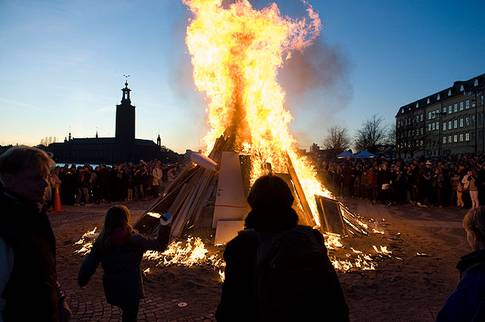
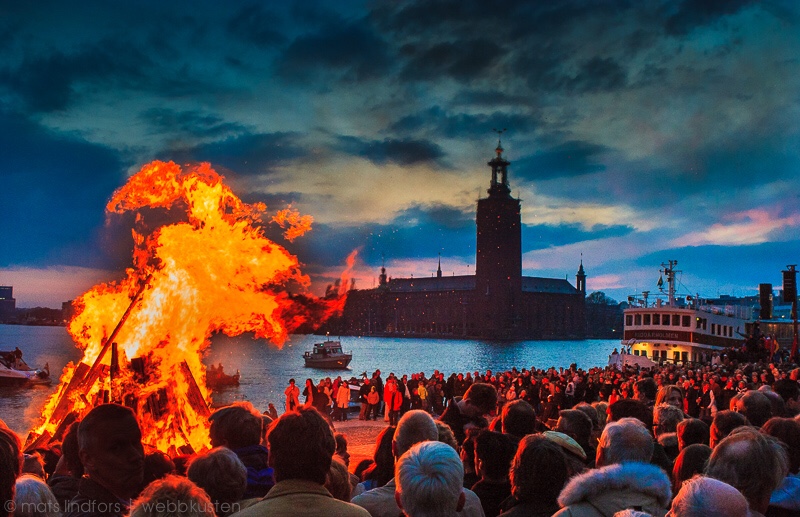
The name ‘Valborg’ is from an English Saint but, despite that, this isn’t really a religious celebration. It’s more to do with the welcoming of spring, and feels rather pagan actually. In the evening on Valborgsmässafton, Swedes gather around huge bonfires and listen to songs. These songs are in the form of traditional choir music designed especially for this occasion to shake off the nasty dark winter and celebrate the burgeoning buds of the lighter season.
And like many traditions in Sweden, this one also has a rural origin. These bonfires are part of a Swedish tradition dating back to the early 18th century. On this day, farm animals were let out to graze and bonfires lit to scare away predators and other evil beings. This is rather ironic as Walpurgis Eve is also an important holiday in Satanism at it marks the founding of the Church of Satan.
But religion aside. On Walpurgis eve, we are joined in the knowledge that we survived another winter, and summer is coming!
Yesterday, Sweden won its first medal at the Paris Olympics – a bronze in Judo.
For a relatively small country, Sweden often does quite well at the Olympics. In the 2020 Tokyo games, 9 medals were won. The most medals Sweden has ever won was in 1912 in Stockholm and 1920 in Antwerp where the athletes won a staggering 64 medals, each time. In London in 1944, a neat 44 medals were won.
Sweden is one of the 14 original countries to participate in the modern Olympics since its beginning in 1896, and has participated every time since then. The one exception is 1904 in St Louis.
The most successful Swedish summer Olympian of all time is Gert Fredriksson, a canoeist who has won 6 gold medals. In the world, the most gold medals have gone to swimmer Michael Phelps who has won a staggering 23 golds! The next best are Russian gymnast Larisa Latynina, Finnish runner Paavo Nurmi and Americans Carl Lewis and Mark Spitz, each with 9 gold medals.
From a historical country perspective, the USA has the most gold medals: a total of 1,179, according to the Olympic Foundation. Following is the now-disbanded Soviet Union, with 473 gold medals. Germany takes third, with 342 gold medals.
Great Britain, France, Italy, China, Sweden and Norway have all won more than 200 gold medals apiece, according to the Olympic Foundation.
This year in Paris, Sweden is realistically hoping to bring home 12 medals, in disciplines such as pole vault, discus, swimming, dressage, volleyball, handball, and sailing.
The judo bronze was unexpected – so let’s see what other surprises Paris might bring.
Today, 30 April, is Walpurgis Eve, called Valborgsmässoafton in Swedish, or ‘Valborg’ for short. The name Walpurgis is taken from the eighth-century Saint Walburga, and in Sweden this day marks the arrival of spring.
In a cold, dark country like Sweden, residents have suffered through a long, miserable winter. So it is no surprise that the arrival of spring is an occasion to mark. On the evening of Valborg, Swedes usually gather to celebrate together.
The forms of celebration vary in different parts of the country and between different cities. However, essential celebrations include lighting a large bonfire, listing to choirs singing traditional spring songs and a speech to honour the arrival of the spring season. Some of the traditional spring songs are titled ‘Beautiful May – Welcome!’ and ‘Longing for the countryside – winter rushes out’. You can see a clip below.
Walpurgis bonfires are an impressive thing to see and are part of a Swedish tradition dating back to the early 18th century. At Walpurgis, cattle was put out to graze and bonfires lit to scare away predators.
The weather is often unpredictable on Walpurgis Eve. It can be sunny and warmish, or it can still snow on 30 April!
Despite bad weather, Swedes still shiver around the bonfires and ironically celebrate the arrival of Spring.
This week is Stockholm Pride. It culminates on Saturday with a huge parade. The event celebrates 25 years this year, and some people question if it is still needed or relevant.
The answer, unfortunately, is more than ever.
But we’ll come to that later.
Currently there are 73 Pride festivals in Sweden during the year. From Arctic Pride way up in the north to Malmö Pride in the south, it is possible to celebrate throughout the year.
This indicates that many Swedes seem to have embraced the concept of Pride with open arms. There is, of course, a commercial benefit but the main reason seems to be that LGBT+ Pride resonates well with the societal Swedish values of equality, tolerance and acceptance.
However, like everything, it has its opponents.
Sweden’s current conservative government is in power, solely with the support of a right-wing populistic party. This party has consistently attacked LGBT people and the Pride movement. For example, this week, one of their politicians tweeted that Pride legitimizes pedophilia.
It is comments like this that plant the seeds of aggressive counter demonstrations, homophobic, anti-Pride propaganda and personal physical attacks. LGBT+ people are still regularly abused, discriminated against and attacked in Sweden. And if we lift our eyes to the broader world, we see examples of LGBT + rights being restricted or removed, and same sex relations being criminalized and punishable with the death penalty.
This is why Pride is still needed, not only as a celebration, but as a political manifestation of human rights.
If you’d like to know where a Pride is near you, go to http://www.svenskapride.sewhich collects all the Swedish events in one place.
With Midsummer arriving on Friday, it is time to start planning for your survival. Midsummer’s Eve is the craziest custom in the Swedish calender and the time of the year when Swedes go a little bonkers. As a non-Swede, get ready to brace yourself. Here are a few hacks to make sure you make it to Midsummer’s Day in one piece.
Greet like a Swede. In Sweden it is considered polite to greet everybody individually, even if you plan to never speak to them again or remember their name. The appropriate way is to stand 1-2 meters away, look directly in their eyes, say ‘hej’ followed by your name. They will do the same. You might even give a small wave or shake hands if you are comfortable doing so. If you are feeling adventurous, follow up your ‘Hej’ with a ‘trevligt’ or even a ‘Glad Midsommar’. Job done. Now you can hit the booze.
Snaps is not the same as a shot. A lot of alcohol gets drunk on Midsummer’s Eve, especially beer and snaps With the popularity of shots in recent years, it’s easy to make the mistake that Swedish snaps is the same thing. Believe me, it is not. Snaps can be up to 40% proof, considerably more than your normal shot. So, go easy and sip the snaps or see yourself slipping sideways off your chair before the strawberry dessert has even been put on the table.
Take tissue. Midsummer’s Eve is a looong day and you probably will need the loo at some point. The trouble is, so will everybody else – to the detriment of the supply of toilet paper. There’s a big chance you will be seeking relief in the woods so come equipped with the appropriate amounts of paper for your needs.
If shy, bring swimwear. Bathing in the icy June waters is a common activity at Midsummer. Swedes generally are not afraid of skinny dipping when they do this. If you are, then come prepared with swimwear and a towel.
Shelve your maturity. Part of Midsummer is dancing around the maypole, playing silly games, pretending to be a frog, participating in competitions. To survive these activities, it helps to conjour up your inner child and forget you are an adult for a while.
Protect yourself. Given the amount of alcohol consumed at Midsummer, it is no surprise that the many babies in Sweden are made on this day. It you don’t want to join the ranks of parents, remember to put it on before you put it in.
Throw in the thermals. It looks like it might be super sunny and warm this Midsummer’s Eve. One of the warmest ever! But it is good to be prepared. It is not unusual that temperatures fall into single figures and that pesky rain pours down onto the smorgasbord. So bring a jumper, a rain jacket and even thermals to enhance your experience.
Don’t expect culinary miracles on Midsummer’s Eve. The food is exactly the same as is eaten at Christmas and Easter, with a few small summery exceptions – strawberries, cream, dill and new potatoes. Remember to use hand disinfectant before you attack the buffet.
Learn a drinking song. On Midsummer’s Eve, food and alcohol is accompanied by Swedish drinking songs. Learn one in advance and shine at the table. Even better sing one in your own language and you are guaranteed to use those rubbers you packed just for the occasion. For me, ‘what shall we do with the drunken sailor’ works every time.
Argue over the rules. At Midsummer a popular Swedish garden game is called kubb. Involving the throwing of sticks, everybody seems to have their own understanding of the way to play. If you want to feel really Swedish, make sure you start an argument about the rules.
Take pills. Of varying types. Allergy pills are good because there are flowers everywhere: on the table, in the maypole, on peoples’ heads. Pain killers are good as a lot of snaps is consumed. Indigestion pills are good as the food is oily, fatty, acidic, smoky and rich. The after day pill is good, well… because…
That’s it! Follow this guide and you are sure to have a wonderous Midsummer’s Eve in Sweden.
Glad Midsommar!
Please share this post to help others get ready for the big day!
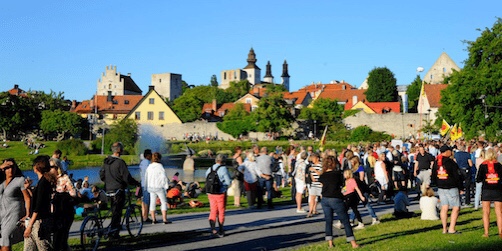
Once a year, with exception of the last two pandemic years, there is a summer politics week in Sweden. The week is happening now, the first since 2019. It takes place in a park called Almedalen on the Baltic island of Gotland, and attracts heavy media coverage.
During the week, the leaders of the eight parliamentary parties deliver speeches – their view of Sweden’s future. This year is especially interesting as there is a General Election in September. The Economy, Crime and Punishment and Education seem to be the top issues so far.
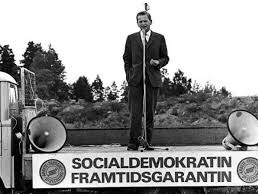
The Almedalen politics week started when legendary Swedish Prime Minister Olof Palme spoke publicly, from the back of a truck, during a summer visit to Gotland. It was at the end of the 60s and there was an audience of a few hundred people. It very quickly became a tradition.
Now Almedalen politics week attracts thousands of participants and is intended to involve the man on the street in politics and to protect the strong Swedish value of democracy and free speech. The idea is that at Almedalen politics week, we meet each other in debate. And in debate and discussion, we influence each other and our environment.
However, Almedalen Politics Week has also been heavily criticized for being elitist. The event has become a popular opportunity for businesses to meet and network with each other.
In a parallel existence, some people go to Almedalen only for this purpose and not to participate in any political activities. Social media has, in previous years, been awash with images of participants mingling, drinking rose wine, partying, dancing and taking drunken groupies.
Post Covid, we all have an opportunity to make changes. We don’t have to go back to the way things were before. The pandemic was a kind of system crash. It will be interesting to see how Almedalen politics week renews itself this year.


 Watching the Swedes