Swedish Midsummer – food and drink

Swedish Midsummer celebrates abundance and as such, a great deal of food and drink is consumed. After guests arrive and have their first drink(s), the wreaths start to get made, the potatoes peeled, strawberries topped and the maypole gets decorated with flowers and leaves. Once erected, and danced around, it’s time for lunch.

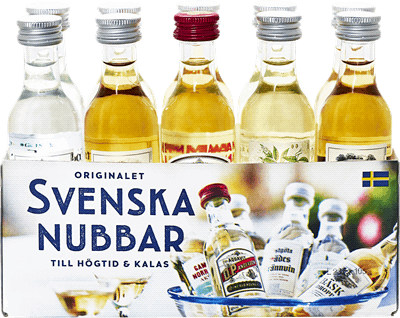
As far as drinking goes, ‘nubbe’, or snaps, is a common tipple accompanied by traditional drinking songs and washed down with beer. A popular brand of snaps is OP Anderson which is flavored with aniseed and fennel and is 40% proof. The drink has been around for 130 years on the market – the first snaps being sold in 1891! Another popular nubbe , the Danish Jubileums, is 40% proof and tastes of dill, coriander and bitter orange. There are also small-sized bottles than can be bought in fun packages that have a mixture of flavorings.
When it comes to the food, in the evening it has become popular in recent years to have a barbecue. But it is at lunch time when the traditional food is consumed, with a Midsummer smorgasbord (buffet).

On this buffet, it is common to find various types of pickled herring, soused herring, boiled new potatoes, gravlax with ‘hovmästare’ sauce, smoked salmon, Västerbotten cheese pie, crisp bread and mature cheese, chopped herbs, red onion, egg halves, ‘silltårta’ (herring cake), various sauces and mixes, fresh and smoked shrimps, fish roe.

As you can imagine, this food is very rich and fatty, which is why it is usually eaten together with the alcoholic snaps.

For dessert, the only thing to eat are Swedish strawberries and cream or a home-made strawberry cake. Anything else would be sacrilege. Some families also eat rhubarb pie.

After lunch, bolstered by the snaps, it’s usually time for garden games, a walk in the woods or a quick dip in the not-quite-yet-warm-enough lake or sea.

If the party lasts really late into the night, then there can also be a ‘vickning’. This is a ‘midnight meal’ designed to sober up drunk guests. It often includes some leftovers from the day, or can also be a very welcome hot dog. 🌭

Baby we’re burning – Swedes, songs and Satanists

valbiorg

Tonight, the 30th April, in Sweden is Valborgsmässoafton. Yes, another one of those long indecipherable Swedish words.

This one translates as Walpurgis Eve, and is celebrated in many European countries such as Germany, Holland, the Czech Republic, Lithuania, Latvia, Estonia and Finland. 

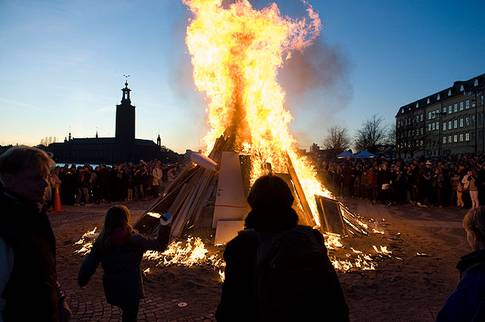
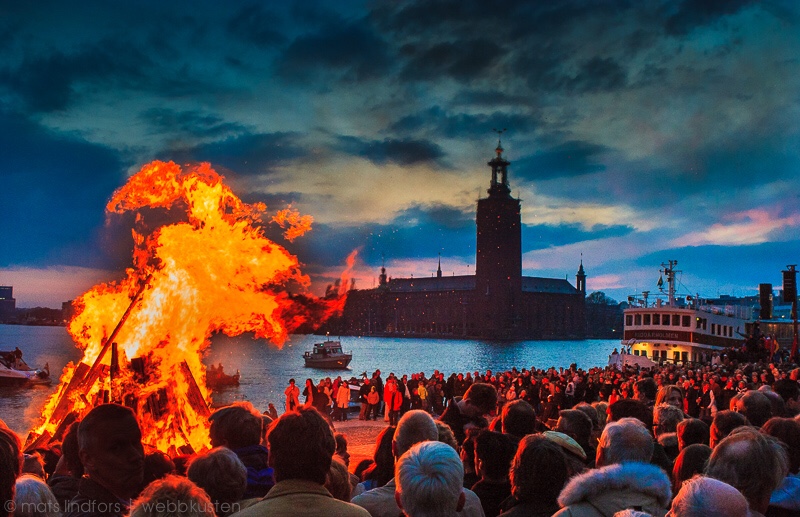
The name ‘Valborg’ is from an English Saint but, despite that, this isn’t really a religious celebration. It’s more to do with the welcoming of spring, and feels rather pagan actually. In the evening on Valborgsmässafton, Swedes gather around huge bonfires and listen to songs. These songs are in the form of traditional choir music designed especially for this occasion to shake off  the nasty dark winter and celebrate the burgeoning buds of the lighter season.

And like many traditions in Sweden, this one also has a rural origin. These bonfires are part of a Swedish tradition dating back to the early 18th century. On this day, farm animals were let out to graze and bonfires lit to scare away predators and other evil beings. This is rather ironic as Walpurgis Eve is also an important holiday in Satanism at it marks the founding of the Church of Satan.

But religion aside. On Walpurgis eve, we are joined in the knowledge that we survived another winter, and summer is coming!

Advent Calendar – Dec 24: Kalle Anka

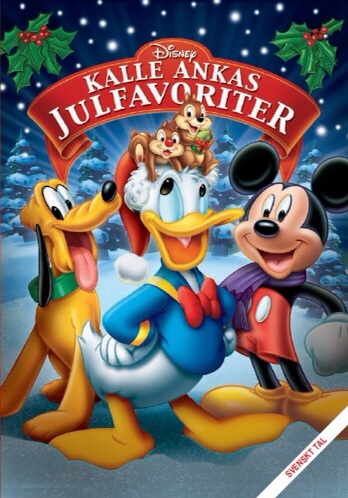
Window 24. As I am following the Swedish system of advent calendars, today is the last window, not the 25th as in the UK. So here is the final word: Kalle Anka. This is the Swedish name for Donald Duck – a Disney character with a strong, and unexpected, connection to Swedish Christmas.

Traditional Christmas celebrations on Christmas Eve in Sweden get off to a slow start. It all begins with a Christmas breakfast, consisting of rice porridge, wort bread, ham and Christmas cheese, amongst other things. After breakfast, some people go for a walk, some go to church, others begin the preparation for the Christmas julbord (buffet).

When to eat julbord differs from family to family. For some, it’s at lunch time, for others it more towards late afternoon. One surprising time marker is Kalle Anka (Donald Duck).

Every Christmas Eve since 1960, the Disney show ‘From All of Us to All of You’ featuring Donald Duck and his friends has been broadcasted on Swedish television at 3pm (now 3.05pm). Every single year. A very weird tradition for someone like me who grew up listening to the Queen’s speech on Christmas Day at 3pm. In the UK we have the monarch. In Sweden, Donald Duck.

So the discussion in Swedish homes is ‘should we eat before or after Kalle?’.

Today, Kalle Anka is watched as a sentimental tradition, or as background noise on Christmas Eve. But in the 1960’s when it began, it was the only time of the year that cartoons were shown on tv, so it was a Christmas treat. Since it’s been broadcast for almost 60 years, it is an integral part of what many Swedes associate with Christmas.

After Kalle Anka och julbord, it’s time for a visit from Tomten with gift-giving. This is followed usually by more food and drink. Some people conclude the day with a Midnight service at their local church.

Christmas is, like many places around the world, a time of overconsumption. Enormous amounts of food are left over and eaten during the following days.

In Sweden, Christmas Day and Boxing Day are both Public holidays – and the official end of Christmas is January 13th. Then it is time to traditionally throw out the Christmas tree. The lights in the windows have usually disappeared by February.

And as the daylight slowly returns to Sweden, people start planning for the lighter and warmer time of the year. And Christmas fades into memory…until next December.

Advent Calendar – Dec 15: Musikhjälpen

Window 15. Today’s word is ‘Musikhjälpen‘ which translates as Music Aid.

Since 2008, the radio/tv program ‘Musikhjälpen’ has become a traditional part of the lead up to Christmas.

In this program, 3 presenters are locked into a glass ‘cage’ on a town square somewhere in small town Sweden – this year from the northern town of Sundsvall. They are sleep deprived and only allowed to eat liquids.

From the cage, they broadcast radio and tv round the clock until they are released a week later.

The program is a fund-raising event for Sweden’s international aid organization Radiohjälpen. People up and down the country request songs and make donations, or carry out fund-raising activities. Live music performed in the ‘cage’ has also become an important part of the event. At most, the event has raised a staggering 74,410,363 SEK in 2017 when the theme was fighting against child prostitution.

Every year the theme is different; this year the theme is ‘every woman has the right to survive her pregnancy’.

Throughout the years, many of Sweden’s music and media celebrities have taken on the challenge of incarceration, such as singers Sara Dawn Finer, Daniel Adams-Ray, Molly Sandén, Miriam Bryant and Linnea Henriksson, and rappers Petter and Timbuktu. This year, radio profiles Linnea Wikblad and Assia Dahir are locked in with YouTube influencer Emil Hansius.

The program is based on an original format called Serious Request from Holland and is an amazing display of charity just a couple of weeks before Christmas.

Advent Calendar – Dec 13: Lucia

Window 13: Today’s word is ‘Lucia‘ – a light-bringing saint who is commemorated today.

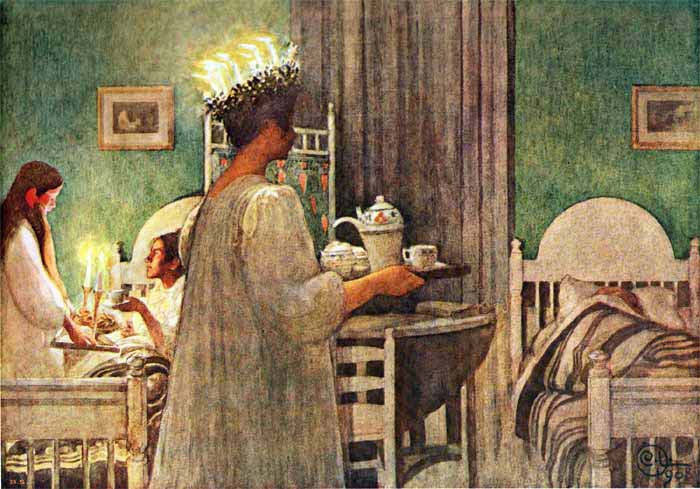
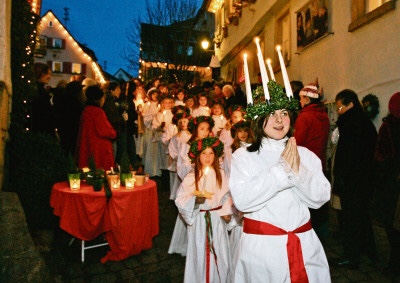
At the darkest time of the year, Santa Lucia (St Lucy) pays us a visit early in the morning. Lucia has candles in her hair and is surrounded by her handmaidens and boys, and shines light into the dark depths of our spirits. And slowly, slowly, the day awakens.

Santa Lucia is believed to have been a Sicilian saint who suffered a martyr’s death in Syracuse, Sicily around AD 310. She was seeking help for her mother’s long-term illness at the shrine of Saint Agnes, in her native Sicily, when an angel appeared to her in a dream beside the shrine. As a result of this, Lucia became a devout Christian and refused to compromise her virginity in marriage.

Officials threatened to drag her off to a brothel if she did not renounce her Christian beliefs, but were unable to move her, even with a thousand men and fifty oxen pulling. So they stacked materials for a fire around her instead and set light to it, but she would not stop speaking.

One of the soldiers stuck a spear through her throat to stop her, but to no effect. Soon afterwards, the Roman consulate in charge was hauled off to Rome on charges of theft from the state and beheaded. Lucia was able to die only when she was given the Christian sacrement.

The tradition of Santa Lucia is said to have been brought to Sweden via Italian merchants and the idea of lighting up the dark appealed so much that the tradition remained. The current tradition of having a white-dressed woman with candles in her hair appearing on the morning of the Lucia day started in the area around Lake Vänern in the late 18th century and spread slowly to other parts of the country during the 19th century.

The modern tradition of having public processions in the Swedish cities started in 1927 when a newspaper in Stockholm elected an official Lucia for Stockholm that year. The initiative was then followed around the country through the local press. Today most cities in Sweden appoint a Lucia every year. Schools elect a Lucia and her maids among the students. The regional Lucias will visit shopping malls, old people’s homes and churches, singing and handing out gingerbread.

So, it might be cold and dark outside, but remember – after darkness comes the light.

Advent Calendar – Dec 10: Nobeldagen

Window number 10. Today’s word is ‘Nobeldagen‘ which translates as ‘Nobel Day’.
Nobel Day is not actually anything to do with Christmas. However, it is a traditional part of the lead up to Christmas. Every year on 10 December, since 1901, the Nobel Prizes are awarded. The date commemorates the death of Alfred Nobel in 1896.

Nobel prizes are awarded in the 6 categories of Literature, Chemistry, Physics, Medicine or Physiology, Economics and Peace. All prizes are awarded in Stockholm, except the peace prize which is awarded in Oslo. Laureates receive a gold medal, a diploma and 10 million Swedish crowns.

Most laureates are happy to accept their prize and the accolade. However, Jean Paul Satre famously declined the Literature Prize in 1964, claiming he did not want to be institutionalized.

In 1974 he was joined by Le Duc Tbo who refused to accept the Peace Prize for his work to end the Vietnam War, saying ‘peace has not yet been established.’

In 1935, German journalist Carl von Ossietzky – a vocal critic of Hitler- won the Peace Prize. This led Hitler to bar all Germans from accepting a Nobel Prize. Three German laureates were subsequently forced to decline their awards. However, they later were presented with their diplomas and medals.

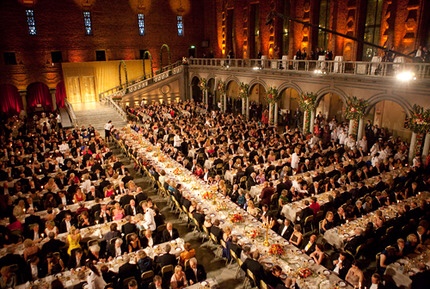
With celebratory lectures, conversations, ceremonies and concerts, Nobel Day culminates with a banquet in the Stockholm City Hall. The banquet lasts about 3 and a half hours and is televised. It is an extremely grand and formal occasion. Everything from the porcelain to the floral arrangements to the dresses, the entertainment and the menu are under scrutiny for the tv viewers.

The guests include not only the Nobel laureates and their families, but also Swedish royals and aristocrats, politicians, ministers, celebrities and other notable people. Even though there are 1300 guests, is virtually impossible for ordinary folk to get an invitation to the banquet. We have to enjoy it from afar, via the screens in our living rooms.

However exclusive the whole thing might be, it is still a welcome splash of glamour in the dark approach to Christmas. Stockholmers are also treated to the light festival called Nobel Lights, which takes place around the city. For a guide to where the various light installations are, check this out: https://nobelweeklights.se/

Happy Midsummer!

It’s finally arrived – Midsummer’s Eve – this most Swedish of all traditions. Today, friends and families gather to eat, drink and be merry. As you may have read in previous posts this week, this festivity is strongly connected to history, fertility, light and tradition.

Music is an important part of the day. All around the area, a lot of classic summer songs drift out from various loud speakers. The day often starts with gentle, folk-oriented music, and ends up with Swedish dance band and Eurovision pop.

To celebrate the day, I have made a Spotify playlist of the songs that I associate with Midsummer. For me, they are Sweden. Have a listen if you are interested.

Oh, and Glad Midsommar! 🌸🌸🌸

Walpurgis Eve – when spring arrives in Sweden

Today, 30 April, is Walpurgis Eve, called Valborgsmässoafton in Swedish, or ‘Valborg’ for short. The name Walpurgis is taken from the eighth-century Saint Walburga, and in Sweden this day marks the arrival of spring.

In a cold, dark country like Sweden, residents have suffered through a long, miserable winter. So it is no surprise that the arrival of spring is an occasion to mark. On the evening of Valborg, Swedes usually gather to celebrate together.

The forms of celebration vary in different parts of the country and between different cities. However, essential celebrations include lighting a large bonfire, listing to choirs singing traditional spring songs and a speech to honour the arrival of the spring season. Some of the traditional spring songs are titled ‘Beautiful May – Welcome!’ and ‘Longing for the countryside – winter rushes out’. You can see a clip below.

Walpurgis bonfires are an impressive thing to see and are part of a Swedish tradition dating back to the early 18th century. At Walpurgis, cattle was put out to graze and bonfires lit to scare away predators.

The weather is often unpredictable on Walpurgis Eve. It can be sunny and warmish, or it can still snow on 30 April!

Despite bad weather, Swedes still shiver around the bonfires and ironically celebrate the arrival of Spring.

Advent Calendar – Dec 20: Jullåt

Window 20. Today’s word is ‘Jullåt‘ which translates as ‘Christmas song’. The ‘å’ letter in Swedish is pronounced something like ‘or’.

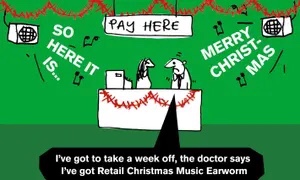
Obviously, the Christmas song is not unique to a Swedish Christmas. Like many other countries around the world, the playing of Christmas music starts in shops sometime in November and probably gives the shop assistants PTSD by the time Christmas has actually arrived.

The big international songs are popular in Sweden. According to the top list released by STIM (Sweden’s Music Copyright Protection Organisation), the most played international songs on Swedish radio are Wham’s ‘Last Christmas’, ‘All I want for Christmas is you’ by Mariah Carey and Band Aid’s ‘Do they know it’s Christmas’.

However, there is also a plethora of Christmas music in Swedish to torment us – classic, carols, hymns, psalms and pop. Many of the songs have predictable titles about Christmas time and lighting candles. The top three most-played Swedish songs are called ‘Tänd ett ljus’ (Light a candle), ‘Jul, jul, strålande jul’ (Christmas, Christmas, glorious Christmas) and ‘Mer jul’ (More Christmas).

But there are also some songs with rather strange titles. Here are just a few of them:

  • Hello (Christmas) goblins
  • The fox rushes over the ice
  • Our Christmas ham has escaped
  • Three gingerbread men
  • The Christmas goat
  • Staffan was a stable boy
  • Drunk again at Christmas
  • The gnomes’ Christmas night

A popular tradition at Christmas is to go to one of the many Christmas concerts that take place up and down the country. These concerts can be for example choir concerts, church concerts, school concerts or professional shows with famous Swedish singers such as Carola and Måns Zelmerlöw.

I myself am performing with my choir in a Christmas concert this evening in Stockholm and our special guest artist is the inimitable winner of Sweden’s Drag Race – Admira.

If you’d like to listen to some Swedish Christmas music, check it out here

Advent Calendar – Dec 15: Musikhjälpen

Window 15. Today’s word is ‘Musikhjälpen‘ which translates as Music Aid.

Since 2008, the radio/tv program ‘Musikhjälpen’ has become a traditional part of the lead up to Christmas.

In this program, 3 presenters are locked into a glass ‘cage’ on a town square somewhere in small town Sweden – this year from the town of Växjö in county Småland. They are sleep deprived and only allowed to eat liquids.

From the cage, they broadcast radio and tv round the clock until they are released a week later.

The program is a fund-raising event for Sweden’s international aid organization Radiohjälpen. People up and down the country request songs and make donations, or carry out fund-raising activities. Live music performed in the ‘cage’ has also become an important part of the event. At most, the event has raised a staggering 74,410,363 SEK in 2017 when the theme was fighting against child prostitution.

Every year the theme is different; this year the theme is ‘nobody should die from hunger’.

Throughout the years, many of Sweden’s music and media celebrities have taken on the challenge of incarceration, such as singers Sara Dawn Finer, Daniel Adams-Ray, Molly Sandén, Miriam Bryant and Linnea Henriksson, and rappers Petter and Timbuktu. This year, singer Oscar Zia is locked in together with radio profile Linnea Wikblad and comedian Sofia Dalén.

The program is based on an original format called Serious Request from Holland and is an amazing display of charity just a couple of weeks before Christmas.