How Swedish students celebrate!


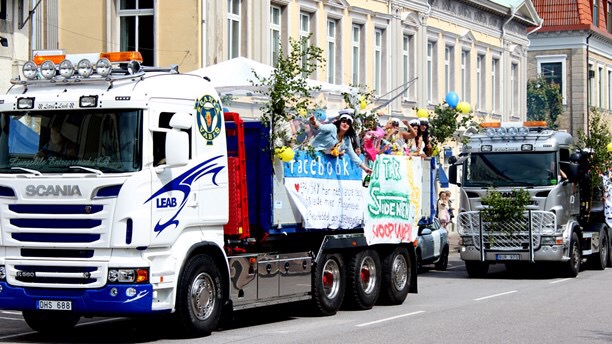
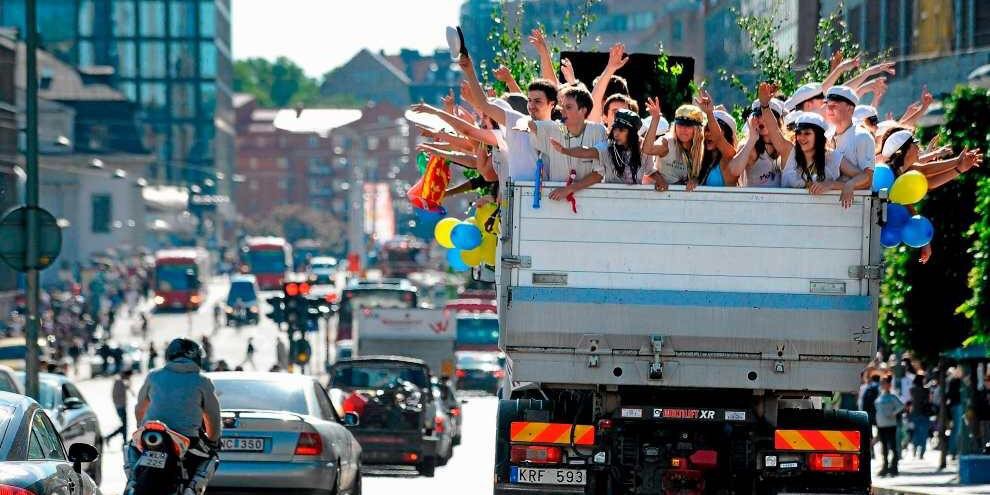
This time of the year, a common sight and sound on the streets of Sweden is 19-year old students on trucks.

Dressed in traditional white caps, and often bolstered with alcohol, the students jump up and down to the booming music from loud speakers concealed in the vehicle. They scream, sing, shout and spray beer on each other and sometimes unsuspecting pedestrians.

Many of them have banners hanging on the side of the trucks. Usually these just contain information about their school and class, but sometimes they’re personal, political or funny.

These youngsters are celebrating the end of their school career. They have just graduated from Sixth Form College/High School. 

It’s not all fun and games though. Every year the media reports accidents and injuries, which is not entirely unexpected considering the mad energy with which the students jump and scream. And trucks have been banned from certain roads and areas in the towns. 

In Sweden, doing ‘studenten’, as it’s called in Swedish, is a major rite of passage into adult life. The youngsters finish their last day at school, come running out of the building to be greeted by waiting parents and families holding placards with a childhood photo on.

The students then climb aboard their trucks for their lap of honour. After that they go around to each other’s homes where each family usually arranges a reception to honour the newly-graduated student. 

It is a very common sight on the streets of Sweden this time of the year and a refreshing reminder of the hopefulness of youth. 
Swedish caviar – but not as you know it

kalleskaviarWhen you hear the word ‘caviar’, you probably get an instant picture in your head – a picture of jewelled fish eggs, vodka, champagne, Russia and luxuriousness.
Until you hear about Swedish caviar – or more specifically a popular Swedish fishy foodstuff called ‘Kalle’s kaviar’. The New York Times referred to it as ‘challenging the global gag reflex’.

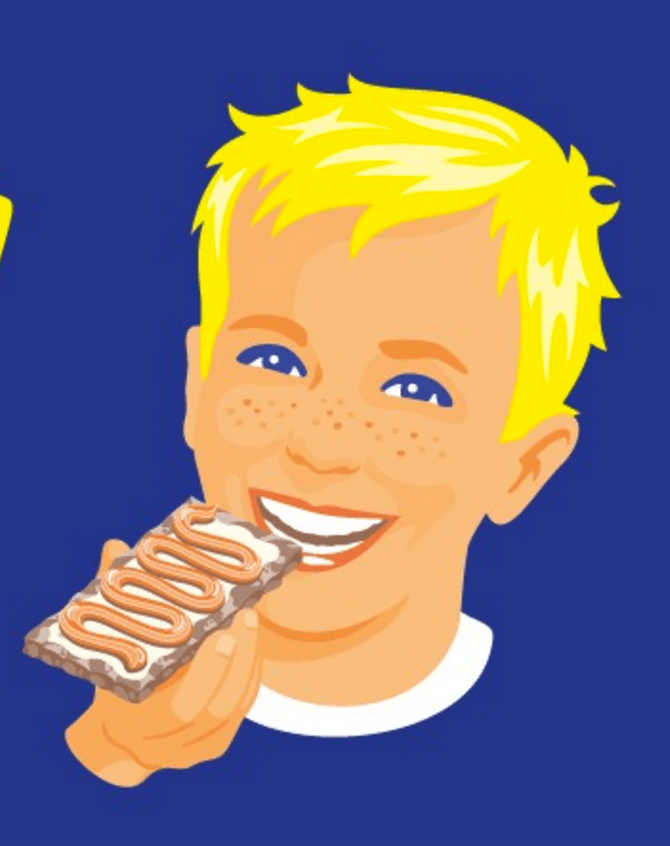
Kalle’s caviar comes in a tube, emblazened with the image of a blue-eyed, blonde-haired boy called Kalle. It hit the Swedish market in 1954, and has remained an extremely popular food since then. The tube contains smoked, sugar-salted cod and sik roe. It also contains lots of sugar, lots of salt, potato flakes and tomato purée. To eat it, one simply squeezes it from the tube, like toothpaste, onto an open sandwich usually containing boiled eggs. Kalle’s caviar is a fishy staple in the Swedish diet. It has a very pungent, extremely salty fishy taste.

It seems to be a divider amongst people. Some people love it, some people despise it. I would politely say that it’s an acquired taste. It certainly is a taste that has took me twenty years to acquire. When I first tasted it, I remember balking and questioning if it was even fit for human consumption. But now, I will happily squeeze the fishy stuff onto my boiled egg at breakfast time.

Sure, it’s caviar. But not as you know it.


Swedish National Day – a new king, an old king, a new constitution and 500 years of independence.

On 6 June 1523, Gustav Vasa was crowned King of Sweden. He was one of the few survivors of the Stockholm Bloodbath, in which his father and 80 other nobles were murdered, Game of Thrones style.

He ruled the country until 1560. During his reign, he released Sweden from the Kalmar Union consisting of Sweden, Denmark and Norway. He also turned Sweden from a catholic country into a Protestant one, with the monarch and not the pope as head of the church.

6 June is another significant day in Swedish history – on 6 June 1809 the country signed a new constitution. This lay the foundation for Sweden’s current status as an independent democracy and was in place until 1974.

The constitution returned political power to the parliament after King Gustav IV Adolph was deposed in a military coup in 1809. He was the last Swedish monarch to rule over Finland. After him, the crown passed not to his children but to his uncle, Charles XIII. Charles had no legitimate heir, which set into motion the quest for a successor. This was found the following year in the person of Jean-Baptiste Bernadotte, the first monarch of the present royal family.

For these two reasons, Sweden celebrates its National Day today – June 6th. It was declared in 1983, and was first celebrated as a public holiday in 2005.

The day is celebrated with various events up and down the country.

Today is a Swedish squeeze day

Today is a ‘squeeze day’ in Sweden. What, you may wonder, is a squeeze day?

It is not a day when everybody goes around hugging each other, or a day for drinking copious amounts of fresh citrus juice.

No, a ‘squeeze day’, or ‘klämdag’ in Swedish, is a day of the week that falls between a public holiday and a weekend.

In Sweden, when a public holiday occurs on a Tuesday or a Thursday, a common custom is to take the day between the holiday and the weekend as a day off. Often this is even subsidized by the employer. In English, this is called a ‘bridge day’ but in Swedish it’s cutely referred to as a ‘squeeze day’.

As yesterday (Thursday) was a public holiday, many people are also off work today.

Why is May 1st celebrated in Sweden?

In Sweden, and 160 other countries, May 1st is International Workers’ Day. Sweden has been celebrating it since 1939.

But why specifically May 1st?

The answer is found in a massacre in the USA. On 1 May 1886, laborers in Chicago went out on strike for an 8 hour working day. On 4 May 1886, the Chicago police force and the demonstrators clashed in a physical conflict. Eleven people died.

The event is called the Haymarket Massacre. Seven of the demonstrators were sentenced to death, despite lack of evidence. To commemorate the massacre, the socialist organization suggested that 1 May should become day of demonstrations every year around the world. Ironically, USA does not follow this tradition, but celebrates their Labour Day in September instead.

In Sweden, traffic is shut off, huge flag-waving demonstrations are held and people gather to hear political speeches.

The demonstrations represent people from various parties. However, since most of them are from the political left, the streets are awash with bright red flags and banners.

Not all Swedes demonstrate of course. For many, today is just a day off work – an opportunity to perhaps nurse a hangover from the festivities of the previous evening or to relax, go for a walk and enjoy the day.

Baby we’re burning – Swedes, songs and Satanists

valbiorg

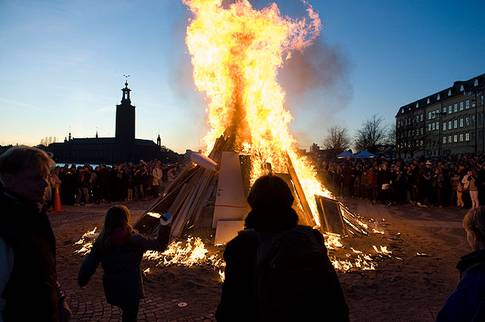
Tonight, the 30th April, in Sweden is Valborgsmässoafton. Yes, another one of those long indecipherable Swedish words.

This one translates as Walpurgis Eve, and is celebrated in many European countries such as Germany, Holland, the Czech Republic, Lithuania, Latvia, Estonia and Finland. 

The name ‘Valborg’ is from an English Saint but, despite that, this isn’t really a religious celebration. It’s more to do with the welcoming of spring, and feels rather pagan actually. In the evening on Valborgsmässafton, Swedes gather around huge bonfires and listen to songs. These songs are in the form of traditional choir music designed especially for this occasion to shake off  the nasty dark winter and celebrate the burgeoning buds of the lighter season.

And like many traditions in Sweden, this one also has a rural origin. These bonfires are part of a Swedish tradition dating back to the early 18th century. On this day, farm animals were let out to graze and bonfires lit to scare away predators and other evil beings. This is rather ironic as Walpurgis Eve is also an important holiday in Satanism at it marks the founding of the Church of Satan.

But religion aside. On Walpurgis eve, we are joined in the knowledge that we survived another winter, and summer is coming!

A witch-filled Clean Thursday in Sweden

easterwitchmooon

Today is ‘Maundy Thursday’ in English and in Swedish it is called ‘Skärtorsdag’. The word ‘skär’ means ‘clean’ – and it is a biblical reference.

If you know your bible stories, today is when Jesus gathered his disciples together for the Last Supper. Prior to the Last Supper, Jesus washed their feet. And he washed them clean – a symbolic metaphor for purification and the washing away of sin.

So, today is Clean Thursday. In fact, in English ‘Maundy Thursday’ also relates to the same act in the bible – the act of ritual cleaning is known an The Maundy.

However, in Sweden, today isn’t that much about washing feet – it’s more about witchcraft!

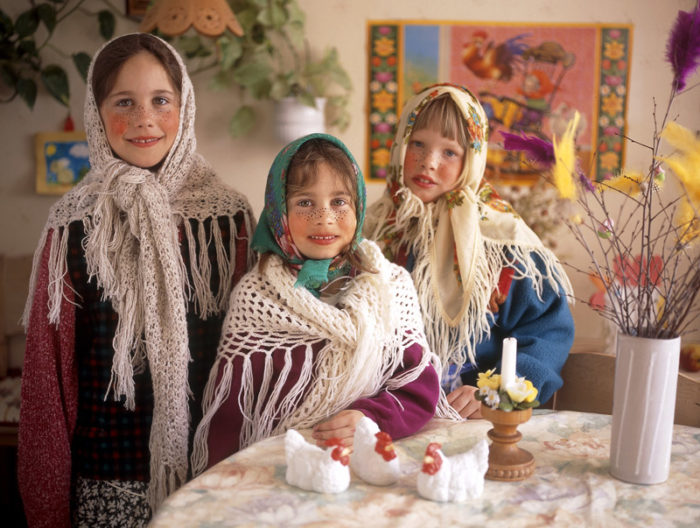
Today is celebrated by children dressing up as witches, rather like we do in the UK and USA on Halloween. Children go door to door in their outfits begging for sweets. This tradition originates from the belief centuries ago that the Skärtorsdag was the night of the witches, where these wicked hags would climb onto their broomsticks and fly to a mountain called Blåkulla. It was a night of danger and evil, and Swedish people would bar their doors to their houses and barns and leave outside gifts that would make the witches’ journey easier – food, milk, clothes, broomsticks. Today, that translates into the Swedish version of trick or treating.

paskkarringar-2-700x528

So if you celebrate by cleaning, or by dressing up as a witch or by eating candy – you’ll be kicking off your Easter the Swedish way!

April, April! You stupid herring!

april-fools-day-2015

Playing April Fool’s jokes on each other on the first of April is a tradition in many countries – Sweden included. In fact it is an old tradition – the oldest written reference being in 1392 in Chaucer’s ‘The Cantebury Tales’.

In Sweden, when someone is tricked, the tradition is to say ‘April, April din dumma sill!‘. This translates as ‘April, April you stupid herring!’. This is however not as weird as it might sound. In many countries, such as Italy, France and Holland, April 1st is known as “April fish”. On this day, people try to attach paper fish onto the backs of their victims.

April Fool’s pranks are common in newspapers, with classics such as:

  • IKEA is getting into the airline business. Furnishing all the flights with Ikea furniture, the name of the airline is FLYKEA.
  • Swedish supermarket chain ICA introduced toothpaste with the taste of chocolate. It might be brown, but it makes your teeth white.
  • Burger King introduced a new burger for left-handed people where ingredients were rotated 180 degrees.

I had a look this morning at the media to see if I could identify any April Fools tricks and I found one! A paper in northern Sweden reported that it had found a leaked document from the Swedish Armed Forces, revealing that Sweden is to receive its first moose cavalry. No animal is better suited for battle than the king of the forest, the newspaper claims. An AI image also shows armed soldiers riding moose!


Swedish astrology

The earliest astrology can trace its roots to 19th Century BC. Beginning in Mesopotamia, it later spread to Greece and Rome, and eventually Central and Northern Europe.

Western astrology has twelve signs, reflecting the month in which you were born. In English, these signs are named after the original Greek words. But not the Swedish names. Like much else in the Swedish language, the words for these signs are very literal. They are also in the definite form.

Aquarius – Vattumannen (the Water Man)

Pisces – Fiskarna (the Fish)

Aries – Väduren (the Ram)

Taurus – Oxen (the Oxe)

Cancer – Kräftan (the Crab)

Gemini – Tvillingarna (the Twins)

Leo – Lejonet (the Lion)

Virgo – Jungfrun (the Maiden / virgin)

Libra – Vågen (the Scale)

Scorpio – Skorpionen (the Scorpion)

Sagittarius – Skytten (the Archer)

Capricorn – Stenbocken (the Goat/Ibex)

It’s Fat Tuesday – Swedish style!

Today it’s ‘Fat Tuesday’ in Sweden, known as Shrove Tuesday or Mardi Gras around the world.

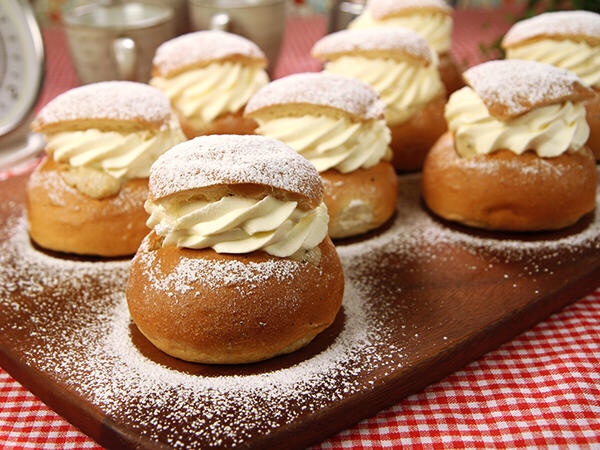
While in the UK we eat pancakes (today is even called Pancake Day) and in Latin America they scoff down fried bread, Swedes celebrate by eating the traditional cream Lent bun – the ‘semla’. 40 million of them every year! I’m also clearly going to indulge. In fact, my mouth is watering just writing this post.

The semla is a creamy bun filled with delicious almond paste. Traditionally, they were only eaten in Sweden to commemorate the start of Lent and the great Fast, leading up to Easter. In the south of Sweden, they still refer to them as ‘fastlagsbullar’ – Shrovetide buns. Nowadays however, semlas are usually sold anytime between Christmas and Easter.

I just love them. I could eat a barrel load. But I’d end up looking like a barrel if I did. I love the taste of them, and the feeling of luxurious indulgence. I also love the knowledge that as you take a bite into a creamy semla, you are biting into over 500 years’ history of Scandinavian baking.

The word ‘semla’ comes from the Latin ‘simila’ which means fine flour and originally referred just to the bun without any filling. As long ago as the 1500’s, bakers started to hollow out the middle of the bun and fill it with cream and butter. As ingredients became more available, bakers started adding almond and cardemon and the type of semla that we know today developed towards the end of the 1800’s. After rationing of sugar and dairy products ceased at the end of WW2, the semla took off and became very popular.

Newspapers often have the ‘Semla of the Year’ award, and nominate the best semla in town. Consequently, Swedes flock like sugar-addicted lemmings to the winning bakery, and you can stand in a queue for an hour to get your hands on one, if you haven’t ordered in advance.

Nowadays the semla trend has reached new heights. Every year bakers around the country try to launch new types of semla, with their own spin on it -for example, the semla wrap, the semla burger, the semla layer cake, the semla cocktail, semla ice cream, semla nachos, semla langos, the chocolate semla, the vanilla semla, the lactose-free, gluten-free vegan semla. In 2021, the gross-sounding fermented Baltic herring semla was revealed.

But I’m a traditionalist in this matter. Give me a classic round fluffy cardemon-scented wheat bun brimming over with whipped cream and almond paste.

And give it to me NOOOOWWW!!!