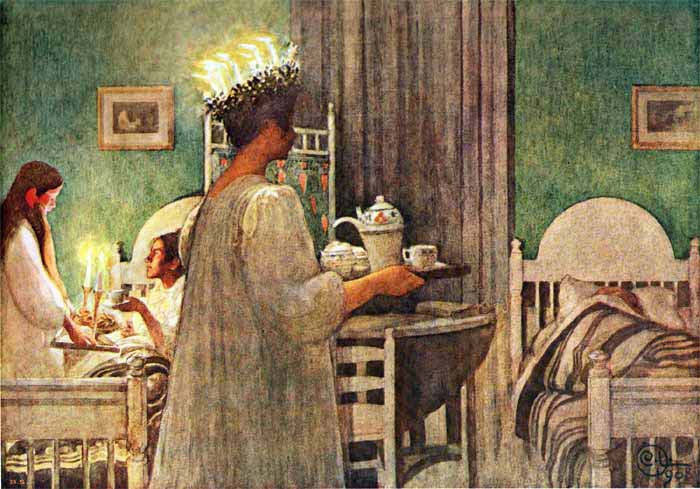
Sweden’s Lucia Celebration

At the darkest time of the year, Santa Lucia (St Lucy) pays us a visit early in the morning on December 13th. Lucia has candles in her hair and is surrounded by her handmaidens and boys, and shines light into the dark depths of our spirits. And slowly, slowly, the day awakens.

Santa Lucia is believed to have been a Sicilian saint who suffered a martyr’s death in Syracuse, Sicily around AD 310. She was seeking help for her mother’s long-term illness at the shrine of Saint Agnes, in her native Sicily, when an angel appeared to her in a dream beside the shrine. As a result of this, Lucia became a devout Christian and refused to compromise her virginity in marriage.

Officials threatened to drag her off to a brothel if she did not renounce her Christian beliefs, but were unable to move her, even with a thousand men and fifty oxen pulling. So they stacked materials for a fire around her instead and set light to it, but she would not stop speaking.

One of the soldiers stuck a spear through her throat to stop her, but to no effect. Soon afterwards, the Roman consulate in charge was hauled off to Rome on charges of theft from the state and beheaded. Lucia was able to die only when she was given the Christian sacrement.

The tradition of Santa Lucia is said to have been brought to Sweden via Italian merchants and the idea of lighting up the dark appealed so much that the tradition remained. The current tradition of having a white-dressed woman with candles in her hair appearing on the morning of the Lucia day started in the area around Lake Vänern in the late 18th century and spread slowly to other parts of the country during the 19th century.

The modern tradition of having public processions in the Swedish cities started in 1927 when a newspaper in Stockholm elected an official Lucia for Stockholm that year. The initiative was then followed around the country through the local press. Today most cities in Sweden appoint a Lucia every year. Schools elect a Lucia and her maids among the students. The regional Lucias will visit shopping malls, old people’s homes and churches, singing and handing out gingerbread.
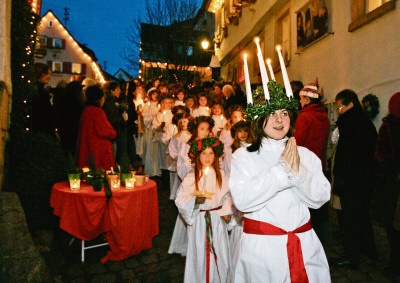
Not only does Lucia represent tradition, but there is also a symbolic meaning. Never more important than this year when the world is in turmoil. So remember, it might be cold and dark right now, but after the darkness comes the light.
Swedish caviar – but not as you know it

kalleskaviarWhen you hear the word ‘caviar’, you probably get an instant picture in your head – a picture of jewelled fish eggs, vodka, champagne, Russia and luxuriousness.


Until you hear about Swedish caviar – or more specifically a popular Swedish fishy foodstuff called ‘Kalle’s kaviar’. The New York Times referred to it as ‘challenging the global gag reflex’.

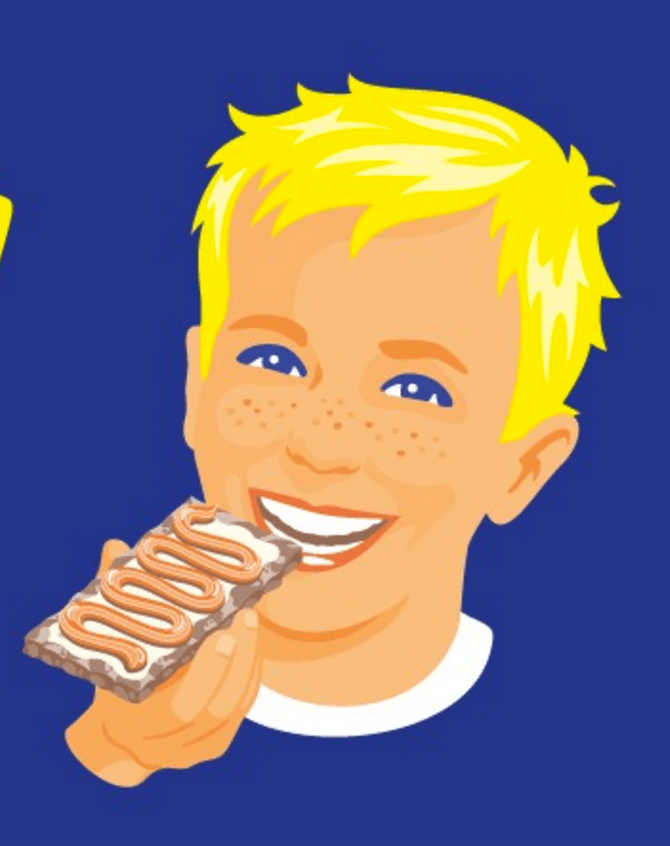
Kalle’s caviar comes in a tube, emblazened with the image of a blue-eyed, blonde-haired boy called Kalle. It hit the Swedish market in 1954, and has remained an extremely popular food since then. The tube contains smoked, sugar-salted cod and sik roe. It also contains lots of sugar, lots of salt, potato flakes and tomato purée. To eat it, one simply squeezes it from the tube, like toothpaste, onto an open sandwich usually containing boiled eggs. Kalle’s caviar is a fishy staple in the Swedish diet. It has a very pungent, extremely salty fishy taste.

It seems to be a divider amongst people. Some people love it, some people despise it. I would politely say that it’s an acquired taste. It certainly is a taste that has took me twenty years to acquire. When I first tasted it, I remember balking and questioning if it was even fit for human consumption. But now, I will happily squeeze the fishy stuff onto my boiled egg at breakfast time.

Sure, it’s caviar. But not as you know it.


April, April! You stupid herring!

april-fools-day-2015

Playing April Fool’s jokes on each other on the first of April is a tradition in many countries – Sweden included. In fact it is an old tradition – the oldest written reference being in 1392 in Chaucer’s ‘The Cantebury Tales’.

In Sweden, when someone is tricked, the tradition is to say ‘April, April din dumma sill!‘. This translates as ‘April, April you stupid herring!’. This is however not as weird as it might sound. In many countries, such as Italy, France and Holland, April 1st is known as “April fish”. On this day, people try to attach paper fish onto the backs of their victims.

April Fool’s pranks are common in newspapers, with classics such as:

  • IKEA is getting into the airline business. Furnishing all the flights with Ikea furniture, the name of the airline is FLYKEA.
  • Swedish supermarket chain ICA introduced toothpaste with the taste of chocolate. It might be brown, but it makes your teeth white.
  • Burger King introduced a new burger for left-handed people where ingredients were rotated 180 degrees.

I had a look this morning at the media to see if I could identify any April Fools tricks and I found one! A paper in northern Sweden reported that it had found a leaked document from the Swedish Armed Forces, revealing that Sweden is to receive its first moose cavalry. No animal is better suited for battle than the king of the forest, the newspaper claims. An AI image also shows armed soldiers riding moose!


Odd Swedish names

Ok, I know that English has quite a lot of funny names such as Dick and Willy, but Sweden also has its fair share.

Here come the top 10 hysterical and odd names that people in Sweden actually have.

  • 1. Gun. A popular name of over 18000 women in Sweden. Not bad for a pacifist country
  • 2. Jerker. Seriously. A man’s name, and also the name of a piece of furniture at IKEA.
  • 3. Saga. Ugly when pronounced in English, this name for a woman actually means ‘fairy tale’.
  • 4. Odd. An odd one this. A name owned currently by 735 men in Sweden.
  • 5. Even. Interestingly, the name Even also exists. Odd and Even would make a well-balanced coupled wouldn’t they?
  • 6. Love. It’s true. You could fall in love with a Swedish boy called Love.
  • 7. Ninni. A name of a Swedish woman. Although it means ‘an idiot’ in English, I assume all Ninnis in Sweden are not stupid.
  • 8. Knut. An unfortunate name that, at best, gets pronounced as nut, and at worst gets the letters mixed up to mean something altogether more rude
  • 9. Tintin. Yeah, it’s true. There are many people in Sweden, both male and female, who have this name. Over 500 to be more precise.
  • 10. Titti. This has to be the queen of all unfortunate Swedish names. 1024 women in Sweden currently bear this name with pride.
  • Advent Calendar – Dec 24: Kalle Anka

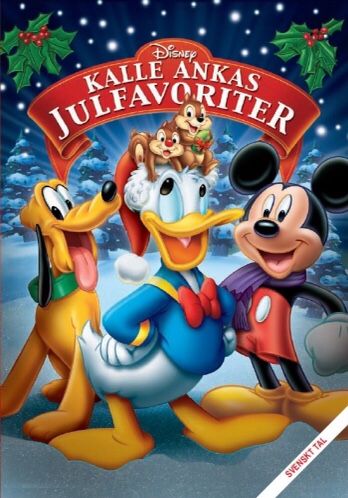
    Window 24. As I am following the Swedish system of advent calendars, today is the last window, not the 25th as in the UK. So here is the final word: Kalle Anka. This is the Swedish name for Donald Duck – a Disney character with a strong, and unexpected, connection to Swedish Christmas.

    Traditional Christmas celebrations on Christmas Eve in Sweden get off to a slow start. It all begins with a Christmas breakfast, consisting of rice porridge, wort bread, ham and Christmas cheese, amongst other things. After breakfast, some people go for a walk, some go to church, others begin the preparation for the Christmas julbord (buffet).

    When to eat julbord differs from family to family. For some, it’s at lunch time, for others it more towards late afternoon. One surprising time marker is Kalle Anka (Donald Duck).

    Every Christmas Eve since 1960, the Disney show ‘From All of Us to All of You’ featuring Donald Duck and his friends has been broadcasted on Swedish television at 3pm (now 3.05pm). Every single year. A very weird tradition for someone like me who grew up listening to the Queen’s speech on Christmas Day at 3pm. In the UK we have the monarch. In Sweden, Donald Duck.

    So the discussion in Swedish homes is ‘should we eat before or after Kalle?’.

    Today, Kalle Anka is watched as a sentimental tradition, or as background noise on Christmas Eve. But in the 1960’s when it began, it was the only time of the year that cartoons were shown on tv, so it was a Christmas treat. Since it’s been broadcast for almost 60 years, it is an integral part of what many Swedes associate with Christmas.

    After Kalle Anka och julbord, it’s time for a visit from Tomten with gift-giving. This is followed usually by more food and drink. Some people conclude the day with a Midnight service at their local church.

    Christmas is, like many places around the world, a time of overconsumption. Enormous amounts of food are left over and eaten during the following days.

    In Sweden, Christmas Day and Boxing Day are both Public holidays – and the official end of Christmas is January 13th. Then it is time to traditionally throw out the Christmas tree. The lights in the windows have usually disappeared by February.

    And as the daylight slowly returns to Sweden, people start planning for the lighter and warmer time of the year. And Christmas fades into memory…until next December.

    Advent Calendar – Dec 22: Tomten

    Window 22. Today’s word is ‘Tomten‘ – who is the Swedish equivalent of Santa Claus.

    Around the world, Santa is based on the mythology of St Nikolas – the Greek/Turkish patron saint who’s legend morphed in the USA from the Dutch immigrants’ Sinterklaas to the jolly figure who rewards good children that we see today.

    The Swedish symbol of Tomten is partially based on St Niklas and the American depiction of Santa Claus. However, he is also based on a goat and a mythical sprite.

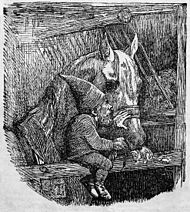
    Let’s travel back to rural Sweden hundreds of years ago. Here, in the countryside, Tomten was a kind of sprite (hob, gnome, pixie) who lived on the farm and made sure that the farm had good luck.

    Tomten was described as a little man, dressed in sackcloth and with a beard. He usually lived in the barn and was shy, mischievous, and irritable – and also vengeful. To keep Tomten happy, the farmer would leave out rice porridge for him to eat – a food that became known as ‘tomtegröt’ and that is still eaten for Christmas breakfast in Sweden today.

    With industrialization in the late 1800’s, Sweden started to become inspired by the German St Nicholas, and in modern minds he merged with the rural sprite to become ‘jultomte’ – the gift-bearing sprite.

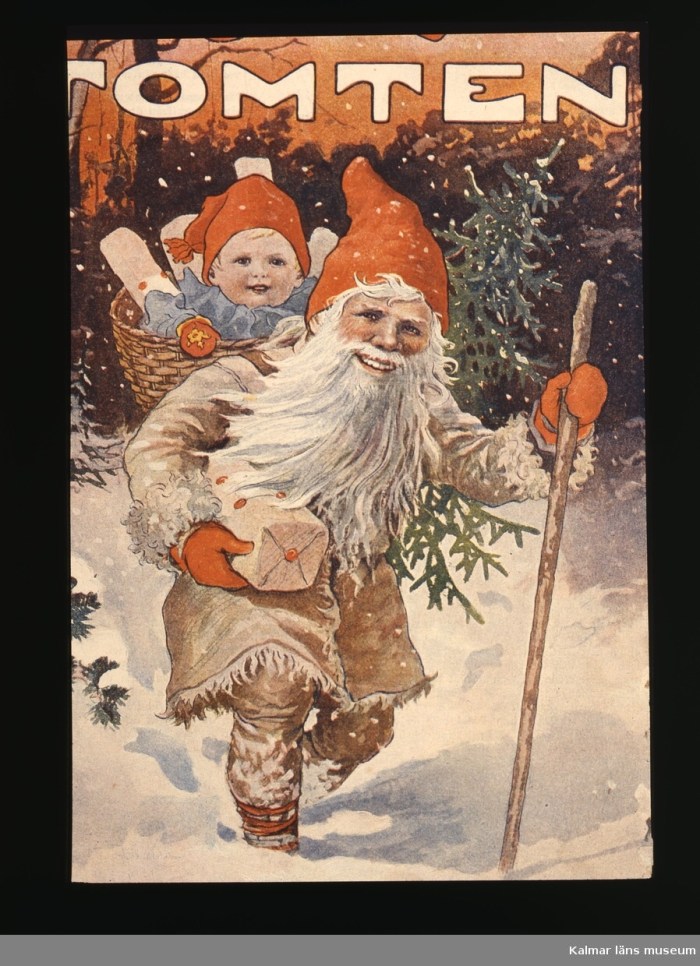
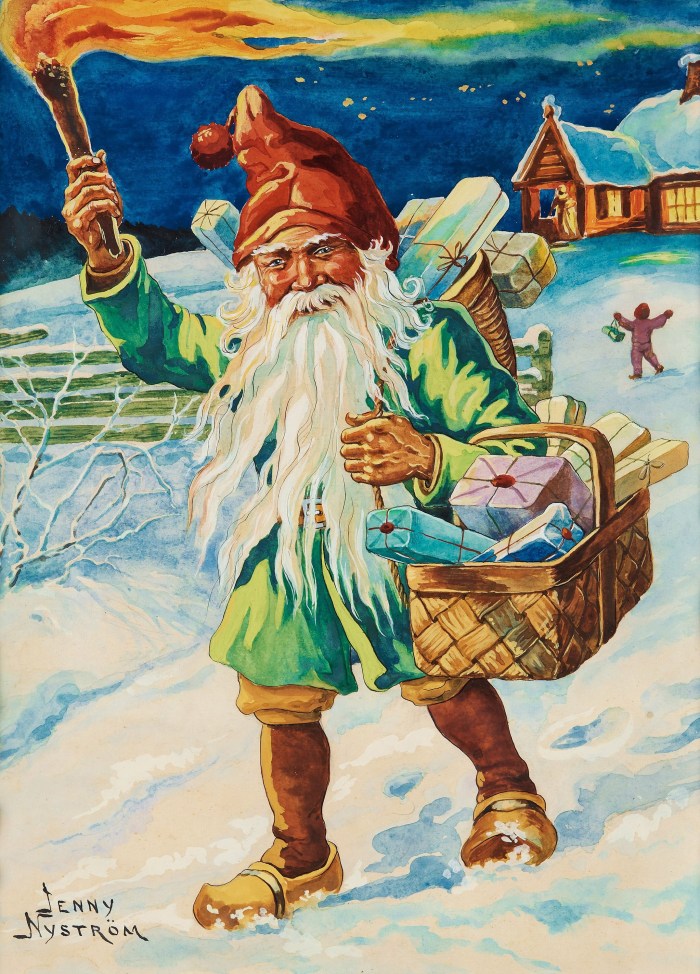
    Popular Christmas cards by Swedish artist Jenny Nyström depicted this new version of Tomten in 1874 and strongly influenced the Swedish way of seeing jultomte. He was dressed in red hat, with a fluffy white beard. He is also seen to have many little helpers – known as ‘tomtenissar’ (a kind of elf).

    And in 1881, a poem by Viktor Rydberg called ‘Tomten’ strongly cemented his transformation and associated the figure with mid-winter and Christmas time.

    Prior to this concept of Jultomte/Tomten, gifts were brought in Sweden by the Christmas goat. Straw goats are still a part of Christmas decorations in Sweden and can be found hanging in Christmas trees or standing at the foot of the tree.

    In Sweden today, Tomten arrives on Christmas Eve, usually in the late afternoon. He delivers gifts to families, usually with the introduction of ‘Ho, Ho, Ho are there any good children here?’

    Strangely, he always seems to arrive just when a member of the family (often dad) has gone out to the shops or gone for a walk.

    Advent Calendar – Dec 21: Julvärd

    Window 21. Today’s word is ‘Julvärd‘ which translates as Christmas host.

    The term Christmas host is not referring to the religious bread that represents the body of Christ. Although you’d be forgiven for thinking so at this time of the year.

    No, the Christmas host is a personality on tv who guides the viewers through the proceedings on Christmas Eve.

    For 27 years the ‘julvärd’ was the same person – a man called Arne Weise – and he is, for many Swedes, eternally associated with Christmas Eve.

    But since 2003, a new host is announced every year and it is considered a great honour to be given the role. This year the ‘julvärd’ is popular tv personality Mark Levengood.

    While the role of ‘julvärd’ might seem trivial, it is actually very important. The Christmas host is present throughout the whole day and introduces the programs. He or she also talks about the value of Christmas and what it means. And not least, the ‘julvärd’ keeps lonely people company by inviting themselves into living rooms up and down the country.

    The ‘Julvärd’ can be seen on SVT – Sweden’s Public Service Television – and is usually broadcast live.

    Advent Calendar Dec 20: Mistel

    Window 20. Today’s word is ‘mistel‘ which translates as ‘mistletoe’.

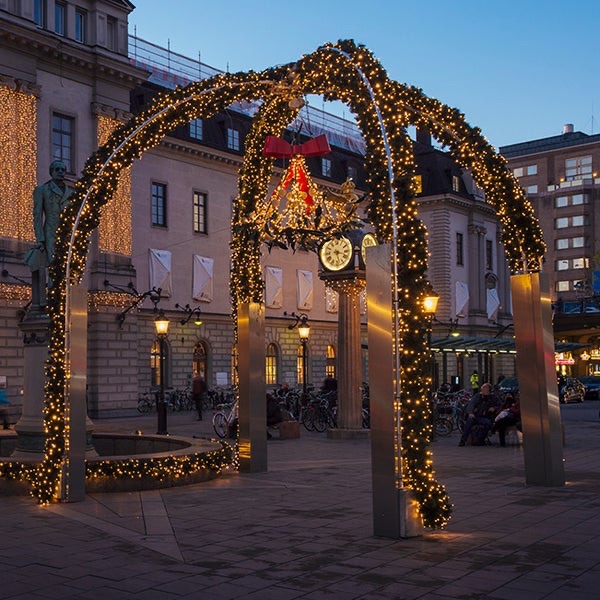
    Kissing under the mistletoe is a tradition in many countries and outside Central Station in Stockholm, there is an enormous one to pucker up under.

    But do you know the origin of the tradition?

    Well, one of the theories is that it comes from Norse mythology in a story about the god Baldur. In the story, Baldur’s mother Frigg casts a powerful magic to make sure that no plant grown on earth could be used as a weapon against her son. The one plant the spell does not reach is the mistletoe, as it does not grow out of the earth, but out of a tree’s branches. The scheming Loki, upon learning this, makes a spear out of mistletoe — the spear that would eventually kill Baldur. 

    In many tellings, Frigg then declares the mistletoe to be a symbol of love after her son’s death and promises to kiss anyone who passes underneath it. 

    Advent Calendar – Dec 19: Julklappsrim

    Window 19. Today’s word is ‘Julklappsrim‘ which translates as ‘Christmas present rhyme’

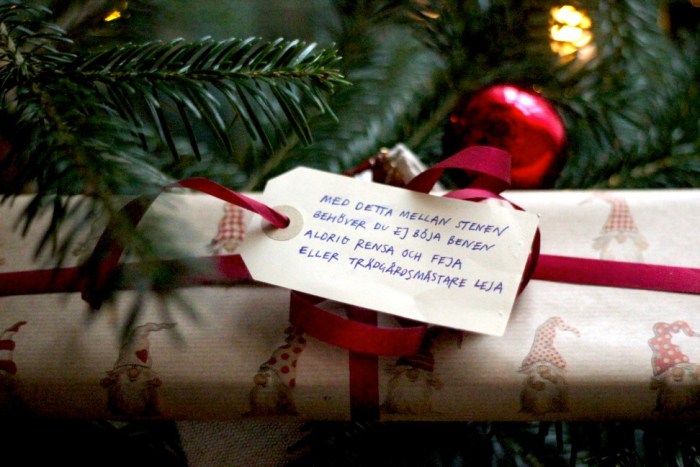
    If you receive a gift at Christmas time,

    You’ll find in Sweden that it comes with a rhyme.

    The packets are wrapped, the present to hide

    And a poem describes all the contents inside.

    You see, Swedes write poems on the label

    Sometimes direct, sometimes a fable.

    They sit in a workshop creating their verse,

    It needs to be brief, but not at all terse.

    The poem is read, the packet ripped open

    And you see what you got, but it still leaves you hopin’

    For a phone or a trip or a book about crime,

    Wrapped up with a Swedish Christmas rhyme.

    Advent Calendar – Dec 18: Skumtomte

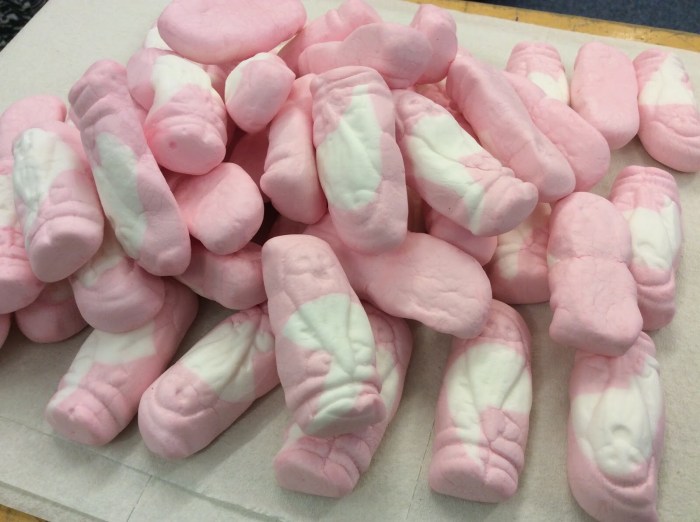
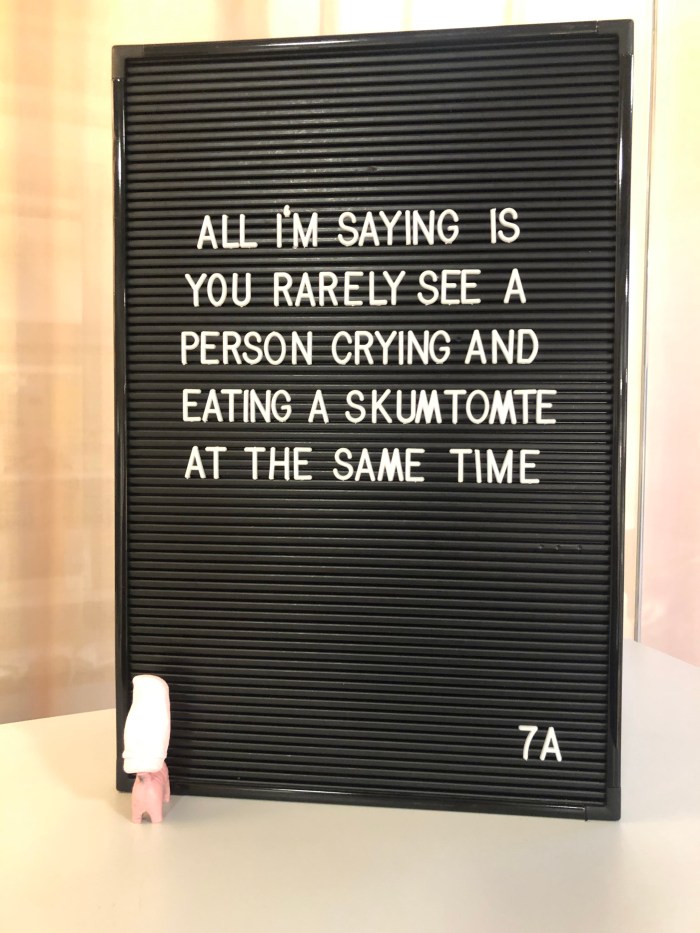
    Window 18. Today’s word is ‘Skumtomte‘ which translates as ‘Marshmallow Santa’.

    January is a month when it is often jam-packed at gyms up and down Sweden. This is usually due to the amount of food, snacks, and alcohol consumed over the Christmas and New Year period. The festive season is also one of the times of year when a lot of sugar and sweets are consumed.

    One of the most popular sweets in yuletide Sweden is the ‘skumtomte’ – the marshmallow Santa. The skumtomte is traditionally pink and white and strawberry flavoured.

    Thanks to the wonders of product development, new limited flavours have appeared in recent years: apple and cinnamon, blueberry, mint and gingerbread being some examples.

    They have been manufactured since 1934, and every year over 194,000,000 are consumed in Sweden and Finland. It seems like it wouldn’t be Christmas without a skumtomte.

    Other sweet things that Swedes eat around Christmas are:

    • Ischoklad – ‘ice chocolate’ – chocolate with coconut fat in tiny cupcake forms
    • Ris a la Malta – a cold rice dessert with cream, vanilla and mandarines
    • Risgrynsgröt – rice porridge with sugar, cinnamon and milk
    • Knäck – butterscotch
    • Kola – toffee
    • Fudge – fudge
    • Marsipangris – marzipan pig
    • Lussekatt – saffron bun
    • Polkagris – Candy cane
    • Chokladtryffel – chocolate truffle
    • Dadlar – dates
    • Fikon – figs
    • Pepparkaka – ginger biscuits
    • Gröna kulor – marmalade balls
    • Aladdin and/or Paradis – popular boxes of chocolates

    So, get eating – the gym can wait until 2025!