Swedish Advent – let the cosy season begin


It’s the first of Advent today, which is an atmospheric and almost romantic time in Sweden.

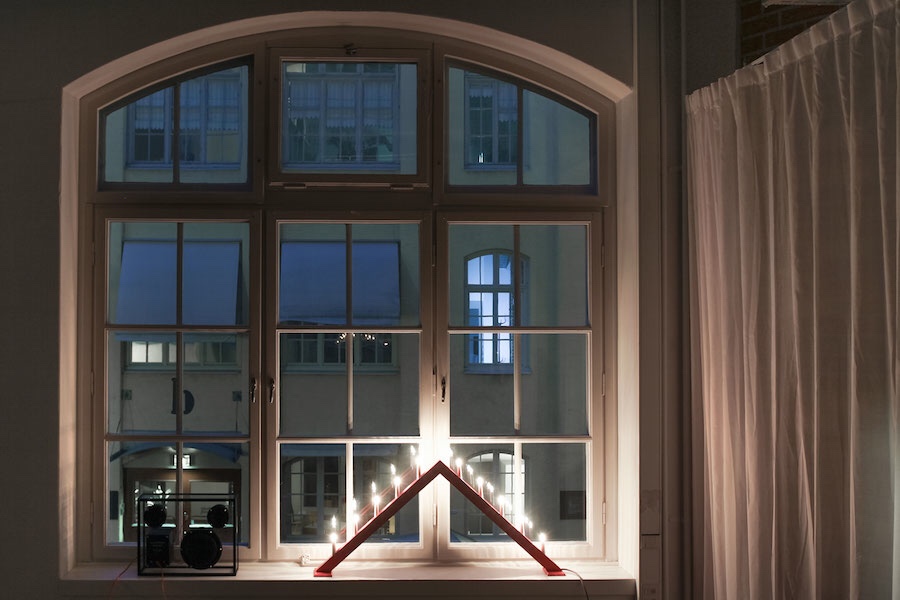
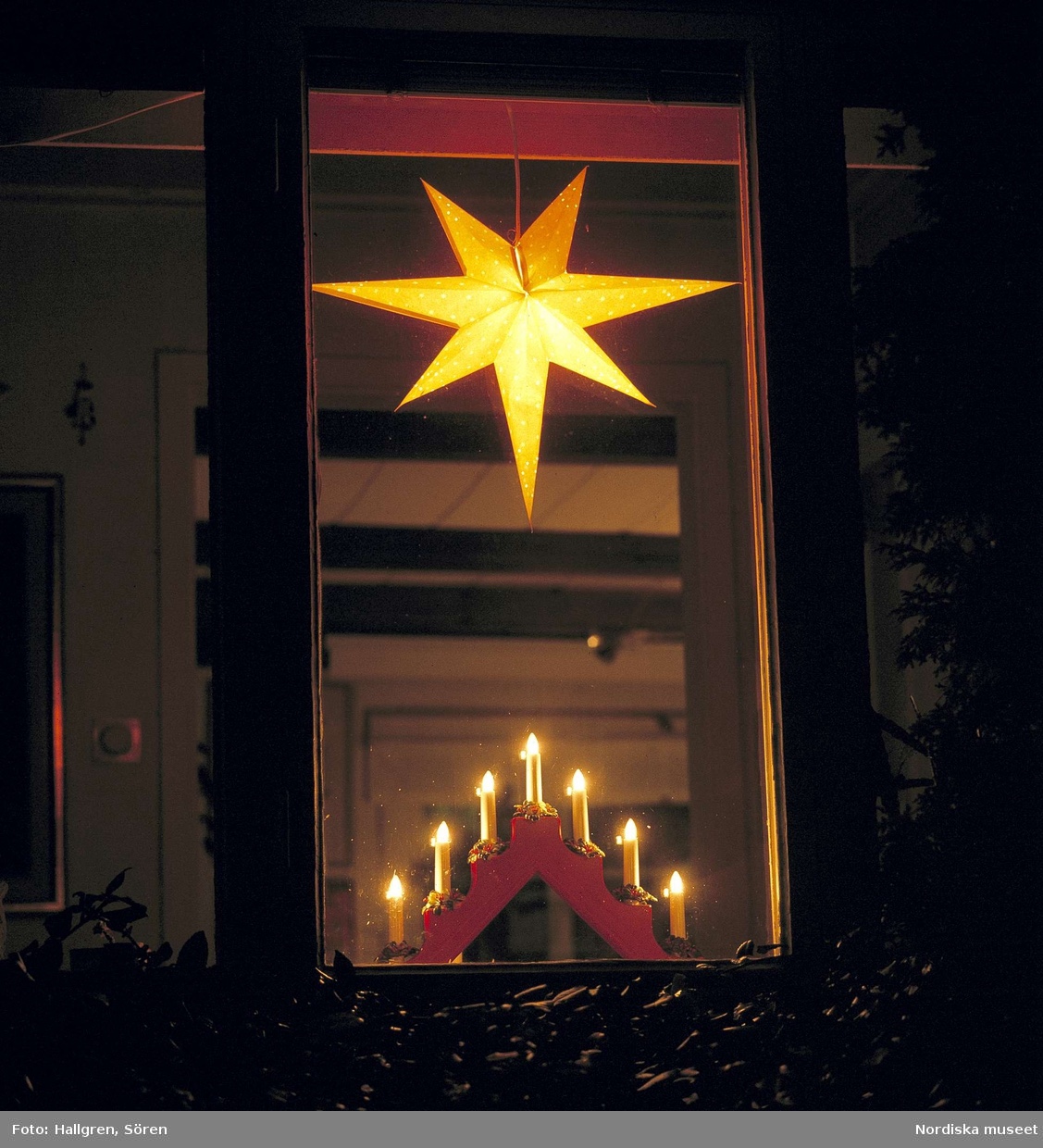
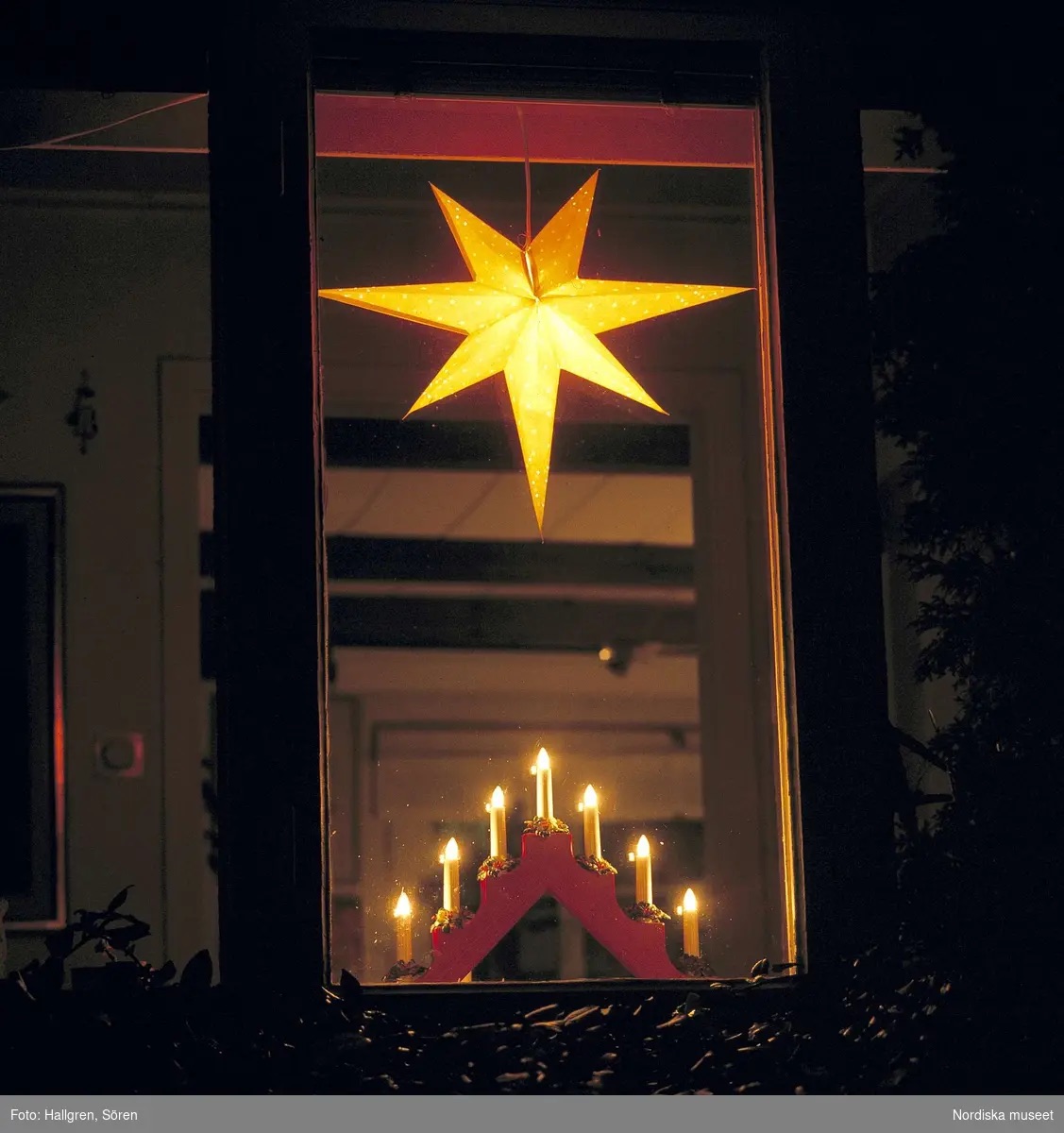
Swedes decorate their houses, apartments and windows with lights. From ceilings, illuminated stars are hung. On window ledges, electric advent candles are placed. On tables, four candles are positioned and one is lit every Sunday up until Christmas. Small candles, often red, are dotted about the home. People eat gingerbread and drink mulled wine. Some people go to an advent concert in their local church or concert house. I personally went to a very atmospheric and cosy concert in Stockholm’s City Hall yesterday.

Some years, there is already deepish snow at the first of Advent. But this year in Stockholm, it is warm, so there isn’t any. Instead, it is very dark. The collective advent decoration is a definite reprieve from this darkness as light is spread into these murky places.

The word ‘advent’ comes from the Latin ‘adventus’ which means ‘arrival’ and is traditionally the start of the period where we wait for the arrival of nativity, or Christmas. Some religions also see it as waiting for the second coming of Christ. But in this secular society that is Sweden, the waiting is probably for the snow to come, the cold to hit, the water to freeze to ice and for winter to clasp its fingers firmly around us.

April, April! You stupid herring!

april-fools-day-2015

Playing April Fool’s jokes on each other on the first of April is a tradition in many countries – Sweden included. In fact it is an old tradition – the oldest written reference being in 1392 in Chaucer’s ‘The Cantebury Tales’.

In Sweden, when someone is tricked, the tradition is to say ‘April, April din dumma sill!‘. This translates as ‘April, April you stupid herring!’. This is however not as weird as it might sound. In many countries, such as Italy, France and Holland, April 1st is known as “April fish”. On this day, people try to attach paper fish onto the backs of their victims.

April Fool’s pranks are common in newspapers, with classics such as:

  • IKEA is getting into the airline business. Furnishing all the flights with Ikea furniture, the name of the airline is FLYKEA.
  • Swedish supermarket chain ICA introduced toothpaste with the taste of chocolate. It might be brown, but it makes your teeth white.
  • Burger King introduced a new burger for left-handed people where ingredients were rotated 180 degrees.

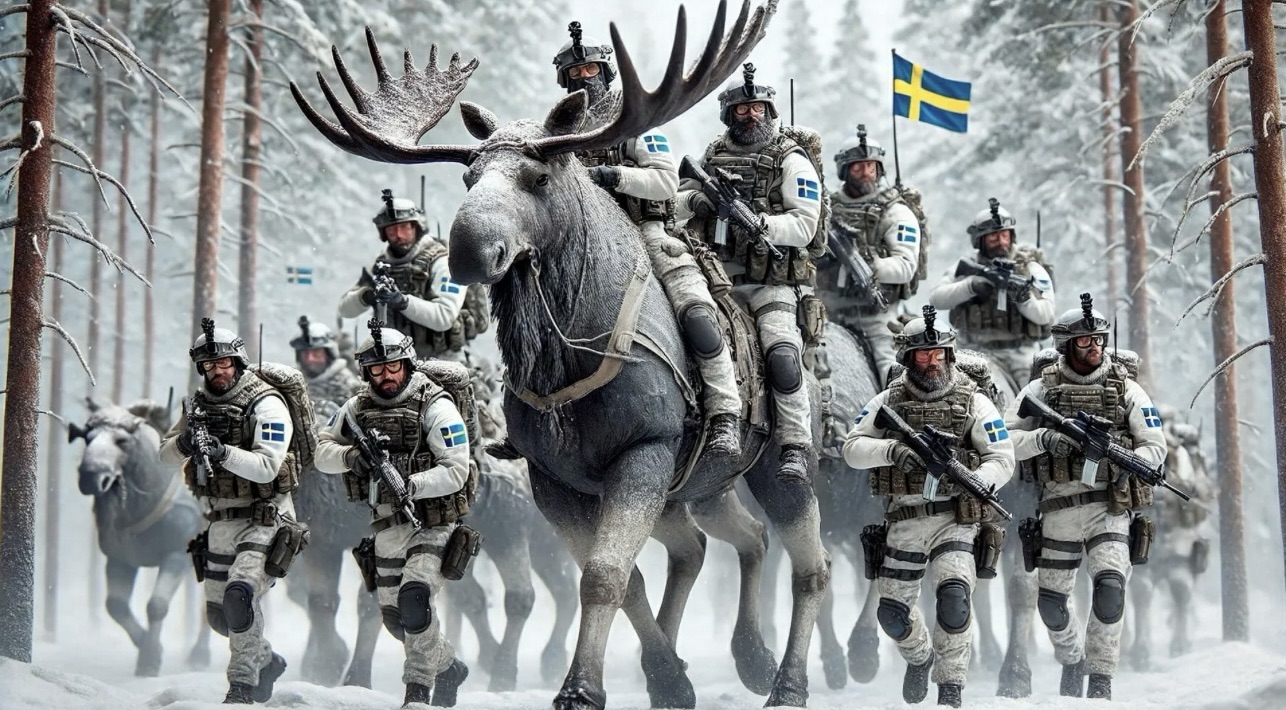
I had a look this morning at the media to see if I could identify any April Fools tricks and I found one! A paper in northern Sweden reported that it had found a leaked document from the Swedish Armed Forces, revealing that Sweden is to receive its first moose cavalry. No animal is better suited for battle than the king of the forest, the newspaper claims. An AI image also shows armed soldiers riding moose!


Thirteenth Day in Sweden

Today, 6 January, is a national holiday in Sweden and in many places around the world. In Sweden, not a lot happens on this day – it is just another day off. If it lands on a weekend, the bank holiday is forfeited, unlike in many other countries where the following Monday is taken off in lieu.

So what does the 6 January celebrate?

In orthodox churches, the 6 January is celebrated as the day of Jesus’ birth.

In western Christianity, the 6 January notes the arrival of the three wise men (the magi) to Bethlehem to visit the baby Jesus in his cradle. These wise men are said to represent the three continents of Europe, Africa and Asia.

In Eastern Christianity, today celebrates the baptism of Jesus in the Jordan river and his manifestation to the world as the son of God.

January 6 also commemorates the legend of the Wedding at Cana, where Jesus exercised his divinity by turning water into wine.

Epiphany

In English, today is called Epiphany – which comes from the Greek word ἐπιφάνεια, epipháneia, meaning ‘manifestation’ or ‘appearance’. It is derived from the verb φαίνειν, phainein, meaning “to appear”. It signifies the day when Jesus first appeared to the Gentiles, in his cradle.

In the practical language of Swedish, there is no reference to manifesting or appearing. Today is given the name of Trettondag Jul (Thirteenth Day Yule) – literally thirteen days after Christmas Eve.

Swedish Advent


It’s the first of Advent today, which is an atmospheric and almost romantic time in Sweden.

Swedes decorate their houses, apartments and windows with lights. From ceilings, illuminated stars are hung. On window ledges, electric advent candles are placed. On tables, four candles are positioned and one is lit every Sunday up until Christmas. Small candles, often red, are dotted about the home. People eat gingerbread and drink mulled wine.

Some years, there is already deepish snow at the first of Advent. But this year in Stockholm, it is unseasonably warm, so there isn’t any. Instead, it is very dark. The collective advent decoration is a definite reprieve from this darkness as light is spread into these murky places.

The word ‘advent’ comes from the Latin ‘adventus’ which means ‘arrival’ and is traditionally the start of the period where we wait for the arrival of nativity, or Christmas. Some religions also see it as waiting for the second coming of Christ. But in this secular society that is Sweden, the waiting is probably for the snow to come, the cold to hit, the water to freeze to ice and for winter to clasp its fingers firmly around us.
Swedish Americans and American Swedes

When Armand ‘Mondo’ Duplantis won the Olympic Gold and broke the world record in the pole vault, he did it representing Sweden. Although he grew up in the USA, his mother is Swedish, and he has Swedish citizenship.

According to Statistics Sweden, Mondo is one of approximately 40,000 American citizens living in Sweden. Sweden and America have a long political relationship, with Sweden being the second country, after France, to officially acknowledge America’s independence in the 1700’s. Since then, the relationship has been smooth, with a couple of hiccups during the presidencies of Olof Palme and later Donald Trump. Today, the USA is Sweden’s third largest trade partner, and American-owned companies make up the largest number of foreign companies in Sweden.

Many Americans have family ties to Sweden due to the mass emigration of Swedes to the USA in 1885-1912. In fact, this is such a significant part of Sweden’s history that there is a tv program called ‘Allt för Sverige’ which helps Americans trace their Swedish Ancestry.

At the end of the 19th century 1.3 million Swedes fled famine and persecution in Sweden for a new life in the USA. This was a third of the population at the time. These Swedish Americans were mostly of Lutheran faith and settled primarily in the Mid West.

Prior to this, in 1638, the first Swedish settlers founded New Sweden, around Delaware. It only lasted 17 years before being absorbed into New Netherland and ceased to be a Swedish colony.

In 1639, Swedish settler Jonas Bronck settled a colony around the area of today’s New York. The settlement grew and flourished, and today is called The Bronx – after its original Swedish founder.

According the American Community survey, Swedish Americans and descendants make up around 2% of the US population today. Around 56,000 people still speak Swedish in their homes.

Some famous Americans of Swedish descent include: Taylor Swift, Emma Stone, Jake Gyllenhaal, Scarlet Johansson, Candice Bergen, Kirsten Dunst, Val Kilmer, Michelle Pfeiffer, Julia Roberts, Uma Thurman, Peggy Lee, Steven Soderbergh and George W Bush.

The ABC of Swedish town planning

ABC is a concept in Swedish town planning, said to have been minted by Stockholm city planner Sven Markelius around 1952. ABC refers to the approach of building a suburb where modern families have easy access to work, dwelling and services, such as shops. A stands for ‘arbete’ (work), B stands for ‘bostad’ (accommodation) and C stands for ‘centrum’ (center for services and shops).

ABC city planning was introduced mid 1950’s and it expanded suburban Stockholm to the north and south. This growth was spurred on by the influx of people to the capital after the Second World War, and the severe shortage of accommodation.

In the original development plan from 1952, Markelius suggests that blocks of flats should be constructed within 450m of the centre, small houses should be built within 900m of the centre and light industry 600m from the centre. Everything should be built compactly in order to facilitate daily life for its 16000 residents. An underground system would connect the ABC suburb to the rest of the city and Stockholm’s downtown.

If you’d like to visit an ABC suburb, the two that are mostly still in tact are Vällingby to the north of Stockholm, and Farsta to the south.

Thirteenth Day in Sweden

Today, 6 January, is a national holiday in Sweden and in many places around the world. In Sweden, not a lot happens on this day – it is just another day off. If it lands on a weekend, as it does this year, the bank holiday is forfeited, unlike in many other countries where the following Monday is taken off in lieu.

So what does the 6 January celebrate?

In orthodox churches, the 6 January is celebrated as the day of Jesus’ birth.

In western Christianity, the 6 January notes the arrival of the three wise men (the magi) to Bethlehem to visit the baby Jesus in his cradle. These wise men are said to represent the three continents of Europe, Africa and Asia.

In Eastern Christianity, today celebrates the baptism of Jesus in the Jordan river and his manifestation to the world as the son of God.

January 6 also commemorates the legend of the Wedding at Cana, where Jesus exercised his divinity by turning water into wine.

Epiphany

In English, today is called Epiphany – which comes from the Greek word ἐπιφάνεια, epipháneia, meaning ‘manifestation’ or ‘appearance’. It is derived from the verb φαίνειν, phainein, meaning “to appear”. It signifies the day when Jesus first appeared to the Gentiles, in his cradle.

In the practical language of Swedish, there is no reference to manifesting or appearing. Today is given the practical name of Trettondag Jul (Thirteenth Day Yule) – literally thirteen days after Christmas Eve.

And so it is Advent – Swedish style


Today, the first of Advent, the light shines strong in the darkness.

Since the 1930’s Swedes have decorated their homes with lights from the first of Advent. The tradition was inspired from Germany, where the Advent star had been a popular decoration since the 1880’s. The star symbolizes the star of Bethlehem that guided the three wise men to the stable, where the baby Jesus lay in a manger.

Today, the star has lost most of its religious symbolism. In Sweden, illuminated advent stars are hung in windows. On window ledges, electric advent candles are placed. Gardens and balconies are decorated with fairy lights. On tables, four candles are positioned and one is lit every Sunday up until Christmas. Small candles, often red, are dotted about the home. Some people change curtains and populate their homes with small gnomes and fragrant flowers.

Since November is often a grim month, the collective advent decoration is a welcome arrival as light is spread into the murky places. From the dark street, it is lovely to see windows lit up in every apartment.

This weekend is also the starting signal for the Swedish ‘glöggfest’. People go to each other’s homes and drink ‘glögg’ (mulled wine), eat gingerbread and saffron buns. It is a very cosy time of year.

Where Swedish names originate

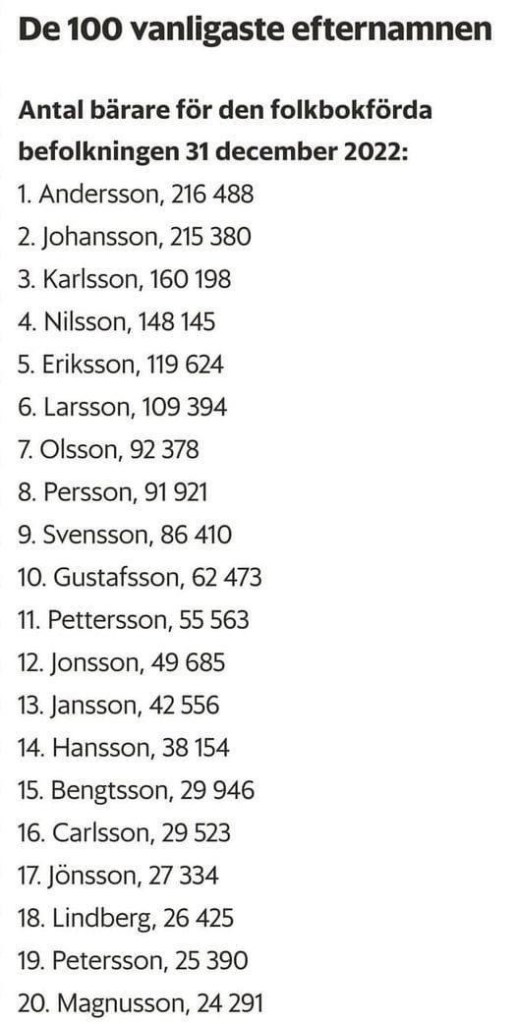
19 of the top 20 surnames in Sweden end with ‘son’. Where does this name come from?

Over 120 years ago, most Swedish surnames were patronymic – a surname formed by adding -son to someone’s father’s name, and it means “son of.” Someone named Fredrik Andersson, for instance, was Fredrik, son of Anders. This type of name was also sometimes created with the addition of the suffix -dottir, or -dotter meaning daughter; someone named Selma Torsdotter would have been Selma, the daughter of Tor. However this is rare – due to the patriarchal structure of society at the time.

When laws eventually required all families in the various Scandinavian countries to decide on a heritable last name — one that would pass down intact instead of changing every generation — many families adopted a current name as their hereditary surname. This is known as a “frozen patronymic.”

Sweden passed the Names Adoption Act in 1901, requiring all citizens to have heritable surnames that are passed down to each generation.

Most people took a patronymic surname to pass down, and as we see, patronymics are still the most common Swedish names.

Some Swedish families took names referring to places or things in nature, such as Lindberg (lime mountain), Engström (meadow stream) or Blomqvist (flower twig).

Other Swedish surnames came from trades such as Åkerman (ploughman) or Möller (miller), or from the military such as Skold (shield) or Svärd (sword).

Another source of Swedish names up to about the 18th century were Latinized names, which were based on place of birth – such as Floderus (from Floda).

Many names today end with ‘ander’ – Wallander, Wikander, Nylander – this comes from the Greek word for ‘man’.

A friendly conflict between Sweden and Finland

Neighbouring countries Sweden and Finland have entered into a friendly conflict. The subject? The Eurovision Song Contest.

On Saturday, artist Loreen took home the win for Sweden, just ahead of Finland. And the Finns weren’t happy, many of them saying the competition was fixed.

Now, when the televoting statistics have been released, it has become known that Finland was the only country to give Sweden zero points in the public vote. This is weird as the Finnish jury had awarded Sweden the maximum 12 points, and the song Tattoo is currently number 1 on the Finnish chart. One can wonder who was responsible for an attempt at fixing?

It has also come out that the Finnish tv commentator encouraged citizens to vote tactically in a message, something that viewers clearly did.

The issue isn’t an important one, however it is funny to observe as tensions rise between the two Nordic neighbours. It’ll probably run out in the sand, but will be interesting to see how Sweden enacts it’s revenge next year.