Sweden’s Pink Thursday – washing and witches

jesus feet

Today, the Thursday before Easter is called Skärtorsdag in Swedish. As the word ‘skär’ translates as a shocking pink colour, many people joke that today is ‘pink Thursday’. But the word ‘skär’ in this case relates to something else – something far more biblical.

The word ‘skär’ is an early Nordic word meaning clean and pure. And here, we see a parallel to the English word for ‘Skärtorsdag’. In English, today is called ‘Maundy Thursday’ and it relates to the religious rite known as ‘the maundy’ which involved the ritualistic cleaning of feet. According to Christian belief, today was the day that Jesus performed this act until the recipients had clean and pure feet. It also is the day of the infamous Last Supper.

However, in Sweden today, ‘Skärtrorsdag’ is not celebrated in any great religious fashion but in a pagan manner. A old pagan belief in Sweden was that on this day witches would mount their broomsticks to fly away to the legendary mountain known as Blåkulla. At Blåkulla it was believed that the devil held his earthly court. There the witches celebrated their sabbath and danced with the devil.

In modern day Sweden, we see this reflected in the many children who dress up as witches. These kids paint Easter cards and walk around the neighbourhood knocking on doors to wish everybody a happy Easter. In exchange, they hope to receive Easter sweets.


påskkkärring

The sound of the city


Often when we travel, we return with stories of food, climate, people. But one of the things that strikes me when I’m abroad is sound. Each city, each place, seems to have its own sound identity. I love sitting in the evenings looking out over cityscapes and drinking in the melodies of the night. In Stockholm, there is the hum of boats or of water lapping gently against shores, wind blowing through trees. In Bangkok it’s the sound of the tuk-tuks and the tinkle of chimes. In Delhi it’s the distant voices from temples and markets and all night traffic. In New York, it’s the hum of traffic and people, the buzzing of neon lights and the scream of emergency vehicles. Here in Nairobi, where I am today, it’s the sound of traffic interspersed with drum beats and wailing music.  Distant voices carrying through the night full of woeful stories. 

As I sit and listen, I experience another layer of the city, another layer of the culture. With full respect to food and climate, it’s the sound of the city that rules the night. 

Swedish sunflowers

sunflowers

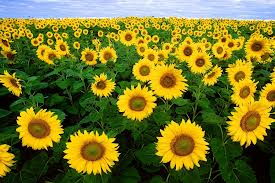
Sunflowers might not be the first thing you think of when you think of Sweden. But at this time of year, the place is full of them. Well, not really sunflowers per se, but a type of sunflower.

The fantastic thing about sunflowers, apart from their brash yellow colour and the flocks of butterflies that they attract, is the way in which they move. Their big, open faces look up at the sky, reaching for the light, and when the sun is out the sunflower moves its face to follow the its path across the sky. They really enjoy soaking up the rays of light and the warmth that the sun provides. It’s a fantastic sight to behold as you drive through the countryside in France or Italy.

But we’re not in France or Italy, we’re in Sweden. So what has this got to do with Sweden then?

Well, Swedes are like sunflowers.

Confused? Let me explain.

After a long, dark, cold winter, Spring eventually arrives.  This year, it seemed to arrive early. This week, temperatures soared to 14 degrees celcius, the sky was blue and people hit the streets and the parks. Everybody emerged from their winter hybernation.

They sat on park benches, on blankets, on window ledges, outside restaurants, on balconies. They leaned up against sunny walls. And as they sat there, they lifted their faces, just like sunflowers, to face the sun and to feel the warming rays of light on their pale wintery skin. Sometimes people just stopped randomly on street corners and lifted their faces up to the sun, eyes closed, to soak up the light.

So you see, Swedish sunflowers are the Swedes themselves. And you’d be hard pushed to find a more sun-worshipping, thankful population at this time of the year.

90 km on skis – a yearly Swedish challenge


Today, the world’s longest cross country ski race takes place in the county of Darlana in Sweden.  Called Vasaloppet, it entails participants skiing 90 kilometers from start to finish. It’s an extremely popular race, which can take up to 12 hours to complete, and which is broadcast live on tv. When tickets to participate are released, they sell out in 15 minutes – it’s that popular. 

The first Vasalopp was in 1922 and takes place annually, the first Sunday in March. It’s an amazing sight to watch, as more than 15000 mad skiers glide along, the swishing sound of ski on snow filling the air. The person who has completed the race fastest is Jörgen Brink, who in 2012 won the race in just over 3 hours 40 minutes. 

So why is this race called the Vasalopp? Well, it is to commemorate the escape to Norway through Darlana of King Gustav Vasa in 1521. Legend has it that he skied, but experts believe he more likely completed this escape on snow shoes. 

Modern day skiers don’t see the experience as an escape, they see it as a challenge and a rite of passage. 

And as you sit watching the TV comfortably from the sofa, with tea and toast, you take vicarious pride in their crazy achievement. 


How a Swedish hand bag can cause a storm

Lady Bracknell’s horror when she exclaims ..‘a handbag!!?’ in Oscar Wilde’s ‘The Importance of Being Ernest’, has never been so relevant as it is today. 

Indeed, a handbag is causing quite a stir in Sweden. 

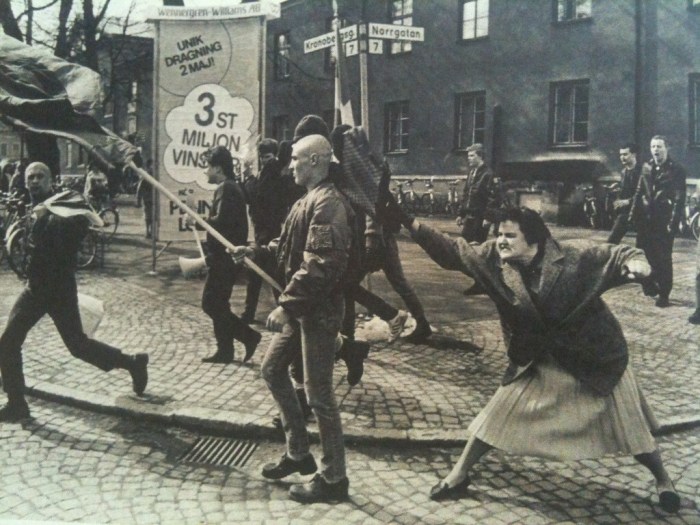
A famous photograph from 1985 is the catalyst. This photograph depicts Danuta Danielsson stepping out from a crowd to hit a neo Nazi across the head with her handbag. Now, a statue has been made depicting this snapshot of time but the local council in the Swedish town of Växsjö is refusing to allow it to be erected. The reason? They claim that the statue commemorates violence and say that it is not ok to hit somebody just because you disagree with them. 

And I agree with that. But there is another perspective. The statue can reflect an act of individual courage or symbolise the very real relationship between nationalism and anti-fascism that we see in Sweden today. 

It seems like this handbag is dividing the country. As a response to this situation, handbags have been mysteriously appearing on statues all over the country. 

Yes….‘a handbag!!?’


Reflections from a Swedish supermarket queue


Standing in a queue, waiting to pay. In front of me, there’s a woman in her late thirties. She has a baby in a pushchair, she’s dressed in exercise gear and she has loads of food. Manically, she unpacks her trolley and unceremoniously dumps her items onto the belt. She sees me standing behind her and, as I only have three items, she generously offers for me to go before her. 

I admit I am surprised by this uncommon offer. But I graciously thank her and say no worries – I can wait. The supermarket is playing a favourite tune and I’m actually enjoying it, I tell her. 

‘It’s nice to hear somebody isn’t Saturday-stressed’ (lördagsstressad) she mutters bitterly back at me. 

‘Saturday-stressed’ is a term I’ve never heard, I never am and I certainly never intend to be. 

Are Swedes masochists?

A quick look at a definition of ‘Masochistic Personality Disorder’ tells us that it is ‘A pervasive pattern of self-defeating behavior. The person may often avoid or undermine pleasurable experiences, be drawn to situations or relationships in which they will suffer, and prevent others from helping them’.

There are a few characteristics:

– they choose situations that lead to disappointment, failure, or mistreatment even when better options are clearly available
– they respond with depression, guilt, or a behavior that produces pain
– they incite angry or rejecting responses from others and then feel hurt, defeated, or humiliated
– they reject opportunities for pleasure

I don’t know why, but my mind jumps to Saturday nights in February/March. The annual torture known as ‘Melodifestivalen’ is broadcast as Swedes attempt to select the song to represent them at Eurovision. People compulsively throw themselves into their sofas and watch the drivel that spews out in front of them. One piece of questionable music after another. They watch attentively, they vote.

And then they complain. They complain about the overriding bad quality. They complain about the winning songs. They complain about the host’s dress or hairdo. They complain that the best song didn’t get through. They complain about the dance routines. They complain on social media, during brunch and when they’re out on their Sunday walk.

But yet, the following week they’re there again watching the next episode of this 6-week long debacle.

So are Swedes masochists? Hell, yes!!

IMG_4994

Stand up for Swedes

IMG_4978

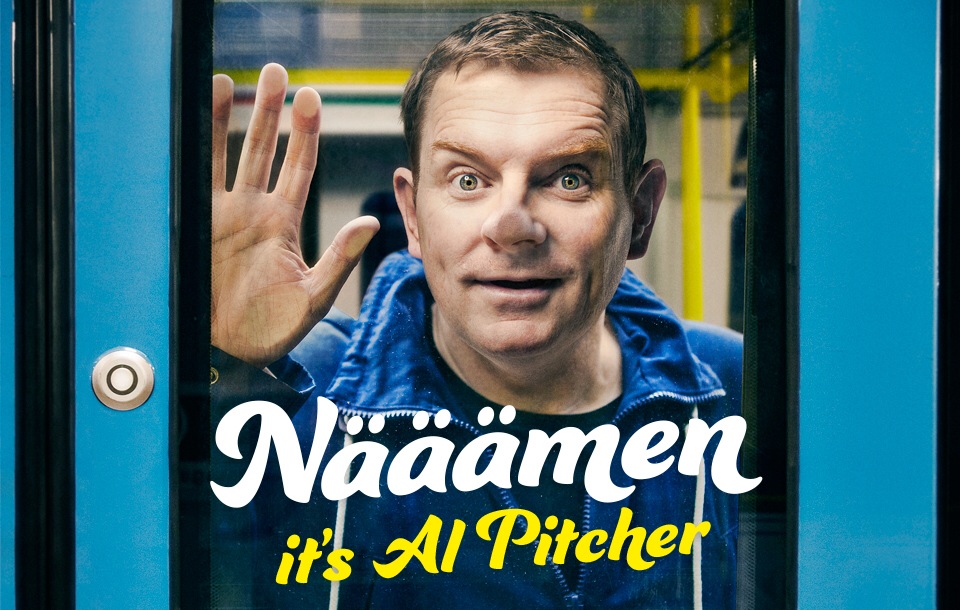
Last night I went to see a hilariously funny stand up comedian called Al Pitcher. From New Zealand, this fast-thinking, quick-talking ironist talks about his family life in Sweden, what he finds fascinating about Swedes, why he loves them and how they dumbfound him. In his one man show at Rival on Mariatorget, he bounced between naked toddlers to poisonous ticks, from helping old ladies in a Stockholm suburb to his exploits in the isolated regions of Norrland. He even made the town of Flen sound semi-interesting by describing his dancing a jig to Swedish folk music when he was there.

It was a pleasure to spend a couple of hours in the company of Al Pitcher. If you get a chance to see his up-coming shows, I highly recommend it. You can get more information at http://www.alpitcher.se or likewise http://www.alpitcher.com You can also follow him on Facebook.

Playa del Ingles – Swedish invasion

2015/01/img_4911.png

Currently enjoying a week in the sun on Gran Canaria. It’s altogether a very Spanish experience. Er, well, maybe not.

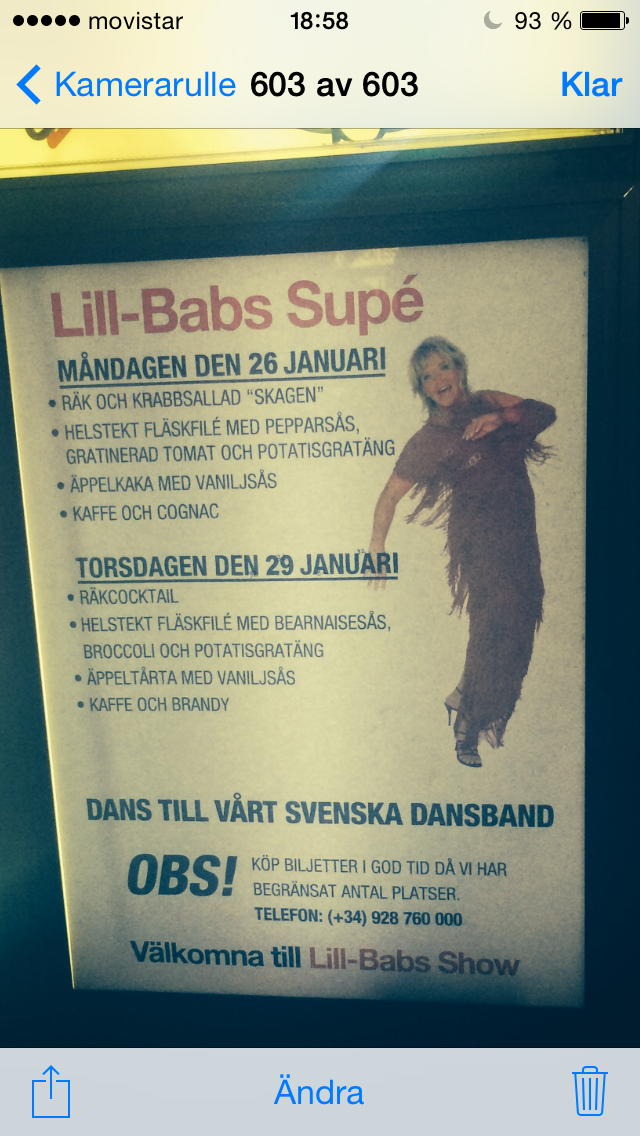
Yesterday evening we headed off to a well-known dance palace called Playa del Sol. The reason it’s well known is because it is a Swedish oasis, in the middle of the tourist sprawl. A restaurant and dance club, this is where Swedes, mostly of an older generation, come to eat Swedish food, drink cheaply, listen to orchestra music and strictly come dancing. The place has certainly seen better days, with it’s tired decor, faded colors and jaded staff.

Last night a Swedish legend was performing. The 75 odd year old Lill-Babs is Sweden’s equivalent to the UK’s Cilla Black and she’s still going strong. The show was sold out and her white haired audience of regulars went wild as she crooned to her classic hits from previous decades. Her energy and her saucy jokes had the audience agog. They were in the palm of her hand.

For me, this was a fantastic cultural experience – a mixture of fascination, sentimentality and horror. But mostly I was a witness to how a singer can create a life long following of loyal and loving fans through her hard work and professionalism.

Lill-Babs is really proof that the show does go on. And it goes on and on and on in this little Swedish dance paradise on a small island far away in the Atlantic Ocean.