Today is a ‘squeeze day’ in Sweden. What, you may wonder, is a squeeze day?
It is not a day when everybody goes around hugging each other, or a day for drinking copious amounts of fresh citrus juice.
No, a ‘squeeze day’, or ‘klämdag’ in Swedish, is a day of the week that falls between a public holiday and a weekend.
In Sweden, when a public holiday occurs on a Tuesday or a Thursday, a common custom is to take the day between the holiday and the weekend as a day off. Often this is even subsidized by the employer. In English, this is called a ‘bridge day’ but in Swedish it’s cutely referred to as a ‘squeeze day’.
As yesterday (Thursday) was a public holiday, many people are also off work today.
In Sweden, and 160 other countries, May 1st is International Workers’ Day. Sweden has been celebrating it since 1939.
But why specifically May 1st?
The answer is found in a massacre in the USA. On 1 May 1886, laborers in Chicago went out on strike for an 8 hour working day. On 4 May 1886, the Chicago police force and the demonstrators clashed in a physical conflict. Eleven people died.
The event is called the Haymarket Massacre. Seven of the demonstrators were sentenced to death, despite lack of evidence. To commemorate the massacre, the socialist organization suggested that 1 May should become day of demonstrations every year around the world. Ironically, USA does not follow this tradition, but celebrates their Labour Day in September instead.
In Sweden, traffic is shut off, huge flag-waving demonstrations are held and people gather to hear political speeches.
The demonstrations represent people from various parties. However, since most of them are from the political left, the streets are awash with bright red flags and banners.
Not all Swedes demonstrate of course. For many, today is just a day off work – an opportunity to perhaps nurse a hangover from the festivities of the previous evening or to relax, go for a walk and enjoy the day.
Tonight, the 30th April, in Sweden is Valborgsmässoafton. Yes, another one of those long indecipherable Swedish words.
This one translates as Walpurgis Eve, and is celebrated in many European countries such as Germany, Holland, the Czech Republic, Lithuania, Latvia, Estonia and Finland.
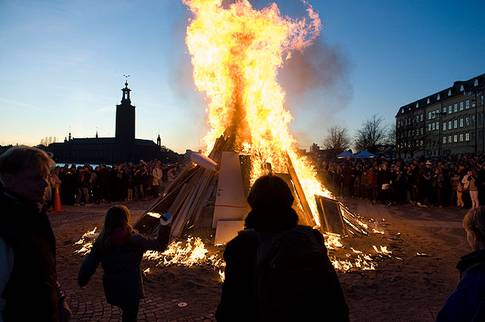
The name ‘Valborg’ is from an English Saint but, despite that, this isn’t really a religious celebration. It’s more to do with the welcoming of spring, and feels rather pagan actually. In the evening on Valborgsmässafton, Swedes gather around huge bonfires and listen to songs. These songs are in the form of traditional choir music designed especially for this occasion to shake off the nasty dark winter and celebrate the burgeoning buds of the lighter season.
And like many traditions in Sweden, this one also has a rural origin. These bonfires are part of a Swedish tradition dating back to the early 18th century. On this day, farm animals were let out to graze and bonfires lit to scare away predators and other evil beings. This is rather ironic as Walpurgis Eve is also an important holiday in Satanism at it marks the founding of the Church of Satan.
But religion aside. On Walpurgis eve, we are joined in the knowledge that we survived another winter, and summer is coming!
Playing April Fool’s jokes on each other on the first of April is a tradition in many countries – Sweden included. In fact it is an old tradition – the oldest written reference being in 1392 in Chaucer’s ‘The Cantebury Tales’.
In Sweden, when someone is tricked, the tradition is to say ‘April, April din dumma sill!‘. This translates as ‘April, April you stupid herring!’. This is however not as weird as it might sound. In many countries, such as Italy, France and Holland, April 1st is known as “April fish”. On this day, people try to attach paper fish onto the backs of their victims.
April Fool’s pranks are common in newspapers, with classics such as:
IKEA is getting into the airline business. Furnishing all the flights with Ikea furniture, the name of the airline is FLYKEA.
Swedish supermarket chain ICA introduced toothpaste with the taste of chocolate. It might be brown, but it makes your teeth white.
Burger King introduced a new burger for left-handed people where ingredients were rotated 180 degrees.
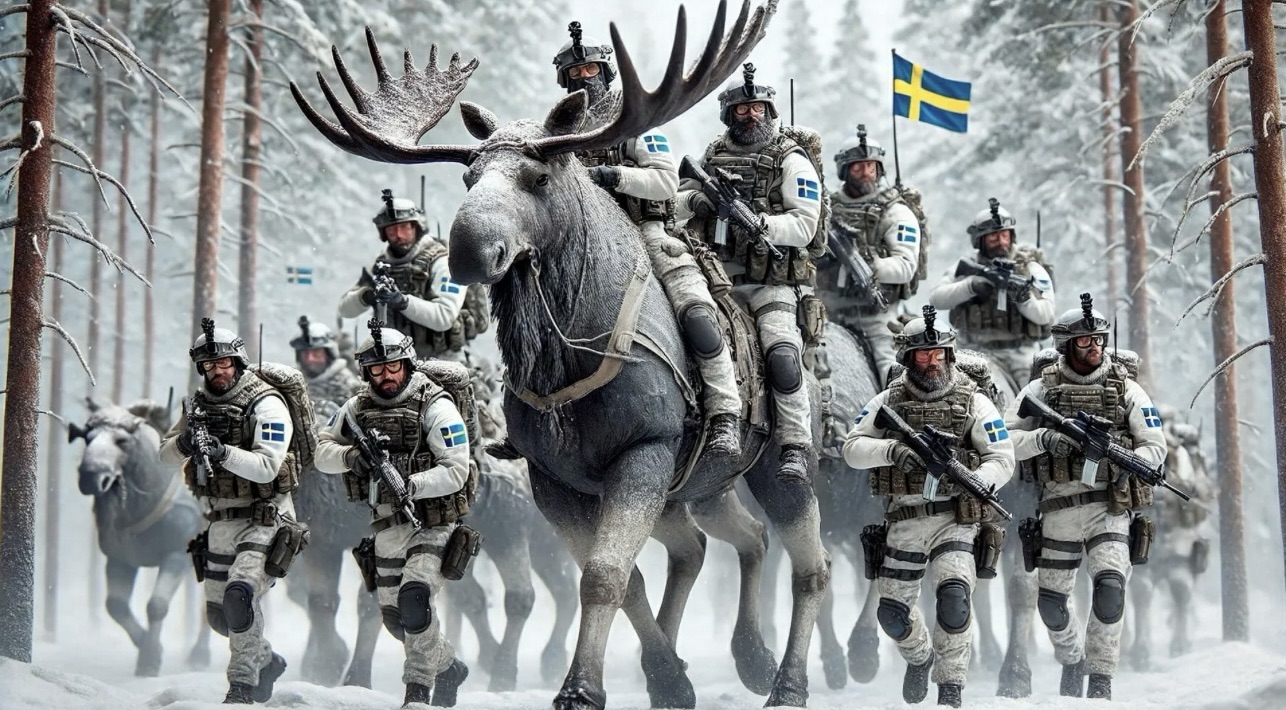
I had a look this morning at the media to see if I could identify any April Fools tricks and I found one! A paper in northern Sweden reported that it had found a leaked document from the Swedish Armed Forces, revealing that Sweden is to receive its first moose cavalry. No animal is better suited for battle than the king of the forest, the newspaper claims. An AI image also shows armed soldiers riding moose!
The earliest astrology can trace its roots to 19th Century BC. Beginning in Mesopotamia, it later spread to Greece and Rome, and eventually Central and Northern Europe.
Western astrology has twelve signs, reflecting the month in which you were born. In English, these signs are named after the original Greek words. But not the Swedish names. Like much else in the Swedish language, the words for these signs are very literal. They are also in the definite form.
Today it’s ‘Fat Tuesday’ in Sweden, known as Shrove Tuesday or Mardi Gras around the world.
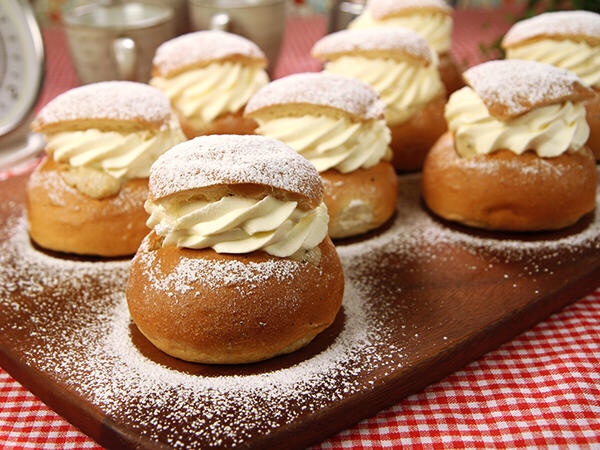
While in the UK we eat pancakes (today is even called Pancake Day) and in Latin America they scoff down fried bread, Swedes celebrate by eating the traditional cream Lent bun – the ‘semla’. 40 million of them every year! I’m also clearly going to indulge. In fact, my mouth is watering just writing this post.
The semla is a creamy bun filled with delicious almond paste. Traditionally, they were only eaten in Sweden to commemorate the start of Lent and the great Fast, leading up to Easter. In the south of Sweden, they still refer to them as ‘fastlagsbullar’ – Shrovetide buns. Nowadays however, semlas are usually sold anytime between Christmas and Easter.
I just love them. I could eat a barrel load. But I’d end up looking like a barrel if I did. I love the taste of them, and the feeling of luxurious indulgence. I also love the knowledge that as you take a bite into a creamy semla, you are biting into over 500 years’ history of Scandinavian baking.
The word ‘semla’ comes from the Latin ‘simila’ which means fine flour and originally referred just to the bun without any filling. As long ago as the 1500’s, bakers started to hollow out the middle of the bun and fill it with cream and butter. As ingredients became more available, bakers started adding almond and cardemon and the type of semla that we know today developed towards the end of the 1800’s. After rationing of sugar and dairy products ceased at the end of WW2, the semla took off and became very popular.
Newspapers often have the ‘Semla of the Year’ award, and nominate the best semla in town. Consequently, Swedes flock like sugar-addicted lemmings to the winning bakery, and you can stand in a queue for an hour to get your hands on one, if you haven’t ordered in advance.
Nowadays the semla trend has reached new heights. Every year bakers around the country try to launch new types of semla, with their own spin on it -for example, the semla wrap, the semla burger, the semla layer cake, the semla cocktail, semla ice cream, semla nachos, semla langos, the chocolate semla, the vanilla semla, the lactose-free, gluten-free vegan semla. In 2021, the gross-sounding fermented Baltic herring semla was revealed.
But I’m a traditionalist in this matter. Give me a classic round fluffy cardemon-scented wheat bun brimming over with whipped cream and almond paste.
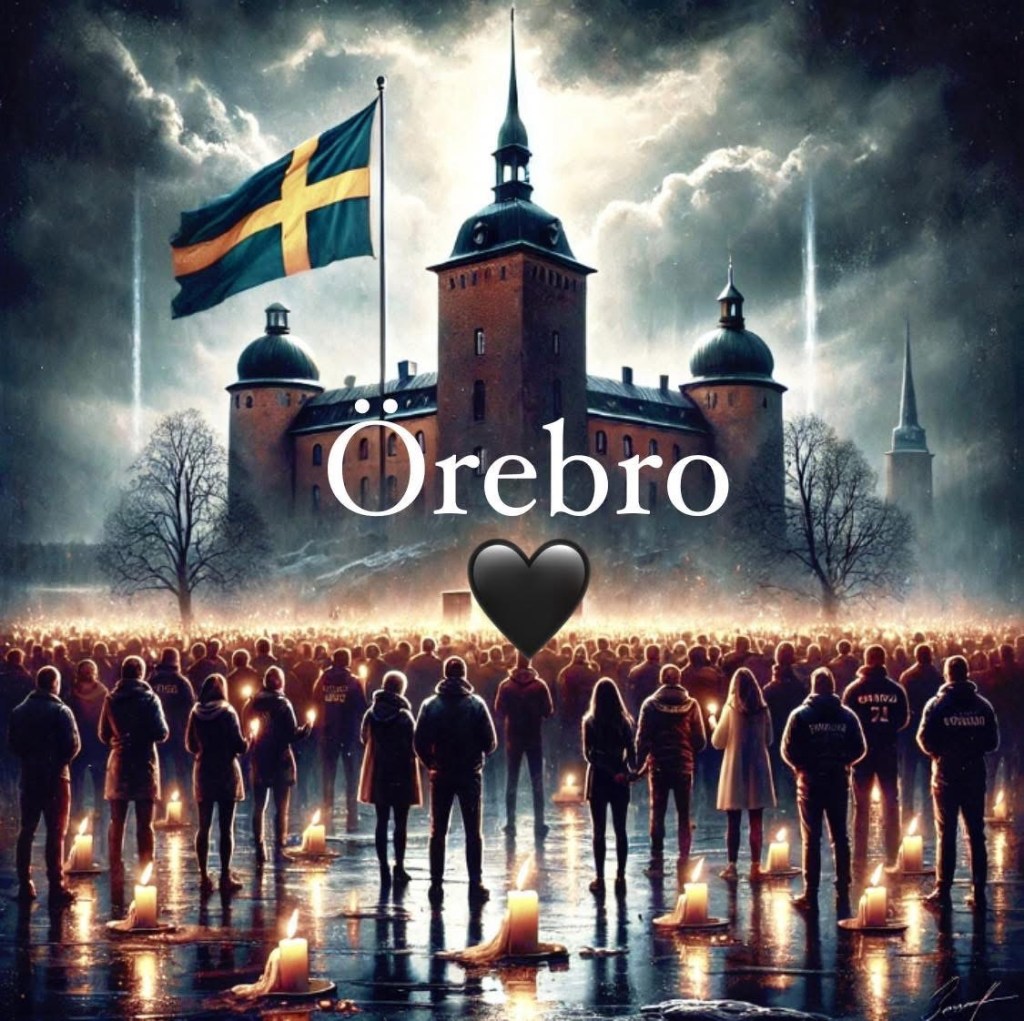
Yesterday in the town of Örebro in Sweden, 10 people were killed in a despicable school shooting. While this kind of attack is rare in Sweden, it follows a rapidly escalating period of terrible bombings, gang shootings and other hate crimes in society. In 2025, so far, there has been at least one crime of this type reported on the news every day.
Politicians, police and the population in general are devastated. It seems like authorities have lost control, and it is not easy to fix, as it has been going on a long time. However, it is resolvable – with the right strategies and the right investments.
I was curious on how AI might solve the problem, so I asked the question. And this is what I got. Definitely food for thought, and many good suggestions for concrete action.
Stopping a wave of shootings and bombings requires a multi-layered approach that addresses both immediate threats and the deeper causes of violence. Here are some key strategies:
1. Immediate Security Measures
• Increase Law Enforcement Presence: Deploy more police in high-risk areas to deter attacks.
• Improve Intelligence Gathering: Strengthen surveillance, monitoring of extremist groups, and cooperation between law enforcement agencies.
• Gun and Explosive Control: Tighten regulations on firearms, ammunition, and bomb-making materials.
2. Addressing Root Causes
• Social and Economic Programs: Address poverty, unemployment, and lack of opportunities that may push individuals toward violence.
• Education and Awareness: Promote education programs that counter radicalization and teach conflict resolution.
• Mental Health Support: Provide access to counseling and mental health services to identify and assist individuals at risk.
• De-radicalization Programs: Engage with communities to rehabilitate individuals influenced by extremist ideologies.
3. Political and Legal Reforms
• Strengthen Laws Against Violence: Enforce strict penalties for illegal weapons possession, terrorist activities, and hate crimes.
• Promote Dialogue and Mediation: Encourage political and community leaders to engage in discussions that prevent extremism and violence.
• Fight Corruption: Ensure law enforcement and government agencies operate transparently to maintain public trust.
4. Long-Term Cultural Shifts
• Promote Nonviolence and Tolerance: Through media, education, and religious institutions, promote peaceful coexistence.
• Strengthen Community Bonds: Encourage local communities to work together in preventing violence.
• Regulate Social Media Misinformation: Work with tech companies to prevent the spread of extremist propaganda.
A society that combines strong security measures with social reforms and long-term cultural changes has the best chance of stopping a wave of shootings and bombings.
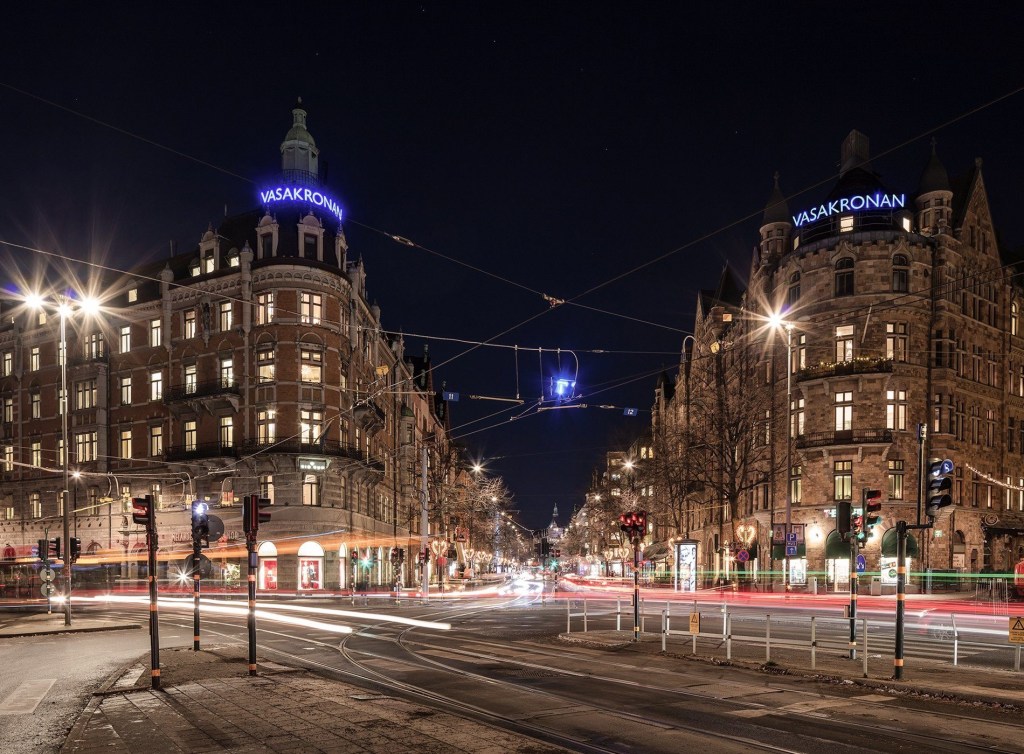
You can learn a lot about a culture from the names of its streets and squares. From heros, to events, and significant dates, you often find cultural concepts immortalised in the names the citizens choose to give their roads. This is my next series of posts – the streets and squares of Sweden.
First out – Birger Jarlsgatan, a major road cutting through the center of Stockholm. The word ‘gata’ means street.
But who then was Birger Jarl?
Birger Jarl was a Swedish statesman, and later regent, who played an important role in the consolidation of Sweden. He lived 1210-1266 and is attributed with the foundation of Stockholm. He was a significant character in Sweden’s history.
Not only is he commemorated with his own street, but he also has his own city square, decorated with a bronze statue of the man himself.
Additionally, Sweden’s most well known cenotaph – outdoors at the foot of the tower at Stockholm City Hall – was intended to hold his remains when it was built in 1923. However, the local parish in Vadstena refused to release them. So, the grand sarcophagus has remained empty – unlike the street that bears his name and is one of the busiest in the city.
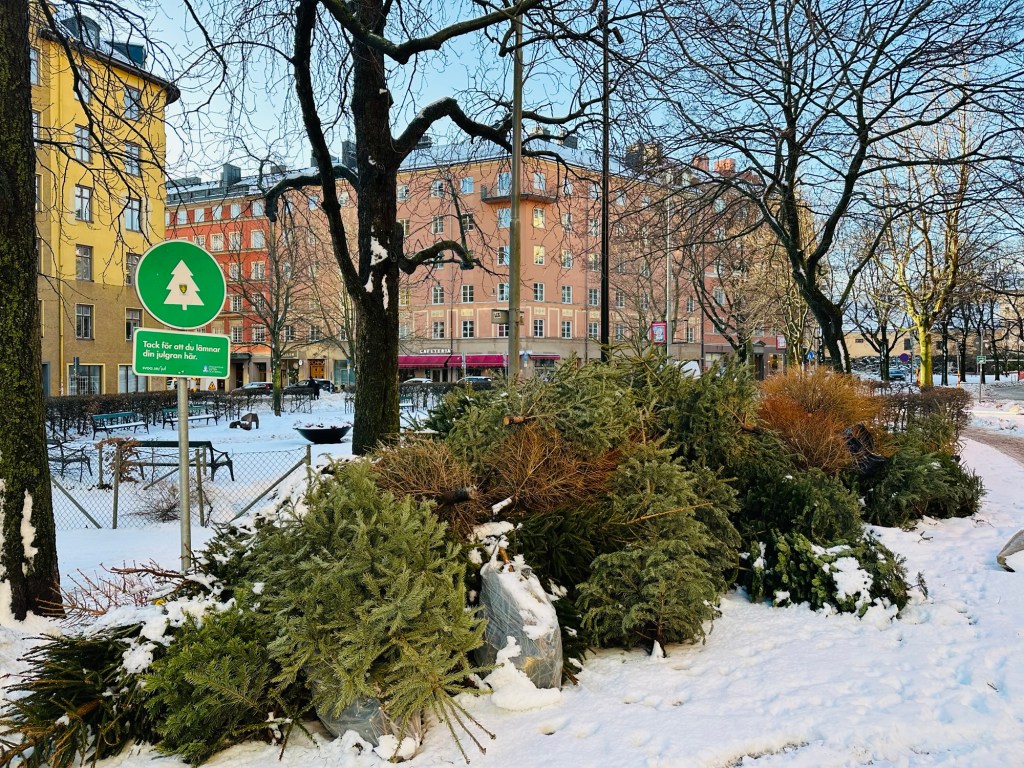
Soon Christmas is officially over in Sweden – the 13 January being the proper last day. Some people, however, already start clearing out Christmas before that. This is evident from the piles of used Christmas trees that appear on the streets all around town.
The discarded Christmas trees are gathered by the local councils and burned to provide heating. About 3 million Christmas trees are estimated to be discarded in Sweden. The heat generated from these is calculated to heat up 1200 houses per year.




 Watching the Swedes