Advent Calendar – Dec 17: Årets Julklapp

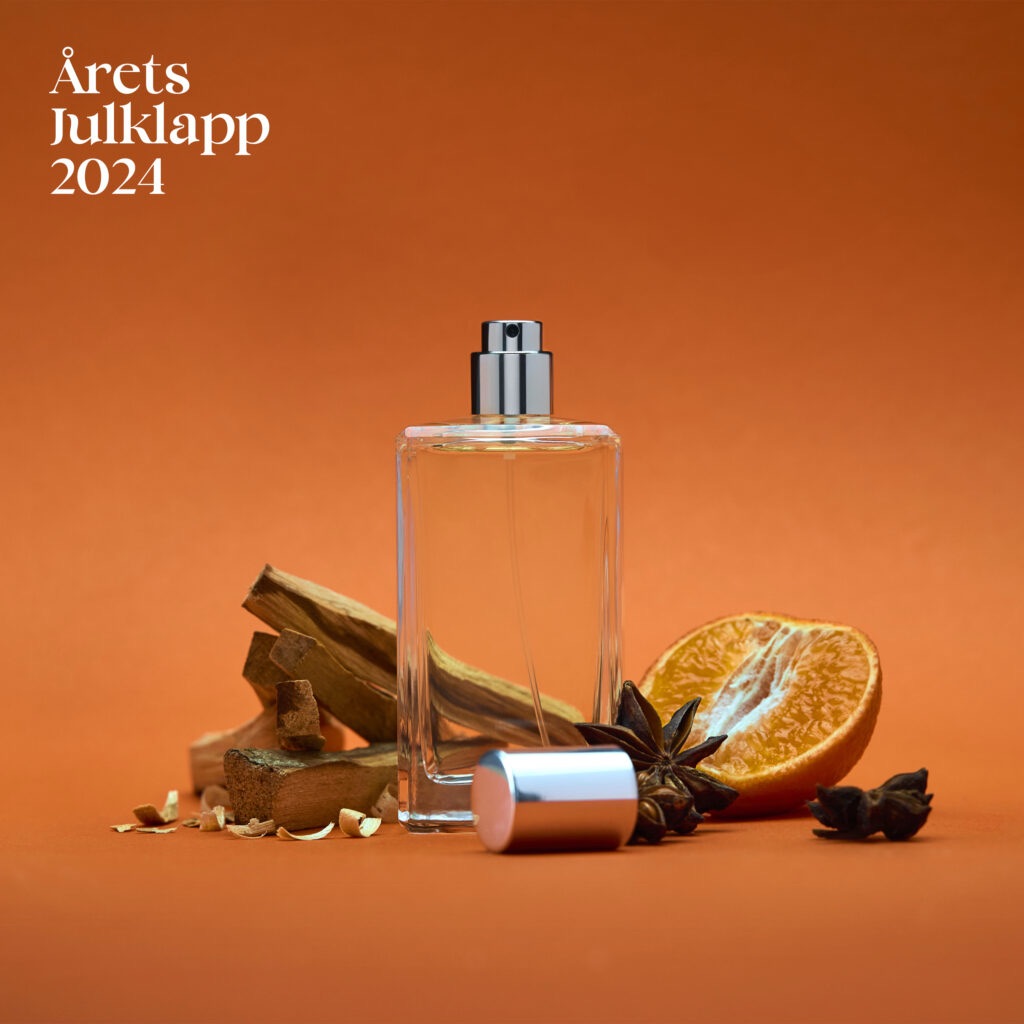
Window 17. Today’s word is ‘Årets julklapp‘ which translates as ‘Christmas present of the year.’

Every year, Sweden’s trade research institute nominates an item that is the ‘Christmas present of the year’. This item should have sold in large quantities and/or represent current trends in Swedish society. 

The first item to be granted this status was in 1988 and it was the baking machine. Since then, various items have been the CD player, VR glasses, the tablet, the spike mat, the book, the food home delivery service, the robot hoover, the woolly hat and the wok.

So this year, what is it? 

Unisex perfume.

Advent Calendar – Dec 16: Julbord

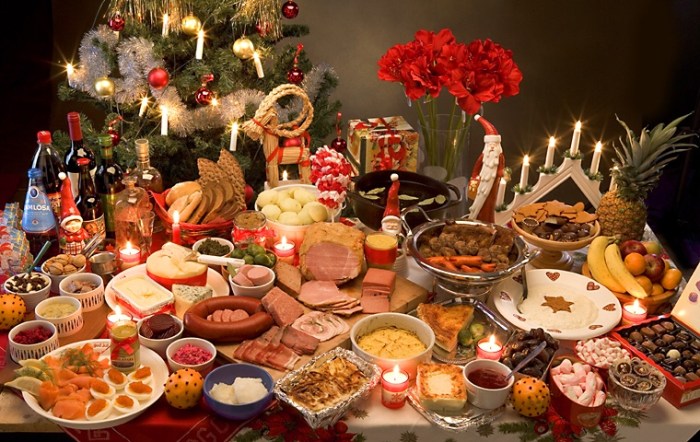
Window 16. Today’s word is ‘Julbord‘ which literally translates as Christmas table.

The word ‘smörgåsbord’ (buffet) is one of the words from the Swedish language to have the biggest international reach. The ‘julbord’ or Christmas table is the ‘smörgåsbord’ that is traditionally eaten in homes and restaurants on Christmas Eve – the day Swedes celebrate Christmas.

In the lead up to Christmas, organisations often take their employees out somewhere for a ‘julbord’.

The ‘julbord’ is an interesting concept – a potpourri of dishes, hot and cold. Not all Swedes enjoy everything on the table, but the dishes still have to be present in the name of tradition.

So, what’s on the Swedish ‘julbord’? Here are some common savoury dishes:

  • Julskinka – Christmas ham
  • Inlagd sill – pickled herring of various sorts
  • Köttbullar – Swedish meatballs
  • Prinskorvar – cocktail sausages
  • Janssons frestelse – potato and anchovy gratin called Jansson’s temptation
  • Gravad lax – cured spiced salmon
  • Kallrökt lax – cold-smoked salmon
  • Varmrökt lax – warm-smoked salmon
  • Kalvsylta – jellied veal
  • Knäckebröd och ost – crispbread and cheese
  • Sillsallad – herring salad
  • Lutfisk – whitefish in lye
  • Dopp i grytan – ‘dip in the pot’ – bread dipped in the broth that the meat is cooked in
  • Cabbage of various colours – most commonly red
  • Vörtbröd – Christmas bread flavoured with wort
  • Julost – Christmas Edam cheese
  • Revbensspjäll – spare ribs
  • Ägghalvor – halved boiled eggs topped with shrimp or caviar

The ‘julbord’ is a banquet, and its history dates back hundreds of years. Around the country there are regional variants to the standard dishes. For example, in county Skåne, they often add eel, and in Bohuslän they add ‘äggost’ – egg cheese! Many regions around Sweden have brown beans and different local sausages on the their Christmas buffet.

All of this food is traditionally washed down with beer, julmust, and snaps.

You have to be careful not to overindulge, if possible, because afterwards comes coffee and dessert. A traditional dessert is called Ris a la Malta, which is fluffy rice in whipped cream and tangerines. At Christmas tables organised in restaurants, they normally have a ‘gottebord’ which is another smörgåsbord consisting solely of sweets and desserts. Common contents are toffee, fudge, gingerbread biscuits, marzipan, ‘lussekatter’, dried fruits, cheese, and chocolates.

Advent Calendar – Dec 15: Musikhjälpen

Window 15. Today’s word is ‘Musikhjälpen‘ which translates as Music Aid.

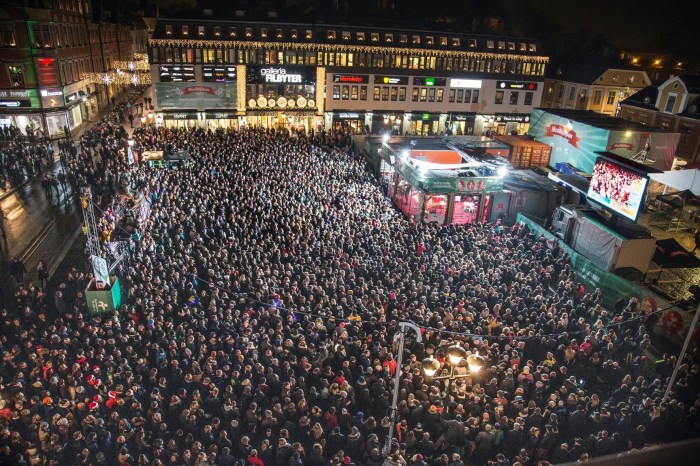
Since 2008, the radio/tv program ‘Musikhjälpen’ has become a traditional part of the lead up to Christmas.

In this program, 3 presenters are locked into a glass ‘cage’ on a town square somewhere in small town Sweden – this year from the northern town of Sundsvall. They are sleep deprived and only allowed to eat liquids.

From the cage, they broadcast radio and tv round the clock until they are released a week later.

The program is a fund-raising event for Sweden’s international aid organization Radiohjälpen. People up and down the country request songs and make donations, or carry out fund-raising activities. Live music performed in the ‘cage’ has also become an important part of the event. At most, the event has raised a staggering 74,410,363 SEK in 2017 when the theme was fighting against child prostitution.

Every year the theme is different; this year the theme is ‘every woman has the right to survive her pregnancy’.

Throughout the years, many of Sweden’s music and media celebrities have taken on the challenge of incarceration, such as singers Sara Dawn Finer, Daniel Adams-Ray, Molly Sandén, Miriam Bryant and Linnea Henriksson, and rappers Petter and Timbuktu. This year, radio profiles Linnea Wikblad and Assia Dahir are locked in with YouTube influencer Emil Hansius.

The program is based on an original format called Serious Request from Holland and is an amazing display of charity just a couple of weeks before Christmas.

Advent Calendar – Dec 14: Lussekatt

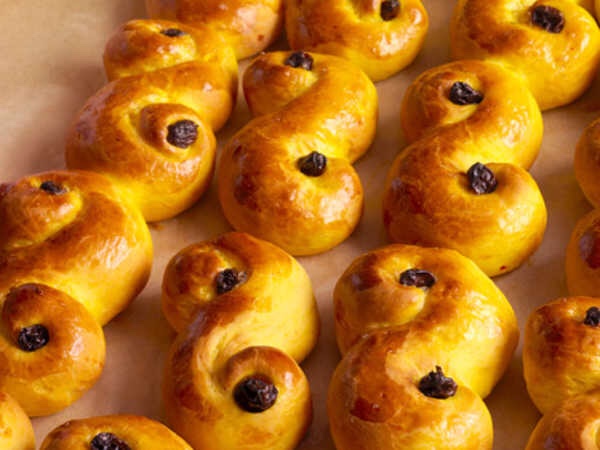
Window 14. Today’s word is ‘Lussekatt‘ which is a traditional saffron bun.

The sight and smell of the lussekatt screams Advent and Christmas in Sweden. The lussekatt, is a rich, spiced yeast-leavened sweet bun that is flavoured with saffron and usually contains raisins. In fact, saffron is a very popular ingredient at Christmas time with a whole cornucopia of baked goods being spiced with the expensive substance.

The lussekatt buns are baked into many shapes, of which the most common is a reversed S-shape. They are traditionally eaten during Advent, and especially on Saint Lucy’s Day, December 13. This could be the reason why it is called ‘lusse’ – a derivative of Lucy. However, there is a more sinister explanation.

In one theory, the lussekatt has its origins in Germany in the 1600’s. According to legend at that time, the devil used to appear as a cat, to torment children. To counteract this, people baked buns and colored them bright yellow to mimic the sun and scare away the devil. In West Sweden, the saffron buns were referred to as Devil’s buns (‘döbelskatt’) and the theory is that the name Lussekatt, comes from the word Lucifer. And the shape? Could it reflect a cat’s tail, or even the devil’s tongue?

Whatever the origin, the lussekatt remains a clear favourite in Sweden to eat at Christmas with pepparkaka and washed down with glögg.

If you’d like to bake your own lussekatt, you can find a recipe here

Advent Calendar – Dec 13: Lucia

Window 13: Today’s word is ‘Lucia‘ – a light-bringing saint who is commemorated today.

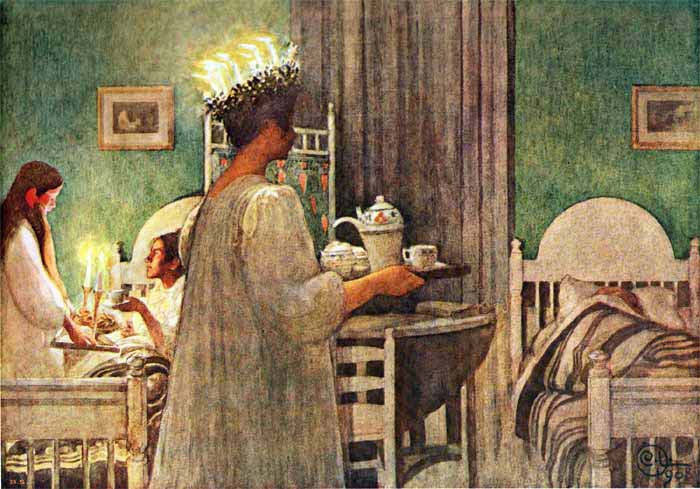
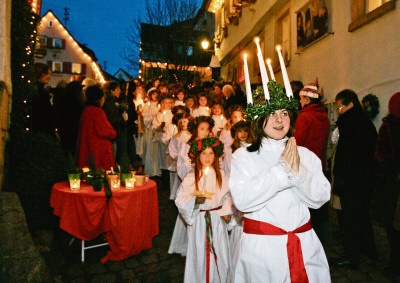
At the darkest time of the year, Santa Lucia (St Lucy) pays us a visit early in the morning. Lucia has candles in her hair and is surrounded by her handmaidens and boys, and shines light into the dark depths of our spirits. And slowly, slowly, the day awakens.

Santa Lucia is believed to have been a Sicilian saint who suffered a martyr’s death in Syracuse, Sicily around AD 310. She was seeking help for her mother’s long-term illness at the shrine of Saint Agnes, in her native Sicily, when an angel appeared to her in a dream beside the shrine. As a result of this, Lucia became a devout Christian and refused to compromise her virginity in marriage.

Officials threatened to drag her off to a brothel if she did not renounce her Christian beliefs, but were unable to move her, even with a thousand men and fifty oxen pulling. So they stacked materials for a fire around her instead and set light to it, but she would not stop speaking.

One of the soldiers stuck a spear through her throat to stop her, but to no effect. Soon afterwards, the Roman consulate in charge was hauled off to Rome on charges of theft from the state and beheaded. Lucia was able to die only when she was given the Christian sacrement.

The tradition of Santa Lucia is said to have been brought to Sweden via Italian merchants and the idea of lighting up the dark appealed so much that the tradition remained. The current tradition of having a white-dressed woman with candles in her hair appearing on the morning of the Lucia day started in the area around Lake Vänern in the late 18th century and spread slowly to other parts of the country during the 19th century.

The modern tradition of having public processions in the Swedish cities started in 1927 when a newspaper in Stockholm elected an official Lucia for Stockholm that year. The initiative was then followed around the country through the local press. Today most cities in Sweden appoint a Lucia every year. Schools elect a Lucia and her maids among the students. The regional Lucias will visit shopping malls, old people’s homes and churches, singing and handing out gingerbread.

So, it might be cold and dark outside, but remember – after darkness comes the light.

Advent Calendar – Dec 12: Julstjärna

Window 12. Today’s word is ‘Julstjärna‘ which translates literally as Christmas star and is a plant. It is pronounced ‘yule hwaerna’ (ish).

The Christmas star – ”Julstjärna” – is a plant originating in Mexico, that is popular as a decoration at Christmas time in Sweden. In the wild, it can grow to be several meters tall.

Its English name is poinsettia, named after Joel Roberts Poinsett, who was the first US minister to Mexico and who was credited with introducing the plant to the USA in the 1820’s. Actually, today December 12 is international poinsettia day, the anniversary of the death of Mr Poinsett.

The ‘julstjärna’ is not a plant that one sees very often during the rest of the year in Sweden, but suddenly at Christmas it explodes onto the scene and is a feature in most offices, homes and public buildings.

The flower has dark green and red leaves which is why it is popular at Christmas I guess. It also comes with white leaves, pink leaves and speckled leaves. The leaves are shaped a bit like a star, and I am assuming that where the Swedish name ‘Christmas star’ comes from. In Sweden, approximately 9 million ‘julstjärnor’ are bought every year.

Other popular flowers and plants that Swedes decorate their homes with at Christmas time are, amongst others, the towering amaryllis, the fragrant hyacinth, the romantic mistletoe, the tempestuous red tulip, and ilex – which are stiff branches with bright red berries on them.

Advent Calendar – Dec 10: Nobeldagen

Window number 10. Today’s word is ‘Nobeldagen‘ which translates as ‘Nobel Day’.
Nobel Day is not actually anything to do with Christmas. However, it is a traditional part of the lead up to Christmas. Every year on 10 December, since 1901, the Nobel Prizes are awarded. The date commemorates the death of Alfred Nobel in 1896.

Nobel prizes are awarded in the 6 categories of Literature, Chemistry, Physics, Medicine or Physiology, Economics and Peace. All prizes are awarded in Stockholm, except the peace prize which is awarded in Oslo. Laureates receive a gold medal, a diploma and 10 million Swedish crowns.

Most laureates are happy to accept their prize and the accolade. However, Jean Paul Satre famously declined the Literature Prize in 1964, claiming he did not want to be institutionalized.

In 1974 he was joined by Le Duc Tbo who refused to accept the Peace Prize for his work to end the Vietnam War, saying ‘peace has not yet been established.’

In 1935, German journalist Carl von Ossietzky – a vocal critic of Hitler- won the Peace Prize. This led Hitler to bar all Germans from accepting a Nobel Prize. Three German laureates were subsequently forced to decline their awards. However, they later were presented with their diplomas and medals.

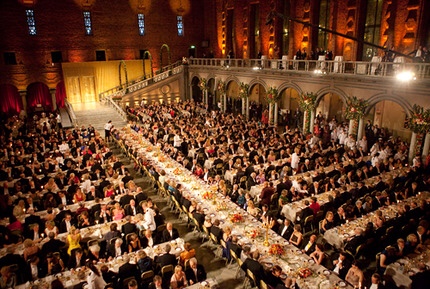
With celebratory lectures, conversations, ceremonies and concerts, Nobel Day culminates with a banquet in the Stockholm City Hall. The banquet lasts about 3 and a half hours and is televised. It is an extremely grand and formal occasion. Everything from the porcelain to the floral arrangements to the dresses, the entertainment and the menu are under scrutiny for the tv viewers.

The guests include not only the Nobel laureates and their families, but also Swedish royals and aristocrats, politicians, ministers, celebrities and other notable people. Even though there are 1300 guests, is virtually impossible for ordinary folk to get an invitation to the banquet. We have to enjoy it from afar, via the screens in our living rooms.

However exclusive the whole thing might be, it is still a welcome splash of glamour in the dark approach to Christmas. Stockholmers are also treated to the light festival called Nobel Lights, which takes place around the city. For a guide to where the various light installations are, check this out: https://nobelweeklights.se/

Swedish politics week – a summer tradition

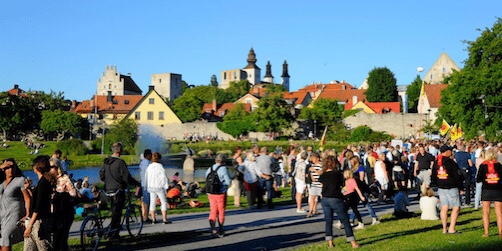
Once a year, with exception of the two pandemic years, there is a summer politics week in Sweden. The week is happening now. It takes place in a park called Almedalen on the Baltic island of Gotland, and attracts heavy media coverage.

During the week, the leaders of the eight parliamentary parties deliver speeches – their view of Sweden’s challenges and future.

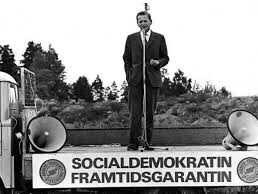
The Almedalen politics week started when legendary Swedish Prime Minister Olof Palme spoke publicly, from the back of a truck, during a summer visit to Gotland. It was at the end of the 60s and there was an audience of a few hundred people. It very quickly became a tradition.

Now Almedalen politics week attracts thousands of participants and is intended to involve the person on the street in politics and to protect the strong Swedish value of democracy and free speech. The idea is that at Almedalen politics week, we meet each other in debate. And in debate and discussion, we influence each other and our environment. This is an amazing, and very Swedish, approach to politics.

However, Almedalen Politics Week has also been heavily criticized for being elitist. Accommodation is, for example, very difficult to find, and expensive to book. The event has also become a popular opportunity for businesses to promote themselves by meeting, networking and partying with each other and engaging in media stunts. And writing it off as a marketing initiative.

Some people go to Almedalen only for this purpose and not to participate in any political activities. Social media is every year awash with images of participants mingling, drinking rose wine, partying, dancing and taking drunken groupies.

This is of course a provocation for many Swedes who perceive Politics Week as a week to enact change, and not to party and mingle. With this expanded version of Almedalen Politics Week, the question becomes is it still a platform for democracy or has it been watered-down by all of the ballyhoo?

Why is May 1st celebrated in Sweden?

In Sweden, and 160 other countries, May 1st is International Workers’ Day. Sweden has been celebrating it since 1939.

But why specifically May 1st?

The answer is found in a massacre in the USA. On 1 May 1886, laborers in Chicago went out on strike for an 8 hour working day. On 4 May 1886, the Chicago police force and the demonstrators clashed in a physical conflict. Eleven people died.

The event is called the Haymarket Massacre. Seven of the demonstrators were sentenced to death, despite lack of evidence. To commemorate the massacre, the socialist organization suggested that 1 May should become day of demonstrations every year around the world. Ironically, USA does not follow this tradition, but celebrates their Labour Day in September instead.

In Sweden, traffic is shut off, huge flag-waving demonstrations are held and people gather to hear political speeches.

The demonstrations represent people from various parties. However, since most of them are from the political left, the streets are awash with bright red flags and banners.

Not all Swedes demonstrate of course. For many, today is just a day off work – an opportunity to perhaps nurse a hangover from the festivities of the previous evening or to relax, go for a walk and enjoy the day.

Walpurgis Eve – when spring arrives in Sweden

Today, 30 April, is Walpurgis Eve, called Valborgsmässoafton in Swedish, or ‘Valborg’ for short. The name Walpurgis is taken from the eighth-century Saint Walburga, and in Sweden this day marks the arrival of spring.

In a cold, dark country like Sweden, residents have suffered through a long, miserable winter. So it is no surprise that the arrival of spring is an occasion to mark. On the evening of Valborg, Swedes usually gather to celebrate together.

The forms of celebration vary in different parts of the country and between different cities. However, essential celebrations include lighting a large bonfire, listing to choirs singing traditional spring songs and a speech to honour the arrival of the spring season. Some of the traditional spring songs are titled ‘Beautiful May – Welcome!’ and ‘Longing for the countryside – winter rushes out’. You can see a clip below.

Walpurgis bonfires are an impressive thing to see and are part of a Swedish tradition dating back to the early 18th century. At Walpurgis, cattle was put out to graze and bonfires lit to scare away predators.

The weather is often unpredictable on Walpurgis Eve. It can be sunny and warmish, or it can still snow on 30 April!

Despite bad weather, Swedes still shiver around the bonfires and ironically celebrate the arrival of Spring.