Stockholm A-Z: Wine and Whisky

IMG_4411.JPG

When visiting Sweden, people are often struck by the system for purchasing alcohol. In bars and restaurants everything goes as expected but if you want to buy a bottle of, for example, wine or whisky then this is done in the state-owned alcohol shops known as Systembolaget. These shops have restricted opening hours closing at 6 or 7pm on weekdays and 2 or 3pm on Saturdays. On Sundays and Public Holidays they are closed. Only in Finland, Iceland, Norway and the Faro Islands do they have similar concepts.

Sweden’s alcohol monopoly started in the 1800’s and the national company Systembolaget was formed in 1955.

Systembolaget has a retail network of circa 426 stores, around 25 in Stockholm. The company has an interesting mandate from the Swedish state – to help limit the medical and social harm caused by alcohol and thereby improve public health. This explains why access to alcohol is restricted through the number of stores, opening hours and retail rules, and why the corporation is aims not to maximise its profit. In other words, the alcohol monopoly is highly socio-political -its foremost aim is to stop people consuming alcohol, or at least to consume it responsibly.

Although strange for many visitors, it’s a concept that seems to work – Swedes consume on average 9.1 litres of pure alcohol per person annually. How long this state monopoly is allowed to last is however a question decided by the politicians on national and EU level and an important factor is the how strong the support of the Swedish people is. Systembolaget is loved by some and hated by others. On the one hand you have the limitation to individual freedom of choice, lack of accessibility and lack of competition. On the other hand, you have a very broad product range, knowledgeable wine experts and a brand-independent consumer environment.

However you look at it, Systembolaget has economic significance in Sweden. It employs many people, spawns an industry of wine merchants, turns over billions of crowns a year, contributing to the state income.

So if you want to buy a bottle of alcohol head down to your nearest Systembolaget. Just not on a Sunday.

Stockholm A-Z: Vasa

IMG_4410.JPG

It’s amazing that a country like Sweden, known for its technological success and innovative thinking, is also proud owner of one of history’s most epic fails. The Vasa ship, built in the 1700’s was supposed to be the grandest, most fear-instilling vessel of its time. It included an unprecedented 64 canons and was reflective of the great warrior king Gustav Vasa.

The problem is the ship never made it to battle. In fact, it didn’t even make it out of the harbour. The Vasa ship sank on its maiden voyage in 1628 right to the bottom of the Baltic Sea. However, because of the brackish nature of the water, the Vasa didn’t rot and in the 1980’s was able to be miraculously salvaged – a case of achievement winning over failure. Today, the boat is housed in the stunning Vasa Museum on Djurgården. If you only see one museum in Stockholm, this is the one to see.

You don’t have to be a lover of maritime history to enjoy it. Just reflect over how the people of Stockholm, centuries later, overcame defeat and humiliation and restored their pride. If nothing else, the Vasa Museum is a celebration of modern innovation and tenacity as much as it medieval delusions of grandeur.

Stockholm A-Z: Under ground city

IMG_4409.JPG

Deep under the bowels of Stockholm runs a comprehensive underground system taking travellers quickly around the centre and out to the suburbs. Stockholm’s underground (Tunnelbana) dates from year 1933 and consists of three lines: blue, red and green with all lines passing through the middle point of T-Centralen, Central Station. The underground is a perfect way to get around in a city where the climate can be challenging for half of the year. However, being tucked under the earth doesn’t mean a lost opportunity. In fact, Stockholm’s underground is said to be the world’s longest art gallery with 90 of the 100 stations being decorated with mosaic, paintings or sculptures. The blue line is by far the most interesting with eye-popping Kungsträdgården, Solna and Rådhuset being of particular interest.

Stockholm A-Z: Stockholmers

IMG_4407.JPG

To find one word that sums up Stockholmers is tough. As true East Londoners are supposedly defined by if they were born within the sound of Bow church bells, ‘real Stockholmers’ are defined by having being born and raised here for 6 generations. That’s no mean feat, and needless to say there’s not that many of them.

So what is a Stockholmer? Like most world cities, the people of Stockholm are urban mongrels. In the rapidly expanding population, if you literally swung a cat on the street, you would probably hit somebody from another part of the country. The majority of the residents of Stockholm have migrated here from ‘the countryside’. Chosen to come to get a job, go to college, chase a dream or eat from the smörgåsbord of the capital. Consequently, you will find that Stockholmers are hard-working, focused, cosmopolitan people who want to make a difference to their lives but still dream of the idyll of the countryside.

On the surface, Stockholmers seem fairly homogenous in terms of appearance. People are generally very trend conscious and if one person wears a checked scarf, it’s not long before everyone’s doing it. Diversity of style is not so easy to find when compared to other, larger cities. Often voted amongst the most beautiful people in the world, this conformity and fashion-consciousness combined with fitness orientation can be part of the reason. However, Stockholmers rarely find themselves in the top list for the most friendly people in the world. Residents are often perceived as cool and aloof and not very helpful. I’ve personally had enough people closing doors on me, walking into me as though I wasn’t there and ignoring me to share this perception to some degree. Like many urbanites, Stockholmers are busy, stressed and wrapped up in their own thing. For example, balancing child care with child events, work and social life can sometimes lead to a lack of awareness of others around. Add to this the challenges of being battered by a cold dark winter and you find a population generally more inwardly-focused than outwardly-conscious.

That said, Stockholmer’s can be schizophrenic. The inward focus of the winter shifts as the lighter warmer season arrives. An understandable lifting of the spirits is tangible, cafés move out onto the streets, people ditch the quilted coats in favour of airier clothes and more laughter is heard. People embrace the outdoor life and try to soak up as much UV as possible. It is literally like coming out of hibernation.

For Stockholmers, cultural activities, sport of all kinds, physical activity, shopping, personal pampering, eating out are all part of the agenda. The social Swedish concept of ‘fika’, drinking coffee and eating cake, is popular in the city and reflected by the large number of cafés and bakeries. Even here, trends play an important role, and the current trend of artisan baked goods seems to have a long-lasting grip.

Most Stockholmers seem to love their city and many take an interest in planning regulations and environmental issues. Despite this, Stockholm is the only city in the world that I know of where the term ‘unSwedish’ is used as a positive description of, for example, a cafe, a butique or a restaurant. It seems like the migrant soul of many Swedes extends beyond the capital city to other, more exotic places.

So, one word to describe Stockholmers isn’t possible. A diverse, cosmopolitan, schizophrenic, conformist population is perhaps the closest definition we can get.

Stockholm A-Z: Queen of the Mälaren

IMG_4404.JPG

Throughout the years, Stockholm has been given many nicknames: The Venice of the North, Beauty on Water, The Capital of Scandinavia, the Oak, Cissy swamp. Another old nickname for the city is the Queen of the Mälaren. Built on 14 islands between the Baltic Sea and the lake Mälaren, it’s not hard to see why Stockholm was given this majestic title.

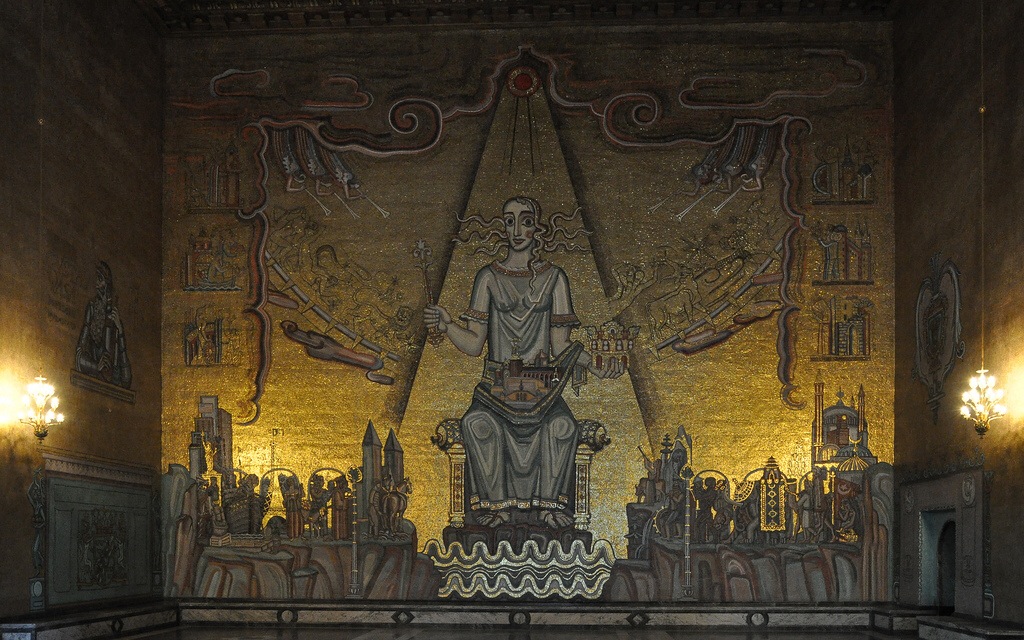
Inspired by this nickname, a mural was created in the Gold Room of the City Hall. The mural depicts a giant woman, the Queen of the Mälaren, being honoured from the east and the west. Legend has it that this mural received heavy criticism at the City Hall’s opening in 1923 as people perceived her as ugly, unlike the beautiful Stockholm. The artist, who had modelled her on his wife, irritatedly responded ‘her eyes are big so she can watch over the world, her feet are big so she can sit firm and her golden hair symbolises the sun’.

Whatever your opinion the Queen of the Mälaren is an eye-catching dominating image in the City Hall and well worth the visit.

Stockholm’s City Hall sits proudly on the island of Kungsholmen opposite the abstract conference centre of Stockholm Warterfront. The location of the Nobel banquet, the City Hall offers beautiful interiors, halls and chambers. It’s highest point is the 106 meter high clock tower which can be reached by an elevator or 365 steps for the energetic. From the top, you have a magnificent view over the city and the Mälaren. And for a moment as you stand there, taking in the commanding panorama, you feel like the Queen of the Mälaren.

Stockholm A-Z: Långholmen

IMG_4397.JPG

Tucked away on the north west coast of Södermalm, in Lake Mälaren, is the oasis of Långholmen. This island is accessed by small bridges and is a paradise for sunbathers and swimmers. The island has a bloody history – it was originally a prison island, housing criminals up until 1975 when it was closed. Today the old prison houses schools, apartments, a hotel, a conference centre, an inn and a very interesting hostel where you can spend the night in the former prison cells. Outside the prison is a popular beach which attracts hundreds of bathers on sunny days. In fact the whole island attracts its fair share of sun-worshippers. If the crowded beach is not your scene, it’s possible to jump of the rocks or low-hanging branches all around the island. In the winter, the lake freezes and you can walk around the island in the very same place you bathed just six months earlier.

On Långholmen you will also find cafés and restaurants, ice cream stands, a spinnery, a museum, a caravan site and cutely colourful allotments.

Långholmen is easily accessible by bike and connects to the other side of lake Mälaren via the imposing bridge Västerbron. From this high vantage point, you can look down over the city hall, the old town, the city, into the harbour and out into the Baltic Sea.

Close to the island of Långholmen is the residential island of Reimersholme. This smaller island was once the place for a wool factory where the prisoners of Långholmen were put to work. The factory is long gone but the island is worth the walk around to take in the beautiful panoramas over the lake.

Just close to Långholmen and to Reimersholme is a favourite historical Stockholm cafe. Set in a pleasant garden, the cafe Lasse i Parken was, in the 1700’s, a worker’s cottage. Nowadays the only people working there are the catering staff, as Stockholmers enjoy their coffee and cakes listening to live music or stand-up comedy.

Stockholm A-Z: LGBT living

Sweden is internationally known for its tolerance and openness and this means Stockholm is a great city to live in for members of the lesbian and gay community. However, visitors to the Swedish capital might be disappointed in the size of the gay scene. Where many other capital cities have gay neighbourhoods, or lots of gay and lesbian restaurants, cafés and bars to choose from, Stockholm's choices are limited.

One of the reasons for this is that the very tolerance and acceptance that exists in the city has led to a a general integration into the mainstream. Where other places around the world have needed to develop a strong and powerful subculture, it seems to have been less important in Sweden. This means that in Stockholm most places are mixed.

However, there are today a couple of bars, Torget in the Old Town is aimed and a young twinky fashionable crowd and Side Track on Södermalm aimed generally at the older and bear crowd and SLM for the fetish crowd. If you want to strut your stuff, a few clubs nights exist such as Patricia, Candy and Wonk. For a nice cup of coffee or a bite to eat head towards gay cafe restaurant Adams Bistro in the Odenplan area.

Other than occasional parties and club nights, there's very little just for lesbians and unfortunately nothing apart from interest groups exclusively for the transgender community.

In the summer half of the year, the very popular outdoor bar/restaurant Mälarpaviljongen opens its doors and is well worth a visit to take in beautiful Stockholm views and beautiful Stockholmers.

For more information on venues grab the gay rag QX or visit http://www.qx.se. Also check here for gay beaches, gay-friendly beaches and cruising areas such as Långholmen, Frescati and Kårsön.

Once a year, Stockholm organises the biggest Pride festival in Northern Europe. Usually on the first weekend in August, Stockholm Pride is a real carnival and succeeds in balancing the playful, the sexual and the political. The festival attracts up to 60000 participants who take to the streets in pride. Pride week is usually packed with club nights and parties and definitely worth a visit.

But LGBT living isn't only about parties and festivals. In Stockholm's community there is a plethora of things to occupy yourself with. If you enjoy singing, you can listen to Stockholms Gay Choir, the oldest gay men's choir in Europe. They give concerts twice yearly at Christmas and in the spring and are well worth the modest entrance fee. If exercise is your thing, then Stockholm's gay rugby team Stockholm Beserkers are a good option. On frequent Sundays they compete, and they practice on Monday and Wednesday evenings on Årstafältet if you want to go along.

If swimming is your thing, Stockholm Dolphins practice at Eriksdalsbadet on Södermalm. For more info: http://www.qx.se

And for dancing outside of the clubs, why not give Queer Salsa a go? Check out Queer Salsa Stockholm on Facebook for more information

.

IMG_4393.PNG

Stockholm A-Z: Kayak life

IMG_4392.JPG

If you’re up for a bit of adventure, then renting a kayak and heading off into Stockholm’s many waterways might be the thing for you. Kayaking has become a very popular part of urban life in the Swedish capital and seeing those little colourful plastic vessels bobbing around is an integral part of Stockholm’s water views.

As the city is built on many small islands, a kayak is a perfect way to experience it. There are many places around Stockholm to rent, the most popular being in Rålamshovsparken on Kungsholmen, on Långholmen and in Pampas Marina in Solna. You don’t to have kayaked before to rent, although since you’re heading out into water, it’s a good idea to have lessons or a little previous experience under your belt. Life belts are provided.

Popular routes are around the island of Kungsholmen, where, from the glistening water, you can take in the Old Town, the City Hall, the coastal stretch of Norrmälarstrand and the architecturally interesting dockland development of Lindholmen.

Another route is around Långholmen, skimming through the narrow boating canal, skirting the island of Södermalm and propelling along the grandiose lake Mälaren to see the woodlands and bathing areas along the water’s edge.

If you’re interested in less of an urban experience and would like to convene with nature, there are plenty of opportunities to kayak outside of the city. In the archipelago, you can kayak from island to island, through narrow inlets and open water, round skerries and cobs, rocky outcrops and sandy beaches. Take a boat out to the lush island of Grindö for example and spend the day kayaking in some of the world’s most beautiful natural environments. More information: http://www.horisontkajak.se

One of Stockholm’s brand names is ‘beauty on water’. From a kayak, it’s hard to disagree.

Stockholm A-Z: Junibacken

IMG_4391.PNG

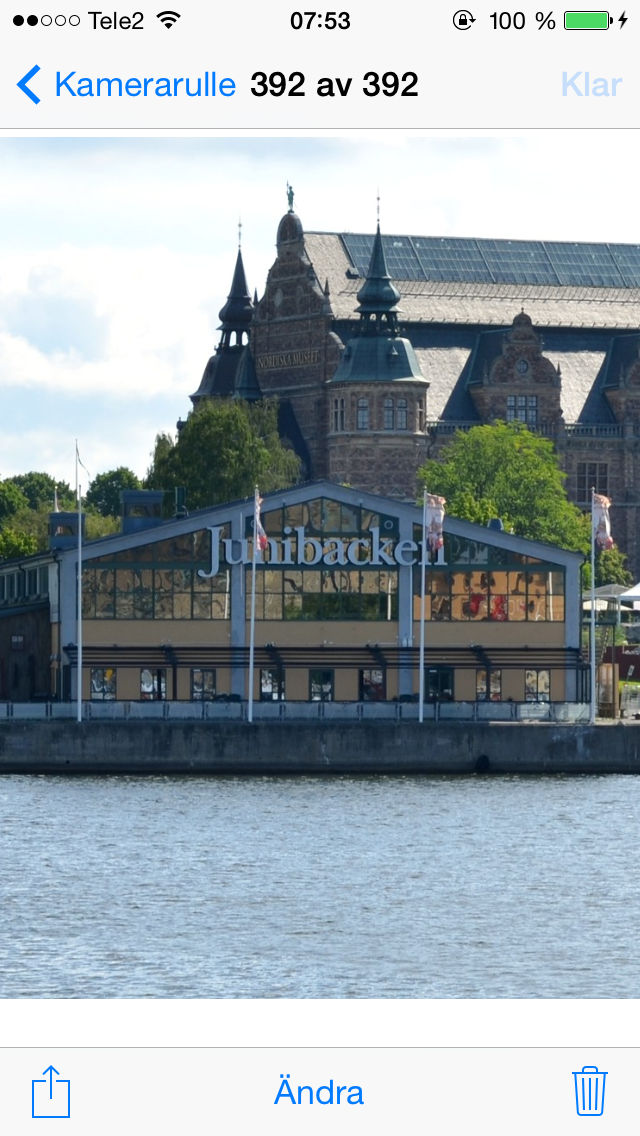
In the hustle and bustle of urban city life there is still room for fairy tales. Out on the museum island of Djurgården, you’ll find a place dedicated to them. A perfect destination for kids and families, Junibacken celebrates the fantastical stories of various Swedish writers, especially the writer Astrid Lindgren. Astrid Lindgren is today still very popular in Sweden and she is the third most translated children’s author after Hans Christian Andersen and the Brothers Grimm. She’s estimated to have sold a staggering 144 million books worldwide and has a whole army of fictional characters to her name.

Here at Junibacken you can meet all of her most well-known characters such as the airborne Karlsson on the roof, the naughty Emil of Lönnerberga, the feisty Ronja the robber’s daughter and the internationally renowned Pippi Longstocking. After traveling the museum train, children arrive at the home of the world’s strongest girl where they can play as wildly as they like.

A visit to Junibacken is a thoroughly Swedish experience, seen through the eyes of children. It is also a testament to a beloved national treasure that ensures her stories will never be forgotten.

Stockholm A-Z: Ice

IMG_4387.PNG

Nothing sums up Stockholm in the winter months than the word ice. As temperatures plummet, sheets of ice start covering the waterways, icicles form on the guttering and pavements turn into treacherous rinks. There are few places in the world that are as beautiful as Stockholm in the winter and the city is well worth a visit December to March. Imagine this – a crisp blue winter sky and a hazy cool sun hanging low. The trees twinkling with the fresh white of snow and the city’s orange and red buildings glistening with ice and smoky plumes of steam. It’s really a sight to behold. It’s so achingly beautiful you almost forget it’s minus 20 degrees and your nose turned to an ice cube long ago.

Stockholmers really know how to make the most of the unfavourable climate. In Kungsträdgården, an outdoor ice rink is built and you can skate around listening to music and enjoying the afternoon sun. If more adventurous skating is your cup of tea then open water skating is made possible on the many frozen lakes outside of town. On these frozen lakes, you can also go pimple fishing. This entails drilling a hole through the ice, dropping the line into the water and sitting on a stool waiting for a passing fish to bite. What might seem to some like savage amusement is actually a very meditative way to spend a few hours. A morning walk on the frozen Mälaren is another popular pastime. Wrapped warmly in think coats, woollen hats and scarves, Stockholmers walk on the water and finish with brunch or a cup of hot chocolate at a nearby restaurant. Outside of the city, in the forests, tracks are made for cross-country skiing, and even parks such as Tantolunden and Gärdet plough shorter tracks for the urbanites to practice on.

As the ice descends on the city, a sense of cosiness develops. In Stockholm’s Old Town, the narrowed cobbled streets seem to be transformed back into previous centuries. There’s nothing more romantic on a winter’s evening than to stroll here, chunky snow flakes pouring down from the sky, the crunch of the ice and snow underfoot.

Stockholm’s smart embracing of ice has even manifested in an Ice Bar, located in the Nordic Sea Hotel. Indoors, wrapped in thermal clothes, you can partake of a vodka drink out of a glass made of ice. This place is an offshoot from the Ice Hotel in the arctic north of Sweden, which is well worth a visit.

It would be an error of judgement to think Stockholm is only a summer city. There is a great deal to do even in the frozen months.