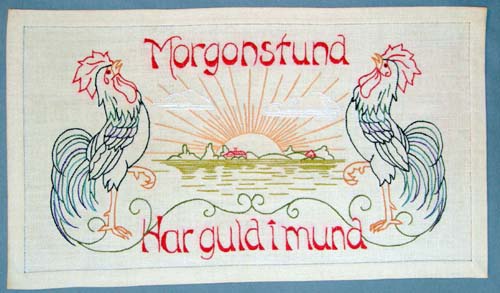
A saying you might hear early risers in Sweden use is ‘morgonstund har guld i mund’ which means the same as the English ‘the early bird catches the worm’. In other words, people who get up early, get a lot acheived.
It is borrowed from the German saying with the same meaning and exists in many other languages.
There is some disagreement on what the saying actually refers to. According to various sources, it translates as ’early morning has gold in its hand’ with ‘mund’ being an old word for ‘hand’. Others say that ‘mund’ refers to ‘mouth’ – making the saying ‘early morning has gold in its mouth’.
The Swedish word for ‘mouth’ is ‘mun’ and one theory is that it was changed to ‘mund’ to simply rhyme with ‘morgonstund’.
We will probably never know the actually origin. like many sayings, the real explanation is lost in the mists of time.
Today, Oct 4, is the day that Swedes up and down the country celebrate that most Swedish of foods – the cinnamon bun.
The cinnamon bun – kanelbulle- was invented in Sweden in the 1920’s and sold in bakeries. In the 1950’s, as ingredients, such as sugar and cinnamon, became more affordable, people started to bake them at home.
In 1999, Oct 4 was crowned as National Cinnamon Bun Day. At least 9,000,000 buns are consumed during the day.
Today, Oct 4, is the day that Swedes up and down the country celebrate that most Swedish of foods – the cinnamon bun.
The cinnamon bun – kanelbulle- was invented in Sweden in the 1920’s and sold in bakeries. In the 1950’s, as ingredients, such as sugar and cinnamon, became more affordable, people started to bake them at home.
In 1999, Oct 4 was crowned as National Cinnamon Bun Day. At least 9,000,000 buns are consumed during the day.
Yesterday, Sweden qualified for the final in team table tennis at the Paris Olympics. This is following the unexpected silver won by Truls Möregård in table tennis singles. And table tennis fans up and down Sweden are going crazy!
Table Tennis, or Ping Pong as it is also called – a name originating from the Mandarin Ping Pang Qiu – has the nickname ‘pingis’ in Swedish. It is a very popular sport in Sweden, with the first game played in the 1890’s, and the first Swedish championship organised in 1925.
Although elite table tennis is generally dominated by the Chinese, Sweden has had some success over the years. Probably the best Swedish player through history is Jan-Ove Waldner. Known as ‘The Evergreen Tree’ in China, Waldner had an extraordinary successful and long career. He won a total of 20 Gold, 17 Silver and 9 Bronze medals in the Olympics, World and European Championships. Jörgen Persson, Kjell Johansson, Marie Svensson and Stellan Bengtsson are other successful ping pong athletes.
On a non-elite level, the game of ‘rundpingis’ is popular in Sweden. This is knock-out ping pong played in large groups where people run around the table and hit one shot each. Another popular pastime is outdoors table tennis, with many parks building tables and nets out of weather-proof iron.
So, if you feel inspired by the current Olympic successes, grab a racket and go play a round of table tennis. Who knows, maybe you’ll be the next pingis star in pingis heaven!
When Armand ‘Mondo’ Duplantis won the Olympic Gold and broke the world record in the pole vault, he did it representing Sweden. Although he grew up in the USA, his mother is Swedish, and he has Swedish citizenship.
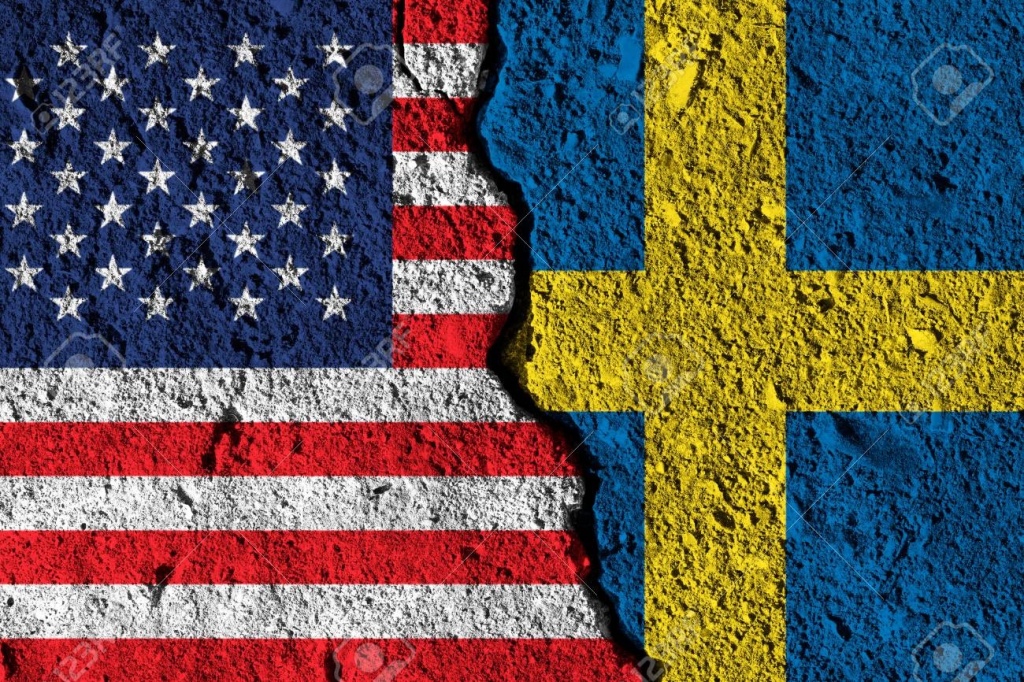
According to Statistics Sweden, Mondo is one of approximately 40,000 American citizens living in Sweden. Sweden and America have a long political relationship, with Sweden being the second country, after France, to officially acknowledge America’s independence in the 1700’s. Since then, the relationship has been smooth, with a couple of hiccups during the presidencies of Olof Palme and later Donald Trump. Today, the USA is Sweden’s third largest trade partner, and American-owned companies make up the largest number of foreign companies in Sweden.
Many Americans have family ties to Sweden due to the mass emigration of Swedes to the USA in 1885-1912. In fact, this is such a significant part of Sweden’s history that there is a tv program called ‘Allt för Sverige’ which helps Americans trace their Swedish Ancestry.
At the end of the 19th century 1.3 million Swedes fled famine and persecution in Sweden for a new life in the USA. This was a third of the population at the time. These Swedish Americans were mostly of Lutheran faith and settled primarily in the Mid West.
Prior to this, in 1638, the first Swedish settlers founded New Sweden, around Delaware. It only lasted 17 years before being absorbed into New Netherland and ceased to be a Swedish colony.
In 1639, Swedish settler Jonas Bronck settled a colony around the area of today’s New York. The settlement grew and flourished, and today is called The Bronx – after its original Swedish founder.
According the American Community survey, Swedish Americans and descendants make up around 2% of the US population today. Around 56,000 people still speak Swedish in their homes.
Some famous Americans of Swedish descent include: Taylor Swift, Emma Stone, Jake Gyllenhaal, Scarlet Johansson, Candice Bergen, Kirsten Dunst, Val Kilmer, Michelle Pfeiffer, Julia Roberts, Uma Thurman, Peggy Lee, Steven Soderbergh and George W Bush.
ABC is a concept in Swedish town planning, said to have been minted by Stockholm city planner Sven Markelius around 1952. ABC refers to the approach of building a suburb where modern families have easy access to work, dwelling and services, such as shops. A stands for ‘arbete’ (work), B stands for ‘bostad’ (accommodation) and C stands for ‘centrum’ (center for services and shops).
ABC city planning was introduced mid 1950’s and it expanded suburban Stockholm to the north and south. This growth was spurred on by the influx of people to the capital after the Second World War, and the severe shortage of accommodation.
In the original development plan from 1952, Markelius suggests that blocks of flats should be constructed within 450m of the centre, small houses should be built within 900m of the centre and light industry 600m from the centre. Everything should be built compactly in order to facilitate daily life for its 16000 residents. An underground system would connect the ABC suburb to the rest of the city and Stockholm’s downtown.
If you’d like to visit an ABC suburb, the two that are mostly still in tact are Vällingby to the north of Stockholm, and Farsta to the south.
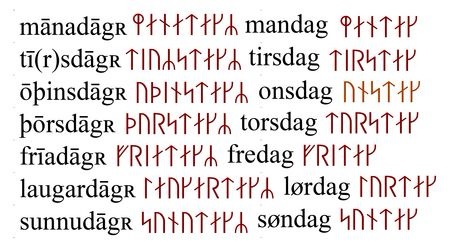
All of the Swedish weekdays, and several of them in English, stem from Norse mythology. Additionally all, but one, are named after the Gods and Goddesses of that period.
Måndag – Monday – named after the Norse God ‘Måne’, which means moon.
Tisdag – Tuesday- named after the Norse God ‘Tyr’, a God of War. This relates to the Roman God of War – Mars – in Germanic ‘Tui’.
Onsdag – Wednesday – named after the Norse God ‘Oden’, the King God of Wisdom, War and Death. In Germanic, the God was called Woden.
Torsdag – Thursday – named after the Norse God ‘Thor’, the God of Thunder
Fredag – Friday – named after the Norse Goddess ‘Freya’ or ‘Frigg’, the Goddess of Love and Fertility (also by the way Oden’s wife)
Lördag – Saturday – named not after a god, but after the Norse tradition of bathing – called ‘att löga sig’. The English Saturday stems from the Roman God Saturn.
Söndag – Sunday – named after the Nordic Goddess of the Sun – ‘Sol’ or ‘Sunna’.
If you’re interested in knowing how to pronounce the Swedish days of the week, check out this little film, and put your dancing shoes on!
This week is Stockholm Pride. It culminates on Saturday with a huge parade. The event has gone on for over 25 years, and some people question if it is still needed or relevant.
The answer, unfortunately, is more than ever.
But we’ll come to that later.
Currently there are 73 Pride festivals in Sweden during the year. From Arctic Pride way up in the north to Malmö Pride in the south, it is possible to celebrate throughout the year.
This indicates that many Swedes seem to have embraced the concept of Pride with open arms. There is, of course, a commercial benefit but the main reason seems to be that LGBTQI+ Pride resonates well with the societal Swedish values of equality, tolerance and acceptance.
However, like everything, it has its opponents.
Sweden’s current conservative government is in power, solely with the support of a right-wing populistic party. This party has consistently attacked LGBTQI+ people and the Pride movement.
This leads to aggressive counter demonstrations, homophobic, anti-Pride propaganda and personal physical attacks. LGBTQI+ people are still regularly abused, discriminated against and attacked in Sweden. It happened to a person I know in Stockholm just last week.
And if we lift our eyes to the broader world, we see examples of LGBTQI+ rights being restricted or removed, and same sex relations being criminalized and punishable with the death penalty. Human rights are under attack all throughout Europe, USA and many other countries.
You’ve probably heard of the word smorgasbord. It is a Swedish word that we borrow in English for a plentiful buffet of food. It stems from the Swedish word for sandwich – ‘smörgås’.
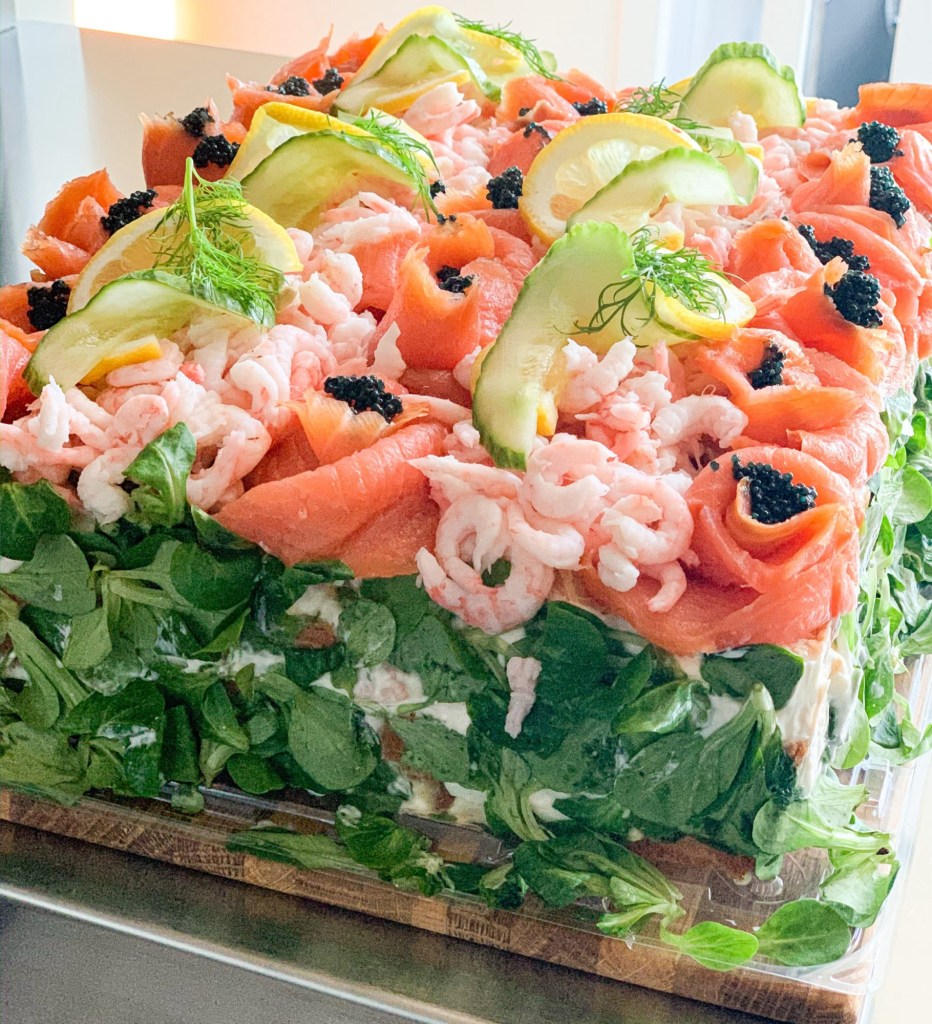
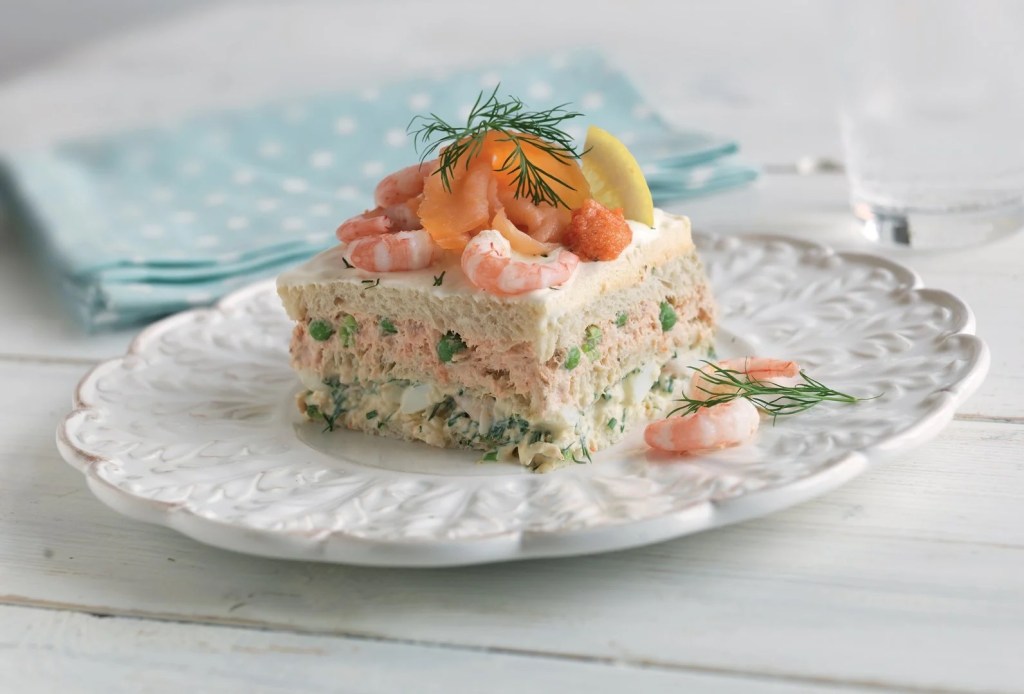
So while smorgasbord might be known to you, I am doubting that ’smörgåstårta’ is as familiar. The ’smörgåstårta’ translates as ‘sandwich cake’, and it is a dish served at celebratory events such as birthdays, anniversaries, weddings and even funerals. It has an almost iconic status in Sweden.
The Swedish sandwich cake is not a sweet dish. It is a cake-shaped dish built in layers of bread. Between each layer of bread is a variety of fillings, for example ham, beef, shrimps, salmon, vegetables. It is full of egg and mayonnaise and is garnished with various vegetables or herbs such as dill, caviar, cucumber and radishes. It looks like a layered cream cake and is sliced and served cold like a cake.
The smörgåstårta first was mentioned in a newspaper in 1934, and quickly grew in popularity through the decades. It easily took hold as Sweden had a tradition of eating open sandwiches, and of considering a sandwich a meal in itself. The sandwich cake became an elevated version of this and was considered to be luxurious – and it still is today. It even has its own day of celebration – 13 November is smörgåstårta’s day!
The sandwich cake has been imported from Sweden and become popular in other countries in the north – being a festive sight in Finland, Estonia and Iceland.
As you can imagine, a slice of sandwich cake is very filling. Its creamy consistency and rich ingredients make it difficult to stomach more than two servings for most people. This usually results in smörgåstårta being eaten for lunch for several days afterwards.
If you’re interested in making one, here’s a recipe in English: Swedish sandwich cake





 Watching the Swedes