Advent Calendar – Dec 11: Nubbe

Window 11. Today’s word is ‘Nubbe‘ which is the colloquial word for an alcoholic shot known as snaps.

Nubbe, or snaps, is a really popular drink that Swedes enjoy at Christmas time. At its base, it is a strong spirit (30-38% alcohol content) called ‘brännvin’ which is distilled from potatoes or grain.

It can be plain and colourless, or flavoured with herbs and spices. Sometimes it can be sweet and infused with, for example blackcurrant, elderflower or raspberry. Others can be so bitter they make your toes curl – flavoured with for example aniseed, wort or wormwood. If it includes caraway or dill, it can according to EU patent protection be called akvavit.

A mouthful-size of ‘brännvin’ is called a snaps or a nubbe and it is drunk out of small glasses. Usually it is consumed when eating traditional food, and may also be accompanied by a ‘snapsvisa’ – a drinking song.

One popular drinking song at Christmas is called ‘Hej Tomtegubbar‘ which translates roughly as:

‘Hello goblins, fill your glasses and let’s be jolly together.

Hello goblins, fill your glasses and let’s be jolly together.

Our time is brief upon the earth, with many troubles and little mirth

Hello goblins, fill your glasses and let’s be jolly together.

After a few snapses, the party atmosphere usually begins – with more singing, speeches and maybe even some dancing. For Swedes, snaps is such an important tradition that it is drunk not only at Christmas but at most festive times – such as Easter, Midsummer and autumn’s crayfish party.

According to The Swedish alcohol monopoly, Swedes have been flavouring their ‘brännvin’ since the 1500’s and the word ‘Nubbe’ as a slang word for snaps turned up first in 1892.

Advent Calendar – Dec 8: Ernst

December 8th window: ‘Ernst‘ which translates as, well… Ernst.

What on earth is an Ernst you might wonder? Well, the question should rather be ‘who’ is Ernst.

Ernst Kirschsteiger is a person who, by many, is considered to be Mr Christmas in Sweden. He is a very popular interior designer who currently has a TV program called Ernst’s Christmas.

In his program he simply explodes festive spirit. He decorates and bakes and creates. He wallpapers and chisels and hammers. He sews and paints and he crafts. I would describe his design ethic as a nature-oriented retro scandi chic. He has a poetic, philosophical attitude to interior design coupled with practical solutions.

One week he made, for example, Christmas decorations out of mandarin peel and wire and inspired us with a wreath of dried garden flowers, moss and brussel sprouts.

Some people find him very cheesy and goofy but he has definitely cornered the market on Christmas coziness. Many viewers see him as the idea of male perfection – a sensitive man who cooks, builds and decorates the home – all wrapped up in one sweet Christmas treat.

Since his tv debut in 2000, Ernst Kirschsteiger has grown to be a phenomena who only needs referring to by his first name, like Cher, Madonna and Prince. So popular is he that a book of his quotes and poetic wisdoms called ‘Ernstologi’ was released in 2006 and became a popular Christmas present that year.

If you want to witness the phenomena (in Swedish however), watch this YouTube clip and enjoy!

Advent Calendar Dec 5: Julmust

Every day, I will open a window containing a Swedish word that has something to do with Christmas and the festive season.

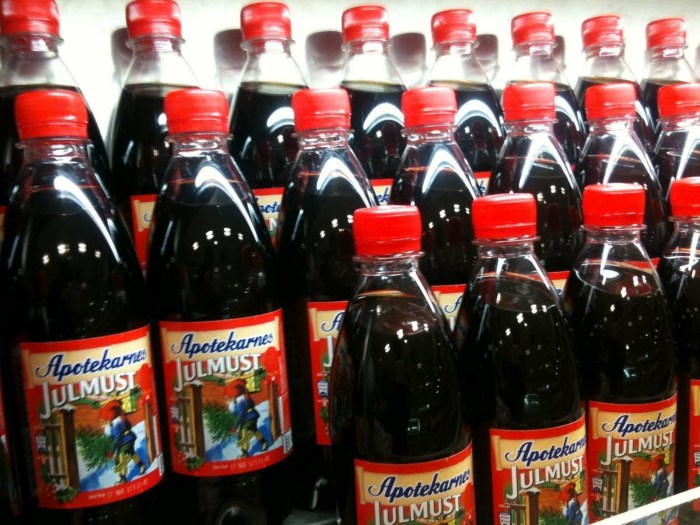
Today’s word is ‘Julmust‘ which is a fizzy Christmas beverage.

I would venture to say every Swede likes to drink at least one glass of julmust at Christmas. However, according to statistics it is even more!

Apparently, Swedes drink an average of 5 litres per person of the fizzy drink during December. The alcohol-free bottled soft drink comes in different sizes, fully sugared and also in diet form.

Said to include over 30 ingredients, its actual recipe is top secret, only known to three people. Despite all the cloak and dagger stuff, the connoisseur can detect the flavour of hops and malt. The taste is reminiscent of the old-fashioned ‘Dandelion and Burdock’ drink for those of you that understand that British reference.

Julmust was invented by a teetotaler and sales began in 1910 as an alternative to ale and port. Although intended to be alcohol-free, the drink can be mixed with gin, vodka, rum or Jägermeister to make Christmassy cocktails. When blended with porter or stout and other ingredients, it creates a classic Christmas drink called Mumma.

I have even drunk julmust mixed with red wine – a so called Kalimusto. I recommend trying the experience – although it actually is a fairly unpleasant one!

If you live outside of Sweden and want to try julmust, head to your nearest Ikea! Called Vintersaga, they sell the beverage in 500ml bottles.

Advent Calendar Dec 3: Gävlebocken

Every day, I will open a window containing a Swedish word that has something to do with the festive season.

Today’s word is ‘Gävlebocken‘ which translates as ‘The Gävle Goat’.

This strange tradition takes place in the Swedish town of Gävle. Every year, a giant handcrafted straw goat is built on the town’s Castle Square. And almost every year, it gets burned to the ground by a pyromaniac.

One year, it was even burned down before its inauguration. Consequently, the local authority have increased security and have managed to prevent the burning for the last three years.

The symbol of the goat is a traditional Christmas decoration in Sweden, called a ‘julbock’ – a Christmas goat. Usually made of straw, a goat is placed under the Christmas tree or small goats are hung from the branches. The symbol of the goat has ancestry in Scandinavia far back in Nordic mythology and, up to the 1800’s, it was the goat who brought presents during the festive season. A kind of precursor to Santa Claus.

So although the Christmas goat has endured for centuries, it remains to be seen if the Gävle goat survives until the New Year.

And so it is Advent – Swedish style


Today, the first of Advent, the light shines strong in the darkness.

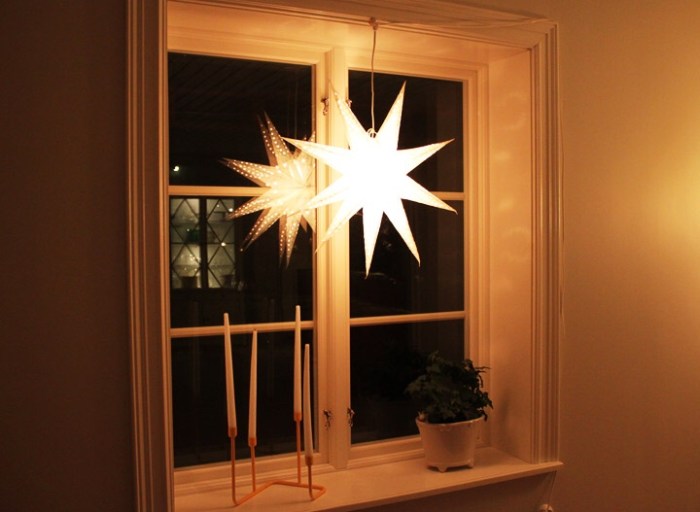
Swedes decorate their houses, apartments and windows with lights. From ceilings, illuminated stars are hung. On window ledges, electric advent candles are placed. On tables, four candles are positioned and one is lit every Sunday up until Christmas. Small candles, often red, are dotted about the home. Some people change curtains and populate their homes with small gnomes and flowers.

Since November is a grim month, the collective advent decoration is a welcome arrival as light is spread into the murky places. From the dark street, it is lovely to see windows lit up in every apartment.

This weekend is also the starting signal for the Swedish ‘glöggfest’. People go to each other’s homes and drink ‘glögg’ (mulled wine), eat gingerbread and saffron buns. It is a very cosy time of year.

And so it is Advent – Swedish style


Today, the first of Advent, the light shines strong in the darkness.

Swedes decorate their houses, apartments and windows with lights. From ceilings, illuminated stars are hung. On window ledges, electric advent candles are placed. On tables, four candles are positioned and one is lit every Sunday up until Christmas. Small candles, often red, are dotted about the home. Some people change curtains and populate their homes with small gnomes and flowers.

Since November is a grim month, the collective advent decoration is a welcome arrival as light is spread into the murky places. From the dark street, it is lovely to see windows lit up in every apartment.

This weekend is also the starting signal for the Swedish ‘glöggfest’. People go to each other’s homes and drink ‘glögg’ (mulled wine), eat gingerbread and saffron buns. It is a very cosy time of year.

Plastic Sweden

Today, July 3rd, is International Plastic Bag Free Day. Plastic pollution is a man-made global catastrophe. Around 500 billion plastic bags are used on a global scale – most of them littering the planet and having a negative effect on the environment, wildlife and human health. Plastic bags can take up to 500 years before they decay properly.

A staggering 300 million tons of plastic are produced every year. At least 8 million tons of this ends up in the sea every year. Scientists estimate that more than 5 trillion pieces of plastic are currently floating in our oceans.

International Plastic Bag Free Day was introduced to encourage people to choose paper over plastic, to go on plastic bag scavenging outings and to recycle.

In Sweden, in May 2020, a tax was added to plastic bags in shops. After 8 months, the statistics showed a reduced consumption from 83 bags per person to 55. The EU goal is to reduce this number to 40 by 2025.

In November this year, Sweden will introduce additional tax to plastics intended for one-time use, such as food containers and mugs. In 2024, there will also be a total ban on cups and containers that contain more than 10% plastic.

So, think about anything small you can do to help today. Take a bag with you to the shop. Take a mug to your local cafe. Don’t put your fruit and veg in a plastic bag at the supermarket. Cook at home, don’t buy take away. Reuse. Recycle.

The Svenssons go to the gym

I was cleaning up some old posts in my blog, and found this one from almost 10 years ago! I thought it was worth sharing. It’s takes us back to times gone by – when tourists came to Stockholm and when public spaces were open without restriction. And when I went to the gym!

I work out at my local gym in a nearby hotel. The gym is used by local residents and hotel guests alike. It’s a small gym, long and narrow, with enough room for one treadmill, a couple of step machines, a few weight machines and a free weights area. Being small it gets easily cramped, so it’s necessary to show respect for each other and cooperate so everyone gets the most out of the space available.

This weekend I was there on my own. It was a paradise. I could move freely about the gym without considering the needs of anyone else. It was a rare pleasure.

Until, hotel guest Mr Svensson walks in. The hotel also has a small plunge pool and Mr Svensson is ready for that. However, he’s decided that a little exercise on the step-machine would be good first. Dressed only in a pair of swimming trunks, bear-breasted and bare-footed, the sweaty 70-year old Mr Svensson climbs onto the machine and starts excersing. Gym etikett? Forgetikett. Half-naked and out of breath, Mr Svensson seems to have no sense of dignity or consideration.

I manage to ignore Mr Svensson, half successfully, when daughter and son-in-law Svensson come in and climb onto the machines beside him. They begin to converse. Loudly. The musical they went to last night was sooo good. Stockholm is sooo stressful. People even run on the escalators. I focus on my arm curls and try to banish them.

I consider myself a person who is able to focus. In most situations. Even Swedish country folk criticising the big city doesn’t penetrate my focus. But then it happens. Grandma Svensson arrives, dressed in an outdoor coat and comfortable boots. In her arms, she carries granddaughter Svensson, a year-old baby, who she proceeds to put down and allow to crawl all over the gym floor.

This rug rat, the loud conversation, the naked step machine grandad all prove too much for me, so I leave. My work-out is finished.

On the way home, I try to analyse the situation. Why did they think it was ok to behave that way in a gym? They clearly had a sense of entitlement.

I don’t know the answer but I am glad of one thing – I am glad I wasn’t in the plunge pool.

Sex working in Sweden

Today, June 2, is International Sex Workers’ Day. It is celebrated today because on 2 June, 1975, 100 sex workers occupied the Sant-Nizier Church in Lyon, France to express anger about their exploitative living conditions and work culture. The Church was brutally raided by the police forces on 10 June. This action became a national movement and the day is now recognised in Europe and worldwide.

In 1999, Sweden was unique in the world with the introduction of a ‘Sex Purchase Act’. The act makes it illegal to purchase sex but not to sell it. Under this law, it is the customer that is the criminal but not the sex worker, who is considered to already be in a vulnerable position. The law is based on the principle that prostitution is an act of violence against women. The ‘Swedish Model’ has been duplicated and adapted in the other Scandinavian countries as well as Canada, Ireland and France.

The Swedish Sex Purchase Act stands as a complete opposite to the laws in Germany and the Netherlands where the purchasing of sex services is legalized. Proponents of the Swedish law would at this is why Germany and the Netherlands have become European hotspots for sex tourism and trafficking.

However, many organisations, including Amnesty International, WHO and Human Rights Watch oppose the Swedish model. They suggest instead that legalization improves the sex worker’s access to health care, their ability to report crime and ability to organize themselves in, for example, unions. They also claim that the sex worker is not always a victim of the situation and that the Swedish law forces them into risky behavior and contributes to their poverty.

Despite the criticism, the Swedish law stands strong and does not look like it will be changed anytime soon. It seems that most Swedes agree with the law, based on the belief that nobody has the right to buy another person’s body.

What do you think?