Swedish expressions – ‘more stupid than the train’


prins albert

The Swedish train system is notorious for its lack of reliability and continuous delays. Anybody who travels by train in Sweden has probably called it stupid, or worse, in anger or frustration. However, this is not where the Swedish expression (you are) ‘more stupid than the train’ comes from.

To understand the origin of this expression, we have to travel to my home country of England and to the end of the Industrial Revolution. In the 1800’s the rail industry was booming and in 1856 Sweden imported a train from the UK, pictured above.

A Swedish tradition is to give names to trains, and this particular train was christened ‘Prince August’ after King Oskar I’s youngest son. Prince August was well-known across the country for not being the brightest light in the Christmas tree. His weak intellect was well referred to in stories of the time. This was a period in history, however, when open criticism of the Royal family borded upon treason. So, the people created an expression – more stupid than the train – to describe somebody’s idiocy while at the same time referring ‘discretely’ to the royal fool by referencing the train of the same name.

This tradition of naming trains, and train carriages, still exists in Sweden today. Only this morning I travelled in a carriage called Pippi, but I’m afraid it wasn’t much of an adventure. Here is a list of all the carriage names on the Stockholm underground – see if your is there!

How SD is seducing you

sd affisch

Standing on the train platform this morning I was confronted by a huge poster from nationalistic party the Sweden Democrats, asking me to vote for them in the approaching election. The poster consisted of men and women, all white, smiling down at me in a welcoming unthreatening manner. ‘SD 2018’ – the simple slogan emblazoned across the poster – intended to show me that those who support SD today are not nazis, criminals, sexists or homophobes (as proven time and time again in the press). On the contrary they are presented as ordinary, happy people who just want a change of government.

As I stood there, I understood how clever SD’s PR and Marketing people are. They have a strong understanding of influencing techniques – and they’re not afraid to use them to seduce the unsuspecting general public.

Psychologist Robert Cialdini is considered the guru of influencing skills. In his ground-breaking book, ‘Influence’, he introduced six key principles on which influence is based. Based on his extensive research, he found that if we apply these principles, we are able to persuade others more easily. Used positively, they can help move us towards agreement with each other, used negatively they can be applied to manipulate and even coerce people into making decisions that might be bad for them.

As I stood on the platform and absorbed SD’s poster, I realised how artfully they are using two of Cialdini’s principles. The principle called ‘Social Proof’ and the principle called ‘Liking’.

Social Proof
This principle relies on people’s sense of “safety in numbers.” If we see that others are doing something, we are more likely to do the same. It somehow feels validated. For example, we’re more likely to work late if others in our team are doing the same, put a tip in a jar if it already contains money, or eat in a restaurant if it’s full of guests. We assume that if lots of other people are doing something, then it must be OK. We’re particularly susceptible to this principle when we’re feeling uncertain, and we’re even more likely to be influenced if the people we see seem to be similar to us. That’s why commercials often use parents to advertise household products and why SD uses smiling, happy Nordic people.

Liking
Cialdini says that we’re more likely to be influenced by people we like. Likability comes in many forms – people might be familiar to us, we might just simply trust them or they might physically look like us. We have an inherent feeling of liking when we see them. Companies that use sales agents from within the community employ this principle with huge success. People are more likely to buy from people like themselves, from friends, and from people they know and respect. Facebook, for example, builds its business model on ‘liking’. SD uses this principle to manipulate us into thinking they are just like us. They think like us. They would never do anything to harm us. We can trust them.

As in previous posts, I am trying to shine a light on how SD is manipulating us, society and the election. They are masters of manipulation – spreading fear and uncertainty in the minds of the susceptible electorate, when in fact Sweden is currently booming and economically very stable. There are problems in society, no doubt, but these are not best solved by giving power to a party that we know is manipulative and devious. Judging by the level of scheming we see when they are trying to gain favour, just imagine how this will escalate if they have power.

A vote for SD is not a vote for a better Sweden.

Do not be duped into falling for the deceit.

You are being manipulated.

Do not be seduced.


Why is Sweden….according to Google

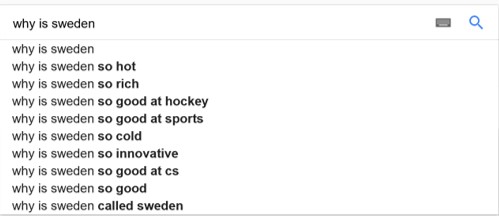
A quick Google search punching in the words ‘why is Sweden..’ led to a very telling autocorrect.

why is sweden

  • Why is Sweden so hot?
  • Why is Sweden so rich?
  • Why is Sweden so good at hockey?
  • Why is Sweden so good at sports?
  • Why is Sweden so cold?
  • Why is Sweden so innovative?
  • Why is Sweden so good at CS?
  • Why is Sweden so good?
  • Why is Sweden called Sweden?

So, if this represents the most common searches for Sweden, it certainly seems positive! Sweden is hot, rich, good at all sorts of things and innovative! I only wish I knew what CS is –  Christmas shopping? Classic socialism? Counting suicides? Consuming spirits? Well, whatever it is, they are apparently very good at it!


Sweden you are being manipulated

In the Second World War, one fear that the German soldiers had was being sent to the frontline in Russia which meant certain death. They feared this so much that they would be willing to do anything to avoid it. This fear has become the name of an influencing tactic known as the ‘Russian Front.’ It is a highly manipulative negative tactic that we see being used in Swedish politics today.

To apply the Russian Front tactic, we offer a person something that they will never choose but we dress it up so that it seems more real. We paint a picture of pain, then

offer them the alternative that we really want them to choose.

Example:

There is a job available in Sewage Maintenance, the last guy died. I do hear they’re looking for people in reception though. Should I recommend you?

The Russian Front is the application of a principle called ‘Hurt and Rescue’.

‘Hurting’ means making somebody feel pain of some kind, pointing out what is wrong, making them want to get away from something. ‘Rescuing’ means removing their hurt, saving them from their pains. It creates relief.

With this in mind, think now about what is currently going on in Swedish politics. The extreme right wing nazi party – the NMR – have been very vocal recently. They have been involved in homophobic, racist and sexist attacks. They have received a lot of media attention and harassed, threatened and film documented people from minority groups. The NMR are the Russian Front. They are here to ‘hurt’ us. In contrast to them, the other right wing party, the SD, look more acceptable, although they also have a racist and sexist agenda of hate. But compared to the hurt of the NMR, the SD can appear as the ‘rescue’.

This is very, very dangerous. It is extremely manipulative. It is a well orchestrated trap. It is very strategic, and well planned. Its intention is to force fearful voters into the hands of SD in September’s general election.

The key to not falling into this trap is to see it. To see it for what it is. The fear we are experiencing is not real. It is choreographed. The solution is not SD. Do not allow yourself to be manipulated. Do not vote out of the illusion of fear. This is a high stakes game, and we are pawns. But we do have the power, if we see through the manipulation tactics.

The Russian Front is not real.

SD is not the solution.

Please spread and share this message.

Swedish election language – val*****

Valspecial

Currently there’s a lot of election campaigning going on in Sweden. In a couple of weeks, Swedes will decide who they would like to have in their government. It’s a bit of a nail-biter as the established parties are waning in popularity and the far-right populist party is gaining ground. Time will tell how the public votes. But in the meantime, let’s have a little lesson in Swedish election language. The Swedish word for election is ‘val’, which also means choice and also means whale. The word ‘val’ appears in front of lots of words in election times. Here are a selection of my personal favourites that I’ve spotted in the media:

  • Valbråk – ‘election fight’ – some kind of conflict that arises in association with an election. It can be connected to posters or pamphlets or anything that gets people agitated, often by making populistic ‘vallöfte’
  • Valfläsk – ‘election pork’ – a weird one, describing the hyperbole, the bullshit and the exaggerated claims made at the time of elections
  • Valfusk – ‘election cheating’ – used to describe corruption in relation to an election
  • Vallöfte – ‘election promise’ – what the party promises, and more often than not fails to deliver
  • Valstuga – ‘election cottage’ – small wooden houses on a public square where representatives from each party stand and represent their policies
  • Valspurt – ‘election spurt’ – nothing saucy, but rather a word to describe the escalating final run up to voting day
  • Valchock – ‘election shock’ – an unexpected result, rather like Brexit or Trump and perhaps what we are heading for in Sweden in a couple of weeks’ time.


Do you have any other any other election words that particularly amuse you?


An ironic Swedish election error!

In Sweden there is a General Election in less than a month, and the parties are papering the towns with their posters and their messages.

One party, the Liberals, made a hilarious error on one of their posters. The Liberals are for obligatory Swedish language tests as part of the integration process for foreigners into Sweden. Ironically, they released a poster with incorrect Swedish on it.

The poster in question reads ‘Mot extremism’ and has the smiling face of their leader gleaming out. The problem is that they meant ‘Emot extremism’, which means ‘against extremism’. ‘Mot’ is the Swedish word for ‘towards’. So the poster reads ‘Towards extremism’.

Oh, the irony!

Sweden’s political island week


Once a year, at the beginning of July, there is a politics week in Sweden. The week takes place in an open-air park called Almedalen on the Baltic island of Gotland, and attracts heavy media coverage. Every day of the politics week belongs to a specific party that has a seat in the parliament – there are 8 of them.

The Alemdalen politics week all started 40 years ago when legendary Swedish Prime Minister Olof Palme spoke publicly. It was at the end of the 60s and the Social Democrats on the island took the initiative and asked Olof Palme to make a speech in Almedalen. Palme and his family had spent their summer holidays on the neighbouring island of Fårö for many years. The stage was a lorry platform at Kruttornet and there was an audience of a few hundred people.

Now Almedalen politics week attracts thousands of participants and is intended to involve the man on the street in politics and to protect the strong Swedish value of democracy. However, the concept of democracy has never been so strongly challenged as it is this year. Right wing, nationalist party Sweden Democrats are gaining in popularity and are now the second largest party according to the opinion polls. This is a party that has its roots in nazism, sits in the parliament, focuses on ‘Swedishness’ and, even today, categorizes people according to their ethnicity. Some of their representatives are simply racist.

Democracy is a double-edged sword. Giving an open platform to racist ideas is a difficult thing to stomach, but it does strongly reflect the Swedish belief in freedom of speech. We don’t all agree with each other, but we have to defend the right for each other to think differently – as long as we are not inciting violence.

If we don’t do that, what’s left? What kind of a society do we have then? I am sure it would be a society that we wouldn’t want to live in.

At Almedalen politics week, we meet each other in debate. And in debate and discussion, we influence each other and our environment. And it is then, and only then, we can possibly change our society.

The Nobel Prize of SHAME

SvAka_1_pms

In egalitarian Sweden, there is an elitist, powerful, elected-for-life committee called The Swedish Academy. This (royal) Academy is an appointed committee of 18 members whose purpose is to further the ‘purity, strength, and sublimity of the Swedish language.’ To this aim, they are guardians of the Swedish dictionary, and they award many prizes and scholarships to domestic authors. A mostly dusty, bourgeois old bunch, they also are responsible for awarding the prestigious Nobel Prize for Literature every year.

But not this year. Sex and shame has stopped them.

Today, the Academy announced they will not be awarding a 2018 prize. This has only happened 6 times since its beginnings in 1901  – during the world wars and in 1935, when no worthy winner was identified.

On its website, the academy writes ‘The present decision was arrived at in view of the currently diminished Academy and the reduced public confidence in the Academy.”

The ‘reduced confidence’ they are referring to is the rampaging sexual assault scandal that has engulfed the organisation. Several members of the academy have been slandered, scapegoated and forced out, or left at the own volition.

So no prize in literature this year, but most certainly a prize in shame.

It all started last November in regard to the husband of author Katarina Frostenson who is a member of the Academy. Her husband, photographer Jean-Claude Arnault, who ran a cultural project, with funding from the Swedish Academy itself, was accused by 18 women of sexual assault and harassment. Some of this allegedly happened in Academy premises. It has later been suggested that he even groped Sweden’s Crown Princess Victoria at a formal event.  Naturally, Mr Arnault denies the allegations.

This threw the Academy into turmoil. What unfolded in front of us was a drama of betrayal, sexism, power struggle, internal conflict, dishonesty and manipulation. It was like ‘Culture News’ meets ‘Downton Abbey’. Subsequently, a wave of resignations followed, including Ms Frostenson and the head of the academy, Sara Danius.

Today, there are only 11 members in place but the diminished academy requires a quorum of 12 to vote in any new members.

Since its beginning in 1786, the Academy has only ever allowed 9 women to sit in the committee. 9 women! It is clearly yet another example of a white, male-dominated, middle-class organisation. Can it change? Maybe the only way is to rip down this tower and build it up again in a more egalitarian spirit? Surely, the Academy should represent the population in ethnicity and gender at the very least?

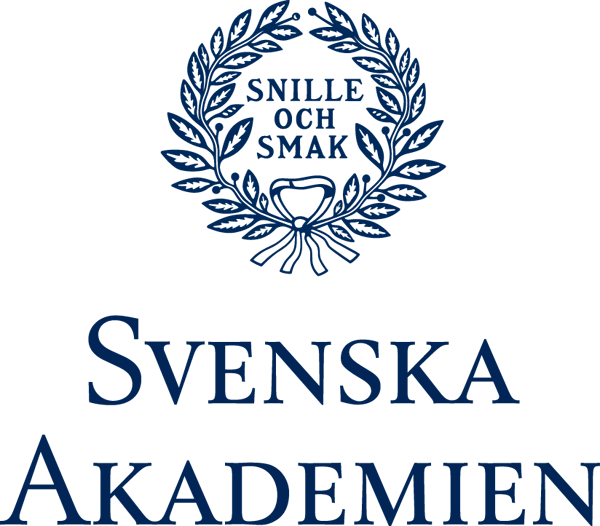
The Academy’s slogan is ‘snille och smak’ – which translates as ‘talent and taste’.

Ironic isn’t it, that they are currently demonstrating neither of them.

Swedes on the march

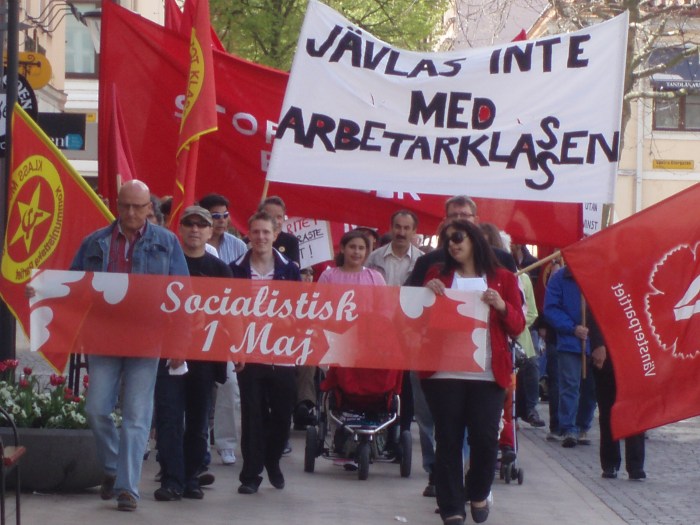
Around Europe, May 1st still contains many ancient pagan spring rites festivities, such as dancing around maypoles, drinking, reveling and welcoming the spring. In Sweden, these festivities have been moved to the festivity of ‘Valborg’ on April 30th, and May 1st has been embraced as the International Workers’ Day.

Since 1938, May 1st has been a public holiday and an important celebration of labourers and the working classes in Sweden. Around the country, traffic is shut off, huge flag-waving demonstrations are held and people gather to hear speeches from their politicians and representatives. Today is especially important for politicians on the left side of the political spectrum, and Sweden’s current government the Social Democrats. For decades, they have held their rally in a square in central Stockholm, known as Norra Bantorget, where the Swedish Trade Union Federation is located.

May Day celebrations are of course not unique to Sweden – many countries around the world have similar events. The day is also a public holiday in many countries – though interestingly not in Sweden’s neighbouring Denmark.

Contrary to the stereotype however, not everybody in Sweden supports the left wing political groups. Many Swedes lean towards the centre or the right. For them, today is just a day off work – an opportunity to perhaps nurse hangovers from the festivities of the previous evening or to relax, meet friends and enjoy the day.

Nowadays, there is always a populist shadow over May 1st celebrations. This year, the nationalistic extreme right-wing Party ‘Nordiska motståndsrörelse’ will also be marching in the small towns of Ludvika and Boden. This inevitably means a counter-demonstration will occur and a potentially violent exchange of opinions will develop.

The Death of a Swedish Icon

Lill-Babs-2015

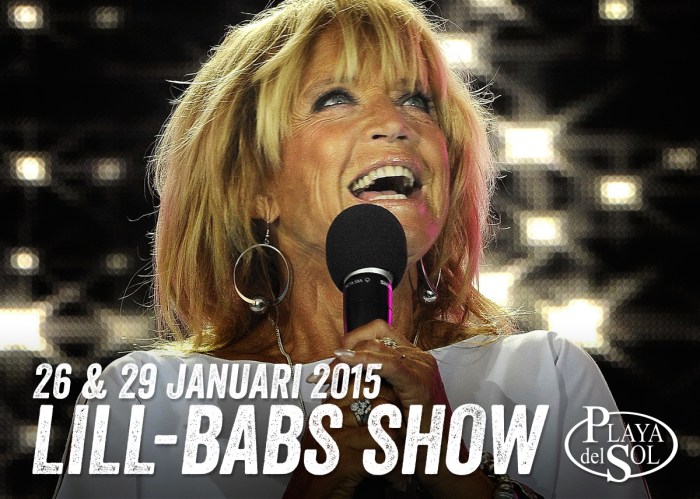
Today, the news of a death reached the Swedish people. The death of an icon. At the age of 80, popular singer Barbro ‘Lill-Babs’ Svensson passed away. Lill-Babs is little known outside of Sweden, but in Sweden she was an icon, a part of the soundtrack of many Swedes’ lives – she was Sweden. To get a grip on her status in the country, think the UK’s Cilla Black, and France’s France Gall – with that combination of untrained vocals and girl next door sex appeal – and you come part of the way.

When I moved to Sweden over 20 years ago, Lill-Babs was possibly one of the first Swedish celebrities that I got to hear of. She was constantly on the tv, on chat shows, in theatres, in concert halls, in the tabloids, in reality programs, in magazine articles and firmly positioned in the national memory. Her modest origins from a small village in rural Sweden contrasted intriguingly with her show-biz lifestyle, her many love affairs and bankruptcies and her glamorous media-trained daughters. She seemed to balance the ability of staying true to your roots with the bravery of a sexually liberated woman surviving decades in a man’s world. In older days, blonde hair, tanned skin, moist lips, bling and leopard print were her signum, along with her distinctive raspy deep voice. She impacted everybody it seems. Even the King of Sweden announced his condolences today saying he will remember her warmth and exuberance.

I had the pleasure of seeing the ‘Lill-Babs Show’ in 2015, when she was 76 years old. She gave annual dinner shows at the Swedish venue called Playa del Sol on Gran Canaria. As I happened to be there on holiday, I went with some friends to watch her perform. I admit I was a little sceptical going in, but I was blown away. There on the stage stood a woman, slightly ravaged by the years, but with a warmth and a humour that is rarely seen. Her energy and professionalism swept us all away and the crowd went wild – well as wild as they could given the average age was about 70. She sang her classics from the previous 6 decades and told cheeky, saucy jokes to the audience. I felt that I wasn’t just seeing a concert but I was having a thoroughly Swedish experience, somehow immersing myself into Swedish popular history and culture. There, on the stage, was not only a singer but a living legend.

April 3, 2018 Lill-Babs died after a short period of illness. She takes with her a piece of Swedish history, an echo of a Sweden long gone. Her legacy is the openness with which she invited the Swedish people into her life – warts and all. I am sure she will not be easily forgotten and that her voice will be echoing loudly through many a Swedish home this evening.