Baby we’re burning – Swedes, songs and Satanists

valbiorg

This weekend, the 30th April, in Sweden is Valborgsmässoafton. Yes, another one of those long indecipherable Swedish words.

This one translates as Walpurgis Eve, and is a day enshrined in tradition not only in Sweden but in other European countries such as Germany, Holland, the Czech Republic, Lithuania, Latvia, Estonia and Finland. Rather Baltic in other words.

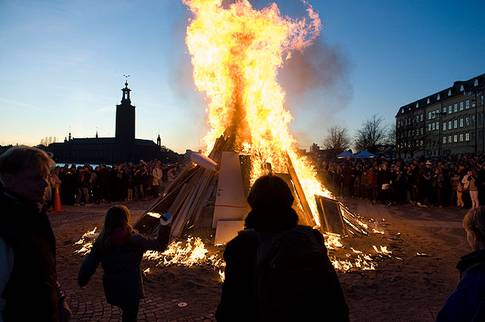
The name ‘Valborg’ is from an English Saint but, despite that, this isn’t really a religious celebration. It’s more to do with the welcoming of spring, and feels rather pagan actually. In the evening on Valborgsmässafton, Swedes gather around huge bonfires and listen to songs. These songs are in the form of traditional choir music designed especially for this occasion to shake off  the nasty dark winter and celebrate the burgeoning buds of the lighter season.

And like many traditions in Sweden, this one also has a rural origin. These bonfires are part of a Swedish tradition dating back to the early 18th century. On this day, farm animals were let out to graze and bonfires lit to scare away predators and other evil beings. This is rather ironic as Walpurgis Eve is also an important holiday in Satanism at it marks the founding of the Church of Satan.

But religion aside. On Walpurgis eve, I am watching the Swedes watching the flames, listening to music and looking forward to the spring and summer months ahead.

We survived another winter, and summer is coming!
Sweden’s Easter Art Drive

konstrundan

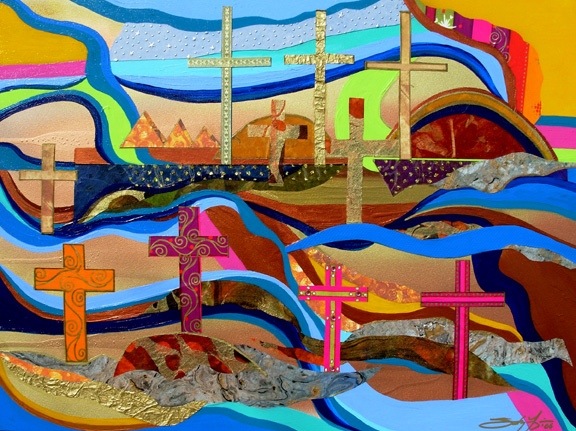
Soon it’s Easter break with 4 lovely days off for most of us. In Sweden, this is a time that many people go out to their country houses or travel abroad to warmer climes. If you’re still in Sweden, and looking for something to do, one suggestion is to head south to the county of Skåne, and the region within Skåne called Österlen. Every year, over Easter, this area hosts an Easter Art Drive, or ‘Open Studios Week’ where you can travel around and get a rare glimpse into the homes and studios of working artists.

This event started in 1968, when a few artists decided to open their studios to the public. Within six years, this had expanded to well over 60 artists welcoming people directly in to their places of work. Most of the artistic fields are represented – sculptors, painters, textile artists, glassblowers, silversmiths, ceramic artists, printmakers, handcraftsmen, wood and computer artists.

It is a fantastic experience. Driving through the beautiful Swedish countryside between villages, wandering amongst the studios built from renovated barns, drinking coffee in the temporarily opened out buildings and hen houses.  The artists themselves are usually there and it is easy to engage in conversation about their work and their inspiration. Everything is for sale, so you can also leave Easter week with a unique and reasonably-priced piece of art under your arm.

For more information, check out http://www.oskg.nu/english

Why do Swedes have a winter sport break? 

Around this time of the year, schools have a week’s holiday. Called Sportlov it’s a traditional time for a winter sport break. 

This tradition was introduced in 1940 and was initially a way to save energy. Heating up schools cost money and, due to rationing, councils were instructed to drastically reduce their heating expenses. To give the pupils something meaningful to do while the school was shut, the authorities organised various activities, many focused on being outdoors and exercising. During the 50’s, experts realised that infection spread less widely at this time of the year if schools were closed for a week. So the winter sport break became cemented and an official disease control method. 

Nowadays, many families head off to the mountains to go skiing, some head off to the Alps for the same purpose.

For those of us left in town, it’s sheer bliss. 

There is hardly anybody on the buses and tube, traffic is significantly thinner and less noisy and it’s easy to get a seat at lunch time. 

And the fact that there are hardly any children in town means the rest of us don’t get infected with kid flu bacteria on our way to work. 

Swedish goats on fire

/home/wpcom/public_html/wp-content/blogs.dir/6dc/32262531/files/2014/12/img_4735.jpg

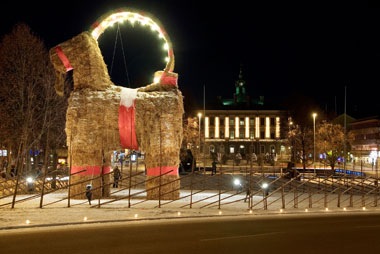
Since the 60’s, in the town of Gävle, north of Stockholm, they have had the Christmas tradition of building a large hay goat in the town centre. Oddly, the goat is a Christmas symbol in Sweden. This ‘Gävle Goat’ has become famous throughout the nation because it has spawned another, less Christmassy tradition. Every year, with few exceptions, the giant goat has been vandalised or set on fire.

This year, guards have successfully intercepted several people during the weeks prior to Christmas who had a mission to set the goat aflame. But it survived! This year, the fortunate goat made it to Christmas Eve without being graffitied, singed or doused in any form of flammable liquid.

But will it make it to 2015? Or will it go up like a New Year’s firework? Well, that cliffhanger will be resolved in a few days.

A literal Swedish Christmas

/home/wpcom/public_html/wp-content/blogs.dir/6dc/32262531/files/2014/12/img_4734.jpg

Swedish is often a very literal language. Today, the 26th December, is a good example of that.

In the UK, today is known as ‘Boxing Day’. In Finland, it’s ‘Stefani Day’. In Ireland it’s ‘Wren’s Day’. In South Africa, it’s the ‘Day of Goodwill’.

And in Sweden? Well, here comes the literalness.

It’s called ‘Second Christmas Day’.

Afton – Swedes’ favourite celebration

20140419-235128.jpg

In the UK, we celebrate ‘Days’ such as Christmas Day & Easter Day. But in Sweden, it is always the Eve ( ‘afton’) that is the big celebration time. There’s Julafton, Påskafton, Valborgsmässoafton, Midsommarafton, nyårsafton, trettondagsafton. Why is this? Anyone know? Cos I’ve always wondered. Surely it can’t just be to get an extra day’s holiday?

Swedish Long Friday, English Good Friday

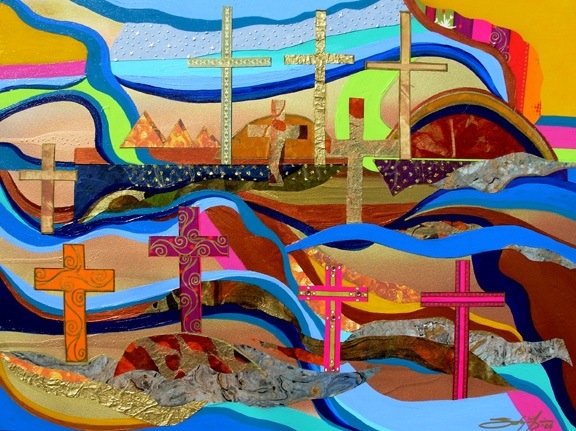
Today is Long Friday in Sweden, Good Friday in English-speaking countries. If you hold to the Christian belief, it’s the day Jesus was crucified on Golgata, outside of Jerusalem.

Why the differences in names for this day? In English-speaking countries, there are differences of opinions as to why it’s called Good Friday. Some people claim Good is an old English word meaning Holy – so Holy Friday. Others say it’s a development of the word God. And other theories say it is good because it is the day Jesus, dying on his cross, was victorious over sin, death and the devil and took upon him all the sins of Mankind. Heavy stuff.

In Sweden, it is called Long Friday as it was said to be a day of mourning for the long day of suffering that Jesus endured will being crucified.

In Sweden, as in the UK, today is a public holiday, people don’t need to dress in black anymore and all the shops and places of entertainment are open. Some people go to church, some paint eggs and decorate Easter trees, some prepare food for Easter Saturday.

I think it’s interesting to know the origins of our traditions. Often these origins are long forgotten. But understanding the history helps put things into perspective as we celebrate in the way we prefer, traditions that have been followed for centuries before and centuries to come.

20140418-082902.jpg

20140418-085041.jpg

Pink Thursday?

20140417-074309.jpg

Today is ‘Skärtorsdag’, or Maundy Thursday in English. In Sweden it’s celebrated by children dressing up as witches. This tradition originates from the belief centuries ago that tonight was the witches night, where witches would make their journey to Blåkulle – the Blue Mountain. It was a night of danger and evil, and Swedish people would bar their doors to their houses and barns and leave outside gifts that would make the witches’ journey easier – food, milk, clothes, broomsticks. Today, Swedes give the children sweets and money.

But why is it called Skärtorsdag’? The word ‘skär’ means ‘pink’. But does that make today Pink Thursday?

Actually not.

The word ‘skär’ has another, pre-Nordic meaning that is more relevant – ‘clean’.

If you know your bible stories, today being the day before Good Friday is the day when Jesus gathered his disciples together for the last supper, introduced communion, and was later betrayed by Judas, and condemned to death on the cross. It is the day evil was said to be released – hence the witches described earlier in this text.

Prior to the last supper, Jesus washed the feet of the disciples. And he washed them clean – a symbolic metaphor for purification and the washing away of sin.

So, today isn’t Pink Thursday – it’s Clean Thursday.

I’d better start mopping the kitchen floor then.

Happy Swedish Names Day

Nils

October 8th was my Name’s Day. Well, not quite….but almost. It was Nils. And since I’m called Neil, well, I take Nils as my day.

Some of you might be wondering what the hell I’m talking about. What is a ‘Name’s Day’? Well, it’s like this. In Sweden, every day has a name, sometimes two. And if your name happens to be represented in this way in the calender, then you can celebrate your day. Strange? Maybe. Unusual? Not really.

A Name’s Day is actually a tradition in lots of countries such as Bulgaria, Croatia and Ukraine. According to Wiki, the custom originated with the Christian calendar of saints: believers named after a saint would celebrate that saint’s feast day. In Sweden, however, there is no longer any explicit connection to Christianity. It’s been a tradition since the Middle Ages and started because the church wanted the people to celebrate Name’s Days instead of birthdays which they viewed as a pagan tradition.

There are different lists though some names are celebrated on the same day in many countries. In 1901 a comprehensive modernization was made in Sweden to make the list up to date with current names. This also happened in Finland, but not in other countries.

But Name’s Days are not without their controversy. The monopoly on calenders, held by the Royal Swedish Academy of Sciences, expired in 1972 and so did the official name day list. And then all hell broke loose. Competing lists emerged and finally in 1986 a new list with three names on each day was designed to create harmony in the Name’s Day chaos. But people weren’t happy. Seven years later, this list was revised and reduced to two names per day. But Swedes were still dissatisfied with this and the Swedish Academy produced a new two-name list which was finally accepted and brought into use in 2001. Although it does not have the official status of older lists, it is now universally used in Sweden. One alternative calender, however, is the Diversity Calender which appoints each day with a more diverse selection of names. For example, on that calender, today is the Finnish name Veli.

How this tradition arrived in Sweden is unclear. Maybe it was imported by foreign religious leaders or merchants, or maybe it’s to do with the fact that the Swedish Protestant Church retains some traditions similar to the Catholic. Whatever the origin, it’s a reason to celebrate. And Swedes love to celebrate!

So, come on Hedvig and Hillevi, today’s your day! Happy Name’s Day to you!!

If you’d like to check out if you’re privileged to have a Name’s Day go to www.dagensnamnsdag.nu

Santa Lucia – the Swedish festival of light

Lucia
Lucia December 13

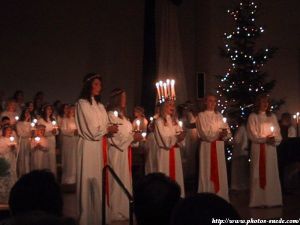
Today is Lucia Day and this is a beautiful day in which Swedes celebrate Saint Lucia who brings the light to all the dark places. It is especially beautiful and atmospheric to witness a Lucia procession at this dark time of year. Lucia herself wears candles in her hair as she leads her maidens and followers around the town streets and in churches. But where does the whole thing come from? Why do Swedes celebrate a Sicilian saint? Agneta Lilja from Södertörn University College gives us a retrospective:

‘The Lucia tradition can be traced back both to St Lucia of Syracuse, a martyr who died in 304, and to the Swedish legend of Lucia as Adam’s first wife. It is said that she consorted with the Devil and that her children were invisible infernals. Thus the name may be associated with both lux (light) and Lucifer (Satan), and its origins are difficult to determine. The present custom appears to be a blend of traditions. In the old almanac, Lucia Night was the longest of the year. It was a dangerous night when supernatural beings were abroad and all animals could speak. By morning, the livestock needed extra feed. People, too, needed extra nourishment and were urged to eat seven or nine hearty breakfasts. This kind of feasting presaged the Christmas fast, which began on Lucia Day. The last person to rise that morning was nicknamed ‘Lusse the Louse’ and often given a playful beating round the legs with birch twigs. The slaughtering and threshing were supposed to be over by Lucia and the sheds to be filled with food in preparation for Christmas. In agrarian Sweden, young people used to dress up as Lucia figures (lussegubbar) that night and wander from house to house singing songs and scrounging for food and schnapps.

The first recorded appearance of a white-clad Lucia in Sweden was in a country house in 1764. The custom did not become universally popular in Swedish society until the 20th century, when schools and local associations in particular began promoting it. The old lussegubbar custom virtually disappeared with urban migration, and white-clad Lucias with their singing processions were considered a more acceptable, controlled form of celebration than the youthful carousals of the past. Stockholm proclaimed its first Lucia in 1927. The custom whereby Lucia serves coffee and buns (lussekatter) dates back to the 1880s, although the buns were around long before that.’