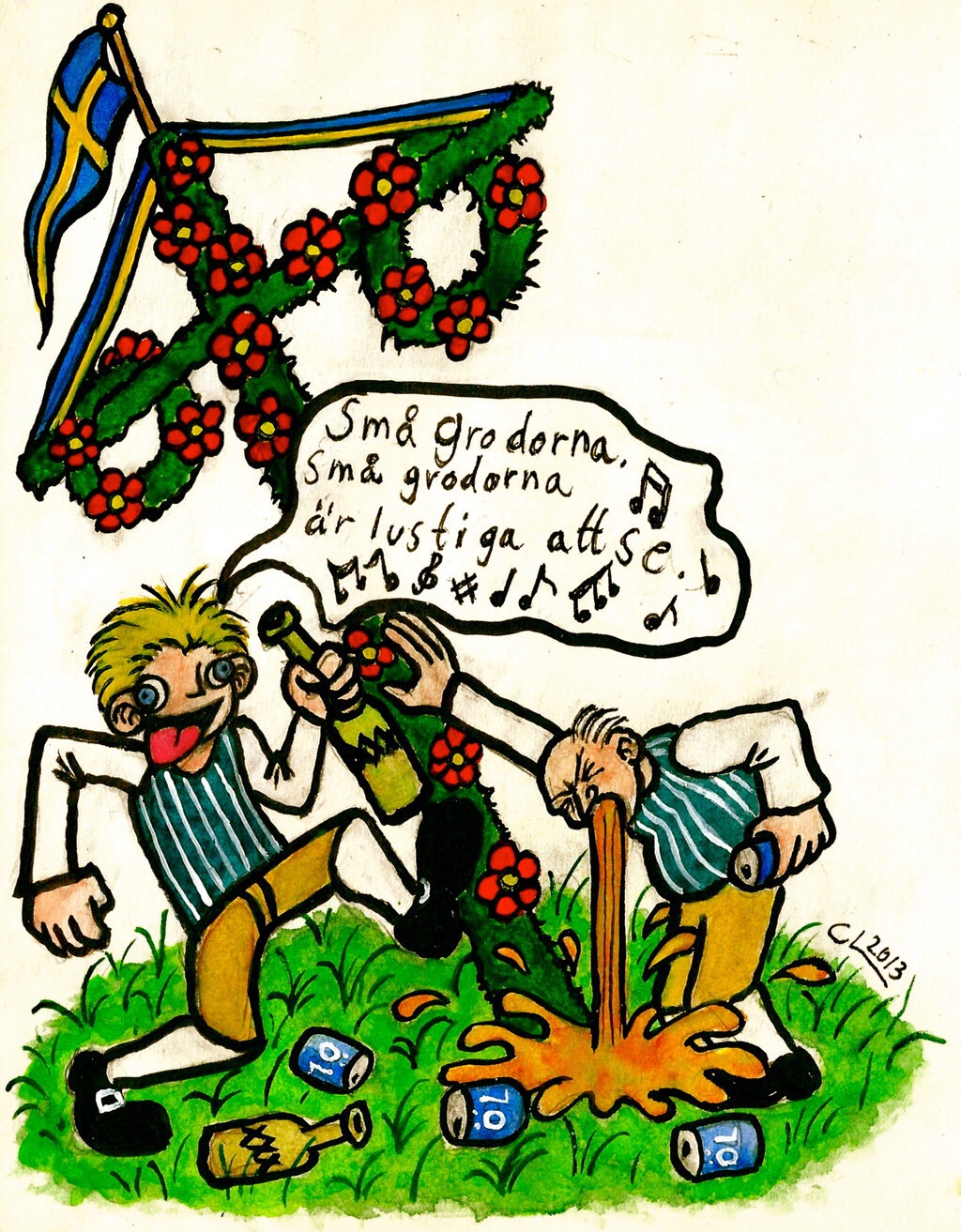
11 hacks for surviving Swedish midsummer

With Midsummer arriving on Friday, it is time to start planning for your survival. Midsummer’s Eve is the craziest custom in the Swedish calender and the time of the year when Swedes go a little bonkers. As a non-Swede, get ready to brace yourself. Here are a few hacks to make sure you make it to Midsummer’s Day in one piece.

Greet like a Swede. In Sweden it is considered polite to greet everybody individually, even if you plan to never speak to them again or remember their name. The appropriate way is to stand 1-2 meters away, look directly in their eyes, say ‘hej’ followed by your name. They will do the same. You might even give a small wave or shake hands if you are comfortable doing so (remnant of the pandemic). If you are feeling adventurous, follow up your ‘Hej’ with a ‘trevligt’ or even a ‘Glad Midsommar’. Job done. Now you can hit the booze.

Snaps is not the same as a shot. A lot of alcohol gets drunk on Midsummer’s Eve, especially beer and snaps With the popularity of shots in recent years, it’s easy to make the mistake that Swedish snaps is the same thing. Believe me, it is not. Snaps can be up to 42% alcohol, considerably more than your normal shot. So, go easy and sip the snaps or see yourself slipping sideways off your chair before the strawberry dessert has even been put on the table.

Take tissue. Midsummer’s Eve is a looong day and you probably will need the loo at some point. The trouble is, so will everybody else – to the detriment of the supply of toilet paper. There’s a big chance you will be seeking relief in the woods so come equipped with the appropriate amounts of paper for your needs.

If shy, bring swimwear. Bathing in the icy June waters is a common activity at Midsummer. Swedes generally are not afraid of skinny dipping when they do this. If you are, then come prepared with swimwear and a towel.

Shelve your maturity. Part of Midsummer is dancing around the maypole, playing silly games, pretending to be a frog, participating in competitions. To survive these activities, it helps to conjour up your inner child and forget you are an adult for a while.

Protect yourself. Given the amount of alcohol consumed at Midsummer, it is no surprise that many babies in Sweden are made on this day. It you don’t want to join the ranks of parents, remember to put it on before you put it in.

Throw in the thermals. It looks like it might be super sunny and warm this Midsummer’s Eve. But it is good to be prepared. It is not unusual that temperatures fall into single figures and that pesky rain pours down onto the smorgasbord. So bring a jumper, a rain jacket and even thermals to enhance your experience.

Don’t expect culinary miracles on Midsummer’s Eve. The food is exactly the same as is eaten at Christmas and Easter, with a few small summery exceptions – strawberries, cream, dill and new potatoes. Remember to use hand disinfectant before you attack the buffet.

Learn a drinking song. On Midsummer’s Eve, food and alcohol is accompanied by Swedish drinking songs. Learn one in advance and shine at the table. Even better sing one in your own language and you are guaranteed to use those rubbers you packed just for the occasion. For me, ‘what shall we do with the drunken sailor’ works every time.

Argue over the rules. At Midsummer a popular Swedish garden game is called kubb. Involving the throwing of sticks, everybody seems to have their own understanding of the way to play. If you want to feel really Swedish, make sure you start an argument about the rules.

Take pills. Of varying types. Allergy pills are good because there are flowers everywhere: on the table, in the maypole, on peoples’ heads. Pain killers are good as a lot of snaps is consumed. Indigestion pills are good as the food is oily, fatty, acidic, smoky and rich. The after day pill is good, well… because…

That’s it! Follow this guide and you are sure to have a wonderous Midsummer’s Eve in Sweden.

Glad Midsommar!

Please share this post to help others get ready for the big day!
11 hacks for surviving Swedish midsummer

With Midsummer arriving on Friday, it is time to start planning for your survival. Midsummer’s Eve is the craziest custom in the Swedish calender and the time of the year when Swedes go a little bonkers. As a non-Swede, get ready to brace yourself. Here are a few hacks to make sure you make it to Midsummer’s Day in one piece.

Greet like a Swede. In Sweden it is considered polite to greet everybody individually, even if you plan to never speak to them again or remember their name. The appropriate way is to stand 1-2 meters away, look directly in their eyes, say ‘hej’ followed by your name. They will do the same. You might even give a small wave or shake hands if you are comfortable doing so. If you are feeling adventurous, follow up your ‘Hej’ with a ‘trevligt’ or even a ‘Glad Midsommar’. Job done. Now you can hit the booze.

Snaps is not the same as a shot. A lot of alcohol gets drunk on Midsummer’s Eve, especially beer and snaps With the popularity of shots in recent years, it’s easy to make the mistake that Swedish snaps is the same thing. Believe me, it is not. Snaps can be up to 40% proof, considerably more than your normal shot. So, go easy and sip the snaps or see yourself slipping sideways off your chair before the strawberry dessert has even been put on the table.

Take tissue. Midsummer’s Eve is a looong day and you probably will need the loo at some point. The trouble is, so will everybody else – to the detriment of the supply of toilet paper. There’s a big chance you will be seeking relief in the woods so come equipped with the appropriate amounts of paper for your needs.

If shy, bring swimwear. Bathing in the icy June waters is a common activity at Midsummer. Swedes generally are not afraid of skinny dipping when they do this. If you are, then come prepared with swimwear and a towel.

Shelve your maturity. Part of Midsummer is dancing around the maypole, playing silly games, pretending to be a frog, participating in competitions. To survive these activities, it helps to conjour up your inner child and forget you are an adult for a while.

Protect yourself. Given the amount of alcohol consumed at Midsummer, it is no surprise that the many babies in Sweden are made on this day. It you don’t want to join the ranks of parents, remember to put it on before you put it in.

Throw in the thermals. It looks like it might be super sunny and warm this Midsummer’s Eve. One of the warmest ever! But it is good to be prepared. It is not unusual that temperatures fall into single figures and that pesky rain pours down onto the smorgasbord. So bring a jumper, a rain jacket and even thermals to enhance your experience.

Don’t expect culinary miracles on Midsummer’s Eve. The food is exactly the same as is eaten at Christmas and Easter, with a few small summery exceptions – strawberries, cream, dill and new potatoes. Remember to use hand disinfectant before you attack the buffet.

Learn a drinking song. On Midsummer’s Eve, food and alcohol is accompanied by Swedish drinking songs. Learn one in advance and shine at the table. Even better sing one in your own language and you are guaranteed to use those rubbers you packed just for the occasion. For me, ‘what shall we do with the drunken sailor’ works every time.

Argue over the rules. At Midsummer a popular Swedish garden game is called kubb. Involving the throwing of sticks, everybody seems to have their own understanding of the way to play. If you want to feel really Swedish, make sure you start an argument about the rules.

Take pills. Of varying types. Allergy pills are good because there are flowers everywhere: on the table, in the maypole, on peoples’ heads. Pain killers are good as a lot of snaps is consumed. Indigestion pills are good as the food is oily, fatty, acidic, smoky and rich. The after day pill is good, well… because…

That’s it! Follow this guide and you are sure to have a wonderous Midsummer’s Eve in Sweden.

Glad Midsommar!

Please share this post to help others get ready for the big day!
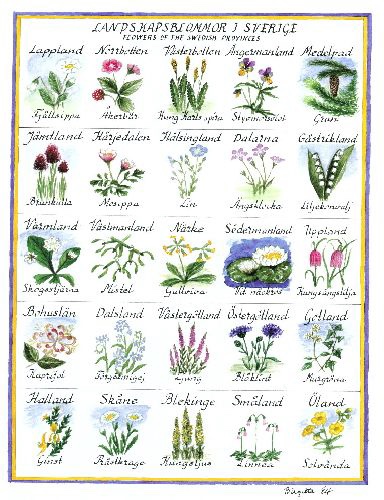
Swedish Province flowers

Since 1908, each of Sweden’s 25 provinces (landskap) has its own animal, coat of arms, flag and flower to define its identity.

Stockholm, for example, is on the border of two provinces – Uppland and Södermanland. The flower of Uppland is the beautiful ‘kungsängslilja’ (snake’s head fritillary). Södermanland has the floating ‘vit näkros’ (white water lily).

Other official provincial flowers include heather, daisy, honeysuckle, forget-me-not, lily of the valley, cowslip and, interestingly in Blekinge, they have the English oak.

Some provinces have been in disagreement for over 100 years on which flower to settle on – so they have two. To see the full list, go to the following link: http://www.ugglemor1.se/Hembygd/sweden-flowers.htm or https://swedesinthestates.com/swedens-provincial-flowers/

In 2021, Sweden’s new national flower was chosen in a public vote. The winner? The colourful and ubiquitous harebell, also known as the small bluebell (in Swedish Blåklocka’.)

I’m from County Durham in the UK, where we have the vivid spring gentian as our county flower. The UK national flower is, since the 1400’s, the Tudor rose.

What’s the national or provincial/county flower where you come from?

Swedish students truck off


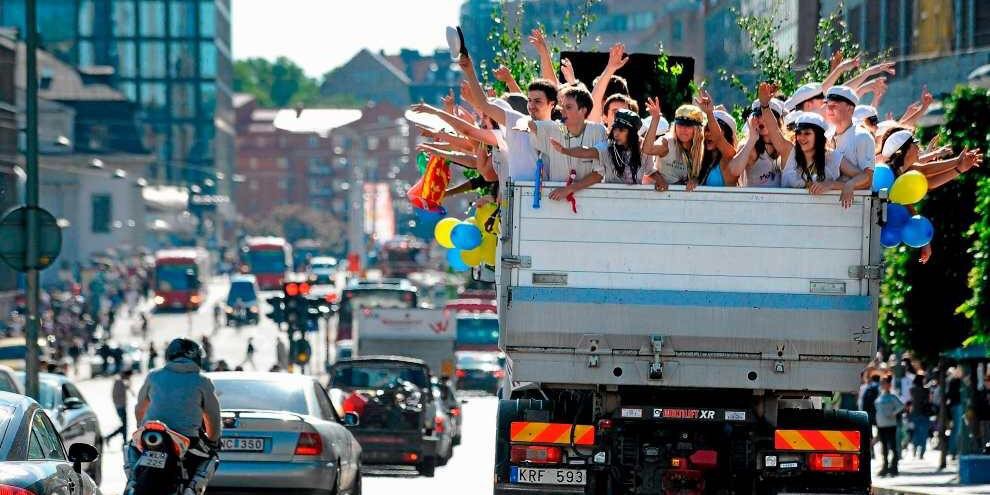
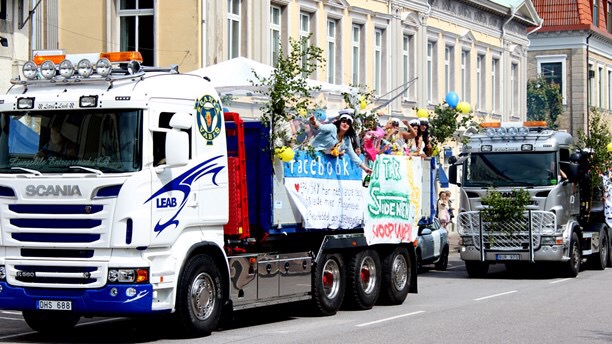
This time of the year, a common sight and sound on the streets of Sweden is students on trucks.

Dressed in traditional white caps, and bolstered with alcohol, the students jump up and down to the booming music from loud speakers concealed in the vehicle. They scream, sing and shout and, if it’s a hot day like today, they spray beer on each other and sometimes unsuspecting pedestrians.

Many of them have banners hanging on the side of the trucks. Usually these are just informative but sometimes they’re personal, political or funny.

These youngsters are celebrating the end of their school career. Most of them are 19 years old and have just graduated from Sixth Form College/High School. In fact, I was just this morning watching my goddaughter as she ran out of her school screaming and dancing, before jumping onto her truck.

It’s not all fun and games though. Every year the media reports accidents and injuries, which is not entirely unexpected considering the mad energy with which the students jump and scream. And trucks have been banned from certain roads and areas in the towns. 

In Sweden, doing ‘studenten’, as it’s called in Swedish, is a major rite of passage into adult life. The youngsters finish their last day at school, come running out of the building to be greeted by waiting parents and families. They then climb aboard their trucks for their lap of honour. After that they go around to each other’s homes where each family usually arranges a reception to honour the newly-graduated student. 

It is a very common sight on the streets of Sweden this time of the year and a refreshing reminder of the hopefulness of youth. 

A friendly conflict between Sweden and Finland

Neighbouring countries Sweden and Finland have entered into a friendly conflict. The subject? The Eurovision Song Contest.

On Saturday, artist Loreen took home the win for Sweden, just ahead of Finland. And the Finns weren’t happy, many of them saying the competition was fixed.

Now, when the televoting statistics have been released, it has become known that Finland was the only country to give Sweden zero points in the public vote. This is weird as the Finnish jury had awarded Sweden the maximum 12 points, and the song Tattoo is currently number 1 on the Finnish chart. One can wonder who was responsible for an attempt at fixing?

It has also come out that the Finnish tv commentator encouraged citizens to vote tactically in a message, something that viewers clearly did.

The issue isn’t an important one, however it is funny to observe as tensions rise between the two Nordic neighbours. It’ll probably run out in the sand, but will be interesting to see how Sweden enacts it’s revenge next year.

The Swedish Hour of the Wolf

In Swedish, there is a term ‘vargtimmen’, which translates as hour of the wolf. It is used to specifically describe the time between 03.00-04.00

Although it sounds like an ancient concept, it was actually coined by Swedish film director Ingemar Bergman in his 1968 film of the same name. Or so he claimed. He describes the ‘vargtimmen’ in the following way:

The hour of the wolf is the hour between night and dawn. It is the hour when most people die, when sleep is the deepest and nightmares the most vivid. It is the hour when insomniacs are hunted by their worst anxieties, when ghosts and demons are at their most powerful. The hour of the wolf is also the hour when most babies are born’.

Other academics believe the concept existed earlier than Bergman’s time, and that it refers to the fact that farmers would get up in the night to protect their wild stock from hunting wolves.

Whatever the origin, the ‘hour of the wolf’ has a definite mystical and almost terrifying implication. When was the last time you lay awake at 03.00 am and chased your demons?

Why is May 1st celebrated in Sweden?

In Sweden, and in many other countries, May 1st has been embraced as the International Workers’ Day. In 1938, May 1st became Sweden’s first non-religious public holiday and has been an important celebration of labourers and the working classes since then.

But why specifically May 1st?

The answer is found in a massacre in the USA. On 1 May 1886, laborers in Chicago went out on strike for an 8 hour working day. On 4 May 1886, Chicago police and the demonstrators clashed and 11 people died.

The event is called the Haymarket massacre. Seven of the demonstrators were sentenced to death, despite lack of evidence. To commemorate the massacre, the socialist organization suggested that 1 May should become day of demonstrations every year around the world.

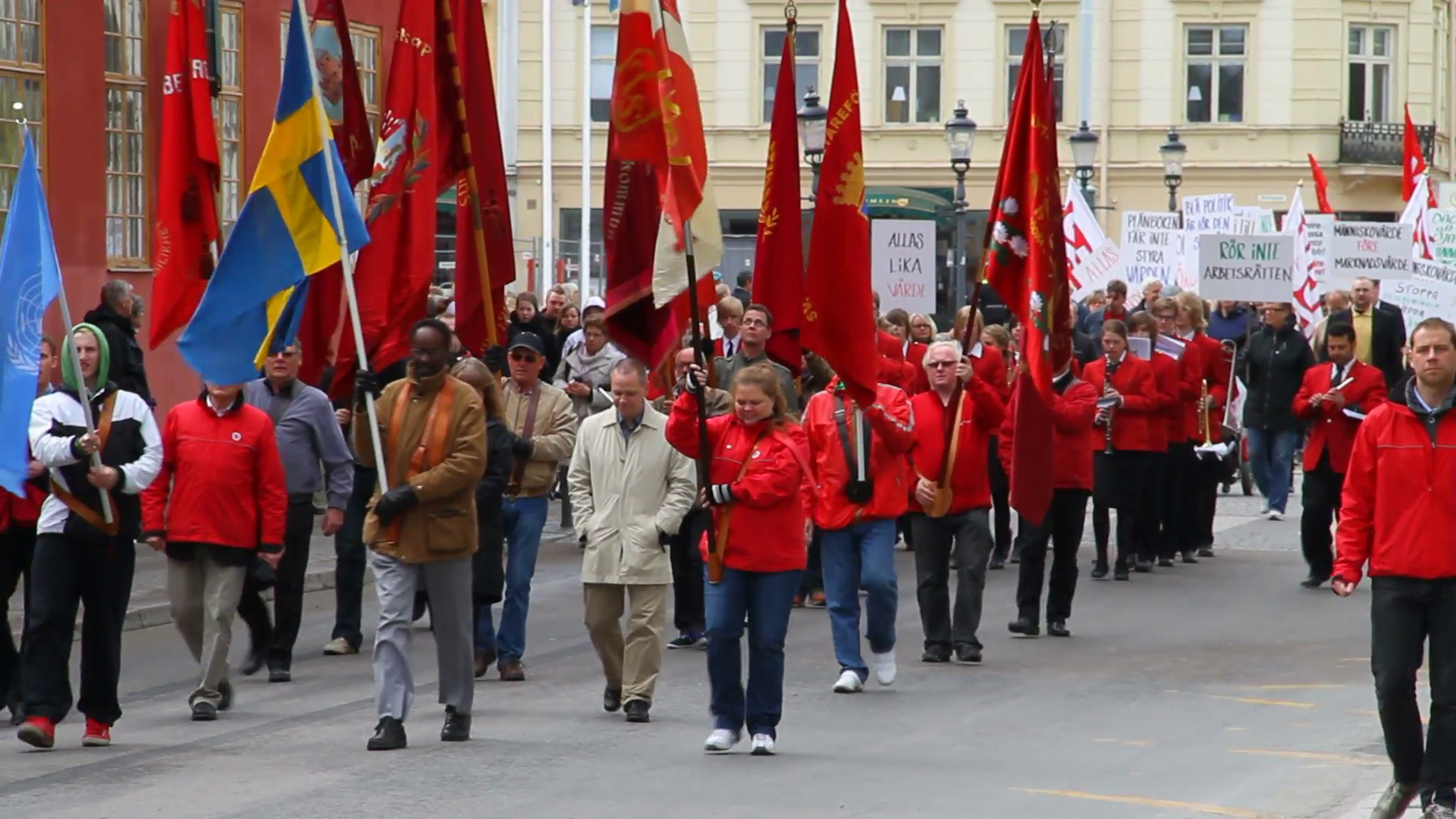
In Sweden, traffic is shut off, huge flag-waving demonstrations are held and people gather to hear speeches from their politicians and representatives.

The demonstrations represent people from various parties. However, since most of them are from the political left, the streets are awash with bright red flags and banners.

Contrary to the stereotype, not everybody in Sweden supports left wing political groups. There are 8 political parties, of which only 2 have a self-proclaimed left-orientation. If you ask a Swede if they are demonstrating, you will either get a ‘yes, of course!’, or as I got yesterday when I asked someone, ‘Hell no! I’m not red!

This means that for many Swedes, today is just a day off work – an opportunity to perhaps nurse a hangover from the festivities of the previous evening or to relax, go for a walk and enjoy the day.

Walpurgis Eve – when spring arrives in Sweden

Today, 30 April, is Walpurgis Eve, called Valborgsmässoafton in Swedish, or ‘Valborg’ for short. The name Walpurgis is taken from the eighth-century Saint Walburga, and in Sweden this day marks the arrival of spring.

In a cold, dark country like Sweden, residents have suffered through a long, miserable winter. So it is no surprise that the arrival of spring is an occasion to mark. On the evening of Valborg, Swedes usually gather to celebrate together.

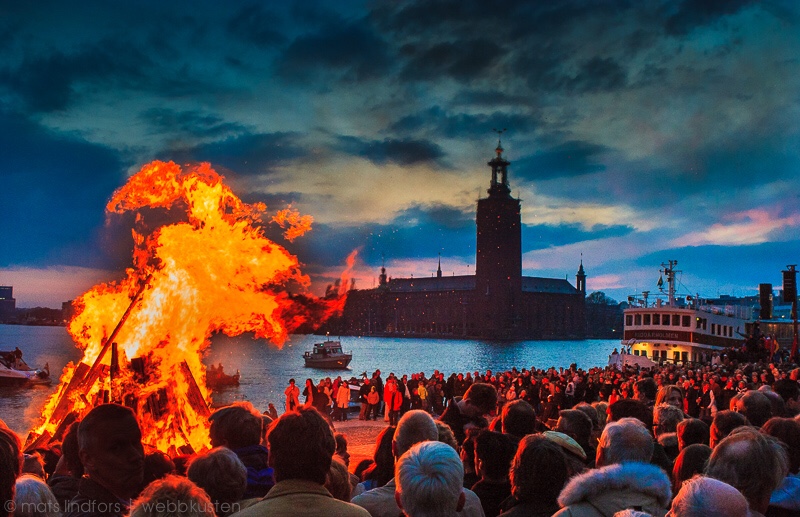
The forms of celebration vary in different parts of the country and between different cities. However, essential celebrations include lighting a large bonfire, listing to choirs singing traditional spring songs and a speech to honour the arrival of the spring season. Some of the traditional spring songs are titled ‘Beautiful May – Welcome!’ and ‘Longing for the countryside – winter rushes out’. You can see a clip below.

Walpurgis bonfires are an impressive thing to see and are part of a Swedish tradition dating back to the early 18th century. At Walpurgis, cattle was put out to graze and bonfires lit to scare away predators.

The weather is often unpredictable on Walpurgis Eve. It can be sunny and warmish, or it can still snow on 30 April! Today looks like it’ll be a cold one.

Despite bad weather, Swedes still shiver around the bonfires and ironically celebrate the arrival of Spring.

April, April! You stupid herring!

april-fools-day-2015

Playing April Fool’s jokes on each other on the first of April is a tradition in many countries – Sweden included. In fact it is an old tradition – the oldest written reference being in 1392 in Chaucer’s ‘The Cantebury Tales’.

In Sweden, when someone is tricked, the tradition is to say ‘April, April din dumma sill!‘. This translates as ‘April, April you stupid herring!’. This is however not as weird as it might sound. In many countries, such as Italy, France and Holland, April 1st is known as “April fish”. On this day, people try to attach paper fish onto the backs of their victims.

April Fool’s pranks are common in newspapers, with classics such as:

  • IKEA is getting into the airline business. Furnishing all the flights with Ikea furniture, the name of the airline is FLYKEA.
  • Swedish supermarket chain ICA introduced toothpaste with the taste of chocolate. It might be brown, but it makes your teeth white.
  • Burger King introduced a new burger for left-handed people where ingredients were rotated 180 degrees.

I had a look this morning to see if I could identify any April Fools tricks and I found one! The tower of Stockholm’s City Hall was apparently flown in from the far east under a blimp. This is a nod to the new Golden Bridge in Stockholm that was manufactured and shipped in one huge piece from China.

If you manage to find another one, please share here!


Sweden crowns their melody Queen

Last night, the final of Sweden’s ‘Melodifestivalen’ took place. The winner gets sent to the Eurovision Song Contest in Liverpool in May. Many Swedes take this competition very seriously – the process of selection takes 6 weeks!

But finally, last night, the victor was crowned. The winner this year was Loreen – again. Loreen won Eurovision Song Contest in 2012 for Sweden with the fantastic song Euphoria.

After two failed attempts, she finally gets to once again represent Sweden 2023 with the song Tattoo. The song, along with her performance and the tv production is a very strong contender to take home the victory. Many Swedes are already feeling triumphant. But Eurovision is often an unpredictable animal – since musical taste levels between the competing countries vary drastically. What is popular in the Nordic countries is usually not as popular in, for example, the Balkans.

So the question remains, will Loreen deliver Sweden’s 7th victory and thereby equal the record for most victories currently held by Ireland?

On May 13, we will find out.

You can catch the song and her performance below: