A crucial night for Sweden

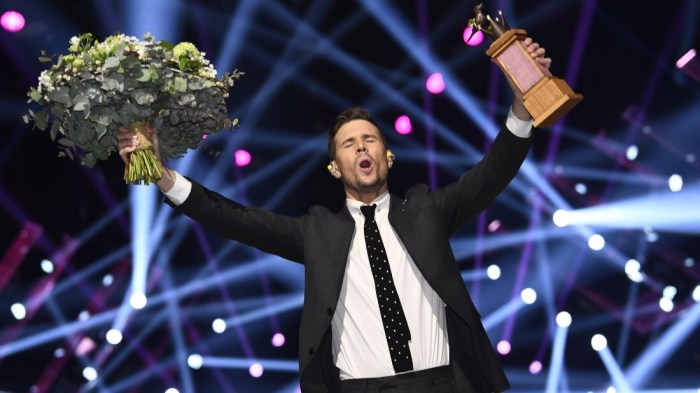
Tonight is the end of a gruelling six weeks. Tonight an important decision is made in Sweden – a crucial decision some might say. Tonight, millions of Swedes gather together to jointly arrive at their conclusion. From North to South, East to West, amongst mountains, by lakes, on islands and in cities, Swedes crowd around their TVs to watch the biggest show broadcasted in the country. This is bigger than royal weddings, political funerals or sporting events. This is huge. Tonight, Swedes decide who should represent them in this year’s Eurovision Contest.

Choosing a representative takes 6 weeks in Sweden. 5 weeks of semi finals, a second chance competition and then the final. It’s a combination of tradition and torture.

But tonight it is all over and Saturday evenings are finally released for other entertainment. In a puff of glitter, the winner is chosen by public vote and jury and then it is all over. Apart, that is, from the after party, the post analysis and the pre programs for the approaching Eurovision Contest in May.

Sweden might be a county of moderation, but Eurovision is a major exception. If anything’s worth doing, apparently it’s worth doing properly. By dragging it out. And out. And out.

Demolishing Swedish treats

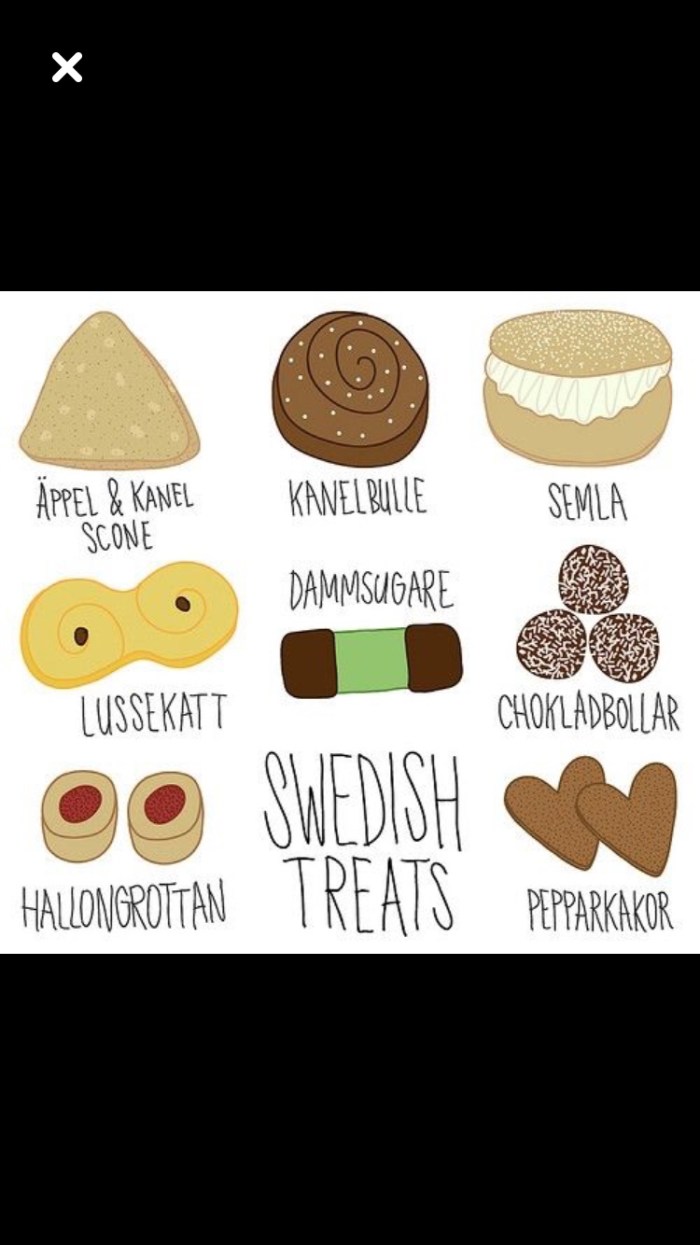
Many Swedes love to ‘fika’ – the tradition of drinking coffee and eating a cake. So much so that somebody decided to create the graphic above about popular Swedish treats. While the drawing is nice, the picture rather shows the meagreness of a Swede’s cake options. What then are some of the terrible choices depicted?

In a previous blog I’ve talked about the creamy bun known as semla, which I happen to think is delicious. In my opinion the semla is the best of them all. It is the king of Swedish treats reigning large over the other, to be honest, rather underwhelming alternatives.

The apple and cinnamon scone – as a British person I would not call this a scone. I don’t know what it is. Some kind of triangular bit of plaster. So, no further comment.

Probably the most popular dry-as-a-bone pastry associated with Sweden is the ‘kanelbulle’ or the cinnamon bun. Sold predictably in every bakery and cafe in Sweden and in their millions at Ikea, the cinnamon bun is only redeemed when drenched in melted, oozing butter.

Then there’s the ‘lussekatt’ – a disgusting saffron bun baked and sold in December. If you like bland, yellow bakes that give you indigestion for hours then this is the one for you.

The ‘dammsugare’ – or vacuum cleaner – is a marzipan roll dipped in chocolate. They can contain a bit of Swedish liqueur ‘punsch’ to take the edge off their otherwise plasticky taste. Altogether pointless and unsatisfying.

‘Chokladboll’ or chocolate ball is a linguistically dubious treat. Traditionally given a racist title, they are basically cocoa balls rolled in coconut. An unpleasant eating experience, these balls tend to ‘grow in your mouth’ as they say in Swedish….

‘Hallongrotta’, literally means raspberry cave. These are vanilla biscuits filled with raspberry jam that melt in the mouth. Unless they’re rock hard. They are a traditional biscuit which seem to evoke memories of grandmas and hot kitchens for many Swedes.

‘Pepparkakor’ are crisp gingerbread biscuits eaten around Christmas time. A ubiquitous classic eaten with Swedish mulled wine – ‘glögg’. They are a must during the festive season in homes, offices and often served covered in bacteria in shops. They come in many sizes and shapes, such as love-hearts, stars, people and goats. Yes, you read that correctly – goats.

So none of the above have a patch on the creamy, gooey, airy, almondy delight that is the semla. I know what I’m ordering with my coffee!

Any other Swedish treats that you think rival the almighty semla?

How Aslan led to Sweden – a personal story of a Swedish odysse

A long-time friend of mine recently wrote a post on Facebook, instigated by the recent school shooting in her home country, USA. In her post, she writes her personal story about her 30 year experience of living in Sweden. With her permission, I am publishing it here. Please read it, I think it sums up the way a lot of people who move to Sweden feel. Here it is:

‘For anyone who might be interested, I would like to share a milestone in my life.

30 years ago this week, I took the adventure that Aslan gave me. (If you’ve read ‘The Narnia Chronicles’, you understand that reference.) I packed up my clothes and few belongings, waved a tearful goodbye to my parents at Dulles International Airport in Washington and moved to Sweden. I knew that the love of my life lived there, and that was most important, but I didn’t know much else. I had NO IDEA how the trajectory of my life would change.

Among the things I have experienced in Sweden are the following:

* An AMAZING Swedish family which took me in, accepted me with all of my weird American quirks and loved/loves me like my own family. They ARE my own family now. Along the way, my Mother-in-law and older sister-in-law were instrumental in helping me learn Swedish. Their patience was infinite. My younger sister-in-law, Marina, has become one of my closest friends, but, she talked so fast, I couldn’t understand a word she said. Sometimes, I still don’t. đŸ˜‚â€ïž

* A society, while not being perfect, holds 2 particular values to be self-evident:

1. We have a responsibility to those who are less fortunate and that responsibility should be incorporated into government policy.

2. Women and men are equal.

* A year of paid maternity leave with each child.

* Unparalleled care through 5! major surgeries, NONE of which I had to pay for.

* A school system which treats me like a professional and gives me a great deal of freedom as to what and how I teach my students in order to reach curriculum goals.

* AMAZING colleagues from a plethora of nations, cultures and languages who are passionate about our students and who are a daily reminder to me of the common humanity of every person on the planet.

* I NEVER have to worry about a gunman in my school. 😔

Forrest Gump said, “Life is like a box of chocolates. You never know what you’re going to get.” So far, I’ve gotten a box of ALL of my favorite kinds. Who knew on that cold Sunday in February of 1988 when my parents hugged me goodbye.

Thanks for reading’. ❀

The worst day in Sweden

Tomorrow, the 24th January, could arguably be the worst day of the year in Sweden. Dark, miserable, cold and poor.

The month of January is notoriously an impoverished month, following the financial excesses of December. Many people struggle through January with their evenings in front of the telly, their long walks at the weekends and their packed lunches at the office. And as the 24th arrives, this deprivation reaches its pinnacle.

You see, most Swedes are paid on the 25th of the month. New, fresh crowns rattle into bank accounts up and down the country. Pubs and restaurants fill up and Ikea is like rush hour in Piccadilly Circus as the consumerism treadmill grinds into action.

But not tomorrow. Tomorrow, the 24th January, sucks. And as we put our leftovers into the fridge to be eaten for lunch, we can be happy that this misery is soon over. On Thursday, we can drink a latte, buy an expensive lunchtime sour dough toast, and knock back a few gin and tonics after work. And maybe, just maybe, be a little less provoked by the sunny holiday pictures on social media.

So hold on, there is light at the end of this long, dark tunnel.

Sweden’s ’Oxe weeks’

I heard on the radio today that somebody felt ‘helgtrött’ – suffering from ‘ weekend exhaustion’. Just as well then that today starts a long work period with no public holidays. After the extended Christmas, New Year and Epiphany break, there isn’t another break until Easter on 30 March 2018. That’s almost 12 weeks!

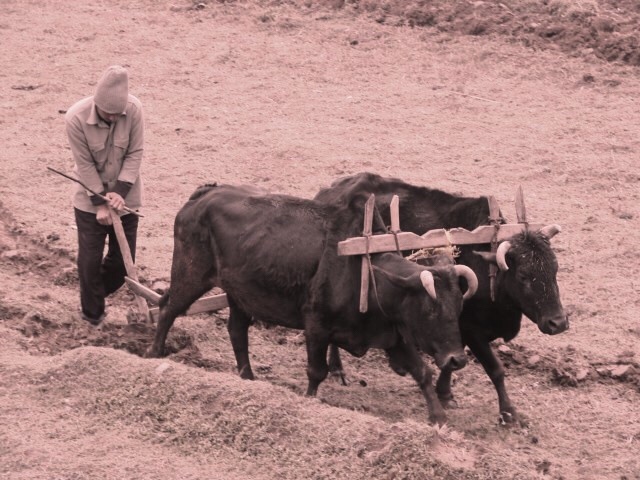
Many Swedes think that this is dreadful and have coined the phrase ‘oxveckorna’ which literally means oxe weeks. Now begins the period of working as hard as an oxe!

Swedish Music Aid

Children are not for sale!

Did you know that every minute, 4 children are sold into the sex industry around the world? An estimated 2,000,000 children are victims of sex trade and many more in human trafficking. These figures are hard to grasp, and even harder to process. Sexual trading of children can involve local boys who are abused by tourists, impoverished girls who are sold as sex slaves to rich families, or children who are ordered like fast food on the internet. The actions of the perpetrators are ruthless and the list of assaults is endless.

But we can do something about it.

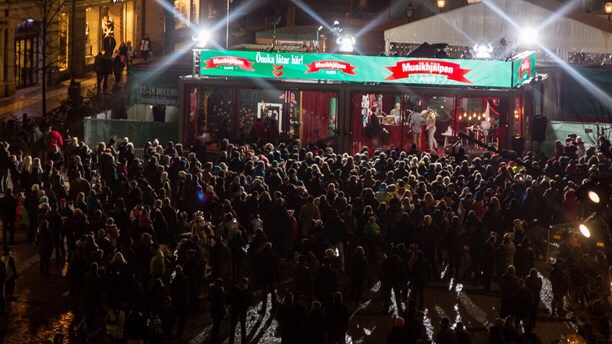
‘Children are not for sale’ is the theme of this year’s charitable Music Aid (MusikhjĂ€lpen) project in Sweden. For the tenth year in a row, three radio hosts are locked into a glass cube for 6 days on a square in a town somewhere in Sweden. This year the event takes places in the northern city of UmeĂ„, and the hosts broadcast music and tv non-stop day and night to gather donations for their good cause. To raise money one can, amongst other things, request a song, carry out a fund-raising action and bid in the various auctions that take place. This is Swedish solidarity at its very best.

Today, 17 Dec, is their final day of incarceration – the hosts are let out of their glass cube this evening and the total amount that has been raised will be announced. The millions of crowns that they gather will be spent on prevention of the child sex trade, protection of at-risk children and rehabilitation of children who have been victims.

It is still not too late for you to make a donation. Download the MusikhjÀlpen app (mh2017) and make a contribution! You can also go to http://www.musikhjalpen.se or find the same on Facebook. Every donation counts!

Your contribution can save a child from a terrible, terrible fate.

Please donate! Please share this blog with your friends and encourage them to do the same.

Is Sweden functional but unfriendly?

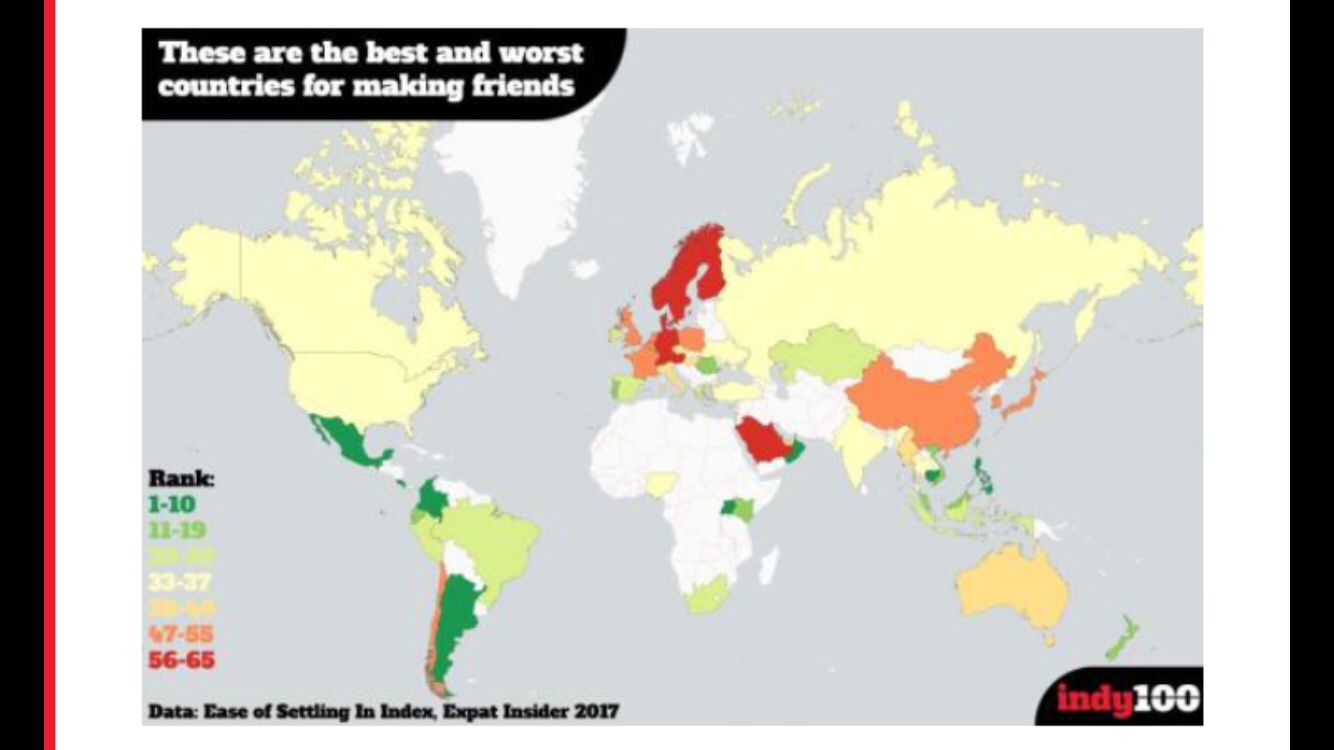
Sweden is used to being at the top of most indexes relating to quality of life, equality, life experience. But not always, as the latest results from the Expat Insider 2017 survey might suggest. The survey looks at masses of elements related to the expat and relocation situation and views the world through expat eyes. The research surveys 65 countries and, in fairness, Sweden has improved from position 42 to 20 overall since 2016. Sweden scores well in travel and transport, safety and security, health and well-being.

So where does Sweden do badly? One of the elements that the survey looks at is ‘ease of settling in’. Here, Sweden doesn’t fare so well. For ‘feeling welcome’ Sweden ranks 51 out of 65 countries, for ‘friendliness’ 56, ‘language’ 15 and, wait for it, for ‘finding friends’ Sweden places 65! Last place. Interestingly Norway and Denmark are 63 and 64 respectively.

What could this tell us about Sweden? Or at least the expat’s experience of the country? Is Sweden seen as a healthy, systematic, safe but cold place? A functioning but unfriendly society?

I have to say that it is not my experience. I have found Swedes to be open and welcoming and I have a lot of great Swedish friends. Friends for life. So why does this survey suggest otherwise? What makes my experience so different from the people in this research? Does it depend on who you meet? Or on how open you are yourself? Is it different if you are single or in a couple? Are the big cities different from the smaller towns? I have no answer, but it is interesting to reflect over.

If you want to read the whole report, here it is:

Click to access Expat_Insider_2017_The_InterNations_Survey.pdf

Swedish malice on the underground

Travelling on the underground, I overhead a Swedish conversation between two people – one of them a spiteful 30-something woman. I say spiteful because she spent the entire journey demeaning and mocking their colleagues. It’s not often I hear such blatant malice so I became curious and listened carefully. Apparently, everyone in the office was a loser, annoying, boring and/or stupid. Nice person, I thought. However, one thing in particular triggered my curiosity.

As she spewed bile, she referred scornfully to one of their colleagues as ‘ you know Annika, she’s short, dumpy and wears office dresses’

What the hell is an ‘office dress’?!

I don’t care too much for that woman on the underground. But I do care about knowing what an ‘office dress’ is and why it’s degrading!

Can anybody can enlighten me, please do!

When Swedish men trivialise the problem

Metoo

Sweden is the country that brands itself on gender equality. So good is the Swedish PR  machine that people outside of Sweden believe it and even the Swedes have bought into themselves. It’s hardly astounding then that when the global #MeToo movement accelerated in Sweden, it exploded in society like a molotov cocktail. In all walks of life, in all professions, Swedish women are coming out with testimonies of physical abuse, mental terror, sexual misconduct, rape, harassment, assault, abuse of power – at the hands of men. And it is sending shock waves through the whole of the country.

Today, a piece of research carried out on behalf of Sweden’s largest news channel was released. Over a thousand people were asked questions in relation to the #MeToo phenomena. In answer to the question, ‘I feel that it is over-exaggerated’, 45% of the men answered ‘yes’. In other words, almost half of Swedish men (in this survey) think that the #MeToo movement is exaggerated!

What is this about? Why are there so many men who think that just because they haven’t experienced the problem, the problem doesn’t exist. Is it self preservation? Arrogance?  Have they bought in to the Swedish illusion of gender equality? Whatever it is, it would seem that these men lack the ability to empathise with any other perspective on life than their own. They cannot see the situation from another perspective – or relate to the female experience and point of view.

I think it’s a case of minimisation. In psychology, and in cultural awareness training, this is a term that we use to describe people’s behaviour when full denial isn’t an option. In the case of #MeToo, I would guess these men do not deny it. But they do question its legitimacy and frequency. Classic minimisation.

Minimisation can be defined as the downplaying of the significance of an event or emotion. It is a common strategy in dealing with feelings of guilt. Minimisation manifests itself in all sorts of ways, such as saying that a hurtful comment was only a joke or reducing somebody’s feelings by saying ‘it’s no big deal’ or ‘what’s the problem?’.

In this case, minimisation is happening on a society level. It is suggesting that there are just a few bad apples or rogues in an organization when in reality problems are widespread and systemic throughout society. Minimisation in this form is a conscious or subconscious tactic used to manipulate others, and ourselves. Perhaps for the subconscious guilt we men feel for being a part of the system.

Trivialising the experiences of the women is distasteful. I get it that it is scary when people are angry and when information that has been hidden for a long time starts to surface. But playing it down will only undermine the validity of the movement. And this movement needs to last.

A societal change is essential. And we men have an important role in it. We should stop suggesting that the #MeToo movement is over-exaggerated, or that women are using it as revenge, or it is a witch hunt against men. Instead, we should listen to the testimonies. We should be shocked by them. We should not accept it. And we should work to change attitudes towards women in Sweden.

Swedish men – get it together!

If equality is something you are proud of in Sweden – then start by believing what you hear. And be an example to men all over the world – ‘In Sweden, we don’t stand for this. In Sweden, we listen. In Sweden we will change.’

Sweden’s insatiable appetite for Eurovision

Sweden must be the country that can call itself Eurovision fan number 1.

So insatiable is the thirst for ‘schlager’, as it is called in Swedish, that the journey towards the May 2018 final began today.

Today, it was announced in a live press conference who will be participating in ‘Melodifestivalen’ – the competition to choose Sweden’s representative. So insatiable is the thirst for ‘schlager’ that there are 28 contestants! 28!

According to the papers, the artists are a mixture of ‘new-comers, classic singers, comebacks, former winners, favourites and LGBT surprises!’ Also, oddly, a parody band and a fat tv cook.

So insatiable is Sweden’s thirst for ‘schlager’ that these 28 contestants start competing with each other in February – in 6 live televised competitions! February Saturday nights in Sweden are ruined for the uninitiated.

The weeks leading up to the Eurovision Song Contest are then filled with Eurovision trivia. So insatiable. Interviews with Sweden’s chosen representative, behind the scenes programs and analysis of every single one of the other countries’ songs grace our televisions. Then finally, once we are already saturated, the two semi finals come. God forbid Sweden doesn’t qualify. Then finally, the final comes. And Sweden usually lands somewhere in the top 10. Then comes the analysis.

Finally sometime at the beginning of June, we are released from the jaws of Eurovision. The summer comes and is filled with ‘schlager’ tours and festivals. And in November, it all kicks off again.

That’s life in the insatiable ‘schlager’ country of Sweden.