Sweden you are being manipulated

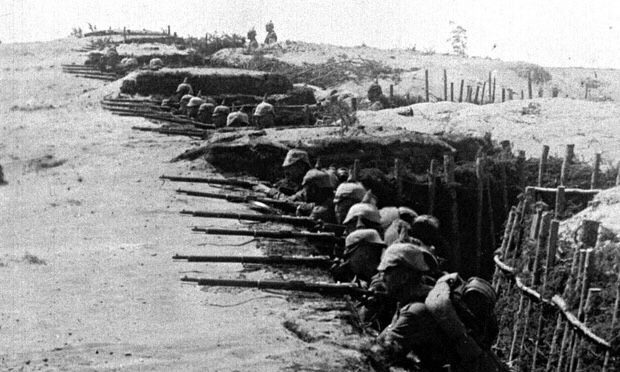
In the Second World War, one fear that the German soldiers had was being sent to the frontline in Russia which meant certain death. They feared this so much that they would be willing to do anything to avoid it. This fear has become the name of an influencing tactic known as the ‘Russian Front.’ It is a highly manipulative negative tactic that we see being used in Swedish politics today.

To apply the Russian Front tactic, we offer a person something that they will never choose but we dress it up so that it seems more real. We paint a picture of pain, then

offer them the alternative that we really want them to choose.

Example:

There is a job available in Sewage Maintenance, the last guy died. I do hear they’re looking for people in reception though. Should I recommend you?

The Russian Front is the application of a principle called ‘Hurt and Rescue’.

‘Hurting’ means making somebody feel pain of some kind, pointing out what is wrong, making them want to get away from something. ‘Rescuing’ means removing their hurt, saving them from their pains. It creates relief.

With this in mind, think now about what is currently going on in Swedish politics. The extreme right wing nazi party – the NMR – have been very vocal recently. They have been involved in homophobic, racist and sexist attacks. They have received a lot of media attention and harassed, threatened and film documented people from minority groups. The NMR are the Russian Front. They are here to ‘hurt’ us. In contrast to them, the other right wing party, the SD, look more acceptable, although they also have a racist and sexist agenda of hate. But compared to the hurt of the NMR, the SD can appear as the ‘rescue’.

This is very, very dangerous. It is extremely manipulative. It is a well orchestrated trap. It is very strategic, and well planned. Its intention is to force fearful voters into the hands of SD in September’s general election.

The key to not falling into this trap is to see it. To see it for what it is. The fear we are experiencing is not real. It is choreographed. The solution is not SD. Do not allow yourself to be manipulated. Do not vote out of the illusion of fear. This is a high stakes game, and we are pawns. But we do have the power, if we see through the manipulation tactics.

The Russian Front is not real.

SD is not the solution.

Please spread and share this message.
Sweden’s political island week


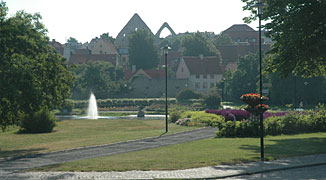
Once a year, at the beginning of July, there is a politics week in Sweden. The week takes place in an open-air park called Almedalen on the Baltic island of Gotland, and attracts heavy media coverage. Every day of the politics week belongs to a specific party that has a seat in the parliament – there are 8 of them.

The Alemdalen politics week all started 40 years ago when legendary Swedish Prime Minister Olof Palme spoke publicly. It was at the end of the 60s and the Social Democrats on the island took the initiative and asked Olof Palme to make a speech in Almedalen. Palme and his family had spent their summer holidays on the neighbouring island of Fårö for many years. The stage was a lorry platform at Kruttornet and there was an audience of a few hundred people.

Now Almedalen politics week attracts thousands of participants and is intended to involve the man on the street in politics and to protect the strong Swedish value of democracy. However, the concept of democracy has never been so strongly challenged as it is this year. Right wing, nationalist party Sweden Democrats are gaining in popularity and are now the second largest party according to the opinion polls. This is a party that has its roots in nazism, sits in the parliament, focuses on ‘Swedishness’ and, even today, categorizes people according to their ethnicity. Some of their representatives are simply racist.

Democracy is a double-edged sword. Giving an open platform to racist ideas is a difficult thing to stomach, but it does strongly reflect the Swedish belief in freedom of speech. We don’t all agree with each other, but we have to defend the right for each other to think differently – as long as we are not inciting violence.

If we don’t do that, what’s left? What kind of a society do we have then? I am sure it would be a society that we wouldn’t want to live in.

At Almedalen politics week, we meet each other in debate. And in debate and discussion, we influence each other and our environment. And it is then, and only then, we can possibly change our society.

The Nobel Prize of SHAME

SvAka_1_pms

In egalitarian Sweden, there is an elitist, powerful, elected-for-life committee called The Swedish Academy. This (royal) Academy is an appointed committee of 18 members whose purpose is to further the ‘purity, strength, and sublimity of the Swedish language.’ To this aim, they are guardians of the Swedish dictionary, and they award many prizes and scholarships to domestic authors. A mostly dusty, bourgeois old bunch, they also are responsible for awarding the prestigious Nobel Prize for Literature every year.

But not this year. Sex and shame has stopped them.

Today, the Academy announced they will not be awarding a 2018 prize. This has only happened 6 times since its beginnings in 1901  – during the world wars and in 1935, when no worthy winner was identified.

On its website, the academy writes ‘The present decision was arrived at in view of the currently diminished Academy and the reduced public confidence in the Academy.”

The ‘reduced confidence’ they are referring to is the rampaging sexual assault scandal that has engulfed the organisation. Several members of the academy have been slandered, scapegoated and forced out, or left at the own volition.

So no prize in literature this year, but most certainly a prize in shame.

It all started last November in regard to the husband of author Katarina Frostenson who is a member of the Academy. Her husband, photographer Jean-Claude Arnault, who ran a cultural project, with funding from the Swedish Academy itself, was accused by 18 women of sexual assault and harassment. Some of this allegedly happened in Academy premises. It has later been suggested that he even groped Sweden’s Crown Princess Victoria at a formal event.  Naturally, Mr Arnault denies the allegations.

This threw the Academy into turmoil. What unfolded in front of us was a drama of betrayal, sexism, power struggle, internal conflict, dishonesty and manipulation. It was like ‘Culture News’ meets ‘Downton Abbey’. Subsequently, a wave of resignations followed, including Ms Frostenson and the head of the academy, Sara Danius.

Today, there are only 11 members in place but the diminished academy requires a quorum of 12 to vote in any new members.

Since its beginning in 1786, the Academy has only ever allowed 9 women to sit in the committee. 9 women! It is clearly yet another example of a white, male-dominated, middle-class organisation. Can it change? Maybe the only way is to rip down this tower and build it up again in a more egalitarian spirit? Surely, the Academy should represent the population in ethnicity and gender at the very least?

The Academy’s slogan is ‘snille och smak’ – which translates as ‘talent and taste’.

Ironic isn’t it, that they are currently demonstrating neither of them.

Sweden’s giant blue penis

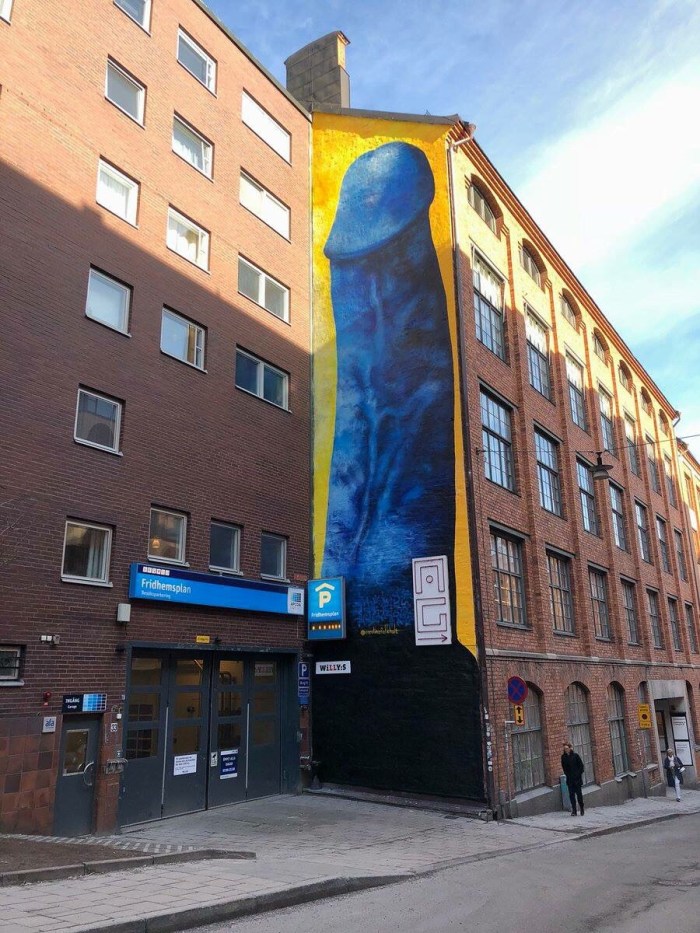
In recent days, a giant blue penis has been the cause of much discussion in Sweden. On the wall of a 5 story building, artist Carolina Falkholt has depicted an enormous blue male member – on a yellow background – Swedish national colours. The artist painted a similar pink penis on a wall in New York but it was painted over after just a couple of days because of public outcry. In a recent interview she says ‘I usually paint pussies, so I thought it was time for a dick..I think it will be allowed to remain here, that people let it take its place in the debate around the body, sexuality and freedom.’

If the purpose of art is to provoke and cause a reaction, she has certainly succeeded. The nature of the painting makes us reflect over why we might be shocked or offended by it – and that is a useful reflection to have.

The mural has been there a few days now. Let’s see how long it lasts!

Swedish Music Aid

Children are not for sale!

Did you know that every minute, 4 children are sold into the sex industry around the world? An estimated 2,000,000 children are victims of sex trade and many more in human trafficking. These figures are hard to grasp, and even harder to process. Sexual trading of children can involve local boys who are abused by tourists, impoverished girls who are sold as sex slaves to rich families, or children who are ordered like fast food on the internet. The actions of the perpetrators are ruthless and the list of assaults is endless.

But we can do something about it.

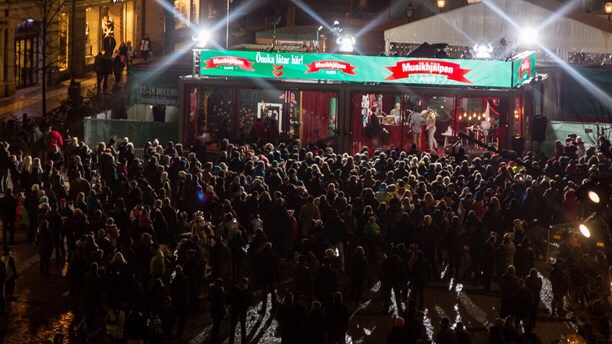
‘Children are not for sale’ is the theme of this year’s charitable Music Aid (Musikhjälpen) project in Sweden. For the tenth year in a row, three radio hosts are locked into a glass cube for 6 days on a square in a town somewhere in Sweden. This year the event takes places in the northern city of Umeå, and the hosts broadcast music and tv non-stop day and night to gather donations for their good cause. To raise money one can, amongst other things, request a song, carry out a fund-raising action and bid in the various auctions that take place. This is Swedish solidarity at its very best.

Today, 17 Dec, is their final day of incarceration – the hosts are let out of their glass cube this evening and the total amount that has been raised will be announced. The millions of crowns that they gather will be spent on prevention of the child sex trade, protection of at-risk children and rehabilitation of children who have been victims.

It is still not too late for you to make a donation. Download the Musikhjälpen app (mh2017) and make a contribution! You can also go to http://www.musikhjalpen.se or find the same on Facebook. Every donation counts!

Your contribution can save a child from a terrible, terrible fate.

Please donate! Please share this blog with your friends and encourage them to do the same.

A casebook example of civil courage

baudin-jpg

Sometimes the best thing we can do is protest with our wallets.

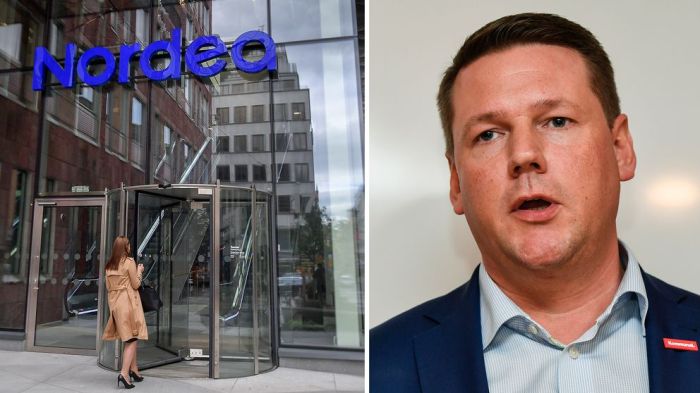
Swedish bank giant Nordea announced recently that they are moving from Sweden to Finland because of a new bank tax that the Swedish government is planning to put in place. The final decision will be made at an annual meeting next year. The threat to move has caused a lot of hoo-ha from both sides of the equation – those who criticise the bank for tax evasion and greed, and those who criticise the government for forcing companies to leave Sweden due to unattractive taxation laws.

Criticising the banks is Sweden’s largest trade union ‘Kommunal.’ – the union that represents council and municipal workers. Just today they announced that if the move happens, they will remove all their money from the bank. We are not talking about a small amount of money either. The amount is one billion Swedish crowns.

‘ We choose banks that reflect our morals and values and who act responsibly. Neither Nordeas MD or board do this,‘ says Kommunal’s chair Tobias Baudine

Kommunal joins other trade unions ‘Handels’ and ‘Seko’ who have also decided to leave Nordea and take with them investments to the value of half a billion Swedish crowns respectively.

Agree or disagree, this is definitely a great example of moral and civil courage. Sometimes as consumers, the best thing we can do is protest with our feet and our wallets.

  • If a business is acting in a way that is contradictory to our values and beliefs then leave them as a customer.
  • If a newspaper is spreading lies and hate, do not buy it or go to its website.
  • If an industry is employing dubious methods, then stop consuming their product.

Do not fund hate. Do not fund greed. Do not fund unethical behaviour (whatever that means for you).

By taking a stance, we have the power to change the world around us. If only we would realise it.


Dividing up Sweden 


Today I thought I was in one region of Sweden, but I was reminded by a Swedish friend that I was in fact somewhere else. This dividing up of Sweden is not easy to get a grip of. 
Sweden is divided into 3 regions: Norrland, in the North, Svealand in the middle and Götaland at the bottom. These regions have no official purpose, except making it easier for weather readers to present their forecasts. 

Within each region, there are many counties (landskap). Sweden has in fact 25 counties, with Lapland being the most northern and Skåne being the most southern. These counties have their own coats of arms, flowers, and often traditional clothing. 

In 1634, the administrative responsibilities for justice, roads, hospitals etc were removed from the counties and given to an organisation of ‘län’ – administrative counties. There are 20 of these in Sweden. There can be more than one county in the area covered by a ‘län’. For example Södermannsland ‘län’ includes the counties of Södermannland, Uppland and Närke. Each ‘län’ has a main city of residence, where the county government (länsstyrelsen) is based and the governer (landshövding) has his/her residence. For Södermannland, this is Nyköping. 

Within each administrative county there are local councils (Kommun) who are responsible for social services on a local level. There are 290 of these in Sweden today. 

So when traveling through Sweden, you will be in a region, a county, an administrative county and a council at the same time. No wonder it’s hard to know where you are sometimes! 

Why Nazis are welcome to Gotland 


When I went to university in the U.K., there was a policy called ‘no platform’. This meant that students were allowed to demonstrate, hold rallies and meetings about any subject they liked except with one agenda – racist. The university claimed it was democratic but also allowed ‘no platform for racists’. I personally do not hold right-wing views, but this policy never sat easily with me as I saw the clear paradox that it created and it raised the question of what a democracy is. This is a question that raises its head very frequently in today’s culturally and politically polarized society. 

One very recent example in Sweden is the annual politics week that finishes today on the Baltic island of Gotland. This is a week where political parties gather and debate the current political landscape of the country. It’s a tradition that started in 1968 under the initiative of legendary leader Olof Palme. This year, for the first time, a Nazi group were allowed to participate  with a tent and speeches. They, course, were condemned by all parties and many voices to ban them were heard – ‘no platform for Nazis’. 

This is the dilemma for any modern democracy. If democracy means that everybody has the right to exercise their own ideas and beliefs, then society can not ban or intervene when people have the ‘wrong’ beliefs. We can’t just stop somebody from participating because we don’t like their point of view. It is different of course if they are breaking the law. But being a nazi is not breaking the law in Sweden, just as it is not illegal to be a civil rights activist, a communist or a feminist campaigner. 

We shouldn’t forget the very foundation of a democratic society means the right to hold whatever belief we want and go wherever we want with whoever we want. That is our liberty. If we start to infringe on it with bans, or ‘no platform’ policies, we are heading down a slippery slope of state control, elitism and autocracy. 

For me, Nazis should not be forbidden to go to Gotland. To ban them is to undermine our democracy. Threatening behavior, nazi symbolism, Hitler salutes, encitement of violence are however illegal and should not be accepted or allowed. 

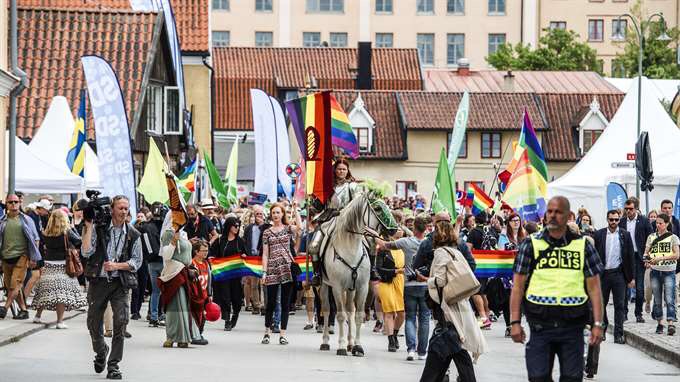
It is in the shadow that their presence casts that a counter balance can be demonstrated. And exactly that happened on Gotland in the form of a well-visited Diversity Parade. Thousands of people marched for a plurastic society and in protest of the views propagated by right wing parties. This was a fantastic manifestation representing the majority of Swedes. And this could only happen in a democratic society. 

Don’t get me wrong, I am not undermining anybody’s discomfort or fear. I am sure that the presence of the Nazis was horrible to experience. But if history has shown us anything it is that we cannot put our heads in the sand and ignore these destructive forces. We must face them head on in debate, in demonstration, in democracy and in massive, massive resistence. 

Bringing politics to the people


politikerveckan

If the election in the UK and USA has shown us anything, it is this. Bring politics closer to the people and you will win.

In the USA, it meant successfully manipulating the beliefs of the disillusioned and the sceptical.

In the UK, it meant focusing on the issues closest to people’s hearts and putting a fire under the asses of young voters.

Politicians in Sweden are, in my opinion, too often remote from the electorate and their reality. This is with one notable distinction in a quickly-growing, right-wing, populist party. This party has now taken the position as the second largest party in Sweden and poses a real threat to the other established parties and their ability to form governments in the future.

Every summer in Sweden, politicians hold a politics week on the island of Gotland in the Baltic Sea. This week brings together all the parties and they discuss and debate the current issues at hand, all televised to a broader Swedish public. I am all for politics and media debates but recently the Gotland Politics Week sits a little uneasy with me. In many ways, it is fantastic but it has moved far from its initial intention of putting politics in focus for the ordinary person. Today, it is more of an elitist gathering of lobbyists, journalists, aides and corporate partners standing in tents sipping free rose wine and partying until the early hours. How can people of the electorate relate to this? How can they even participate when, for example. it costs a lot to travel to remote Gotland and is difficult to find affordable accomodation?

As an alternative to this, a new Politics Week has risen. Initiators from the Stockholm suburbs have decided to bring politics to the people and have arranged a week of political debate and discussion on a football field.

On their website, they write:

‘The purpose of Järva Politics Week is to reduce the distance between politicians and citizens, create better conditions for ordinary people to engage themselves in politics, and put the issues of the local residents on the political agenda. This week gives politicians the opportunity to put forward their policies on exclusion, education, security and marketplace integration directly to the groups who are most impacted.’

It seems like all of the parties have accepted the invitation and most of the party leaders will attend this event to hold a speech.

Hopefully, in the suburbs, looking the real electorate in the eyes, they will realise what is needed to create positive integration, positive change and a positive future for everybody in Sweden.

Segregation on a Swedish school bus

school bus

In Sweden, the school system contains many independant schools run with a specific focus such as music, sport, art or specific religions. They should all follow the national curriculum and, in the case of religious schools, they should teach but not preach.

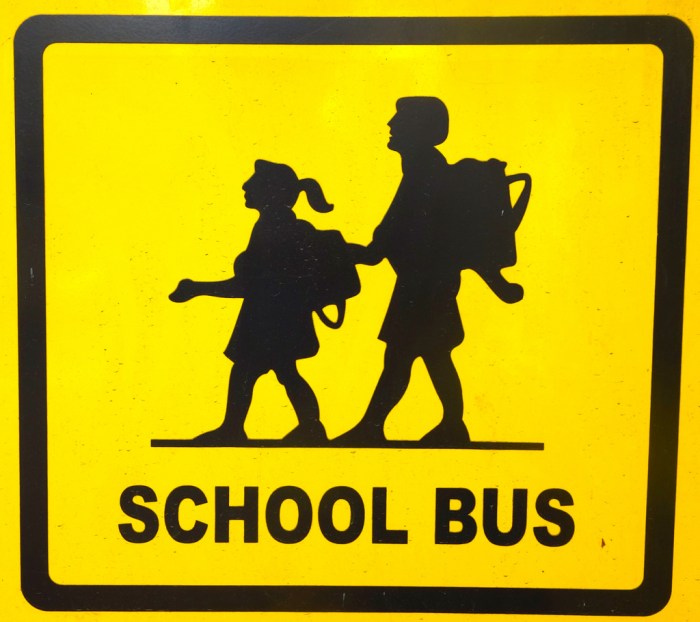
Yesterday, it was revealed that a Stockholm junior school with an islamic orientation has been segregating children on the school bus – boys go through the front entrance and sit at the front, girls go in the rear entrance and sit at the back of the bus. The headmaster of the school has claimed to be unaware of this. This act of segregation has caused a hot debate in Sweden about the ‘islamifying of Sweden’, ‘gender apartheid’ and comments such as it being ‘unSwedish’.

The Swedish Schools Inspectorate are planning on investigating the school further to see if any other ‘undemocratic activities’ are taking place. The Inspectorate has previously allowed segregated classrooms and gender-separated sport lessons.

What can we learn from this?

When this kind of occurance happens in society, it is a great opportunity to reflect on what we learn from it. What is our immediate reaction when we hear examples like this?

  • Do we run straight to the barracades and start defending our cultural heritage?
  • Do we condemn the occurance as, for example, undemocratic or unacceptable?
  • Do we weigh up the pros and cons and try to arrive at a balanced conclusion?
  • Do we think people are allowed to do whatever they want, so anything goes?

All of these are perfectly normal reactions, and one is not better than the other. Obviously, we react in different ways.

I think that these occurances in society provide us with a great opportunity to discuss intercultural competence. Being interculturally competent is generally defined as having an open mindset and the cultural sensitivity to see different perspectives so that one is able to flexibly adapt ones behaviours accordingly. But that doesn’t necessarily mean it’s about accepting that anything is ok. Intercultural competence can also mean balancing up the various perspectives and standing up for what one thinks is acceptable.

Intercultural competence differs significantly from racism and nationalism. Racism and nationalism focus on others being of lower value than myself or the place I come from. Intercultural competence is about accepting everybody’s perspectives are equally as valid – no matter how tough they are and even if I personally don’t agree with some of them.

So how do we arrive at this place of understanding that all perspectives are equally as valid? We can ask ourselves a simple, but complex, question:

‘What do they think is good about segregating boys and girls on a school bus?’

If we can arrive at the answer(s) to that question, we are becoming more interculturally aware and more interculturally competent. We are seeing the situation from their perspective and not only our own. We are presuming they have a good reason, from their perspective, for their behaviour, rather than immediately judging or condemning it.

Once we have reflected over that, we can decide what we personally think. Does it change our point of view? Can we accept their behaviour more easily? Or does it make me hold my view even more stongly? In that situation, we can say something like:

‘I understand why you think it’s good to segregate boys and girls. I understand your perspective. However, I disagree with it. And here in Sweden, we believe in equal treatment of all regardless of their gender, which is why that behaviour is not something we as a society can accept.’

Compared this to the more reactionary ‘the Islamists are trying to take over Sweden!’ and ‘this country is going down the drain’, you see how the ability to perspectives-take creates a more open, less fearful debate.

It is my belief that if we approach occurances like this in a more interculturally competent way, and try to perspectives-take, we can create a society built on mutual understanding and respect for prevailing values rather than a society built on fear and suspicion.

And that has to be a good thing moving forward, doesn’t it?