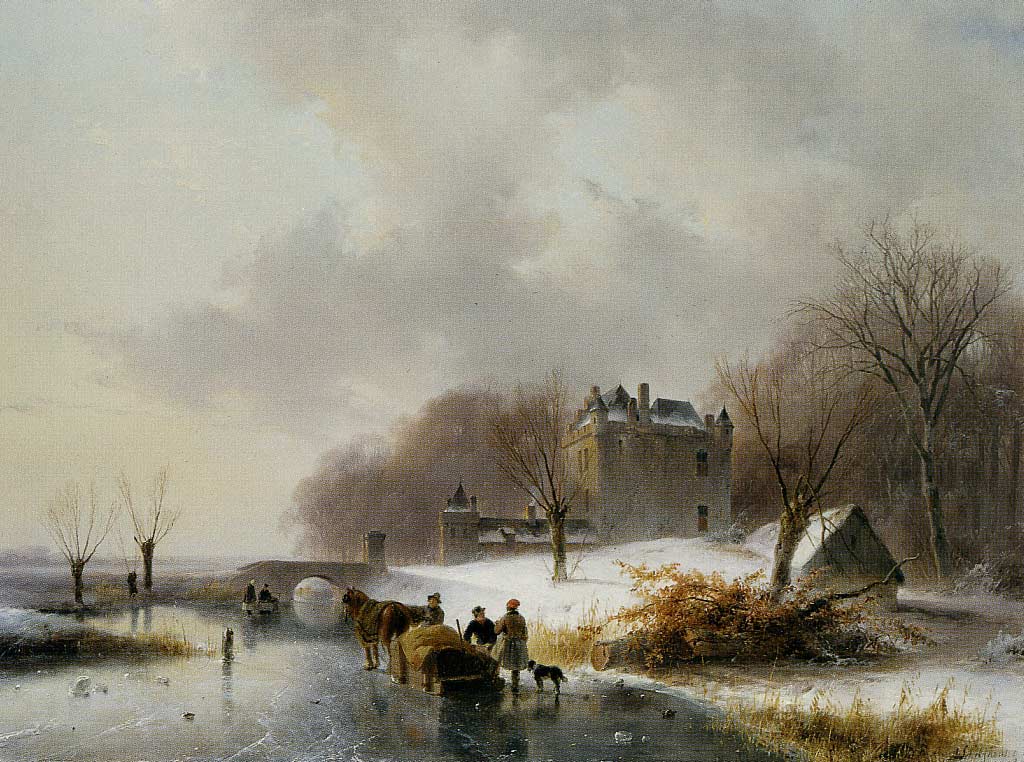
Reflections over a frozen canal


Walking over the bridge on the way home from town today, I looked down at the frozen canal which is now in the process of thawing. Pools of water lay here and there on the surface and ducks were happily bobbing around in the open areas under the jetties.

I lingered for a while and looked down over the canal and over towards the city hall.

On the ice, I noticed thin track lines. The evidence from people on cross-country skis was now melting into the slushy surface. I also noticed footprints. Remnents of Stockholmers out for a walk one winter Sunday on the ice. The footprints had lost their sharpness, they had become diffuse, blurred at the edges. Slowly, slowly, they were disappearing as the canal reclaimed its watery surface.

I was struck by how temporary things are. Soon all proof of those skiers and those Sunday strollers will be gone. Any trace of their activities melted away.

Is this how it is for all of us? Our lives are temporary. We are only here for a fleeting moment. With all our activity, we leave a mark. And then gradually that mark dissipates and nothing is left to show we were ever there.

Are we all Sunday strollers on a frozen Swedish canal?

Suicidal Swedes


So, the newspapers are trying to paint a picture of a ‘Wallander curse’. A second Wallander actor, Emil Forselius, was discovered dead this morning in his apartment. He had committed suicide. A while ago, popular actor Johanna Sällström also killed herself – while in the middle of a Wallander film project.

The myth of Swedish suicide still has a strong hold outside of Sweden. When non-Swedes are asked what stereotypes they have of Swedes very many of them say ‘suicidal’. Why is this the case?

Is it because of the long dark winters and the problem we can have with seasonal adjustment disorder? Maybe. Is it the legacy of depressing, morose Bergman films that have painted a miserable and introspective view of the Swedes? Perhaps. Is it the lack of ‘godliness’, no real strong belief in religion, that means taking your own life is easier? Could be.

Combined, of course, with statistics.

According to statistics, Swedes have the highest suicide rate in the world. This is something that non-Swedes often love to refer to. But statistics are deceptive.

Most countries in the world do not even keep statistics of suicide, especially those countries with strong religious beliefs (which is most of them). When people commit suicide, they call it something else, in order to secure a place for the dead person in heaven or to prevent the family from being burdened with shame.

But in Sweden, suicide is not a sin. Suicide is a tragedy. In Sweden suicide is documented as what it is – suicide – as a reminder for the rest of us how fragile our existence is.

So, of course Sweden has the highest statistics, because Sweden is one of the few countries to actually keep accurate documentation.

I don’t believe that Swedes have a tendency to take their own lives more than other nationals. I just believe that when they do, the nation doesn’t try to hide it. It is hard enough for families to deal with their grief without having to also be weighed down with shame.

Ultimately, Sweden is a modern society where citizens have free choice to make decisions that influence their own lives. Suicide is, in its extreme, a way of exercising this free choice. It is of course a tragedy but it is not something we should ignore and hide.

As long as some people in our society feel that suicide is their only choice, it is our obligation to document and defend an open dialogue about it.
Swedish airport efficiency


Sitting in the airport lounge waiting for my flight to Helsinki, I am amazed by Swedish efficiency. Outside, the heavens have opened. It has been tanking down with snow all day long. And yet, no flights are cancelled or delayed. Snow ploughs are working feverishly to clear the runways. De-icing trucks are eagerly spraying fluids over the bodies and wings of the planes. Staff are shovelling and transporting snow from one place to another.

This is Swedish efficiency at its best. In England, a few flakes of snow and the airport would have been shut, stranding passengers.

I don’t know how long this Swedish efficiency can win against the elements. Long enough for me to be boarded and on my way, I hope.

A sense of perspective


I am tired. Tired of the winter. But not of the snow.

I am tired of everybody moaning.

This year, Sweden has had one of the snowiest winters in decades. The snow came in December and is still here. The streets are covered in ice and, just as you think it might be getting better, another load of snow is dumped upon us.

This week has been especially spectacular. Because of the amounts of snow, the railway system has not been able to operate as it usually does. Trains have been delayed, or cancelled. There haven’t been enough replacement buses to cover the capacity. The underground has been cancelled on any parts of the line that aren’t physically underground.

The newspapers have reported on ‘Snow Chaos’ and ‘a feeling of tension and riot in the air’. Every night the weather has dominated the tv news, every night they have interviewed angry passengers that have had to wait at a station for a train that never comes. People have been up in arms, their anger spiralling. Train personnel have been threatened.

I am so tired. Tired of the moaning. Tired of the news coverage and the sensationalism.

We live in Scandinavia. In Scandinavia it snows. This year it has snowed an exceptional amount. This has meant that services can not operate with their usual reliabilty. Get over it.

We live in a world surrounded by natural disasters, such as the earthquake on Haiti, where people lose their homes, their families, their means of living. In other countries, people die in extreme weather conditions. In Sweden, we miss the train. I think a sense of perspective is required.

First thing this morning, the local government and the board of Swedish Railway anounced that they will be refunding all passengers. All passengers will receive a discount on their monthly travel card equivalent to one week’s travel. This is to compensate everyone for the inconvenience. The inconvenience of living in Sweden?

This political gesture will cost the tax payer 50 million Swedish crowns.

In my opinion, money better spent employing people to maintain the tracks and keep the trains moving.

Being Swedified


Sometimes when you live in a country so long, you forget what is different from your own culture. You adapt. You are culturally aligned. In my case, I have become Swedified.

Take ‘fjärrvärme’. ‘Fjärrvärme’ is long-distance heating. It’s a way of warming houses and apartment buildings and is very common in central Stockholm.

Long-distance heating usually consists of water that is heated up in factories outside the city. The water is then sent through pipes and out to the buildings. The water circulates in each apartment’s radiators and, when it has been used for a long time, gets cold again. Then, it gets sent back to the factory to get heated up again. Logical, huh? And such a natural part of the Swedish infrastructure that I have hardly reflected over it. Until I went to England and told my family about it.

‘That’s outrageous!!’ they said. Surprised by the strong reaction, I asked why.

‘Well, if the government or private companies control the heating, they could just turn it down in order to control the public. They could set the heat to a low level in order to increase national work output. It’s so communist. It’s outrageous.’

I tried to explain that it was a very green way to heat the buildings but couldn’t come up with a decent argument.

I tried to explain that when you pay the monthly apartment fee, you get as much heating as you like. But they thought that this was also outrageous – a neighbour could have their radiators turned up higher and they would pay the same fee as those who had their radiators lower. Communist.

I tried to explain it was the same as other utilities in the UK. Like water, electricity and gas. But they didn’t get it. Controlling your own heating, they claimed, is a basic right.

I floundered. I couldn’t persuade them of the benefits of ‘fjärrvärme’.

I like and accept ‘fjärrvärme’. I think it is a great utility. My acceptance of it sits so deeply now that I can’t explain why it is the way it is. It just is.

I realise I am culturally aligned, at least on this issue. I am Swedified.

Swedes and Ralph Lauren


Just come back from a long weekend in London where I was visiting family and friends. On Saturday, I was trying to persuade my 23-year old nephew to come to Stockholm for a visit. Appealing to his interests, I mentioned how beautiful Swedish girls are.

My sister, who has been to Sweden several times, pipes up.

‘Oh, yes! They’re all really beautiful. Everyone is beautiful! So healthy and well-off looking. They’re all so well-dressed and trendy. Even the pensioners. They all walk around with glowing skin and lovely teeth. They’ve all got jumpers thrown over their shoulders. They all look like models. Yes, all Swedes are Ralph Lauren models!’

Now, there’s a positive stereotype to reinforce!

The right to a voice


A fantastic characteristic of Swedish society is freedom of speech, freedom of religion and of lifestyle. Based on the value of equality, the concept of freedom of speech applies to everyone in the society, even children.

It’s no surprise then that in a country that has a child ombudsman and fierce legislation against corporal punishment, the following is happening. School children are being given the opportunity to evaluate, or grade, their teachers – to give their opinion on the abilities of their teachers. Their evaluations will be public records.

Politicians who support the move say that school is there for the children, not the teachers, Therefore, children should have an influence over their environment and the people who work there.

Politicians who are against say that children are not mature enough to understand the consequences of their grading and that the results could be devastating for individual teachers.

No matter what we think, for or against, I think this is fantastic. A fantastic example of the Swedish belief in equality in practice.

Even the smallest people in this culture have a voice, and a right to share it.

What Estonians, Finns and Swedes have in common


I am currently in Helsinki running a training course. During the morning today, one of the participants mentioned something that he called ‘Estonia complex’. Probing closer, I understood this to mean the big brother complex that Estonia has towards Finland, the feeling of being the country cousin, the smaller player, an inferior.

Interesting concept, this. I have also heard that the Finns have a similar feeling of inferiority towards the Swedes. This possibly comes from the shared history of the two countries and that Finland once belonged to Sweden. This is something you still see evidence of here in Helsinki. All the signs are written both in Finnish and Swedish, for example. ‘The Swedish Theatre’ has a very dominant postion on the main street next to the main department store. Many citizens are fluent in Swedish as well as in their own language.

But this ‘big brother complex’ also exists in Sweden, in my experience. Sweden often compares itself to the rest of the world, with a kind of inferiority complex. Stockholm is referred to as ‘The Venice of the North’, Gothenburg as ‘Little London’, Vänersborg as ‘Little Paris’, Österlen in Skåne as ‘Sweden’s Provence’. It’s not unusual, in the winter, to hear Stockholmers telling visitors, somewhat apologetically, ‘in the summer, this is full of outdoor cafés, just like in southern Europe’.

So this inferiority complex is something that Estonia, Finland and Sweden have in common. I think it’s time to shake off these out-dated comparatives and be proud of their own unique cultural beauty.

If there’s something I’ve learned as I’ve gone through life, it’s this. We should define ourselves by what we are, instead of by what we are not.

I think these three Baltic countries would serve themselves well if they adopted this attitude.

Fucking najs

Standing on the platform at Rådhus tube station today, I noticed the walls were plastered with adverts for Dramaten’s new production of Pygmalion. The slogan designed to attract an audience was – ‘Från Fucking Najs till Förtjusande.’ An interesting tagline.

Yet again, the word ‘fuck’ being bandied about in Swedish media. A while ago, the front page of Stockholm News was ‘Inte Fucka Upp’, and in another paper the journalist referred to someone as a ‘smooth motherfucker.’

I don’t get it. Why is the word ‘fuck’ considered ok to use in newspapers and other printed material in Sweden? Is it considered cool? International? Fashionable? I really don’t get it. As a native English speaker, I have nothing against swear words. But when swear words are used by non-natives, I find it inappropriate and quite franky embarrassing. For them.

Let’s be clear about something. The word ‘fuck’ is a really strong swear word. Sure, it’s thrown around on American and British films, but in every-day use, it is still a taboo word. When it is used, it’s a word most often reserved for use amongst friends and some families. I think it’s a big mistake for non-natives to swear in English. Without the understanding of the social and culural impact of the word, it can be very offensive. Not cool, or international or fashionable.

There’s a reason Dramatan has Eliza Doolittle saying ‘fucking najs’. This is meant to reflect that she is a vulgar guttersnipe not fit to mix with people who have a better command of the language.

I rest my case.

Why this blog?

I love living in Sweden. I love Swedish people. I love Swedish values.

I was born in England but Sweden has, quite simply, become my home. After 15 years of living in Sweden, and working with cultural awareness training, I decided it was time to share my observations on life, culture and society.

My views, my perspectives and my experiences in this cold and warm country in the north.