Reflections from a Swedish supermarket queue


Standing in a queue, waiting to pay. In front of me, there’s a woman in her late thirties. She has a baby in a pushchair, she’s dressed in exercise gear and she has loads of food. Manically, she unpacks her trolley and unceremoniously dumps her items onto the belt. She sees me standing behind her and, as I only have three items, she generously offers for me to go before her. 

I admit I am surprised by this uncommon offer. But I graciously thank her and say no worries – I can wait. The supermarket is playing a favourite tune and I’m actually enjoying it, I tell her. 

‘It’s nice to hear somebody isn’t Saturday-stressed’ (lördagsstressad) she mutters bitterly back at me. 

‘Saturday-stressed’ is a term I’ve never heard, I never am and I certainly never intend to be. 

Why do Swedes have a winter sport break? 

Around this time of the year, schools have a week’s holiday. Called Sportlov it’s a traditional time for a winter sport break. 

This tradition was introduced in 1940 and was initially a way to save energy. Heating up schools cost money and, due to rationing, councils were instructed to drastically reduce their heating expenses. To give the pupils something meaningful to do while the school was shut, the authorities organised various activities, many focused on being outdoors and exercising. During the 50’s, experts realised that infection spread less widely at this time of the year if schools were closed for a week. So the winter sport break became cemented and an official disease control method. 

Nowadays, many families head off to the mountains to go skiing, some head off to the Alps for the same purpose.

For those of us left in town, it’s sheer bliss. 

There is hardly anybody on the buses and tube, traffic is significantly thinner and less noisy and it’s easy to get a seat at lunch time. 

And the fact that there are hardly any children in town means the rest of us don’t get infected with kid flu bacteria on our way to work. 

Are Swedes masochists?

A quick look at a definition of ‘Masochistic Personality Disorder’ tells us that it is ‘A pervasive pattern of self-defeating behavior. The person may often avoid or undermine pleasurable experiences, be drawn to situations or relationships in which they will suffer, and prevent others from helping them’.

There are a few characteristics:

– they choose situations that lead to disappointment, failure, or mistreatment even when better options are clearly available
– they respond with depression, guilt, or a behavior that produces pain
– they incite angry or rejecting responses from others and then feel hurt, defeated, or humiliated
– they reject opportunities for pleasure

I don’t know why, but my mind jumps to Saturday nights in February/March. The annual torture known as ‘Melodifestivalen’ is broadcast as Swedes attempt to select the song to represent them at Eurovision. People compulsively throw themselves into their sofas and watch the drivel that spews out in front of them. One piece of questionable music after another. They watch attentively, they vote.

And then they complain. They complain about the overriding bad quality. They complain about the winning songs. They complain about the host’s dress or hairdo. They complain that the best song didn’t get through. They complain about the dance routines. They complain on social media, during brunch and when they’re out on their Sunday walk.

But yet, the following week they’re there again watching the next episode of this 6-week long debacle.

So are Swedes masochists? Hell, yes!!
IMG_4994

Stand up for Swedes

IMG_4978

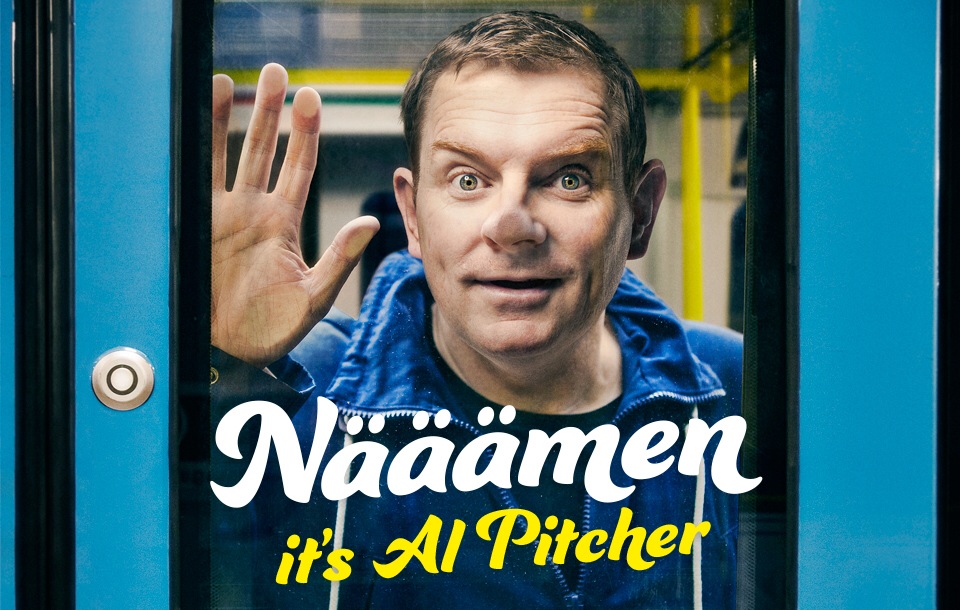
Last night I went to see a hilariously funny stand up comedian called Al Pitcher. From New Zealand, this fast-thinking, quick-talking ironist talks about his family life in Sweden, what he finds fascinating about Swedes, why he loves them and how they dumbfound him. In his one man show at Rival on Mariatorget, he bounced between naked toddlers to poisonous ticks, from helping old ladies in a Stockholm suburb to his exploits in the isolated regions of Norrland. He even made the town of Flen sound semi-interesting by describing his dancing a jig to Swedish folk music when he was there.

It was a pleasure to spend a couple of hours in the company of Al Pitcher. If you get a chance to see his up-coming shows, I highly recommend it. You can get more information at http://www.alpitcher.se or likewise http://www.alpitcher.com You can also follow him on Facebook.

Playa del Ingles – Swedish invasion

2015/01/img_4911.png

Currently enjoying a week in the sun on Gran Canaria. It’s altogether a very Spanish experience. Er, well, maybe not.

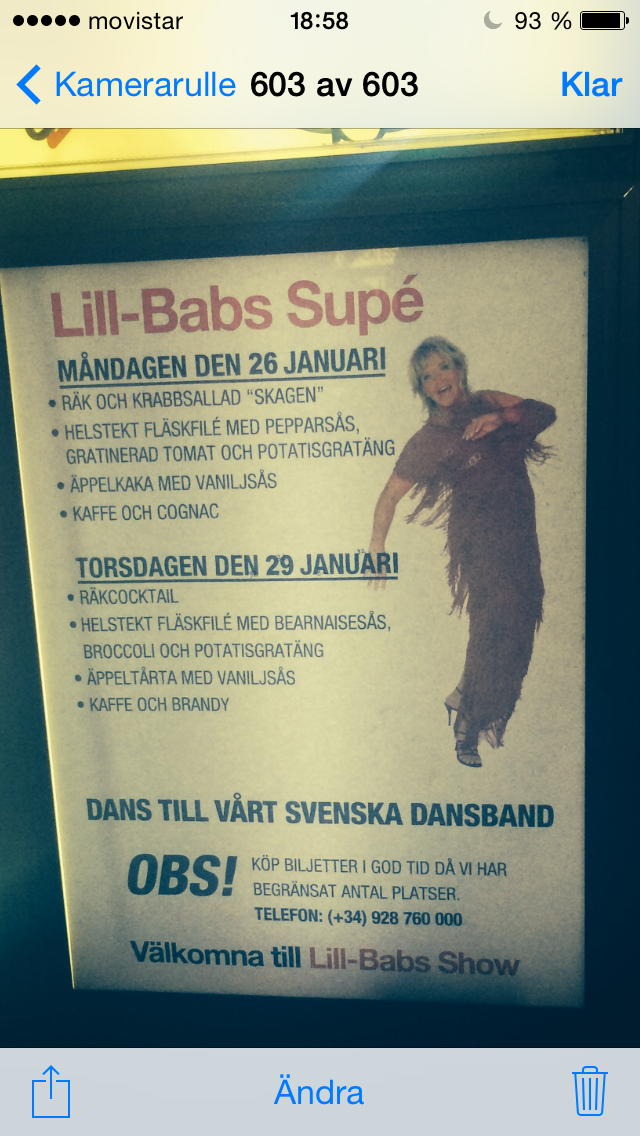
Yesterday evening we headed off to a well-known dance palace called Playa del Sol. The reason it’s well known is because it is a Swedish oasis, in the middle of the tourist sprawl. A restaurant and dance club, this is where Swedes, mostly of an older generation, come to eat Swedish food, drink cheaply, listen to orchestra music and strictly come dancing. The place has certainly seen better days, with it’s tired decor, faded colors and jaded staff.

Last night a Swedish legend was performing. The 75 odd year old Lill-Babs is Sweden’s equivalent to the UK’s Cilla Black and she’s still going strong. The show was sold out and her white haired audience of regulars went wild as she crooned to her classic hits from previous decades. Her energy and her saucy jokes had the audience agog. They were in the palm of her hand.

For me, this was a fantastic cultural experience – a mixture of fascination, sentimentality and horror. But mostly I was a witness to how a singer can create a life long following of loyal and loving fans through her hard work and professionalism.

Lill-Babs is really proof that the show does go on. And it goes on and on and on in this little Swedish dance paradise on a small island far away in the Atlantic Ocean.

Happy Swedes? That’s the question.

happy swede

Yesterday, I ran a seminar on Swedish culture and I got a thought-provoking question from an audience member. It was a question I have never had before.

‘Are Swedes happy with what they are?’ was the question. Somewhat taken aback, I tried to answer the question in the best way I could based on my interpretation of it. I talked about anthropologists are yet to find a culture that thinks their way is wrong. Every culture thinks their way is the right way – otherwise they wouldn’t do things the way they do them. Being culturally competent is about understanding that there are lots of right ways.

After the seminar, I thought more about the question – are Swedes happy with what they are? It resonates around my head still. How happy is the average Swede? How happy is the average person in general? I sincerely hope that most people are happy and living lives that fulfill and enrich them. I hope they are living lives where they can be grateful for what they have and not envious about what they don’t have. I hope they are living lives where they can be the best they can be, surrounded by people they like and free to make the best choices for themselves. I hope their lives are full of life. For me that’s happiness. And in Sweden, that’s the life I am able to live.

So at least I’m happy to be the way I am – in Sweden!

Swedes – the world’s best bosses?

worlds best boss

If you are Swedish, I would like some help from you.

I am carrying out some informal research into what Swedes perceive to be the best management qualities and behaviours. There’s a lot of research out there, but a lot of it is old. I’d like to get some contemporary and fresh input. And I need your help.

If you’d like to help me, please answer the following two questions in the comments field below:

1) What do you think are the most important qualities of a good manager?

2) What do you think are the most important behaviours of a good manager (in relation to you and your work)?

List as many qualities/behavours as you want.

Thank you very much for your help!!

Swedish healthcare – best i test!

2015/01/img_4860.jpg

I’ve always been a fan of Swedish healthcare. Socialised since the 1940’s but publically funded to some degree since the 1700’s, Sweden’s public health care is cheap, egalitarian and of high quality. At least that’s how I’ve always experienced it.

Living in Stockholm though, it seems like the best hospitals are not here. Nor are they in the other large cities such as Malmö or Gothenburg. According to the Medical newspaper ‘Dagens Medicin’, the best hospitals in the three classes ‘university hospital’, ‘medium sized hospital’ and ‘small hospital’ are in the towns of Linköping, Jönköping and Oskarshamn respectively.

So now we know where to head to if we need the best quality healthcare in Sweden.

Say ‘Welcome to Sweden’ – and mean it!

Unemploymentcopy

Last night, I was thinking about my working career and realised that I have always had a job. I have never been unemployed more than a few days. When I lived in the UK, I hopped from employment to employment. When I moved to Sweden 20 years ago I got a job teaching English within a week.  Working in Sweden is probably one of the main contributors to my successful integration into society. Through working, I met Swedes, I learned the language and developed an understanding of the culture. I became participative in Swedish life, I paid taxes and I felt a strong sense of involvement and motivation to contribute.

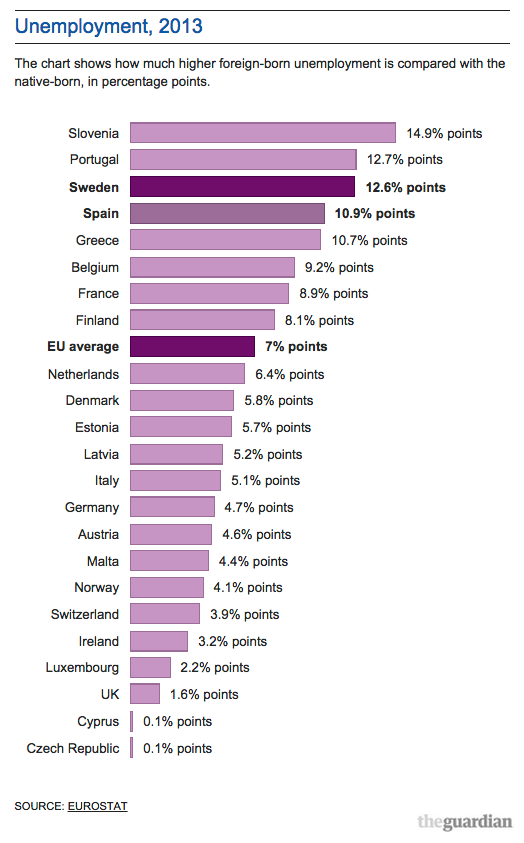
I know I am one of the privileged ones. The latest statistics from Eurostat compares unemployment amongst foreign-born and native-born residents in various European countries. In Sweden during 2013, unemployment was 12.3% higher for foreigners than for natives. This percentage is only higher in Portugal and Slovenia. According to the research, ‘immigrants in Sweden are now more than twice as likely to be unemployed as their native counterparts. In part this is explained by the integration challenge, but in many cases the children of immigrants of certain ethnic backgrounds need to send twice the number of CV’s compared to native-born job applicants before landing a job interview – alongside the challenge, there is also a hint of discrimination.’

This is serious. On the one hand, Sweden is an open and tolerant country. On the other hand, we see the rise of nationalism and the focus on immigration and integration. I strongly believe that what is required are jobs. But not just McJobs. Qualified, relevant jobs. As in my case, through work comes involvement and integration. In Sweden, the foreign-born population is actually more likely to have a higher education compared to the native Swedes. But Sweden has failed to leverage on this. This leads to doctors, lawyers and engineers working as cab drivers and cleaners, something that is corroborated in the OECD International Migration Outlook report which shows that Sweden’s over-qualification rates are among the worst when compared to other advanced economies.

It is no surprise that a failure to integrate foreign born population into Swedish society creates frustration and anger on both sides of the equation. This can be allievated through broad, far-reaching employment initiatives which Sweden has been so good at historically, So be shocked by the statistics and shout this out to the politicians! When we say ‘Welcome to Sweden’, we should mean it.