Swedes number one in the English-speaking league – but at what cost?

In a recent survey, Swedes came out as having the best English in Europe (as a foreign language). They were in the number 1 position, together with Malta, who have English as an official language. Today, a national newspaper presented school results which showed that Swedish students score higher in English than they do in Swedish. In fact, Swedish results are in decline.

I guess this isn’t surprising when you think of how much English is used in daily life in Sweden. Very often, an English word is thrown into the conversation even if there is a perfectly good Swedish word to use. This, coupled with music and media, reflects the fact that English knowledge is on the up.

I think this is a good thing. The world is more and more globalized and today’s kids are tomorrow’s workers, and many of them will be operating in a world of languages other than Swedish. The most worrying part of this development is that Swedish results are down. Every year, small languages become extinct around the world – is this something we can expect of Swedish in centuries to come?

The Nobel Death Prize

image

We are currently in the times of  Nobel prize announcements. Pakistani schoolgirl Malala did not win the peace prize but she has left an indelible mark on our collective memories. She will certainly be remembered. 

But why is there a peace prize in the first place? Well the story goes like this. Alfred Nobel, the inventor of dynamite, woke up one day to his own obituary in the newspaper. Mistakenly, the paper had declared him dead, when in fact it was his brother. As a title for the obituary, the newspaper had written a rather unflattering ‘the angel of death is dead’ and that Alfred Nobel had made it possible to kill more people than anyone who had ever lived. 

Suddenly he understood this is how he would be remembered and, to change it, he founded the Nobel Prizes. Now his name is synonymous with science, literature and peace.

It makes for an interesting reflection. If we could read our own obituary, would we be proud of what we read? Would we also change our behaviours to influence the memory of us and, if so, why not do it now?

The Dream of America – in Sweden

drömmen om amerika

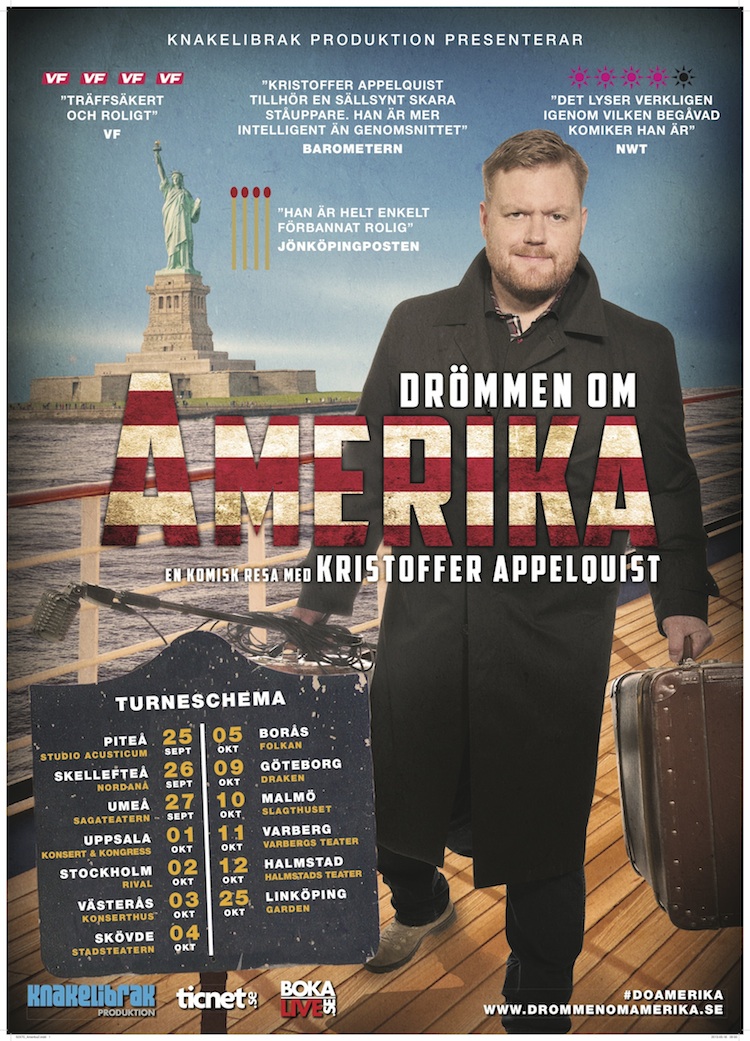
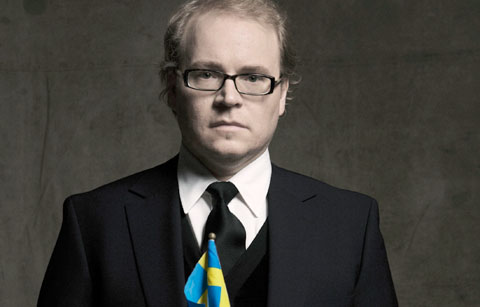
We went to see stand-up comedian Kristoffer Appelqvist at Rival Theatre yesterday evening in his show called ‘Drömmen om Amerika’ – ‘The Dream of America.’ and it was hilarious. The show had, in fact, surprisingly very little to do with America, but focused mostly on Swedish culture and society which was right up my alley!

In each section of his show, Kristoffer Appelqvist started with a childhood dream about the USA, such as how he wanted to be a cop, or how he wanted to be ‘free’, or how he wanted to eat potato chips any time of the day, but then he quickly related this dream to Swedish society and joked mostly about that.

One section of his show was when he described himself as a true liberal, believing in free markets, deregulation, privatisation and freedom of choice just like in America. He was a liberal until an experience changed his opinion. A while ago, he was out ‘easy-riding’ wide-legged on a motorcycle in a remote part of Sweden when he was hit by another vehicle and slammed to the ground.  As he lay on the road, he thought to himself ‘well, this is it, I’ve pissed away my life and now I’m going to die. No ambulance is going to come here because I voted against them in the last election and my private sickness Insurance isn’t going to send someone out to help me. So, this is it. This is where I’ll die.’  To his amazement, 11 minutes later, an ambulance arrived in the middle of nowhere, picked him up and drove him to the nearest hospital where he got care, his own television, nice food and the toothbrush of his colour choice. All at the cost of the tax payer. And it was at this point he understood what his parents had been trying to teach him all along – that although we are often strong and independant, one day we might be down and out and we might need help to pick ourselves up again. Today it could be someone else who needs this support, but tomorrow it might be us. And Kristoffer Appelqvist had a kind of epiphany that it is actually that kind of society he wants to live in.

An interesting, and highly contemporary show when you think about the current debate in the USA regarding Obamacare.

Go see it if you get the chance. He’s touring the country: http://drommenomamerika.se/ 

It’ll be ok, because you’re not Swedish

moving1

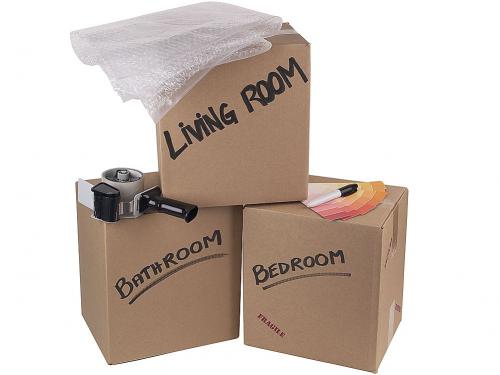
At the weekend I moved apartments. To help me, I employed the services of a moving company. On the day of moving, the three moving guys showed up and one of them, older and grayer, was obviously in charge. Immediately, I noticed that they were talking a foreign language to each other but I didn’t understand it, so I asked the leader where they were from.

‘I’m from Kazakstan and they’re from Azerbaijan but we speak Russian to each other. The Soviets didn’t leave us with much, but they did give us the Russian language’ he said.

Then he asked me where I was from. ‘The UK’ I said.

‘Ah’. he said ‘I thought so! When I spoke to you on the phone last week I thought you weren’t Swedish. And I said to myself this’ll be ok, ‘cos he’s also an immigrant.

This struck a chord with me. His expectation was that everything would be ok because I’m not Swedish. What kind of experiences has he had with Swedish customers that means he has formed this perception? I have heard this before from people of minority groups in Sweden. For example, a shop owner I know who negotiated his rent with the chairman of the Residents’ Board and afterwards said to me ‘Bloody Swede treated me like a damn immigrant!’ Other examples I’ve often heard are from people who accuse Swedes of being ‘arrogant’ and that people who feel ‘disrespected’ and ‘patronised’ by ethnic Swedes.

It makes me wonder if integration is even possible once negative perceptions form and, once formed, how easy are they to change? Cultural perceptions form partly from pre-conceived ideas but also from how we behave towards each other and the cultural interpretation of that behaviour. It is often this interpretation rather than intention that impacts the perception.

Imagine if we were to behave differently, and just see the individual infront of us, not the ‘category’ they belong to. See them and respect them. This would almost certainly lead to the forming of different perceptions and, maybe I’m being an idealist, but I think it would result in a better integration in Sweden.

No religion please – we’re Swedish

svantesson_1081428c

When comparing religious/traditional values with secular/non-traditional values, Sweden always comes out of research as amongst the most secular, non-traditional countries in the world. The low voting frequency in the recent Church elections reflects this. Basically, many people in Sweden don’t want religion to have anything to do with politics and Sweden is one of the few countries in the world that has separated religion and politics from each other.

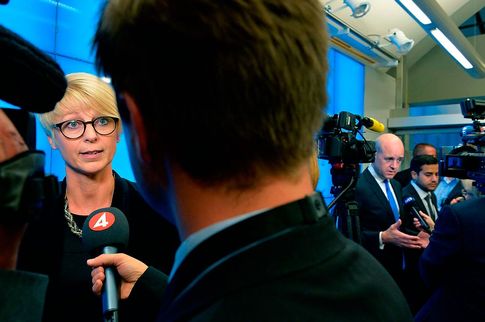
This is clearly shown in the latest outrage to appear on social media in Sweden – the appointment of the new Employment Minister, Elisabeth Svantesson. Ms Svantesson comes from the Swedish Conservative Party – the Moderates – and has recently been given this high profile position in the Cabinet. Where this becomes interesting is what is causing the outrage. It seems that Ms Svantesson holds a religious belief and belongs to a radical Christian organisation which, amongst other things, condemns abortion and homosexuality.

Voices have been risen for her immediate resignation.

This is so different from most other countries around the world. Take a country like the USA -nobody gets to become President there without mentioning God. Many countries are theocracies, where the political leaders and the religious leaders are the same. In most other countries, believing in a religious deity is an advantage, if not a necessity, for a public figure to be taken seriously.

But in Sweden, believing in a God is a rarely an advantage for a public figure. They are often ridiculed and their credibility is challenged by the general public and the press.

And this makes me think…..just when did religion become a liability in Sweden?

‘Att passa på’ and other Swedish pastimes

Fredrik Lindström

Yesterday, I went to see TV celebrity and academic Fredrik Lindström in his one man stand-up show called ”Swedes are also Humans” where he talks about Swedes and Swedish Culture from an inside-out perspective.

One funny thing he talked about was the Swedish pastime of ‘att passa på’. This translates roughly as ‘taking a chance, grabbing the opportunity’. Fredrik Lindström claimed that Swedes love to ‘passa på’, especially when it comes to sitting outdoors. The slightest bit of nice weather and Swedes ‘passa på’ and sit outside, even it requires a woolly jumper, a thick blanket and an infra-heater. This is quite unlike people who live in sunnier climates. He even said that Swedes are provoked by other Swedes who don’t ‘passa på’ and who choose to sit indoors on a sunny July day to watch re-runs of Falcon Crest on TV4Gold.

You probably had to be there to find it funny…..So, maybe you should ‘passa på’ and go see the show. He’s touring around the country.

How many minority languages are there in Sweden?

meänkielen

Swedish is Sweden’s official language and is spoken by most of the 9 million people who live here. Of course, people who live in Sweden speak an array of languages such as English, French, Hindi, Persian and Arabic. But did you know that there are 5 official minority languages in Sweden? In 1999, the Minority Language Committee of Sweden formally declared these five official minority languages.

Finnish – Ethnic Finns make up about 5% of the population of Sweden, and the Finnish language is used by over 200,000 people.

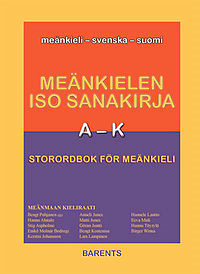
Meänkieli – Spoken by the people of the Torne Valley, it is so closely related to Finnish and is sometimes considered a dialect of Finnish. Between 40,000 and 70,000 people speak Meänkieli as their first language.

Sami – Sami people (formerly known as Lapps) are a people indigenous to the northern regions and who speak a closely related group of languages usually grouped together under the name “Sami”, although at least three separate Sami languages are spoken in Sweden. Between 15,000 and 20,000 Sami people live in Sweden of whom 9,000 are Sami-language speakers. Worldwide, between 20,000 and 40,000 people speak Sami languages (most Sami now speak Swedish, Norwegian, Finnish, or Russian as their first language, depending on the country in which they reside).

Romani – Romani is the language spoken by the Roma people, a nomadic ethnic group originating in northern India. Romani is an Indo-Aryan language, closely related to languages spoken in today’s India, and sometimes written with an Indic Script. Approximately 9,500 people in Sweden speak Romani.

Yiddish – Yiddish is a language formerly spoken by most Ashkenazic Jews. Although the Jewish population of Sweden was traditionally sephardic, after the 18th century, ashkenazic immigration began, and the immigrants brought with them their Yiddish language. There are around 18,000 Jews in Sweden, and about 4,000 speak Yiddish.

Globally Innovative Sweden

zipper

For being a relatively small country, Sweden is very creative.

The Global Innovation Index 2012 ranked Sweden as the most innovative country within the European Union and many inventions have sprung out of this Nordic country. A quick browse on the website http://www.sweden.se lists a few of these inventions.How many of them sid you know were Swedish? 

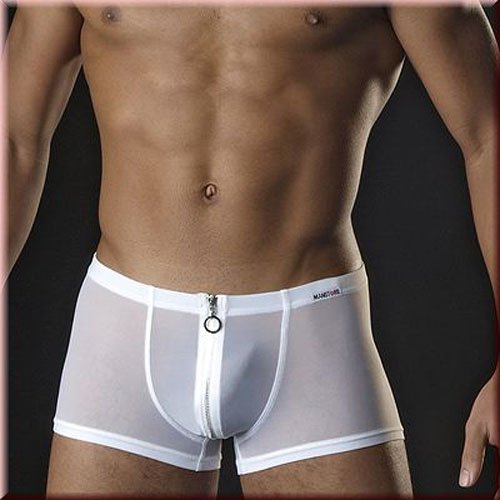
THE ZIPPER The modern-day zipper that we know today was improved by Swedish-American Gideon Sundbäck. His invention was called the seperable fastener and featured interlocking teeth pulled together and apart by a slider for, as the picture demonstrates, ease of access.

AIS Getting completely lost nowadays is difficult thanks to global positioning systems (GPS) which are now an essential part of our daily lives; embedded in various technologies from smartphones to in-car navigation systems. Swedish inventor Håkan Lans is credited with taking GPS technology one step further to create automatic identification systems (AIS) now widely used in the shipping industry for tracking ships and vessel traffic.

THE ADJUSTABLE WRENCH A staple in many toolboxes, the adjustable wrench or spanner, also popularly called “Monkey wrench” or “English key,” often comes in very handy during do-it-yourself (DIY) projects. While the first iteration of this spanner was originally invented in 1842 by British engineer Richard Clyburn, today’s adjustable wrench, the “Swedish Key,” is attributed to Johan Petter Johansson, a Swedish inventor who improved upon Clyburn’s original concept and patented it in 1891.

THE HIV TRACKER A recent addition to the list of Swedish inventions is the HIV tracker: a sensitive device used for mapping out and detecting the spread of HIV and other viruses. Conceptualized by Doctor of Biotechnology Martin Hedström and his team at Lund University, the device can detect extremely low concentrations of poisons, viruses or other substances in liquids — which also makes it potentially invaluable for fighting bioterrorism.

SPOTIFY is a commercial music streaming service providing content from a range of major and independent record labels. Launched in Sweden in October 2008, the service had approximately ten million users as of 15 September 2010 (2010-09-15)about 2.5 million of whom were paying members.Total users reached 20 million by December 2012, 5 million of them paying monthly either $4.99 or $9.99.As of February 2013, the service is available in Andorra, Australia, Austria, Belgium, Denmark, Faroe Islands, Finland, France, Germany, Ireland, Italy, Liechtenstein, Luxembourg, Monaco, the Netherlands, New Zealand, Norway, Poland, Portugal, Spain, Sweden, Switzerland, the United Kingdom and the United States

THE PACEMAKER In 1958, Rune Elmqvist developed a battery-run artificial pacemaker, which was used for the very first pacemaker operation done by surgeon Åke Senning at Karolinska University Hospital in Stockholm. The pacemaker is placed under the heart patient’s skin and the electrical pulses it generates ensure that muscles expand and contract normally, regulating the heart.

POWERTREKK PowerTrekk is a portable charger that uses eco-friendly fuel cell technology to convert hydrogen into electricity. By adding one tablespoon of water along with the fuel pack to the charger, you can connect any compatible electronic device — mobile phones, GPS, laptops, digital cameras — to the PowerTrekk to instantly charge it.

TETRA PAK Thanks to the revolutionary paper-based packaging system called Tetra Pak we can now carry our milk home from the grocery store in cartons instead of glass bottles. Conceptualized in 1946 by Erik Wallenberg and produced by Ruben Rausing, Tetra Pak’s technology is used for storing and distributing liquids, semi-liquids and dairy products.

THE THREE POINT SEATBELT Now a standard requirement in every passenger vehicle saving around one life every six minutes, the three-point seatbelt was developed by Swedish inventor and safety engineer Nils Bohlin in 1959 for Volvo. It’s designed with a Y shape to spread out energy across a moving body during an accident.

ULTRASOUND / ECG Ultrasound is so integral to healthcare today that remembering a time when it didn’t exist is difficult. Along with German researcher Carl Hellmuth Hertz, Swedish physician Inge Edler devised the modern day echocardiograms — a Doppler ultrasound of the heart — that are integral to monitoring cardiovascular health. This invention netted both Hertz and Edler a highly coveted Albert Lasker Clinical Medical Research Award in 1977.

SKYPE Skype was founded in 2003 by Niklas Zennström from Sweden.The Skype software was developed by the Estonians Ahti Heinla, Priit Kasesalu, and Jaan Tallinn, who together with Friis and Zennström were also behind the peer-to-peer file sharing software Kazaa.In August 2003, the first public beta version was released.

No kids please. we’re Swedish

no-children-480

A local café where I live, on the island of Kungsholmen in Stockholm, has recently created debate in the kingdom of Sweden. The owner of the café, tired of having ‘undisciplined kids’ running around the café, put up a sign on the entrance forbidding children. Many people were outraged. Others, me included, cheered at the bravery, the audacity, in a country where many parents let their children run riot. Many of us who want to sit in cafés and sip our macchiatos in peace were excited by this ban.

But then i thought about it, and analysed it from a cultural perspective. Forbidding children, forbidding anyone – is that actually ok? Who would be next on the ban-list? People in wheelchairs? Blacks? Gays?  

As I often write here, Sweden is a country that is leading in many humanitarian values, such as equality and accessibility to people, power and information. In a country like Sweden, a ban like this contradicts everything that most Swedes believe in. So while it may seem like a good idea at the time, it is in fact a discriminatory act.

So maybe the issue is the lack of discipline that parents seem to have for their children? Very possibly so, but kids are kids, and kids make a noise. They cry, they laugh, they talk. And while this is disturbing to other patrons like me, on one level it can be seen as their right to do so until they have learnt the ruling social codes associated with the context they find themselves in.

I believe the café owner has now removed the ban. However, I presume not because he sees the equality issues surrounding this case, but because he received so much negative press that was damaging his business.

If we want freedom in our country, we have to fiercly protect it. Freedom was not won easily but can be slowly chipped away at until one day we are living in a society we actually dont want. Freedom means for everyone. Even when we are personally irritated by certain behaviours or attitudes, freedom is for everybody. And that, to a very high degree, applies also to our children.