How to be a parent in Sweden

Back in the days when we could fly, we all used to find ourselves sharing airport space with lots of other people. This led to me developing a specific skill. Wherever I was in the world, I could always identify the Swedish families. It wasn’t to do with language or looks or fashion style. No, it was to do with parenting.

If there was a child, or children, sprinting around the airport without the supervision of an adult – they were without a doubt Swedish. If kids were screaming at top volume without parental intervention – Swedish. If restaurant queues were building up because a kid couldn’t decide what to eat – invariably Swedish. In an airport, the Swedish parenting style was on show for everybody to see.

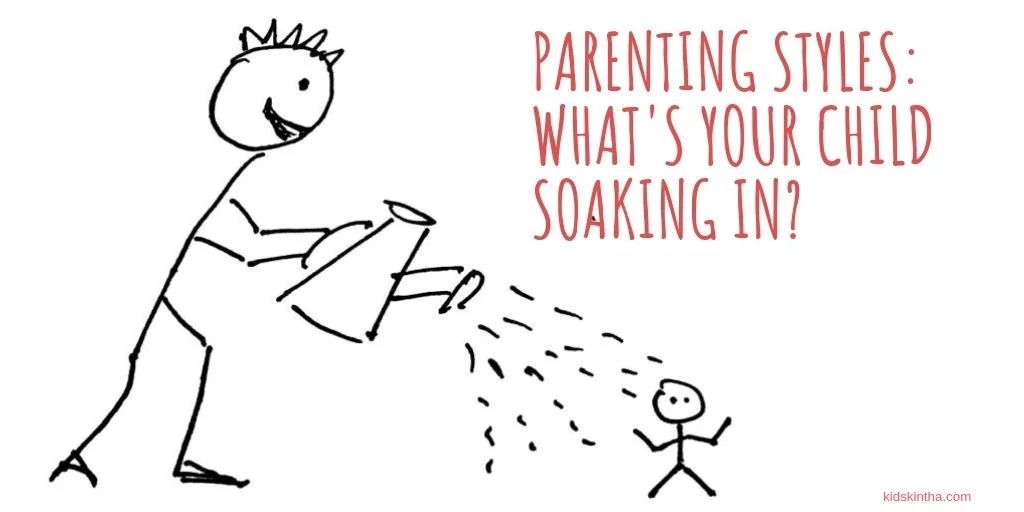
Swedish parenting is child-centric and comparatively free. It can be perceived as permissive and hands-off. Most parents adopt a communicative style with their children, which can seem to the untrained eye that this means there are no boundaries and no consequences. Children are from an early age involved in decisions that affect them, which is in contrast to a more authoritative and punitive style of parenting found in other countries. This leads to a population where self expression and independence is important

Here are 5 typical parenting behaviours in Sweden:

1) Egalitarian parenting. In Sweden, parents get 480 days of paid parental leave to share and, in heterosexual relationships, 90 of those are non-transferable days for fathers only. This is intended to achieve a more equal division of child-rearing responsibilities. This often extends into the division of duties in the home. So both men an women cook, clean, change nappies and stay home with sick children. For Swedes, it’s a no brainier.

2) Cosiness and cuddling. Friday evenings are reserved for family time. Called ‘fredagsmys’, or Friday coziness, it is when families curl up under a blanket, light candles and watch a film or series together—all while eating tacos, pizza, crisps and sweets. It is not unusual for kids to sleep in their parents’ bed until they reach double digits.

3) Right to Day Care. Every child in Sweden has a right to attend day care from one year old. Day care is subsidised and cheap. At Day Care, the kids spend most of their time playing—academia usually begins in earnest around 6 years old. The other reason for organised child care is so that parents can quickly return to the tax-paying workforce – and collectively finance child care and rest of the welfare state.

4) No spanking. Hitting a child is unthinkable – and illegal – in Sweden. Sweden was the first country in the world to ban spanking and all corporal punishment in 1979. As mentioned before, Swedes apply communicative style of parenting and discipline their children by talking and reasoning with them.

5) Go outside. Outdoorsiness starts early with parents leaving their children outside to sleep in their prams in sub zero temperatures. The crisp air is thought to be good for them. In schools, kids go outside and play every day—regardless of the weather. Some day care solutions are set outdoors with kids spending all day every day in the woods. In the summer, it’s not unusual to see naked kids on the beaches, reflecting Sweden’s relaxed attitude to nudity. Sports and being outdoors are highly prioritised in Sweden. Fresh air, and getting dirty, are considered healthy.

So back to those Swedish kids in the airport. Sure, they justifiably could be seen as unruly, disrespectful and unsupervised. But in equal measure, their behaviour can be a result of a flexible, free parental style that encourages independence and self sufficiency from an early age.

The Swedish Death Penalty

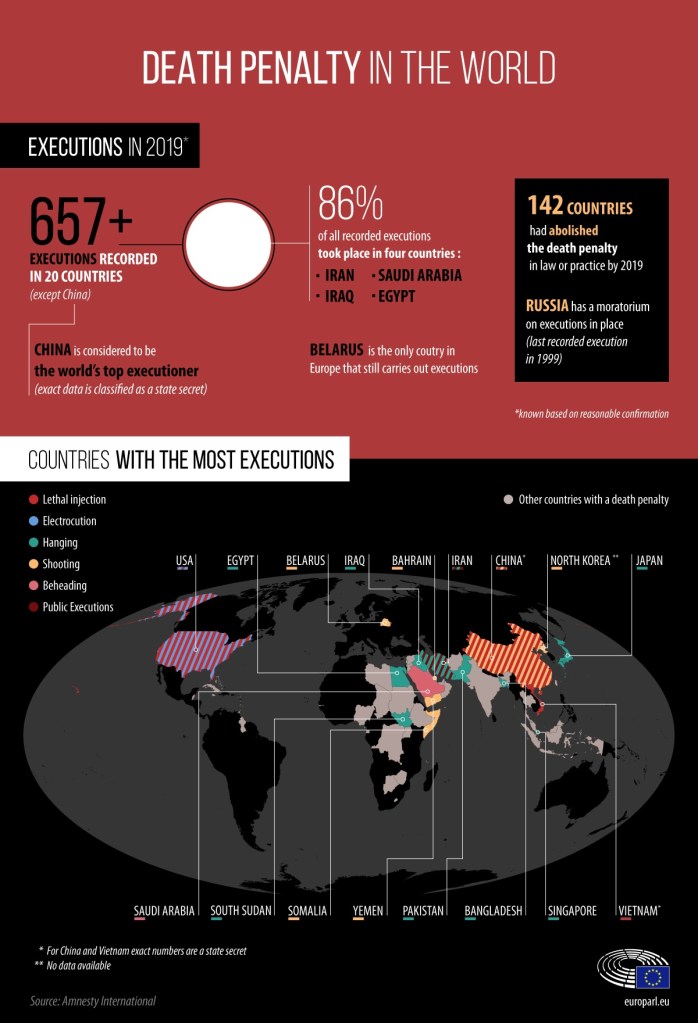
The name Bridget Bishop might not mean anything to you – unless you are seriously into history. On this day, June 10th, in 1692 Bridget Bishop was the first woman to be hanged during the Salem Witch Trials in Massachusetts. In total 19 women were accused of witchcraft and hanged and many others were persecuted. Capital punishment still exists in the USA, with lethal injection and electrocution as the favoured methods. In 2020, 17 executions were carried out in the USA.

In Sweden, capital punishment was legal until 1973, although an execution was last enacted in 1910 on murderer Johan Alfred Ander. The last death penalty was actually given in 1927 but the sentence was changed to hard labour. In 1917, Hilda Nilsson, a child murderer, was sentenced to death. She escaped execution, however, by committing suicide. That meant that the last woman to be executed in Sweden was murderer Anna Månsdotter in 1890.

At the time of its abolition in 1973, beheading was the legal method of execution. Today capital punishment, corporal punishment and torture are all outlawed in Sweden.

Interestingly, 110 countries have completely abolished capital punishment like Sweden. However, over 60% of the world’s population live in countries where the death penalty still exists, such as USA, China, India, Nigeria, Saudi Arabia, Iran and Japan.

Sex working in Sweden

Today, June 2, is International Sex Workers’ Day. It is celebrated today because on 2 June, 1975, 100 sex workers occupied the Sant-Nizier Church in Lyon, France to express anger about their exploitative living conditions and work culture. The Church was brutally raided by the police forces on 10 June. This action became a national movement and the day is now recognised in Europe and worldwide.

In 1999, Sweden was unique in the world with the introduction of a ‘Sex Purchase Act’. The act makes it illegal to purchase sex but not to sell it. Under this law, it is the customer that is the criminal but not the sex worker, who is considered to already be in a vulnerable position. The law is based on the principle that prostitution is an act of violence against women. The ‘Swedish Model’ has been duplicated and adapted in the other Scandinavian countries as well as Canada, Ireland and France.

The Swedish Sex Purchase Act stands as a complete opposite to the laws in Germany and the Netherlands where the purchasing of sex services is legalized. Proponents of the Swedish law would at this is why Germany and the Netherlands have become European hotspots for sex tourism and trafficking.

However, many organisations, including Amnesty International, WHO and Human Rights Watch oppose the Swedish model. They suggest instead that legalization improves the sex worker’s access to health care, their ability to report crime and ability to organize themselves in, for example, unions. They also claim that the sex worker is not always a victim of the situation and that the Swedish law forces them into risky behavior and contributes to their poverty.

Despite the criticism, the Swedish law stands strong and does not look like it will be changed anytime soon. It seems that most Swedes agree with the law, based on the belief that nobody has the right to buy another person’s body.

What do you think?

Swedish hits 1: Waterloo

With the Eurovision contest over, it is safe to say that Sweden’s song won’t be an international hit. Sweden does generally well in the competition, partly because they take it very seriously and partly because they have many talented song writers, singers and musicians. In fact, Sweden is the third largest exporter of pop music after the USA and the UK.

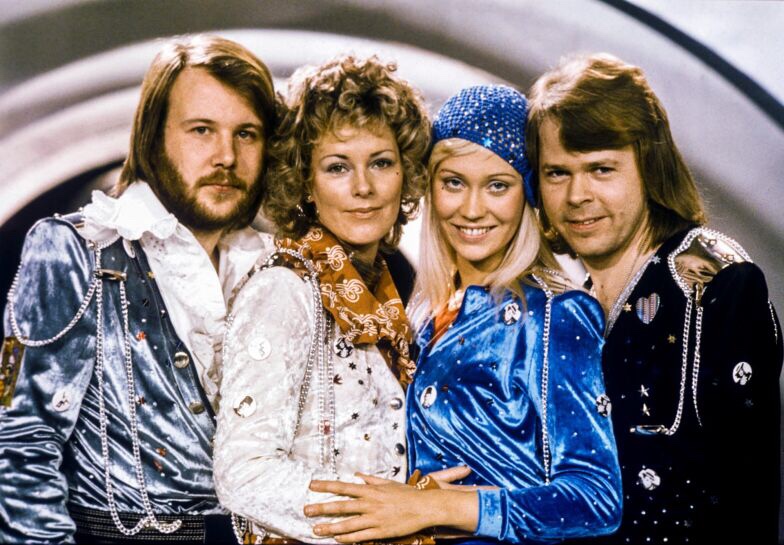
So this has inspired my next series – Swedish hits. I will include hits that you may not even know are Swedish and ones that are so Swedish, they almost smell of meatballs and aquavit. The first hit – an obvious choice – is ABBA’s Waterloo.

ABBA represented Sweden in 1974 in Brighton and won the competition. It was Sweden’s first win of six, and it catapulted ABBA into a legendary career. The song itself was a huge international success, achieving number 1 chart positions in 8 countries and the top 10 in countless others.

The song, written by Andersson, Ulvaeus and Anderson was originally given the much worse title of ‘Honey Pie’. The song was voted the best Eurovision song from the competition’s first 50 years and has somehow come to symbolise the contest because of its catchy tune, memorable lyrics and ABBA’s camp outfits.

Waterloo wasn’t ABBA’s most successful song however. Dancing Queen is their undeniable biggest hit, followed by Super Trouper and Knowing Me Knowing You.

After a decades-long hiatus, ABBA has announced that they will be releasing new music this year. This has been met by ecstasy from fans all over the world. Let’s hope that the songs are not a disappointment and that Abba finally faces its waterloo.

Swedish museums

Today, 18 May, is Museum Day. While most are still closed down due to the pandemic, some are open with restricted hours and pre-booking. In total there are around 170 museums in Sweden, many with free entrance. Stockholm has over 100 museums, making it one of the most museum-dense cities in the world. According to statistics from Sweden’s Museums, here were the top 5 most-visited in Sweden in 2019.

1. Vasa Museum – the restoration project of a large galleon that sunk in Stockholm’s harbour in 1628. Amazing place, and my personal favourite.

2. Skansen – Stockholm’s open air museum depicting Sweden’s historical architecture and culture. Has also a zoo and a large stage for outdoor concerts.

3. National Museum – Sweden’s art and design museum, situated opposite the Royal Palace.

4. Nordic Museum – museum about how people in the nordics have lived, eaten, dressed throughout the centuries

5. Natural History Museum – biology and geology museum with a popular 760 meter dome shaped cinema screen.

All of the above are in Stockholm. Outside the capital, the most visited museums were Frilufts Museum in Linköping, Malmö Museum in Malmö, Wadköping in Örebro, Dunkers in Helsingborg and Gotland Museum on the island of Gotland.

There seems to be a museum for most things in Sweden. Some unusual examples are the Matchstick Museum, the Abba Museum, the Spirit Museum, the Lenin Spa Museum, the Newsagent Museum, the Thermos Flask Museum, the Amber Museum, the Leather Museum, the Cannibal Museum and the Video Game Museum.

Whatever your preference there is a museum to suit everybody in Sweden. Once the doors are open again, I strongly recommend a visit to at least one of them!

Swedish expression: Between the bird cherry and the lilac.

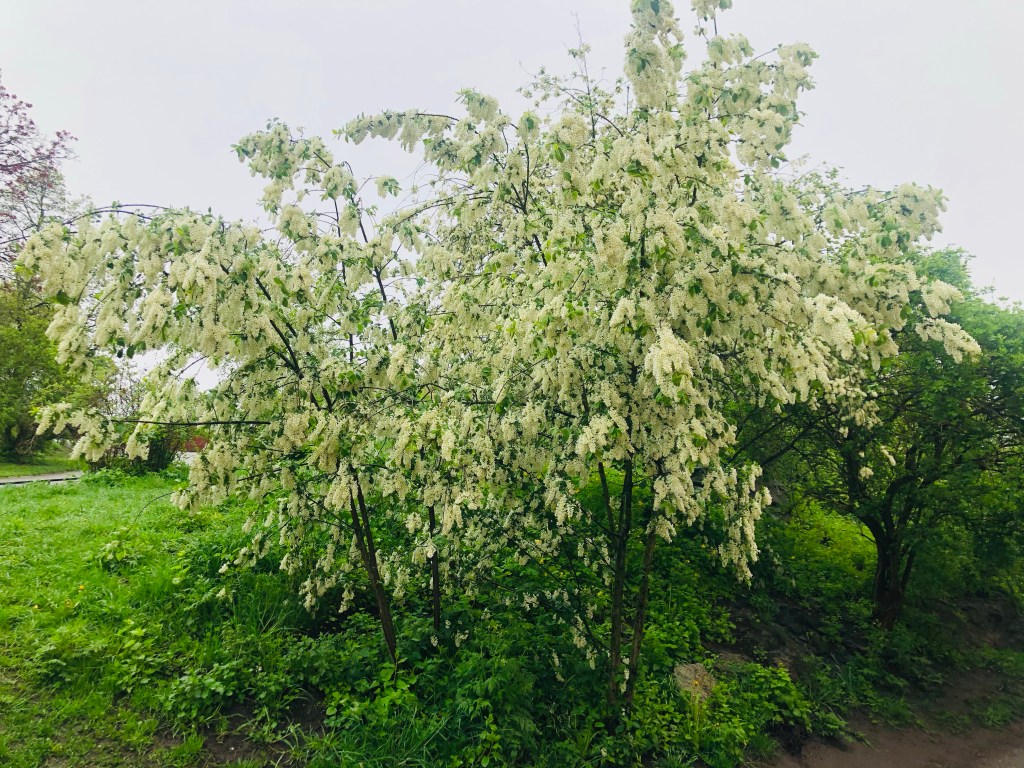
Right now in Stockholm we are between the bird cherry and the lilac. This Swedish expression ‘Mellan hägg och syren’ is used to describe this short period between when these two bushes blossom. At the moment the bird cherry is blossoming, but not yet the lilac. The period reflects the early days of summer and for many Swedes it is the most delightful time of the year. A friend of mine nostalgically said yesterday that ‘it smells like end of school’.

So where does this expression come from? Well, the common theory is that it was first used by a cobbler who put a sign up in the window of his shop. He had decided to take a brief holiday, and the sign read ‘closed between the bird cherry and the lilac’.

Stupid Swedes

Sitting with some friends yesterday, we discussed why the Swedish word ’korkad’ (corked) means stupid. After much research, we couldn’t find an answer but we guessed it had something to do with the fact that cork is empty, light and flighty. Another thought was once you have uncorked a bottle and drunk it, it is an empty vessel.

We might not have found the origin of the word ‘korkad’ but we did find lots of expressions in Swedish to call somebody stupid. Here are 15 of them!

1) Bakom flötet – behind the float (fishing)

2) Tjockskallig – thick skulled

3) Tappad bakom en vagn – dropped behind a carriage

4) Tappad i backen – dropped on the ground

5) Ut och cyklar – out cycling

6) Dum i huvudet – stupid in the head

7) Fårskalle – sheep skull

8) Obegåvad – ungifted

9) Har inte alla hästar i stallet/hemma – doesn’t have all his/her horses in the stable / at home

10) Inte den vassaste kniven i lådan – not the sharpest knife in the drawer

11) Hjulet snurrar men hamstern är död – the wheel is turning but the hamster is dead

12) Född i farstun – born in the porch

13) Har inte alla kottar i granen – doesn’t have all the cones on his/her fir tree

14) Jubelidiot – celebrated idiot

15) Hissen går inte hela vägen upp – the lift doesn’t go all the way to the top floor

Then there are lots of words like ‘korkad’ that are fun to say and all mean stupid. For example, ’trög, bombad, knasig, knäpp, puckad, pantad, pundig, beng, bläng, boll, ding, fläng, prillig, stollig, svagsint, rubbad, koko, blåst’.

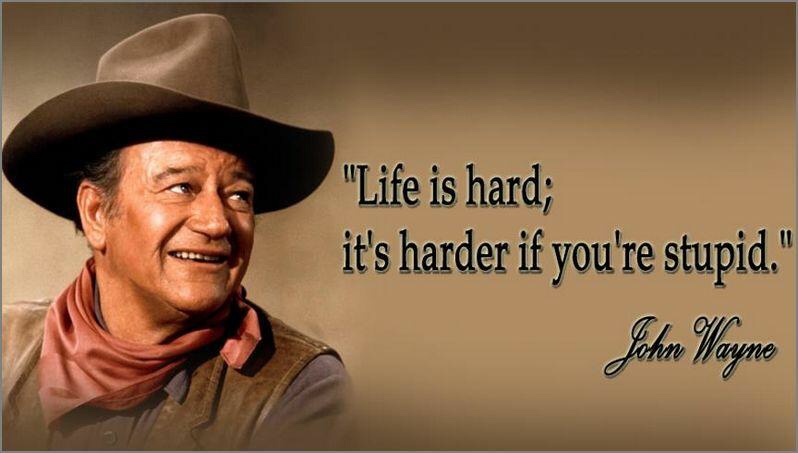
Who knew there were so many ways to call somebody stupid in Swedish? I tend to just say ‘dum’ but I’m now going to practice a few more of these words and expressions.

Swedish cartoons – a bear, an elk, a cool dog and a hotdog

Today, May 5th, is International Cartoonists’ Day, designed to celebrate this specific craft and art form. For all of us, cartoons are part of the tapestry of our lives, and it’s hard to imagine a media landscape without them. This isn’t surprising given that the art form as we know it today – in newspaper, magazine and film – goes back around 170 years.

Although hand-drawn stories originated in the Middle Ages, the satirical and humouristic form we know today started in 1843 in the British Punch magazine. The longest-running newspaper cartoon strip is called The Katzenjammer Kids, known as Knoll and Tott in Swedish. This strip has been published in the American Humorist since 1897. The earliest animated cartoon for film is considered to be Fastasmagorie by French cartoonist Émile Cohl, drawn in 1908. It wasn’t until 20 years later that the first Disney film – Steamboat Willy – appeared, featuring the very familiar Mickey Mouse

So what about Sweden? What is Sweden’s history of cartoons? Cartoon strips in Sweden started in the late 1800’s/early 1900’s. The oldest cartoon strip that is still being published today is 91:a, which started in 1932. In Sweden, international cartoons have been very popular. Although originating abroad, their names are usually Swedified. For example, Donald Duck is Kalle Anka, Popeye is Karl-Alfred and Fred Basset is Laban. The Finnish cartoon Mumin is also very popular. There are, however, some strips that have been drawn by talented Swedish cartoonists. Here are a few:

1) Bamse. The most successful cartoon from Sweden. Bamse is the world’s strongest bear, who eats honey and is best friends with a rabbit (Lilla Skutt) and a tortoise (Skalman). Drawn by Rune Andreasson, Bamse has his own comic strip, magazine and films. When Swedes give each other a strong hug, they call it a ‘Bamse hug’.

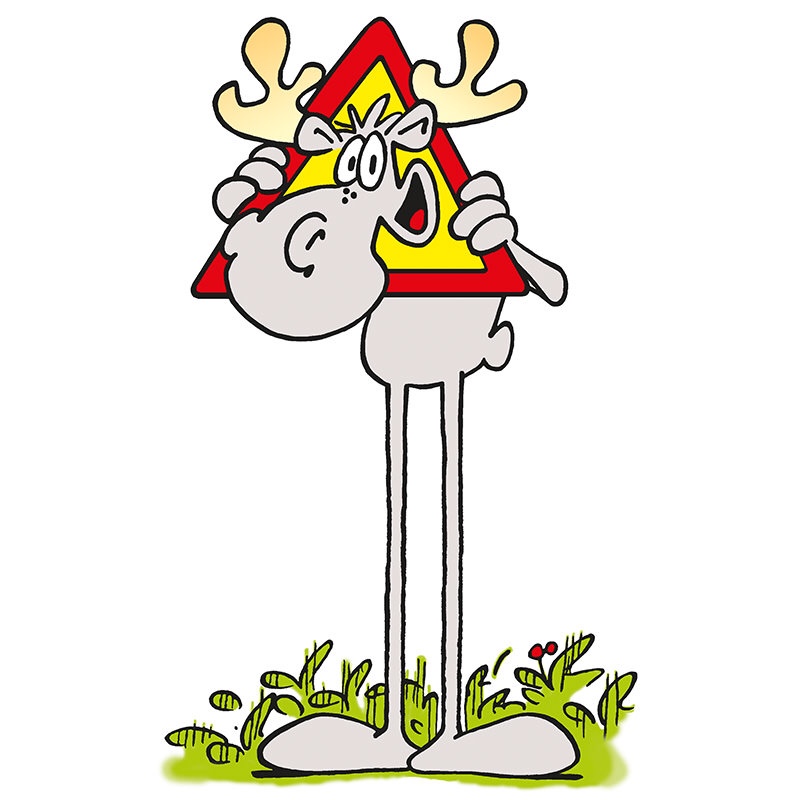
2) Hälge. A melancholy elk drawn by Lars Mortimer. Hälge is constantly on the run from Hunter Edwin and his dog Blixten, who he manages to outwit season after season.

3) Rocky. Cartoonist Martin Kellerman created this autobiographical character aimed at the adult reader. Rocky is a cool dog, the same age as Kellermann and is also a cartoonist. The character is philosophical, satirical and critical and has even been converted into theatre.

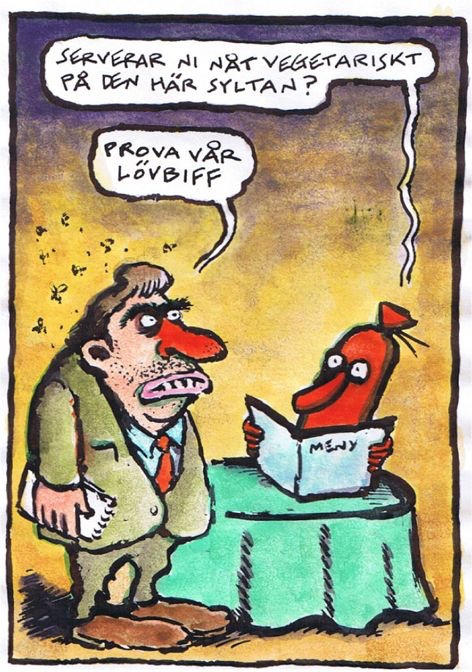
4. Assar. A satirical comic strip that appeared in Swedish newspaper DN, drawn by Ulf Lundqvist. Assar is a talking hot dog who has escaped the hot dog stand and lives in a depressed village populated with small-minded residents. Many of the later stories focused more on these residents than on Assar himself.

All of the examples are successful strips drawn by men. There are several acclaimed female cartoonists in Sweden also. Lena Ackebo and Nina Hemingsson are probably the most well known. Both are satirical cartoonists, with distinctive style. They draw a variety of players, and do not restrict themselves to portraying the antics of one particular named character.

Lena Ackebo cartoon
Nina Hemingsson cartoon

What other Swedish cartoonists deserve a mention? Please let me know below!

Why is May 1st celebrated in Sweden?

In Sweden, and in many other countries, May 1st has been embraced as the International Workers’ Day. In 1938, May 1st became Sweden’s first non-religious public holiday and has been an important celebration of labourers and the working classes since then.

But why specifically May 1st?

The answer is found in a massacre in the USA. On 1 May 1886, laborers in Chicago went out on strike for an 8 hour working day. On 4 May 1886, Chicago police and the demonstrators clashed and 11 people died. The event is called the Haymarket massacre. Seven of the demonstrators were sentenced to death, despite lack of evidence. To commemorate the massacre, the socialist organization suggested that 1 May should become day of demonstrations every year.

Around Sweden, traffic is shut off, huge flag-waving demonstrations are held and people gather to hear speeches from their politicians and representatives. Since the demonstrations are most commonly from the political left, the streets are awash with bright red flags and banners. However, this year, like 2020, is different. As large public gatherings are banned, the speeches are instead broadcast from a studio over Facebook and YouTube.

Contrary to the stereotype, not everybody in Sweden supports left wing political groups. Many Swedes lean towards the centre or the right. For them, today is just a day off work – an opportunity to perhaps nurse hangovers from the festivities of the previous evening or to relax, watch Netflix, go for a walk and enjoy the day.

Walpurgis Eve – when spring arrives in Sweden

Today, 30 April, is Walpurgis Eve, called Valborgsmässoafton in Swedish. The name Walpurgis is taken from the eighth-century Saint Walburga, and in Sweden this day marks the arrival of spring.

On this evening, Swedes usually gather to celebrate together. This pandemic year is of course slightly different as crowds are not allowed.

The forms of celebration vary in different parts of the country and between different cities. Essential celebrations include lighting a large bonfire, listing to choirs singing traditional spring songs and a speech to honour the arrival of the spring season. Walpurgis bonfires are an impressive thing to see and are part of a Swedish tradition dating back to the early 18th century. At Walpurgis, cattle was put out to graze and bonfires lit to scare away predators.

The weather is often unpredictable on Walpurgis Eve. It can be sunny and warmish, or it can still snow on 30 April! Despite bad weather, Swedes still shiver around the bonfires and ironically celebrate the arrival of Spring.