Taking a stand for Sweden’s neighbours

Image

Finally! That’s all I can say! Finally!

The Swedish Minister for Sport, Lena Adelsohn Liljeroth, finally took a stand today against the homophobic Russian regime and announced she will not be attending the Olympic Games Opening or Closing ceremonies in a couple of weeks. In declining the invitation, she joins USA, Germany and France who have previously stated they will be boycotting the ceremonies.

Many people say sport and poltics do not belong together. However, while each individual sportsperson absolutely has the right to fulfill their personal dreams of an Olympic medal, regardless of the country where the games are being held, I believe that governments should have a different perspective. By attending a high-profile event in a country which has dubious human rights, politicians are indirectly condoning the actions of that country. By not attending, politicians are taking a stand against oppression and violence.

I am today proud of Lena Adelsohn Liljeroth and hope that other Swedish politicians and dignitaries will follow suit.

Do you see the horse?

See the horse

Much intercultural understanding arises from misinterpretation and misconception. We tend to think our perceptions of something are correct, when often they can be very wrong. What we see usually isn’t the whole picture.

In a cultural situation, simple situations such as how much eye contact we give people when we talk, how close we stand to somebody when we communicate and what kind of gestures we use are all examples of things that can easily lead to misinterpretation. I remember when I moved to Sweden and some of the misperceptions I had because I didn’t understand the whole picture. I remember, for instance, thinking Swedes were unfeeling, purely based on the lask of emotional response and the more reserved body language than I was used to. I was wrong. Just because a person doesn’t gesticulate or emphasize when they speak does not mean they feel any less.

The road to cultural sensitivity is paved with misunderstanding, misinterpretation and false perception. One key is to suspend judgement about another person or a specific situation and instead try to see the larger context. To ask ourselves why might this have happened? What are all the possible interpretations?

Look at it from another angle, who knows what might emerge. Just like in the visual above…so, do you see the horse?

Are Swedes always off work?

keep-calm-its-nearly-holiday-time

‘Swedes never work, they’re always on holiday’

This is a frequent comment I hear when I work internationally. Colleagues and sometimes customers abroad, are irritated by the fact that they can’t get in touch with Swedes from, for example, the end of June to the second week of August. Sweden seems to be shut down! ‘Swedes never work, and are also lazy’ – they say.

I, of course, defend Sweden’s holiday structure by emphasizing that people work longer hours in the winter to compensate for shorter hours in the summer time. Or that the winters are so long here, it’s only natural that people want to be off work during the warmest, brightest time of the year. Or that thanks to advances in technology, Swedish employees are often still accessible though they might not be at the actual workplace. Or I even try the argument that Sweden has a healthy work-life balance.

These arguments however often fall on stony ground and I am often disbelieved. People shrug their shoulders, shake their heads and roll their eyes. From their perspective, Swedes are spoiled.

I try to encourage cultural understanding, I really do. But sometimes it’s not that easy. For example, situations like this Christmas and New Year don’t help me to be more persuasive. While most Americans got 3 days off work and many Brits got 5 days of work, Swedes frolicked in the free time they were able to access. This festive period was commonly referred to as an ’employees’ Christmas’ meaning it was good for the employees and not for the employers. Many Swedes (and me too) are back to work for the first time today, and have been free since the 23rd December 2013. That makes a total of 12 days off work – 16 days if you also count the weekends.

You see Swedes don’t only take the national holidays off – they also take off the ‘Eve’. So although ‘Christmas Eve’ and ‘Midsummer’s Eve’ are technically not national holidays, they are celebrated as though they are. And then it’s also considered a right to be able to take off a half a day before the ‘Eve’ just in order to get ready for the approaching celebrations. If a national holiday falls on a Thursday or a Tuesday then there’s also something called a ‘Bridge day’. It’s not officially a holiday but most people take it off because there’s no point in going in to work for just one day is there? This Christmas season had a couple of bridge days in it to pad out the time taken off work and required only a little bit of personal holiday leave to be taken.

So the question becomes are Swedes happy that they got 16 days off work? I think most are. But on social media, in the office and on public transport, others complain that it wasn’t long enough, that they’re exhausted or that they need a break.

Mmm, maybe there’s something in the perception of the spoiled Swede?

Glocalization in the Swedish market

glocalizationREV4

Sunny holidays. Weight loss. Healthy eating.
All of the above are currently hot topics in Sweden. Maybe this is not so surprising after the Christmas break, but there is another reason why this is interesting.

Are you familiar with the term ‘glocalization’? The term was made popular in the 90’s by sociologist Roland Robertson and describes the adaptation of a product or service specifically to each locality or culture in which it is sold. The goal of course is to make the product or service more attractive in order to sell more. The method of glocalization is a smart way to meet local needs and at the same time expand business globally. In some ways, it is the opposite of Americanization – which just applies one business model and product wherever in the workd it is. More and more companies are attempting to expand their business in the way of glocalization.

One example of glocalization is the dominant advertizing in a specific region or country. The advertized products or services that most appeal to the locals reflects what the locals perceive as interesting and important. The type and content of the adverts often reflect the attitudes and values of the society. One example I remember is when I was standing on an underground platform in Stockholm a while ago, and I was confronted by huge adverts containing lots of naked backsides, of all shapes, sizes and genders. In the UK, this would probably not occur, but in Sweden, there is a more relaxed attitude to and acceptance of nudity.

Glocalized advertizing is often seasonal. A short glimpse in newspapers, tv, Internet or billboards around Sweden tells us what the locals prioritize at this time of the year – holidays! Almost everywhere you look, there is an advert promoting a sunny break away from the dark and the cold of the Scandinavian winter. The second most common advert at the moment seems to be weight loss -an apparent necessity for getting into that swimsuit on that quickly-approaching sunny holiday.

Another illustration of glocalization is actual adaptation of products. For example, the way in which hamburger chain McDonald’s changes its menu and promotions to appeal to local tastes. In France, for example, they replaced their Ronald McDonald mascot with Asterix the Gaul, a local cartoon character. When in Spain a few years ago, I noticed that McDonald’s had McTapas on their menu. Currently, in Sweden, the food chain is marketing ‘fullkorn’ (wholegrain) burger bread. This clearly appeals to the Swedish consumers’ health interests and the prevailing trend of slow carbohydrates but I’m guessing that they don’t market this kind of bread in, for example, India.

What might we see next if McDonald’s takes glocalization to a Swedish extreme? The festive McSilvia Burger Royale? The homely McTastyMeatballs? The appetizing Mc Filet-of-Herring? or the absolutely delicious McPalt?

Sweden 2014 – two hundred years of peace?

20131230-084644.jpg

So it’s soon the start of a new year – 2014. Another year of sublime and strange Swedish things.

Over Christmas the Swedish King mentioned something in his speech, something that is repeated in the media. For Sweden, 2014 marks the 200th year of peace. In 1814, Sweden signed a treaty with Norway thereby giving them independence. And Sweden, it is claimed, haven’t been at war since then. 200 years of peace is something that the media is proud of.

But hang on a minute. Sweden was ‘neutral’ in the Second World War, but still allowed German troops to cross the nation as they occupied Norway and the country sold iron to Germany for their weapon industry.

In 1961, Sweden was involved in the war in Congo, in the 1990’s in Bosnia and, as we speak, Swedish armed forces are active in Afghanistan and the Libyan Civil War.

Maybe it’s semantic, but is there actually any difference between being in a war and being at war?

Throwing cakes in Swedish politics

jimmie cake

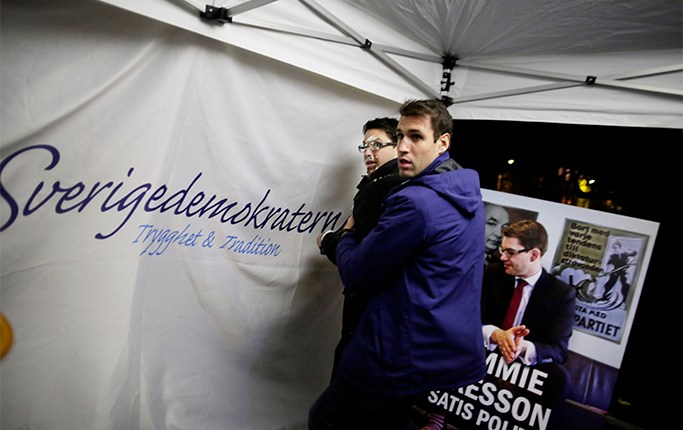
Yesterday evening I happened to be on Nytorget, a square in Stockholm, at the same time as the extreme right wing party, Sweden Democrats, were having a rally. Jimmie Åkesson, the leader of the party, which is gaining favour in Sweden, was signing his newly-released book and a queue of people were standing there to get their copies signed. There was a large group of anti-fascist demonstrators there chanting and protesting their opposition. The whole thing was monitored by armies of police and, despite this, one demonstrator managed to squeeze past security and throw a cake into Jimmie Åkesson’s face. Now, while I in no way condone the thowing of the cake, in fact I think it’s undemocratic and counter-productive, it is a sign of anger and frustration at the politics the Sweden Democrats are trying to enforce in Sweden.

On the way home, I walked past the now-deserted location of the demonstration and saw a lot of trampled flyers on the floor. I picked one up to read what message was being preached by this party. And I was struck by the excellent rhetoric, the smart marketing and the smooth packaging. I don’t care to repeat the message here as I don’t accept it, but needless to say the PR included in the flyer complained about the cost of immigration and appealed to the major concerned groups in society – to the sick, to the elderly, to families and those scared about crime and national security. At the same time, the material promotes ‘safety and tradition’ and the maintenance of the fallacious Swedish identity.

The effective rhetoric is remniscent of a time in the not-so-distance past and the success of the 1930’s Nazi party. Hitler was a clever rhetorician and had the ability to appeal to the masses and exploit their fears in order to gain power and introduce a disgusting politics. All over Europe today, other right-wing rhetoricians are manipulating the citizens and gaining power to implement cynical policies in their respective countries. And they are on the rise in Sweden.

For those of us who are against their xenophobic, homophobic and mysogynistic agenda, we can take a stand by exercising our freedom of speech and our democratic vote. Throwing cakes is not a way to win this argument, it just fuels the sympathy for them. The way to win is in dialogue, debate and discussion – with our parents, our colleagues, our children.

The illusion of the collective Swede

welfare state

Is the notion of the collective Swede just an illusion?

Sweden is famous around the world for its welfare state – the system of tax that provides for the country’s citizens from the cradle to the grave. This system was introduced by politicians from Sweden’s social democratic history and I think that it’s great that it exists. Many assume that the Welfare state is the product of collective thinking and solidarity. Maybe it is. But I’d like to offer an alternative perspective.  

In collective-oriented societies, individuals operate within the context of what is best for the group, even if that means surpressing their individual needs. In exchange for this, they receive loyalty and support from the other members of the group.  

In Sweden, it would be easy to look at the welfare state and relate it to the above definition of a collective. In Sweden, citizens comply to the tax laws and in exchange they are taken care of in times of need.

But let’s look at the welfare state through the lens of individualism instead. According to research, Swedes are amongt the most individualistic countries in the world. Individualistic from the perspective of self-development, self-expression, right to live life the way I want to, self actualization,, freedom to make individual choices about my life. Amongst Swedes, it is very important to have individual choice, to the point that some people feel violated if they experience another person has in some way limited their choices, however minor that might seem.

 So what about the Welfare state? In Sweden, the strong individualistic drive of the citizens created a system in which they don’t have to take responsibility for the group. Once tax is paid, the state takes care of the unemployed, the sick, the elderly so the citizens don’t have to, and consequently people can go about their lives fulfilling their individual dreams and satisfying their individual needs.

When you look at it this way, Sweden’s Welfare state is not an exercise in social solidarity. It’s an exercise in pure individualism.

So is the notion of the collective Swede just an illusion?

Sweden versus Switzerland

swedswiz

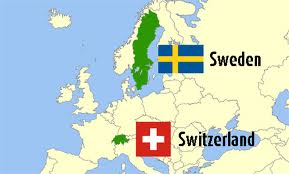
How many times hasn’t Sweden been confused for Switzerland? Many Swedes relate stories of the mix ups that they’ve encountered in their lives. Well it seems that the same happens to Swiss people.

Apparently this is so serious that the Swiss Embassy in China have started a campaign, where entrants can win a trip to Sweden and to Switzerland. All they have to do is send in humorous explanations of how Sweden and Switzerland differ.

In the pictures that follow the campaign, Switzerland is represented by money, cheese fondue and the tennis champion Roger Federer.

And what about Sweden, then? Pictures of a dad carrying a child in a babybjörn, an elk, meatballs and a gay couple are chosen to represent this country in the North.

Apparently, the campaign has had a huge impact in China, and as far as I know a winner has not yet been announced.

So, what’s your input? – What do you think is the biggest difference between Sweden and Switzerland?

Ghosts and Ghouls

halloween drottninggatan

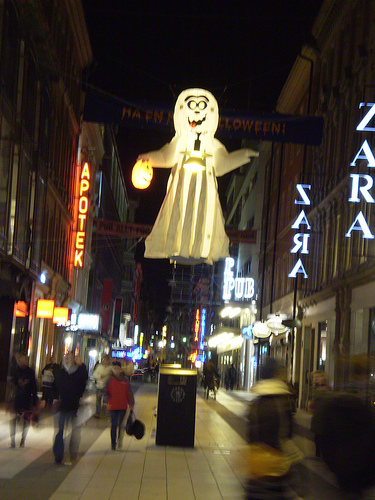
Today is Halloween and in Sweden, the tradition seems to be getting bigger and bigger every year: Jack O’Lanterns everywhere, orange and black, masquerades, scary window decorations.

Most people associate Halloween with USA, but the tradition originated in British Isles and was taken overseas by the immigrants.

Because it’s Halloween, I thought I’d share a childhood memory of the tradition from when I lived in the UK. When I was about 10, we were instructed by the teacher to write a poem about each month of the year. Since I have always loved to write, I set about the task diligently. But when I got to October, I got stuck, I could only get the first line…

‘October, now it’s Halloween,

So I asked my mum for help. She sat down beside me, and almost immediately came up with the next line!

‘October, now it’s Halloween
Ghosts and ghoulies can be seen!’

She was so proud of herself. But I laughed hysterically.

You see, in the 70’s ‘goolies’ was slang for testicles! ‘Ghouls’ means ghosts.

Sometimes grown-ups just don’t get it.

Happy Halloween!

Swedish charity

panini

I’ve always been under the perception, valid or not, that charity (corporate and private) is not big in Sweden. In recent years, a mass of different TV galas might have been changing this – eg, ‘Children of the World’, ‘Cancer Gala’. My impression still, however, is that charity is not something yor average Swede involves themselves so much in. One explanation for this might be the welfare state structure that exists in Sweden – we pay our taxes and the state should take care of the needy. Another explanation might be that we don’t want to accept that there is such a large need for charitable actions in a modern, developed country like Sweden. A third reason is that corporate charitable donations are not tax deductable in Sweden like they are in many other countries such as the USA.

Whatever, the reason, something happened today that really impressed me.

Normally, I love the sandwich and salad shop ‘Panini’ , I buy a lot of lattes and lunches there. Today I love them even more.

Earlier this morning, as I was buying my morning latte, I noticed a sign behind the counter. The sign read:

‘Food should be eaten, not thrown away. At the end of the day, Panini gives Everything that has not been sold to ‘Stadmissionen”s shelter for the homeless’.

This really impressed me. British sandwich chain Prêt-a-Mangér has been doing this for years, and I am so happy to see it in Sweden. Everyone’s a winner – Panini, the consumer, the receivers of the donations.

So, more of this please!!!!! Sometimes, charity does begin at home.