Discovering a Swedish corpse 

This summer, I visited the town of Varberg and its museum where I saw a very old, very famous and historically significant corpse – the Bocksten man. This man was found well-preserved in a peat bog in the 1930’s and he dates from around 1350 making him one of the oldest, best preserved findings of this type in the world. 

A weird thing about Mr Bocksten is that his clothes were miraculously in tact and he has a full head if hair. It’s a rather creepy site to see his flowing blond locks on top of his skull. 

  
Lots of theories abound regarding him. Was he murdered? It seems so. Was he an envoy to the pope? Maybe. A tax collector? Likely. Was he a vampire? Possibly. The final theory is backed up by the fact that the body was discovered with poles staked through it so that he would not rise again after death. 

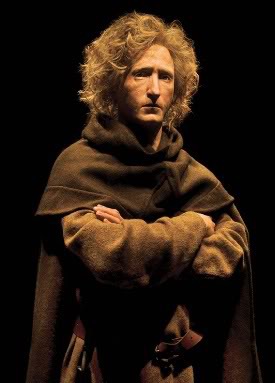
700 years after his death, a team of experts reconstructed the corpse’s face and gave the Bocksten man an eery appearance. When you stand in front of the cabinet containing this reconstruction, he stares right back at you – his eyes full of history and woe. 
  
I remember at school learning about the similar, but even older, Tollund Man  in Denmark and other corpse findings in peat bogs in England and Ireland. I don’t recall learning about the Bocksten Man however, which is strange considering how well preserved and how important the finding was. 

I’m so glad I got the chance to discover it now, and learn about another dimension if Swedish history and culture. 

Ullared – Mecca in Swedish

  
Deep in the woods of rural Sweden lies what can only be described as a Swedish Mecca. To this location, people travel from all over the country. The journey might take several hours, but it’s well worth it for them. 

The place is a village called Ullared. And in Ullared is a massive low-price shopping centre called Gekås. 

Surrounding the airline hanger that is Gekås are a variety of outlet stores, restaurants, a camp site, a hotel – all making the journey more attractive to the pilgrimaging bargain hunter. When I went to Ullared this week for the first time, I felt like I experienced another level of Swedish culture. 

The car park itself was my first surprise, rows upon rows of vehicles that would put any Disneyland to shame. After parking the car, you walk towards the shopping centre like a trail of lemmings. On the way, you pick up a trolley large enough to house a small family. Each trolley is colour-coded and numbered so that it’s easy to locate should you step away from it inside the building. We walked straight  into the store, but I’ve heard that it’s not unusual to wait a long time in a queue – sometimes due to the sheer volume of people, they adopt a one-out, one-in policy. Once inside, you are overwhelmed by the giganticness of the place, the thousands of customers, they yellow and blue blinding interior and the aisle upon aisle upon aisle of bargains. But the initial shock abates quickly. Within 10 seconds, I had purchased a frying pan and was trying to persuade a friend that they should buy individual hamburger thermometers. 

All in all, I ended up with towels, sheets, underwear, freezer bags and a variety of other things. I left the place feeling satisfied with a job well done, even though I am an amateur when compared to many of the other shoppers there. Some seriously disturbed people even spend a week there, camping at the camp site and shopping every day. 

It is hard to explain how legendary Ullared is in Sweden. Everyone has an opinion about it, it seems. At Gekås they turn over multibillions per annum. Employees and regular customers have become TV celebrities thanks to a reality show that follows life in this shopping Mecca and is broadcasted weekly on national television.  At the local museum in Varberg, there is even a small exhibition about Ullared, which reflects its place in popular culture. It was there I learned that the average customer is a single mother of three, aged 42, who visits Ullared twice a year and spends 3600 sek each time. 

So if you ever visit Sweden, and want to experience something outside of the usual red cottages, forests, lakes and beautiful cities, take a trip to Ullared. You never know what you might find there. 

Sweden’s ‘best coast’

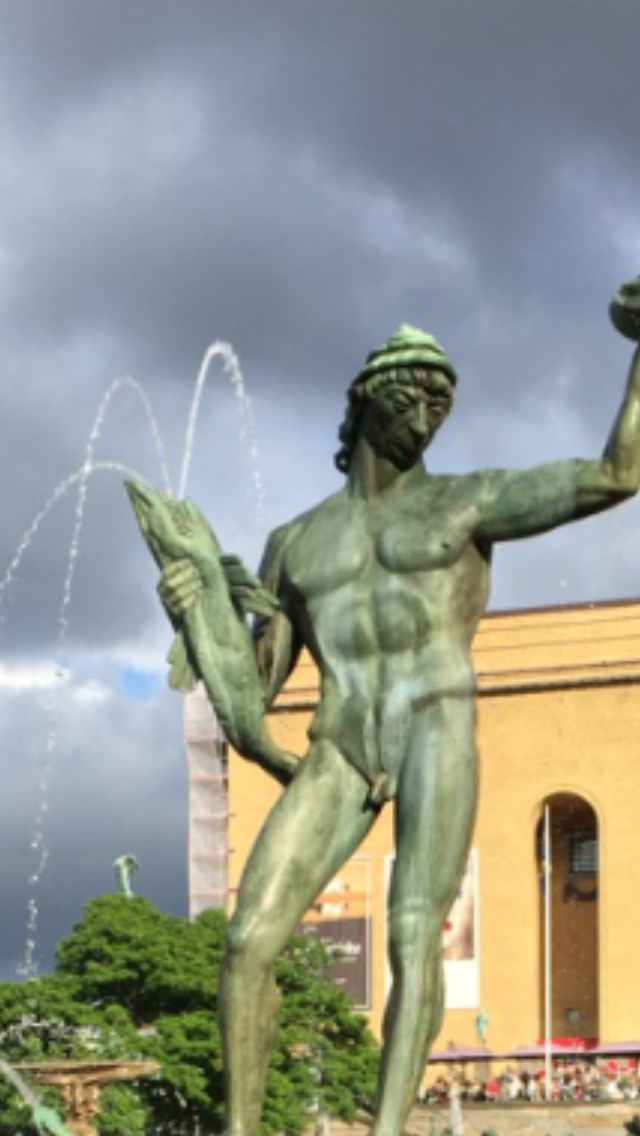
The town of Gothenburg is located on Sweden’s west coast, or the ‘best coast’ as the locals competitively call it in an attempted poke at Stockholm which is on the east coast. Spending a day here, it’s easy to feel the constant presence of the sea. Many of the streets have sea-related or harbour-related names and on the menus around town are a plethora of fish and seafood specialities: hand-peeled shrimp, freshly caught cod and classic fish gratin amongst them. At the top of the main restaurant stretch, known as Avenyn, is a statue. This statue is the grand figure of Poseidon, created by Swedish sculpter Carl Milles. There Poseidon stands in all his naked glory, willy dangling, fish in one hand, guarding the city of the sea. 

The city is currently packed with thousands of tourists, mostly in football gear. This week sees the annual event of the Gothia cup, a football competition for youths that attracts teams from all over the world. 

Gothenburg strikes me as a proud place. Proud of its unique position, proud of its role as Sweden’s second city and, not least, proud of its strong nautical heritage.  


Prawn pig out – a Swedish concept

  
This week I had what can only be described as a very Swedish experience. With friends, I participated in a ‘shrimp cruise’, also referred to as a ‘prawn pig out’. 

It works like this. You board a boat and, as it chugs around the archipelago, you eat as many shrimps as you can stomach. The menu consists of shrimps, aioli, bread. You wash this down with wine, cocktails and beer. Then there’s cheese and coffee. As you peel and pick away, the gastronomical treat is accompanied by a live band playing very loud music of a varied nature – rock, pop, country, Eurovision. I guess it’s to appeal to a wider audience. 

On this particular prawn pig out, there were about 50 passengers. And they were as eclectic as the music. Young couples, middle-aged couples, former party girls, pensioners and a gang of work colleagues from what seemed to be a construction company. Despite our differences, we all had one thing in common – a love for all-you-can-eat shrimps. 

I can’t exactly describe this experience as classy. But it was actually fun. And very very Swedish. 

Top 12 Swedish Summer Songs

  Yesterday I wrote about Thomas Ledin’s ‘Sommaren är kort’ and it got me thinking about other Swedish summer songs. So here’s my top twelve. And, as I hate Thomas Ledin’s song, it doesn’t even make the list. 

12: ‘Sommarnatt’ (Summer night) by Snowstorm. A song in which the singer ‘cruises along through the darkness in his giant machine.’ Classic uncomplicated Swedish lyrics. 

11: ‘Sommarsången’ (Summer song) by Siv Malmkvist. With lyrics like ‘and I want to sing that butterflies are good’, it just has to make the list. 

10: ‘Ta mig till havet’ (Take me to the sea) by Peter Lindblad. ‘The sand is moist, and the woman is young, crazy of longing am I’. Swedish summer sin at its best. 

9: ‘Sommar, sommar, sommar’ by Sten Carlberg is a little ditty that is synonymous with Sweden’s popular radio program ‘Summer on P1’. Summer is about ‘sun and blue skies’ but it slowly dissipates like a dream. 

8: ‘Midsommarnatt’ ( Midsummer’s Night) by Eddy Meduza. Dance band summer to which we ‘dance the whole night long’. 

7. ‘Sol, Vind och Vatten’ (Sun, wind and water) by Ted Gärdestad. An elementary song about tanned legs, high mountains and harbouring secret romantic longing. 

6: ‘Magaluf’ by Orup transports us to the tacky Spanish coast and sings of parties, alcohol and seagulls laughing until they are hoarse. 

5: ‘Our last summer’ by Abba. No list of Swedish music is complete without one of theirs. This one takes us to Paris and romantic walks along the Seine with boring banker Harry. 

4. ‘Så skimrande var aldrig havet’ by Evert Taube, sung by Lill Lindfors. (The sea was never this glistening). A fantastic romantic song by folk legend Taube about summer’s, and maybe life’s, first kiss. ‘The sea was never this glistening, nor the beach this liberating. The fields, the meadows and the trees were never this beautiful, nor did the flowers smell so sweet’. 

3: ‘Sommar’ by Kayo. A jazzy mellow song about the loss of summer with the loss of love – ‘there’ll never be a summer, there’ll never be sunshine, or jetties or mosquitoes – not without you.’ 

2: ‘Sommarkort’ (Summer picture) by Cornelis Vreejsvik. My favorite Cornelis song which captures summer in a melodious song – ‘let’s take a picture of children in the summertime as they dance – a moment on Earth’. 

1. ‘Summer sun’ by Koop. Rhythmic and cool, this song transports you to beach parties drinking rose wine and feeling the light breeze of summer – ‘Midsummer sun your love’s divine, never before have I met your kind.’

The Short Swedish Summer

  
In Sweden there’s a series of classic songs that are strongly related to the summer. One of these songs, I have always hated. It’s by an aging pop star called Thomas Ledin. I fear his summer song may be coming true this year. 

This year, we’ve had the rainiest May and June in human memory. We had a heat wave of 5 days at the beginning of July. And today? It’s 14 degrees and raining again. So much for summer. Maybe that was it last week, flashing by in the blink of an eye. 

So what is Thomas Ledin’s song? In Swedish it goes ‘sommaren är kort, det mesta regnar bort’ which translates as ‘summer is short, most of it just rains away.’

Art meets life in an annoying, but this year truthful, summer melody. 

Swedish weather gods

rainstockholm

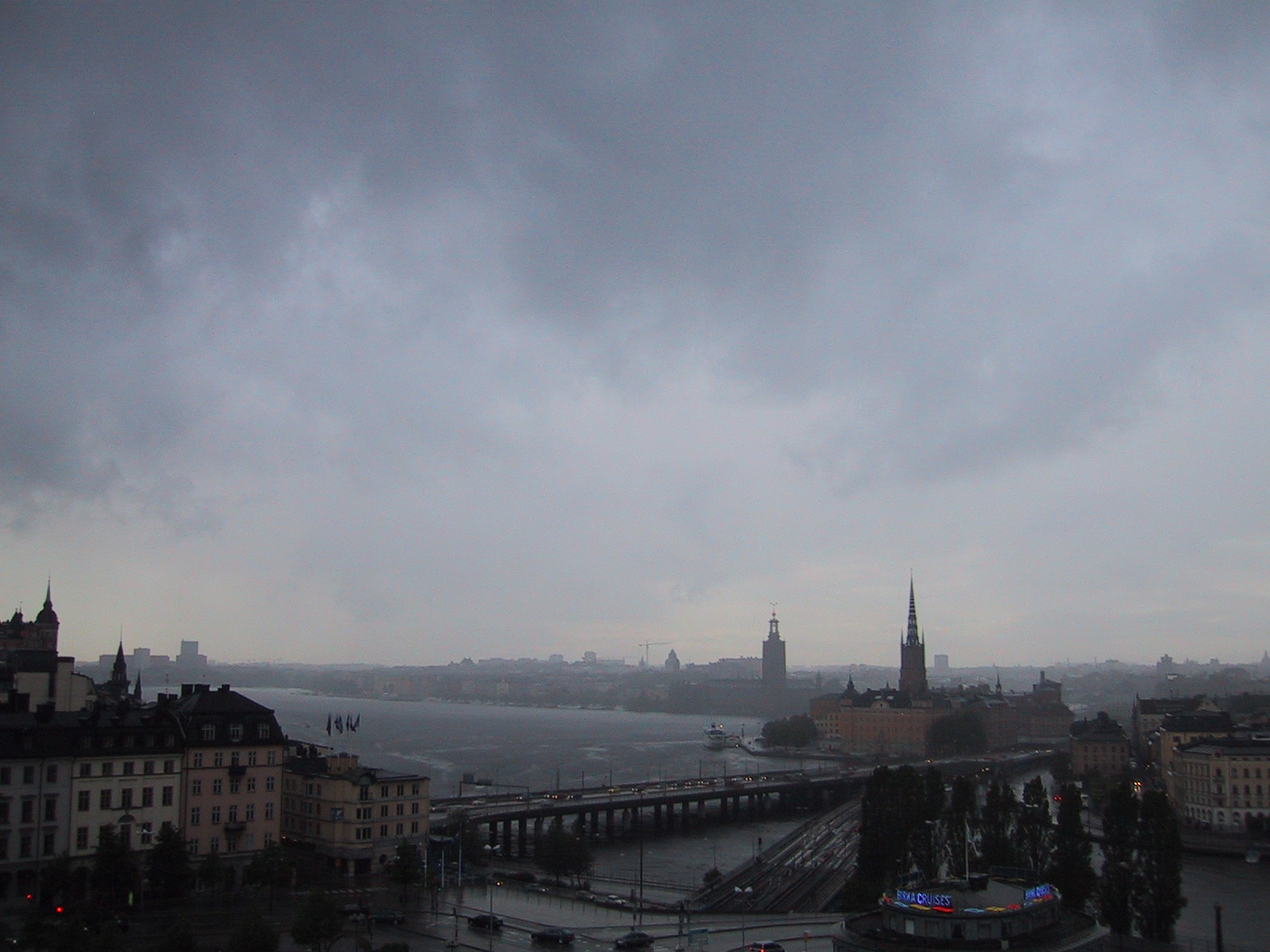
At the moment, I’m hearing a lot of moaning about the weather. It is raining a lot and unusually cold for the time of year.

Or is it?

I remember the first year I moved to Sweden and I was returning to the UK on May 13th to visit family. At Arlanda Stockholm Airport our flight was delayed – because it was snowing!! Snowing on May 13th! When I arrived in London, it was over 20 degrees and people were walking around in shorts.

I also remember another year – on Midsummer’s Eve – in June that we sat outside and it was so cold our breaths were steaming. It was the same temperature on Midsummer’s Eve as it had been on New Year’s Eve.

And I remember another May morning a few years ago when I was late for a meeting beacuse I had to unexpectedly scrape the ice of my car.

So is it so unusual that it’s this cold at this time of the year? Unfortunately not. Up here in the Nordic region, this is what we can expect from our weather gods.

The only thing that can make it change is global warming – not selective memory, collective denial or wishful thinking.

Dorky Swedes – Töntiga Svenskar

dork

For all of their advancement in technology, social issues and equality politics, many Swedes are also hiding a less sophisticated side to their culture. Scratch the surface, and its not far to their dorky side.

I’ve often reflected over this when I go to clubs here in Stockholm. Like many venues around the world, Stockholm nightclubs can have more than one dance floor. The dance floors are often divided into music types, for example, techno, house, pop…..and Eurovision. Usually, the Eurovision dance floor is the smallest one, as the club owners probably don’t want to appear unrefined.  But it is usually the fullest of all the dance floors. It is packed with Swedes shaking their stuff and screaching – loudly – to the lyrics of Carola, Conchita and Loreen. It is so unbelievably dorky. And I love them for it.

Let’s change scenario and go to a house party. Hand shaking, polite conversation and rosé wine. All very cultivated. Fast forward five hours when people have knocked down a couple of bottles of plonk. The cool bossa-jazz background music has been changed and a Spotify competition has evolved playing…….Eurovision. Party guests are bopping around to the old-time Euro melodies such as ‘Good Vibrations’, ‘It Hurts’ and ‘ABC’. It is so unbelievably dorky. And I love them for it.

So what’s the deal? Why do the otherwise cool Swedes turn into a bunch of yahoos when they are at parties or  nightclubs? Well, maybe in a world of technology, of digital communication, of stress and demands, Eurovision music provides escapism. Its simple melodies and inane lyrics don’t require any effort or thought. The basic rhythms can just wash over you and, for a moment, you can forget the seriousness of the world beyond.

It’s either that or the fact that Swedes are just dorks when they drink.

Sweden’s Pink Thursday – washing and witches

jesus feet

Today, the Thursday before Easter is called Skärtorsdag in Swedish. As the word ‘skär’ translates as a shocking pink colour, many people joke that today is ‘pink Thursday’. But the word ‘skär’ in this case relates to something else – something far more biblical.

The word ‘skär’ is an early Nordic word meaning clean and pure. And here, we see a parallel to the English word for ‘Skärtorsdag’. In English, today is called ‘Maundy Thursday’ and it relates to the religious rite known as ‘the maundy’ which involved the ritualistic cleaning of feet. According to Christian belief, today was the day that Jesus performed this act until the recipients had clean and pure feet. It also is the day of the infamous Last Supper.

However, in Sweden today, ‘Skärtrorsdag’ is not celebrated in any great religious fashion but in a pagan manner. A old pagan belief in Sweden was that on this day witches would mount their broomsticks to fly away to the legendary mountain known as Blåkulla. At Blåkulla it was believed that the devil held his earthly court. There the witches celebrated their sabbath and danced with the devil.

In modern day Sweden, we see this reflected in the many children who dress up as witches. These kids paint Easter cards and walk around the neighbourhood knocking on doors to wish everybody a happy Easter. In exchange, they hope to receive Easter sweets.

påskkkärring

Don’t let those Swedes fool you

april fool

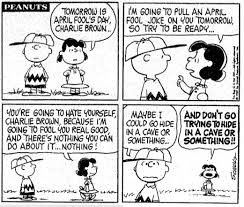
Today is April 1st, which is celebrated in many countries, including Sweden, as April Fool’s Day. On this day, you are allowed to commit pranks and jokes on people – all in good spirit of course. The earliest reference to April Fool’s Day is in Chaucer’s Canterbury Tales from 1392, but nobody really knows the origin of this tradition.

One common place these jokes take place are in the newspapers, and it’s fun to sift through them to see if you can identify what’s real news and what’s a hoax.

Today, a few of the jokes that have been identified in the Swedish press are:

– Banks are going to start charging entrance fees, roughly the same as a cinema ticket

– Princess Madeleine plans to give birth at Västervik’s Hospital in Kalmar. The hospital is currently investing in trendy uniforms in order to appeal to the princess, who is very interested in fashion.

– The three naked beaches in Varberg are going to be closed. Nudity is no longer ok.

–  On the island of Gotland, in the Baltic Sea, the local council will introduce parking fees for the entire Island. In this way, the people who live in the countryside are treated the same way as those who live in the main town.

– In Karlstad, a wind turbine has mysteriously disappeared

– In Katrineholm, 300 house owners are being offered fiber broadband for one krona if, today, they fax in their name, address and a motivation in poem form as to why they deserve fibre at such a low price

– An American hamburger chain is launching a perfume in Japan that smells of hamburger. Called ‘Flame Grilled Fragrance’ it will cost 360 kronor.

In Sweden’s largest national paper, Dagens Nyheter (Daily News), I Think I have identified not one, but two, April jokes!

– 700 000 homes are going to lose their TV channels since the Swedish broadband supplier has failed to reach agreement with SBS Disney. Alot of very popular TV programs will be inaccessible from today.

– In a studio in a Stockholm suburb, a designer has developed figure-huggin outfits for female priests. Now her clothes are a global success.

I’m sure there are a lot more out there in the media. What others have you seen?

If you fall for these lies, the expression to say in English is ‘April Fool!!

In Sweden it’s ‘April! April! You stupid herring!‘ (Now, that I’m afraid is the truth!)