Origins of FIKA

20140102-210626.jpg

Interesting description of the origins of the Swedish word for drinking a cup of coffee – ‘fika’.

In the 1800’s it was weirdly fashionable to invert words. For example, ‘gata’ might have become ‘agat’ or ‘roligt’ might have become ‘igtrol’.

The slang word for coffee at that time was kaffi.

And when this is inverted, it becomes ……. FIKA!!

Sweden 2014 – two hundred years of peace?

20131230-084644.jpg

So it’s soon the start of a new year – 2014. Another year of sublime and strange Swedish things.

Over Christmas the Swedish King mentioned something in his speech, something that is repeated in the media. For Sweden, 2014 marks the 200th year of peace. In 1814, Sweden signed a treaty with Norway thereby giving them independence. And Sweden, it is claimed, haven’t been at war since then. 200 years of peace is something that the media is proud of.

But hang on a minute. Sweden was ‘neutral’ in the Second World War, but still allowed German troops to cross the nation as they occupied Norway and the country sold iron to Germany for their weapon industry.

In 1961, Sweden was involved in the war in Congo, in the 1990’s in Bosnia and, as we speak, Swedish armed forces are active in Afghanistan and the Libyan Civil War.

Maybe it’s semantic, but is there actually any difference between being in a war and being at war?

The illusion of the collective Swede

welfare state

Is the notion of the collective Swede just an illusion?

Sweden is famous around the world for its welfare state – the system of tax that provides for the country’s citizens from the cradle to the grave. This system was introduced by politicians from Sweden’s social democratic history and I think that it’s great that it exists. Many assume that the Welfare state is the product of collective thinking and solidarity. Maybe it is. But I’d like to offer an alternative perspective.  

In collective-oriented societies, individuals operate within the context of what is best for the group, even if that means surpressing their individual needs. In exchange for this, they receive loyalty and support from the other members of the group.  

In Sweden, it would be easy to look at the welfare state and relate it to the above definition of a collective. In Sweden, citizens comply to the tax laws and in exchange they are taken care of in times of need.

But let’s look at the welfare state through the lens of individualism instead. According to research, Swedes are amongt the most individualistic countries in the world. Individualistic from the perspective of self-development, self-expression, right to live life the way I want to, self actualization,, freedom to make individual choices about my life. Amongst Swedes, it is very important to have individual choice, to the point that some people feel violated if they experience another person has in some way limited their choices, however minor that might seem.

 So what about the Welfare state? In Sweden, the strong individualistic drive of the citizens created a system in which they don’t have to take responsibility for the group. Once tax is paid, the state takes care of the unemployed, the sick, the elderly so the citizens don’t have to, and consequently people can go about their lives fulfilling their individual dreams and satisfying their individual needs.

When you look at it this way, Sweden’s Welfare state is not an exercise in social solidarity. It’s an exercise in pure individualism.

So is the notion of the collective Swede just an illusion?

Street begging in Sweden – what to do about it?

Tiggare

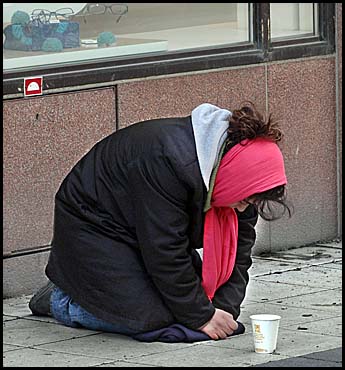
Did you know that Sweden is one of the few countries in the EU where begging is not illegal? A so-called ‘begging crackdown’ came into force in 2011 which criminalized the activity. Beggars on the streets of Swedish towns are becoming more and more common and I, amongst others, have a difficult time deciding what to think about this. On the one hand, we’ve all heard about the gangs of beggars and the organization of donation gathering as a source of income for the gang leaders. On the other hand, there is the individual person sitting on the street freezing in the November rain.

A good friend of mine made a very helpful comment recently that enabled me to reflect over my feelings and I wanted to share that with you. This is what he initially wrote on FB, which created quite a debate (I have loosely translated it into English):

‘There she sat, in the rain. Outside Coop. With her cup and her threadbare clothes. And I stepped out of my car and searched impatiently in my wallet amongst my gold ten krona coins to pay for a trolley. Have to swap this cash, I thought. This wallet’s so heavy with all this loose change. So…..impractical. That’s what I thought. When I walked past her. Without looking. In the rain. Because you know that it’s organized crime. I’m not going to contribute to that. No. So I went shopping, as you do on a Friday. A little bit of Brie from the deli counter, which melts in the mouth. And some other nibbly bits to eat in front of the open fire this evening as the rain beats against the window pain. Have a cosy Friday. The woman at the till was happy to receive all my change, I got a 100 krona bill in exchange. I throw my items into my bag and walk out to the carpark. And there she sits. I stop. I think. I question myself. What kind of person am I? I take the bill out of my wallet and put it in her cup. Where it belongs. I’ve got enough, unlike her. And she still doesn’t.’ (Calle Mikelsens)

This comment on Facebook caused a debate about begging in Sweden and whether Swedish people should accept it or ignore it. In order to explain his point of view, my friend Calle, added another comment which changed my perspective on the issue. This is what he wrote:

‘My reason is clear. I believe in the meeting between people. That I can do what I can but at the same time understand my limitations. Sometimes ten kronor or a hundred krona bill can make a big difference. I don’t want to limit myself by thinking globally but I want to instead do something. We can’t solve poverty with charity. We solve it through political action and taking a stand. But we can, along the way, help those who are at risk of falling. And feel anger every time we put money into the collection tins. I am, despite my naivity, not convinced that a political shift will eradicate world starvation. That requires a larger movement. But I feel that there is a wind of opposition sweeping over the world despite the greed and the grabbing. I have to do what I can on my small scale. That’s where I have to begin…’

So, it’s all about each of us making a choice. Do we want to look at the global perspective, in which the individual often gets lost? Or do we want to look at the local perspective, and understand that what we choose to do, or not to do, can have an impact on another person’s life?

Sweden versus Switzerland

swedswiz

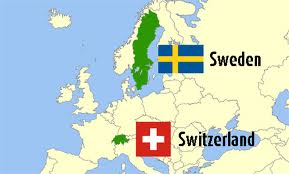
How many times hasn’t Sweden been confused for Switzerland? Many Swedes relate stories of the mix ups that they’ve encountered in their lives. Well it seems that the same happens to Swiss people.

Apparently this is so serious that the Swiss Embassy in China have started a campaign, where entrants can win a trip to Sweden and to Switzerland. All they have to do is send in humorous explanations of how Sweden and Switzerland differ.

In the pictures that follow the campaign, Switzerland is represented by money, cheese fondue and the tennis champion Roger Federer.

And what about Sweden, then? Pictures of a dad carrying a child in a babybjörn, an elk, meatballs and a gay couple are chosen to represent this country in the North.

Apparently, the campaign has had a huge impact in China, and as far as I know a winner has not yet been announced.

So, what’s your input? – What do you think is the biggest difference between Sweden and Switzerland?

Swedish charity

panini

I’ve always been under the perception, valid or not, that charity (corporate and private) is not big in Sweden. In recent years, a mass of different TV galas might have been changing this – eg, ‘Children of the World’, ‘Cancer Gala’. My impression still, however, is that charity is not something yor average Swede involves themselves so much in. One explanation for this might be the welfare state structure that exists in Sweden – we pay our taxes and the state should take care of the needy. Another explanation might be that we don’t want to accept that there is such a large need for charitable actions in a modern, developed country like Sweden. A third reason is that corporate charitable donations are not tax deductable in Sweden like they are in many other countries such as the USA.

Whatever, the reason, something happened today that really impressed me.

Normally, I love the sandwich and salad shop ‘Panini’ , I buy a lot of lattes and lunches there. Today I love them even more.

Earlier this morning, as I was buying my morning latte, I noticed a sign behind the counter. The sign read:

‘Food should be eaten, not thrown away. At the end of the day, Panini gives Everything that has not been sold to ‘Stadmissionen”s shelter for the homeless’.

This really impressed me. British sandwich chain Prêt-a-Mangér has been doing this for years, and I am so happy to see it in Sweden. Everyone’s a winner – Panini, the consumer, the receivers of the donations.

So, more of this please!!!!! Sometimes, charity does begin at home.

Happy Swedish Names Day

Nils

October 8th was my Name’s Day. Well, not quite….but almost. It was Nils. And since I’m called Neil, well, I take Nils as my day.

Some of you might be wondering what the hell I’m talking about. What is a ‘Name’s Day’? Well, it’s like this. In Sweden, every day has a name, sometimes two. And if your name happens to be represented in this way in the calender, then you can celebrate your day. Strange? Maybe. Unusual? Not really.

A Name’s Day is actually a tradition in lots of countries such as Bulgaria, Croatia and Ukraine. According to Wiki, the custom originated with the Christian calendar of saints: believers named after a saint would celebrate that saint’s feast day. In Sweden, however, there is no longer any explicit connection to Christianity. It’s been a tradition since the Middle Ages and started because the church wanted the people to celebrate Name’s Days instead of birthdays which they viewed as a pagan tradition.

There are different lists though some names are celebrated on the same day in many countries. In 1901 a comprehensive modernization was made in Sweden to make the list up to date with current names. This also happened in Finland, but not in other countries.

But Name’s Days are not without their controversy. The monopoly on calenders, held by the Royal Swedish Academy of Sciences, expired in 1972 and so did the official name day list. And then all hell broke loose. Competing lists emerged and finally in 1986 a new list with three names on each day was designed to create harmony in the Name’s Day chaos. But people weren’t happy. Seven years later, this list was revised and reduced to two names per day. But Swedes were still dissatisfied with this and the Swedish Academy produced a new two-name list which was finally accepted and brought into use in 2001. Although it does not have the official status of older lists, it is now universally used in Sweden. One alternative calender, however, is the Diversity Calender which appoints each day with a more diverse selection of names. For example, on that calender, today is the Finnish name Veli.

How this tradition arrived in Sweden is unclear. Maybe it was imported by foreign religious leaders or merchants, or maybe it’s to do with the fact that the Swedish Protestant Church retains some traditions similar to the Catholic. Whatever the origin, it’s a reason to celebrate. And Swedes love to celebrate!

So, come on Hedvig and Hillevi, today’s your day! Happy Name’s Day to you!!

If you’d like to check out if you’re privileged to have a Name’s Day go to www.dagensnamnsdag.nu

It’ll be ok, because you’re not Swedish

moving1

At the weekend I moved apartments. To help me, I employed the services of a moving company. On the day of moving, the three moving guys showed up and one of them, older and grayer, was obviously in charge. Immediately, I noticed that they were talking a foreign language to each other but I didn’t understand it, so I asked the leader where they were from.

‘I’m from Kazakstan and they’re from Azerbaijan but we speak Russian to each other. The Soviets didn’t leave us with much, but they did give us the Russian language’ he said.

Then he asked me where I was from. ‘The UK’ I said.

‘Ah’. he said ‘I thought so! When I spoke to you on the phone last week I thought you weren’t Swedish. And I said to myself this’ll be ok, ‘cos he’s also an immigrant.

This struck a chord with me. His expectation was that everything would be ok because I’m not Swedish. What kind of experiences has he had with Swedish customers that means he has formed this perception? I have heard this before from people of minority groups in Sweden. For example, a shop owner I know who negotiated his rent with the chairman of the Residents’ Board and afterwards said to me ‘Bloody Swede treated me like a damn immigrant!’ Other examples I’ve often heard are from people who accuse Swedes of being ‘arrogant’ and that people who feel ‘disrespected’ and ‘patronised’ by ethnic Swedes.

It makes me wonder if integration is even possible once negative perceptions form and, once formed, how easy are they to change? Cultural perceptions form partly from pre-conceived ideas but also from how we behave towards each other and the cultural interpretation of that behaviour. It is often this interpretation rather than intention that impacts the perception.

Imagine if we were to behave differently, and just see the individual infront of us, not the ‘category’ they belong to. See them and respect them. This would almost certainly lead to the forming of different perceptions and, maybe I’m being an idealist, but I think it would result in a better integration in Sweden.

No religion please – we’re Swedish

svantesson_1081428c

When comparing religious/traditional values with secular/non-traditional values, Sweden always comes out of research as amongst the most secular, non-traditional countries in the world. The low voting frequency in the recent Church elections reflects this. Basically, many people in Sweden don’t want religion to have anything to do with politics and Sweden is one of the few countries in the world that has separated religion and politics from each other.

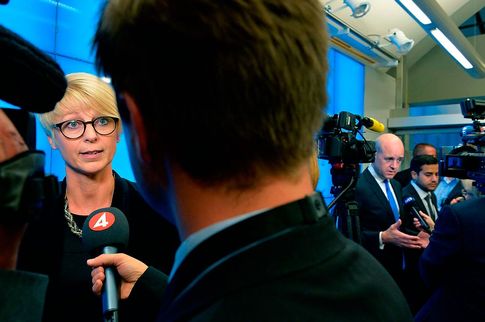
This is clearly shown in the latest outrage to appear on social media in Sweden – the appointment of the new Employment Minister, Elisabeth Svantesson. Ms Svantesson comes from the Swedish Conservative Party – the Moderates – and has recently been given this high profile position in the Cabinet. Where this becomes interesting is what is causing the outrage. It seems that Ms Svantesson holds a religious belief and belongs to a radical Christian organisation which, amongst other things, condemns abortion and homosexuality.

Voices have been risen for her immediate resignation.

This is so different from most other countries around the world. Take a country like the USA -nobody gets to become President there without mentioning God. Many countries are theocracies, where the political leaders and the religious leaders are the same. In most other countries, believing in a religious deity is an advantage, if not a necessity, for a public figure to be taken seriously.

But in Sweden, believing in a God is a rarely an advantage for a public figure. They are often ridiculed and their credibility is challenged by the general public and the press.

And this makes me think…..just when did religion become a liability in Sweden?

How many minority languages are there in Sweden?

meänkielen

Swedish is Sweden’s official language and is spoken by most of the 9 million people who live here. Of course, people who live in Sweden speak an array of languages such as English, French, Hindi, Persian and Arabic. But did you know that there are 5 official minority languages in Sweden? In 1999, the Minority Language Committee of Sweden formally declared these five official minority languages.

Finnish – Ethnic Finns make up about 5% of the population of Sweden, and the Finnish language is used by over 200,000 people.

Meänkieli – Spoken by the people of the Torne Valley, it is so closely related to Finnish and is sometimes considered a dialect of Finnish. Between 40,000 and 70,000 people speak Meänkieli as their first language.

Sami – Sami people (formerly known as Lapps) are a people indigenous to the northern regions and who speak a closely related group of languages usually grouped together under the name “Sami”, although at least three separate Sami languages are spoken in Sweden. Between 15,000 and 20,000 Sami people live in Sweden of whom 9,000 are Sami-language speakers. Worldwide, between 20,000 and 40,000 people speak Sami languages (most Sami now speak Swedish, Norwegian, Finnish, or Russian as their first language, depending on the country in which they reside).

Romani – Romani is the language spoken by the Roma people, a nomadic ethnic group originating in northern India. Romani is an Indo-Aryan language, closely related to languages spoken in today’s India, and sometimes written with an Indic Script. Approximately 9,500 people in Sweden speak Romani.

Yiddish – Yiddish is a language formerly spoken by most Ashkenazic Jews. Although the Jewish population of Sweden was traditionally sephardic, after the 18th century, ashkenazic immigration began, and the immigrants brought with them their Yiddish language. There are around 18,000 Jews in Sweden, and about 4,000 speak Yiddish.