How a Swedish hand bag can cause a storm

Lady Bracknell’s horror when she exclaims ..‘a handbag!!?’ in Oscar Wilde’s ‘The Importance of Being Ernest’, has never been so relevant as it is today. 

Indeed, a handbag is causing quite a stir in Sweden. 

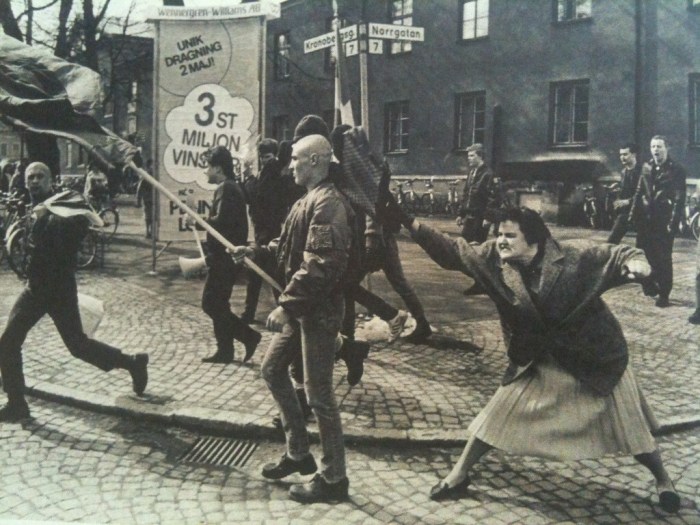
A famous photograph from 1985 is the catalyst. This photograph depicts Danuta Danielsson stepping out from a crowd to hit a neo Nazi across the head with her handbag. Now, a statue has been made depicting this snapshot of time but the local council in the Swedish town of Växsjö is refusing to allow it to be erected. The reason? They claim that the statue commemorates violence and say that it is not ok to hit somebody just because you disagree with them. 

And I agree with that. But there is another perspective. The statue can reflect an act of individual courage or symbolise the very real relationship between nationalism and anti-fascism that we see in Sweden today. 

It seems like this handbag is dividing the country. As a response to this situation, handbags have been mysteriously appearing on statues all over the country. 

Yes….‘a handbag!!?’


Swedes – look up!!

IMG_4975

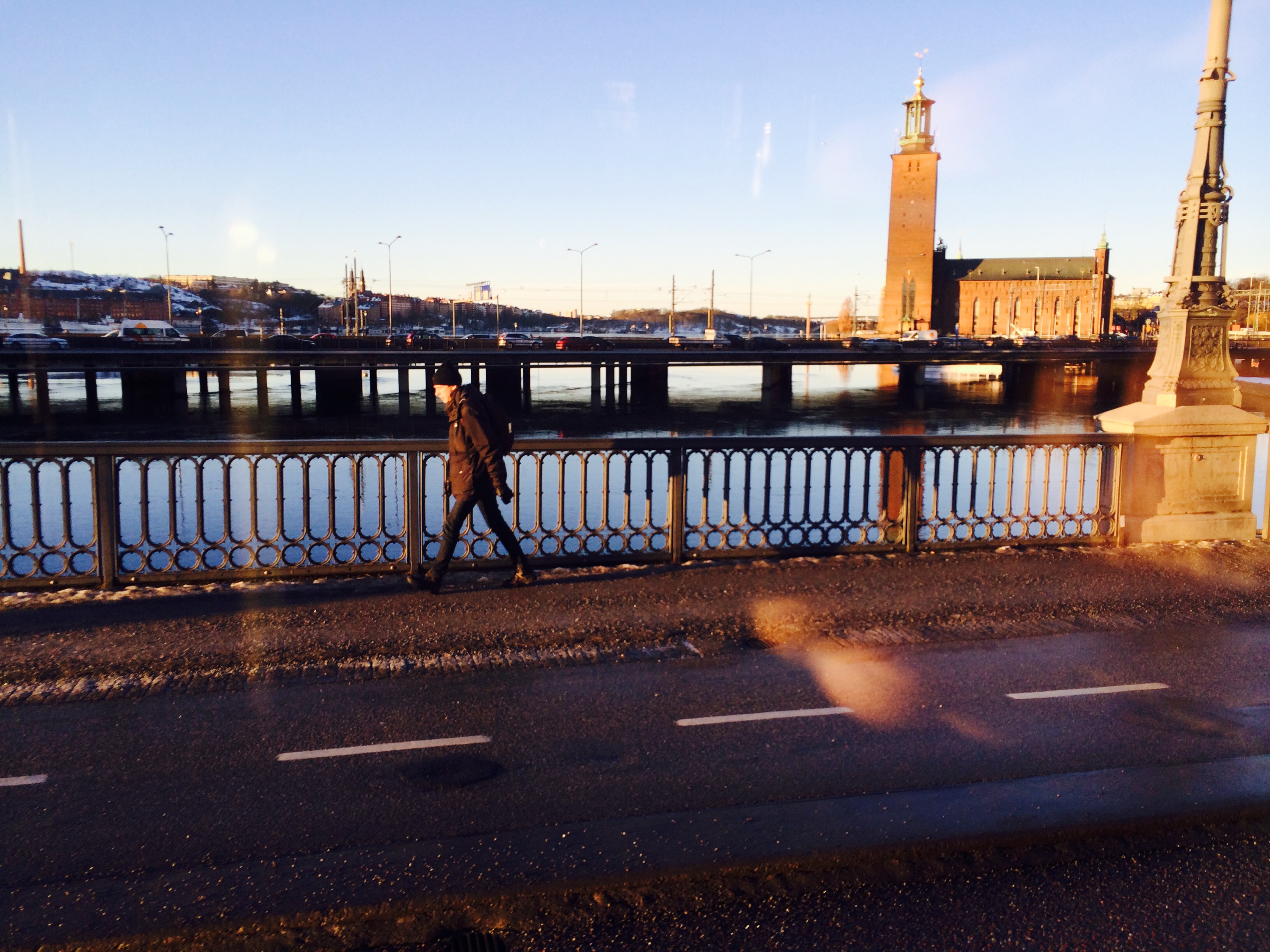
I shared the bus journey this morning with ten other people. Of these ten people, 8 of them had their heads buried in their mobile phones. White headphones on, they were captivated by their little screens. Reading the news, playing a game, updating their statuses was more important than what was going on physically around them.

Outside the sun was shining, the sky was blue and Stockholm looked fantastic. It was a lovely morning, full of energy and light. But these 8 people completely missed it. Think what we all miss when we get sucked into our screens rather than observing the environment around us. Think of the beauty we do not encounter, or the opportunities we miss.

So I’d like to issue a challenge. Next time you’re on the bus, or the tube, or the train – look up! Who knows what you might discover.

Happy Swedes? That’s the question.

happy swede

Yesterday, I ran a seminar on Swedish culture and I got a thought-provoking question from an audience member. It was a question I have never had before.

‘Are Swedes happy with what they are?’ was the question. Somewhat taken aback, I tried to answer the question in the best way I could based on my interpretation of it. I talked about anthropologists are yet to find a culture that thinks their way is wrong. Every culture thinks their way is the right way – otherwise they wouldn’t do things the way they do them. Being culturally competent is about understanding that there are lots of right ways.

After the seminar, I thought more about the question – are Swedes happy with what they are? It resonates around my head still. How happy is the average Swede? How happy is the average person in general? I sincerely hope that most people are happy and living lives that fulfill and enrich them. I hope they are living lives where they can be grateful for what they have and not envious about what they don’t have. I hope they are living lives where they can be the best they can be, surrounded by people they like and free to make the best choices for themselves. I hope their lives are full of life. For me that’s happiness. And in Sweden, that’s the life I am able to live.

So at least I’m happy to be the way I am – in Sweden!

My dad thinks you’re ugly

IMG_4486.JPG

Swedish children’s television presenter Sannah Salameh has recently pointed the spotlight on Swedish body obsession and social control. In a text, she describes how a little girl approaches her on a railway platform and says ‘My dad thinks you’re ugly’. Quite naturally, Sannah is upset and angry, but keeps her composure. It’s not the fault of this little child but of her father who teaches her that judging others by their appearance is valid. Interested, I googled Sannah and ended up on a consumer forum. I was shocked by what I read there, by the vile and bilious comments people felt entitled to write about her appearance. Some people were even demanding she be removed from the tv as the way she looks offended them and scared their children.

In Sweden, as in many other western countries, there is a strong fixation around appearance. Having the right body, the right face, the right clothes is seen as important. Deviate from this and there must be something wrong. You are not seen as an individual but reduced to the fact that you are overweight or dark skinned or ‘damaged goods’, regardless of how talented or intelligent you might be. Thanks to social and established media this seems to have escalated over recent years.

And people like Sannah Salameh end up in the crossfire.

Swedish culture is driven by two strong values – individualism and self actualization. The right to be yourself and to be responsible for your own life. The right to be who you want to be and make the most of yourself. These manifest themselves in different ways in society, for the most positive. But here we have a contradiction. Does Individualism and self actualization only apply as long as you fit into a pre-determined template?

I want to give a big shout out to Sannah Salameh. She is a fantastic, talented woman who, despite her fears and insecurities, stands up for herself and for all women. Don’t let yourself be reduced to your appearance. Don’t let others decide your worth.

And to all fathers of little girls – teach them that their value lies in their intellect and their hearts, not in the way they look.

Austrian stereotypes of Swedes

I was in Vienna at a wedding this weekend and mingled with the other guests. When they found out I lived in Sweden, they wanted to talk about Stockholm and Swedish people. They were very pleasant and what was interesting is how stereotypes persist. Amongst other stereotypes, they thought Swedes were reserved and formal. When I explained that maybe some are but it’s not the case entirely,they actually looked sceptical.

This is the funny thing about stereotypes – they’re often outdated and almost always wrong. How can a single characteristic be applied to 9,000,000 Swedes, or 70 million Brits, and still be accurate? Stereotypes can be fun to talk about but if we start believing them, we’re in trouble. Instead, let’s look at the individual to form our perceptions of that person (understanding we can still be wrong) and try to avoid sweeping condemnations of the collective. I think we’ll get a lot further in our cultural sensitivity that way.

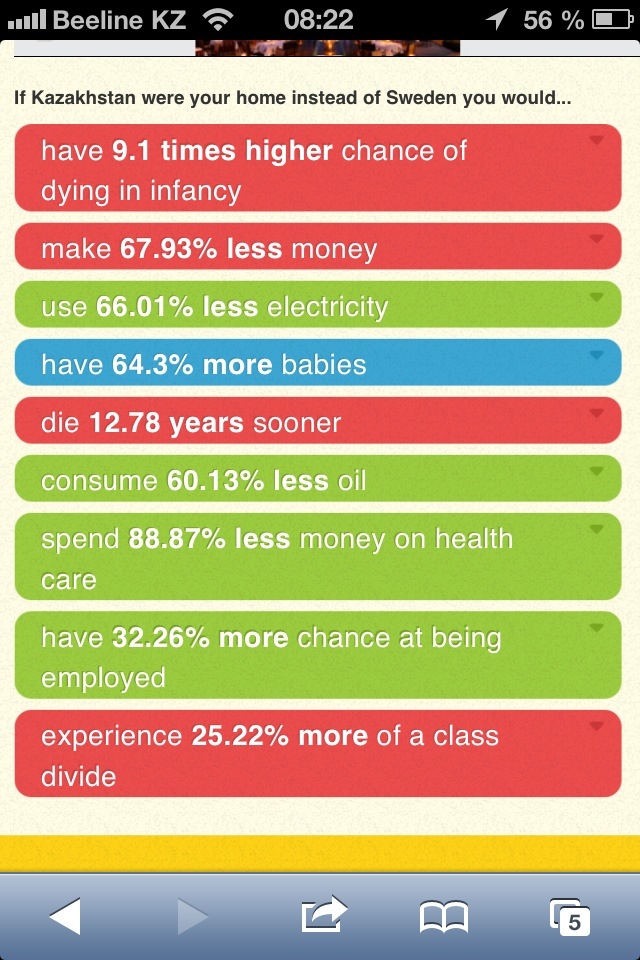
From Sweden to Kazakhstan

20140312-082446.jpg

Am currently in Kazakhstan, a country worlds away from Sweden. The 8th largest country in the world, Kazakhstan is the largest land-locked nation of the globe. And home to Borat. The feeling here is a mix of Chinese, Russian, Mongolian and Central Asian. The contrasts between rich and poor, old and new, traditional, contemporary and Soviet are stark. And right now, it’s cold. Minus 10 degrees and snowy, the mountains tower above the former capital of Almaty and host a wide range of winter sports. Although there’s snow, you couldn’t feel further away from Sweden here. And that, for me, is part of the joy of travelling -stepping outside of our daily routines, comparing differences and appreciating both them and what we have in our own lives.

Are Swedes always off work?

keep-calm-its-nearly-holiday-time

‘Swedes never work, they’re always on holiday’

This is a frequent comment I hear when I work internationally. Colleagues and sometimes customers abroad, are irritated by the fact that they can’t get in touch with Swedes from, for example, the end of June to the second week of August. Sweden seems to be shut down! ‘Swedes never work, and are also lazy’ – they say.

I, of course, defend Sweden’s holiday structure by emphasizing that people work longer hours in the winter to compensate for shorter hours in the summer time. Or that the winters are so long here, it’s only natural that people want to be off work during the warmest, brightest time of the year. Or that thanks to advances in technology, Swedish employees are often still accessible though they might not be at the actual workplace. Or I even try the argument that Sweden has a healthy work-life balance.

These arguments however often fall on stony ground and I am often disbelieved. People shrug their shoulders, shake their heads and roll their eyes. From their perspective, Swedes are spoiled.

I try to encourage cultural understanding, I really do. But sometimes it’s not that easy. For example, situations like this Christmas and New Year don’t help me to be more persuasive. While most Americans got 3 days off work and many Brits got 5 days of work, Swedes frolicked in the free time they were able to access. This festive period was commonly referred to as an ’employees’ Christmas’ meaning it was good for the employees and not for the employers. Many Swedes (and me too) are back to work for the first time today, and have been free since the 23rd December 2013. That makes a total of 12 days off work – 16 days if you also count the weekends.

You see Swedes don’t only take the national holidays off – they also take off the ‘Eve’. So although ‘Christmas Eve’ and ‘Midsummer’s Eve’ are technically not national holidays, they are celebrated as though they are. And then it’s also considered a right to be able to take off a half a day before the ‘Eve’ just in order to get ready for the approaching celebrations. If a national holiday falls on a Thursday or a Tuesday then there’s also something called a ‘Bridge day’. It’s not officially a holiday but most people take it off because there’s no point in going in to work for just one day is there? This Christmas season had a couple of bridge days in it to pad out the time taken off work and required only a little bit of personal holiday leave to be taken.

So the question becomes are Swedes happy that they got 16 days off work? I think most are. But on social media, in the office and on public transport, others complain that it wasn’t long enough, that they’re exhausted or that they need a break.

Mmm, maybe there’s something in the perception of the spoiled Swede?

IKEA – part of the problem or the solution?

CSR

IKEA, the ultimate representative of Swedishness abroad, is currently in hot water. In their customer magazine, IKEA LIVE, they often present articles on people, the reason being to inspire and motivate their members to shop. The idea is that readers don’t just buy a piece of furniture, they buy a ‘Lifestyle’. In 26 countries, the latest IKEA magazine portrays a lesbian couple, Clara and Kirsty, in their home. In terms of representing the Swedish values of equality and tolerance, so far so good.

However, this report on Clara and Kirsty has been removed from the IKEA magazine that is circulated in Russia. IKEA defend their action by stating that they do not want to break the Russian anti-gay propaganda law, a law that has been criticised by the UN for breaking international Human Rights laws. IKEA also says ‘our job is to sell furniture in Russia’.

Many voices, including mine, have been raised in criticism of this action.

Who is it who can take a stand against discriminatory laws?
Who is it who can protect human rights?
Who is it who can lead by example?

In this economically-driven globalized world, it is the large, international corporations who can! IKEA can! If they wanted to. They are concerned that breaking the law may get them sued. I wonder how likely that actually is and even if being sued led to them being forced to remove the article portraying gay lifestyle, that in itself would be taking a stand.

But here is the real twist. Just because IKEA is Swedish do we expect them to represent Swedish values in general? Respect. Honesty. Egalitarianism. Solidarity. The bottom line is that IKEA is a business run purely for profit. Their job is to earn money for their shareholders by ‘selling furniture in Russia’. And, however cynical that may be, are we really surprised at their behaviour?

IKEA like many companies have a policy for Corporate Social Responsibility (CSR). In the light of these latest actions, their policy is a mockery:

‘The IKEA vision is to create a better everyday life for the many people. This includes doing what we can to help create a world where we take better care of the environment, the earth’s resources, and each other. We know this continuous improvement is a never-ending job, and that we are sometimes part of the problem. But we work hard to be part of the solution’.

Clearly in this case, IKEA is part of the problem. I would like to understand what they are doing to be a part of the solution.

Please LIKE and SHARE this post.

Do we have to respect other cultures?

colour and culture fooditerranean

Somebody wrote the following question on Facebook today – ‘to what degree do I have to respect other cultures?’ and it got me thinking.

Since I work with diversity and intercultural competence, you would think my answer would be clear for me – a resounding ‘YES!’ but it’s actually not that straightforward. I think, in fact, the answer depends on what we mean by ‘respect’. If by respect, we mean to accept and acknowledge that other cultures exist within the boundaries of what seems good and right to them, then the answer is ‘yes!’ If disrespect comes from an ethocentric perspective, a sentiment of right/wrong, good/bad, then I don’t think that’s ok. The ethnocentric always thinks their way is best and that other perspectives, or world views, are in some way faulty. This borders on the racist. So how can we balance the acceptance of other cultures with the discomfort we experience when reading or witnessing actions that are unacceptable to us?

It’s not easy but I think that we should accept other cultures, and that we should genuinely repect there are many different ways to view and to be in this world. But, that in no way means that I have to like everything that others do, especially if it compromises what I value or what I perceive as ethical. Intercultural competence is about accepting differences but also about being authentic in your own cultural beliefs without being xenophobic.

So let’s not mix up respect and liking. In my mind, they’re two different things.

Please like and share this post!

Throwing cakes in Swedish politics

jimmie cake

Yesterday evening I happened to be on Nytorget, a square in Stockholm, at the same time as the extreme right wing party, Sweden Democrats, were having a rally. Jimmie Åkesson, the leader of the party, which is gaining favour in Sweden, was signing his newly-released book and a queue of people were standing there to get their copies signed. There was a large group of anti-fascist demonstrators there chanting and protesting their opposition. The whole thing was monitored by armies of police and, despite this, one demonstrator managed to squeeze past security and throw a cake into Jimmie Åkesson’s face. Now, while I in no way condone the thowing of the cake, in fact I think it’s undemocratic and counter-productive, it is a sign of anger and frustration at the politics the Sweden Democrats are trying to enforce in Sweden.

On the way home, I walked past the now-deserted location of the demonstration and saw a lot of trampled flyers on the floor. I picked one up to read what message was being preached by this party. And I was struck by the excellent rhetoric, the smart marketing and the smooth packaging. I don’t care to repeat the message here as I don’t accept it, but needless to say the PR included in the flyer complained about the cost of immigration and appealed to the major concerned groups in society – to the sick, to the elderly, to families and those scared about crime and national security. At the same time, the material promotes ‘safety and tradition’ and the maintenance of the fallacious Swedish identity.

The effective rhetoric is remniscent of a time in the not-so-distance past and the success of the 1930’s Nazi party. Hitler was a clever rhetorician and had the ability to appeal to the masses and exploit their fears in order to gain power and introduce a disgusting politics. All over Europe today, other right-wing rhetoricians are manipulating the citizens and gaining power to implement cynical policies in their respective countries. And they are on the rise in Sweden.

For those of us who are against their xenophobic, homophobic and mysogynistic agenda, we can take a stand by exercising our freedom of speech and our democratic vote. Throwing cakes is not a way to win this argument, it just fuels the sympathy for them. The way to win is in dialogue, debate and discussion – with our parents, our colleagues, our children.