Walpurgis Eve – when spring arrives in Sweden

Today, 30 April, is Walpurgis Eve, called Valborgsmässoafton in Swedish, or ‘Valborg’ for short. The name Walpurgis is taken from the eighth-century Saint Walburga, and in Sweden this day marks the arrival of spring.

In a cold, dark country like Sweden, residents have suffered through a long, miserable winter. So it is no surprise that the arrival of spring is an occasion to mark. On the evening of Valborg, Swedes usually gather to celebrate together.

The forms of celebration vary in different parts of the country and between different cities. However, essential celebrations include lighting a large bonfire, listing to choirs singing traditional spring songs and a speech to honour the arrival of the spring season. Some of the traditional spring songs are titled ‘Beautiful May – Welcome!’ and ‘Longing for the countryside – winter rushes out’. You can see a clip below.

Walpurgis bonfires are an impressive thing to see and are part of a Swedish tradition dating back to the early 18th century. At Walpurgis, cattle was put out to graze and bonfires lit to scare away predators.

The weather is often unpredictable on Walpurgis Eve. It can be sunny and warmish, or it can still snow on 30 April!

Despite bad weather, Swedes still shiver around the bonfires and ironically celebrate the arrival of Spring.
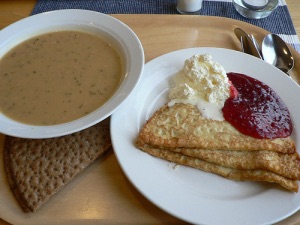
Pea Soup and Pancakes

In all cultures, there is an element of predicatability. Some things that you can feel will always happen. Things that give you a sense of security because you can depend on them.

In Sweden, it’s pea soup and pancakes.

Today is Thursday. In most lunch restaurants and every staff canteen that sells Swedish food, pancakes are on the menu. You can rely on it. It feels dependable. The pancakes are served in a particular way – with whipped cream and jam – and always, always served together with a bowl of steaming pea soup and bread.

Pea soup and pancakes have been consumed in Sweden since the 1200’s. It’s believed that because Friday was a day of fasting, people ate as much filling food as possible on the Thursday before. And that’s how the tradition was born.

It’s fun to watch Swedes on Thursdays. In the staff canteen, grown men queue up to ladle their soup into their bowls and pile pancake after pancake onto a plate like a Scooby snack. Then they gleefully paste on the jam and smother it with whipped cream. It’s like watching a jelly and ice cream party for 10-year olds.

Pancakes on Thursdays is especially interesting for us Brits. Traditionally, we only get to eat pancakes once a year – on ‘Pancake Day’ – Shrove Tuesday. On this day, when Swedes traditionally tuck into the Lent bun called ‘semla’, we Brits make pancakes and cover them with sugar, lemon juice and chocolate sauce.