The Giant of the North’s weakness for lions

Long, long ago, when Stockholm was still a village, the people had built a big wall to protect themselves from the outside. You see Stockholm wasn’t as safe as it is today. Packs of lions, tigers and wolves roamed the countryside. And just outside the wall, there lived four one-eyed giants. The giant of the North, the giant of the South, the giant of the East and the giant of the West. These giants were brothers and of all of them, the giant of the North was the largest and the strongest and the most scary. He lived on a hill overlooking the village and watched and waited for his opportunity to attack.

Now, the people of the village couldn’t remain behind locked gates all the time. Merchants sometimes had to leave in order to trade with other towns. Builders had to leave in order to reinforce the walls and bridges from the outside. And shepherds and herdsmen had to pass through the gates in order to exercise and feed their sheep and cattle. But leaving the village was a treachorous endeavour – often people fell into the grasps of a patrolling giant and were gulped up whole.

The giant of the North didn’t care too much for people. He thought they tasted gristly and bony. His favourite food was lions. Not only were they fat and tasty but he liked the way their manes tickled his throat as he swallowed them. But lions were rare, so he had to satisfy his great hunger with sheep. Whenever the shepherds left the village, he pounced and ate as many as he could before they ran back to safety behind the wall.

The King of the village was worried about this and he announced a competition for the villagers to come up with the best idea for beating the giant of the North. Various suggestions were made but, when they tried them, none seemed to work. There were no more ideas and the King became more and more desparate.

Now, the King had a wife, Drottning Matilda. Drottning Matilda was a clever woman and she thought she might have the solution. She went to the King and asked for an audience with him.

‘How can we solve this terrible problem?’ said the King ‘the sheep are disappearing and the people are cold and starving’

‘It’s easy,’ said Drottning Matilda, ‘if he wants lions, let’s give him lions’.

The next day they set about their plan.

Anybody capable of sowing was instructed to sow sacks together and attach bushes of golden hay to one edge of the sacking. They were also told to add a long rope with a frayed knot at the other end. Then, they gathered together some sheep and draped the sacking over the top of them. The golden hay hung down to disguise the sheep’s face and the frayed rope hung from their rear ends like a long tail. Along the main street of the village, the villagers fastened two of the sheep at various intervals and they placed heavy stones under their wool. The villagers then ran to their homes and locked themselves in behind bolted doors and windows and the church bells started to ring. This was the gatekeeper’s signal to open the Northern gate. And then the villagers waited.

Up on his hill, the giant of the North was busy eating a cow when he saw the gates open, and stay open. ‘At last!’ he thought, ‘Here’s my chance!’ and he thundered down the hill and across the footbridge.

As he approached the gates, he saw that the village seemed abandoned. It was quiet and still. And then he couldn’t believe his eyes! Just inside the gates he saw two lions tied to the side of the street. As fast as he could, he pounced upon them and gobbled them up. Looking further along the road, he saw two more lions tethered by the road side and devoured the animals in two quick bites. Then incredibly he saw two more lions further along the road and ate them up as fast as he could.

And so it went on.

Slowly, the giant of the North ate himself to the end of the road and to the final two sheep disguised as lions. But he was starting to feel a bit odd. Strangely, he felt heavy, as though he’d eaten stones! But that wasn’t possible, he’d eaten lions – not stones! He looked over at the final two lions, which were tied atop a wooden platform, and the giant, mad with gluttony, moved heavily towards them. Finally his big heavy feet reached the wooden platform and his increased weight made the wooden planks bend and groan.

And then suddenly, they snapped! And the giant fell. He feel deep and far into the river rapids below. Struggling to keep his head above the water, the weight of the stones he had eaten pulled him under until eventually he could no longer struggle and was flushed lifelessly downstream and into the sea.

The people of the village rejoiced! The giant is dead!

The King, overjoyed, decided to rename the street after his wife – Drottninggatan and he commanded the village sculptor to make and place statues of lions all along the road to commemorate her cleverness.

The street is still there today, and so are the statues. And if you follow the road to the end, you’ll even see the rapids where the giant perished.

So that’s how the people of Stockholm defeated the giant of the North. But what about the giants of the East, West and South?

Well, that’s another story all together.

lions on drottninggatan

Riddusola the Gorgon and the stone statues

Image


Long, long ago, in Stockholm there was a very grand building which stood alone on its own private island.

This grand building was the place where all the decisions were made. The King, the Prime Minister, the Mayor and the other dignitaries used to meet there to discuss the problems of their times. To get to the building, they had to take a small boat from the town and cross the choppy waters of lake Mälaren. 

Around the same time, slightly to the North of the town, there was a deep grotto and inside lived a gorgon that went by the name of Riddusola. Riddusola was a terrible, terrible gorgon. She had the head of a black goat and the slimy body of a snake. Attached to her back, she had huge wings which were covered in sharp spikes. Riddusola could travel fast over land and water, and she had a terrifying stare. With one look into her eyes, a person would be immediately turned to stone.

Now and again Riddusola would appear from her grotto and descend upon the town. She would slither down streets and across squares, she would glide through the canals and lakes and she would hunt her prey. She wasn’t so fussy. She would eat anything as long as it was alive. But what she liked best was the taste of human flesh. On regular occasions, pigs would go missing, or even children, and their dull cries would be heard from the deepest depths of the gorgon’s grotto.

Early one autumn evening, Riddusola was out in the town hunting for pray when she saw the little boat carrying passengers across to the grand buidling which stood on its own island. Quickly, she jumped into the water and eeled her way towards the boat. As she neared, she saw the boat arrive at the island and the passengers disembarked. There were some lovely, juicy fat people in that boat she thought as she ploughed closer. Suddenly a soldier looked into the water and saw the gorgon approaching. He urgently ushered the dignitaries into the building and slammed the door. But that pathetic door was nothing for a gorgon and Riddusola crashed into the building sending its occupants fleeing in all directions. Oh how she feasted that day! And those she didn’t eat had looked her in the eyes and were immediately turned to stone.

Then Riddusola had an idea. The grand building was rather comfortable she thought – the perfect place for her to live. It was close to the town and also on the edge of the lake. But how could she live here undisturbed? She knew if she was so close then the townspeople would try to kill her in her sleep. So she had another idea – she would have to terrify them!

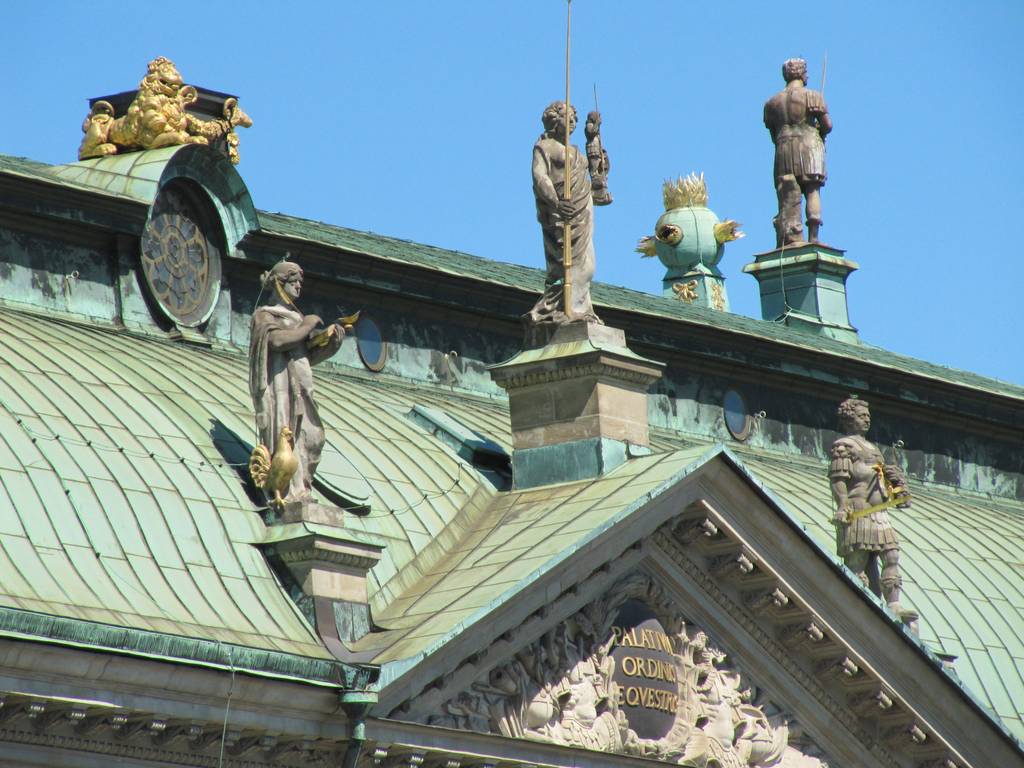
The next morning, the townspeople of Stockholm awoke and went about their daily business. Down by the waterside, they were doing their laundry when they noticed something strange about the grand building on the ísland. They approached it and looked from the other side of the water. No! Could it be true? They witnessed a horrific sight and they ran as fast as they could back to the safety of their homes. There, on the grand building, Riddusola had made a change. Stone figures now ordaned the roof. The stone figures were facing different directions and were clearly the putrified remains of the King, the Prime Minister, the Mayor and other dignitaries,

The grand building is still there, although no longer on an island. It is surrounded by roads and is today called Riddarhuset, Thankfully, the gorgon is long gone. But if you look to the roof, you will see them. The stone remains of the people who looked Riddusola in the eyes.

Do you see the horse?

See the horse

Much intercultural understanding arises from misinterpretation and misconception. We tend to think our perceptions of something are correct, when often they can be very wrong. What we see usually isn’t the whole picture.

In a cultural situation, simple situations such as how much eye contact we give people when we talk, how close we stand to somebody when we communicate and what kind of gestures we use are all examples of things that can easily lead to misinterpretation. I remember when I moved to Sweden and some of the misperceptions I had because I didn’t understand the whole picture. I remember, for instance, thinking Swedes were unfeeling, purely based on the lask of emotional response and the more reserved body language than I was used to. I was wrong. Just because a person doesn’t gesticulate or emphasize when they speak does not mean they feel any less.

The road to cultural sensitivity is paved with misunderstanding, misinterpretation and false perception. One key is to suspend judgement about another person or a specific situation and instead try to see the larger context. To ask ourselves why might this have happened? What are all the possible interpretations?

Look at it from another angle, who knows what might emerge. Just like in the visual above…so, do you see the horse?

Are Swedes always off work?

keep-calm-its-nearly-holiday-time

‘Swedes never work, they’re always on holiday’

This is a frequent comment I hear when I work internationally. Colleagues and sometimes customers abroad, are irritated by the fact that they can’t get in touch with Swedes from, for example, the end of June to the second week of August. Sweden seems to be shut down! ‘Swedes never work, and are also lazy’ – they say.

I, of course, defend Sweden’s holiday structure by emphasizing that people work longer hours in the winter to compensate for shorter hours in the summer time. Or that the winters are so long here, it’s only natural that people want to be off work during the warmest, brightest time of the year. Or that thanks to advances in technology, Swedish employees are often still accessible though they might not be at the actual workplace. Or I even try the argument that Sweden has a healthy work-life balance.

These arguments however often fall on stony ground and I am often disbelieved. People shrug their shoulders, shake their heads and roll their eyes. From their perspective, Swedes are spoiled.

I try to encourage cultural understanding, I really do. But sometimes it’s not that easy. For example, situations like this Christmas and New Year don’t help me to be more persuasive. While most Americans got 3 days off work and many Brits got 5 days of work, Swedes frolicked in the free time they were able to access. This festive period was commonly referred to as an ’employees’ Christmas’ meaning it was good for the employees and not for the employers. Many Swedes (and me too) are back to work for the first time today, and have been free since the 23rd December 2013. That makes a total of 12 days off work – 16 days if you also count the weekends.

You see Swedes don’t only take the national holidays off – they also take off the ‘Eve’. So although ‘Christmas Eve’ and ‘Midsummer’s Eve’ are technically not national holidays, they are celebrated as though they are. And then it’s also considered a right to be able to take off a half a day before the ‘Eve’ just in order to get ready for the approaching celebrations. If a national holiday falls on a Thursday or a Tuesday then there’s also something called a ‘Bridge day’. It’s not officially a holiday but most people take it off because there’s no point in going in to work for just one day is there? This Christmas season had a couple of bridge days in it to pad out the time taken off work and required only a little bit of personal holiday leave to be taken.

So the question becomes are Swedes happy that they got 16 days off work? I think most are. But on social media, in the office and on public transport, others complain that it wasn’t long enough, that they’re exhausted or that they need a break.

Mmm, maybe there’s something in the perception of the spoiled Swede?

The process of ‘culturing’

The word ‘culture’ is not unproblematic. Experts and academics often do not agree with each other on how to define it. Anthropologists may say one thing, sociologists have another description, psychologists something else. This can be confusing for those of us talking about or discussing the intricacies of ‘culture’.

Typically, experts have defined culture as a ‘thing’ – a set of rules, a set of behaviours, a shared way of doing things. This is fine as a definition, but somewhat limited and uncontemporary. This definition ascribes ‘culture’ with a static quality and does not allow for the changing, flexible nature of groups of people.

In former days, when people didn’t travel as much internationally, when there was less interaction across national borders, when there was less global influence on local matters, when technology did not exist to encourage remote contact, when people stayed in one place, it might have been appropriate to describe a culture as a static ‘thing’. In other words, to describe the behaviours and attitudes of a group of people identified by the borders of their nation. Eg, Swedish culture is like this…Swedes are like this…

But I’m afraid this doesn’t work anymore. Thanks to migration, immigration, internationalisation and individual travel, we are subjected to different influences and attitudes. These differences are integrated into our societies and our societies change. So ‘culture’ is not a static concept. It is constantly changing. It is always in flux. It is not a fixed thing, but a fluid thing.

This is why I try to describe what we are experiencing as a process of ‘culturing’. We are forming our realities together. We are constructing our societies and our groups. We are navigating and negotiating with each other constantly. This is why different groups of people do things differently – they have ‘cultured’ differently. But it’s not written in stone – it changes.

And this is why, for me, racism is defunct. It’s unavoidable that there are diverse people with different perspectives in a community. And it’s this diversity that keeps us continuously ‘culturing’.

20140104-112623.jpg

Origins of FIKA

20140102-210626.jpg

Interesting description of the origins of the Swedish word for drinking a cup of coffee – ‘fika’.

In the 1800’s it was weirdly fashionable to invert words. For example, ‘gata’ might have become ‘agat’ or ‘roligt’ might have become ‘igtrol’.

The slang word for coffee at that time was kaffi.

And when this is inverted, it becomes ……. FIKA!!

Glocalization in the Swedish market

glocalizationREV4

Sunny holidays. Weight loss. Healthy eating.
All of the above are currently hot topics in Sweden. Maybe this is not so surprising after the Christmas break, but there is another reason why this is interesting.

Are you familiar with the term ‘glocalization’? The term was made popular in the 90’s by sociologist Roland Robertson and describes the adaptation of a product or service specifically to each locality or culture in which it is sold. The goal of course is to make the product or service more attractive in order to sell more. The method of glocalization is a smart way to meet local needs and at the same time expand business globally. In some ways, it is the opposite of Americanization – which just applies one business model and product wherever in the workd it is. More and more companies are attempting to expand their business in the way of glocalization.

One example of glocalization is the dominant advertizing in a specific region or country. The advertized products or services that most appeal to the locals reflects what the locals perceive as interesting and important. The type and content of the adverts often reflect the attitudes and values of the society. One example I remember is when I was standing on an underground platform in Stockholm a while ago, and I was confronted by huge adverts containing lots of naked backsides, of all shapes, sizes and genders. In the UK, this would probably not occur, but in Sweden, there is a more relaxed attitude to and acceptance of nudity.

Glocalized advertizing is often seasonal. A short glimpse in newspapers, tv, Internet or billboards around Sweden tells us what the locals prioritize at this time of the year – holidays! Almost everywhere you look, there is an advert promoting a sunny break away from the dark and the cold of the Scandinavian winter. The second most common advert at the moment seems to be weight loss -an apparent necessity for getting into that swimsuit on that quickly-approaching sunny holiday.

Another illustration of glocalization is actual adaptation of products. For example, the way in which hamburger chain McDonald’s changes its menu and promotions to appeal to local tastes. In France, for example, they replaced their Ronald McDonald mascot with Asterix the Gaul, a local cartoon character. When in Spain a few years ago, I noticed that McDonald’s had McTapas on their menu. Currently, in Sweden, the food chain is marketing ‘fullkorn’ (wholegrain) burger bread. This clearly appeals to the Swedish consumers’ health interests and the prevailing trend of slow carbohydrates but I’m guessing that they don’t market this kind of bread in, for example, India.

What might we see next if McDonald’s takes glocalization to a Swedish extreme? The festive McSilvia Burger Royale? The homely McTastyMeatballs? The appetizing Mc Filet-of-Herring? or the absolutely delicious McPalt?

Sweden 2014 – two hundred years of peace?

20131230-084644.jpg

So it’s soon the start of a new year – 2014. Another year of sublime and strange Swedish things.

Over Christmas the Swedish King mentioned something in his speech, something that is repeated in the media. For Sweden, 2014 marks the 200th year of peace. In 1814, Sweden signed a treaty with Norway thereby giving them independence. And Sweden, it is claimed, haven’t been at war since then. 200 years of peace is something that the media is proud of.

But hang on a minute. Sweden was ‘neutral’ in the Second World War, but still allowed German troops to cross the nation as they occupied Norway and the country sold iron to Germany for their weapon industry.

In 1961, Sweden was involved in the war in Congo, in the 1990’s in Bosnia and, as we speak, Swedish armed forces are active in Afghanistan and the Libyan Civil War.

Maybe it’s semantic, but is there actually any difference between being in a war and being at war?

Alid’s Lightening Catcher

Long, long ago on a remote southern island in Stockholm, there lived a small group of people. These people supported themselves on fishing and foraging in the woods.

And they were a nasty bunch.

Whenever they got the chance, they would steal from other villages, or they would shout abuse from the hill tops or urinate in the lake water. For years this went on until one day Thor, from his heavenly position, got tired of listening to their behaviour and profane language. Now Thor, being the God of Thunder, had resources at his fingertips. With one swift movement of his hammer, he shot a bolt of lightning down at the villagers and blew them straight off the hillside. 

But this didn’t stop the villagers. Laughing at Thor, they shook their fists and shouted abuse up into the sky. This made Thor more angry and for every time they laughed, he continued to bombard them with lightning. The years went by and with new generations, the behavior of the villagers changed. Tired of being blasted from above, they began to speak more kindly, to stop their stealing and to use appropriate methods of hygiene. But Thor was an unforgiving God and lividly continued to shoot his burning bolts down onto them. 

More time went by and the villagers realized that Thor would not cease. Instead they would have to combat his attacks. They dug a fire pit to engulf the lightning, but it did not work. They built a fountain to extinguish the lightning but this didn’t work either. They sacrificed goats and pigs. But nothing worked and Thor’s wrath continued to rain down. 

In despair, they turned to the wisest woman in the village – Ancient Alid. Alid was somewhat of a witch and the villagers were rather scared of her. But she had an idea. She told them to build a lightning catcher. So the villagers set to work. 

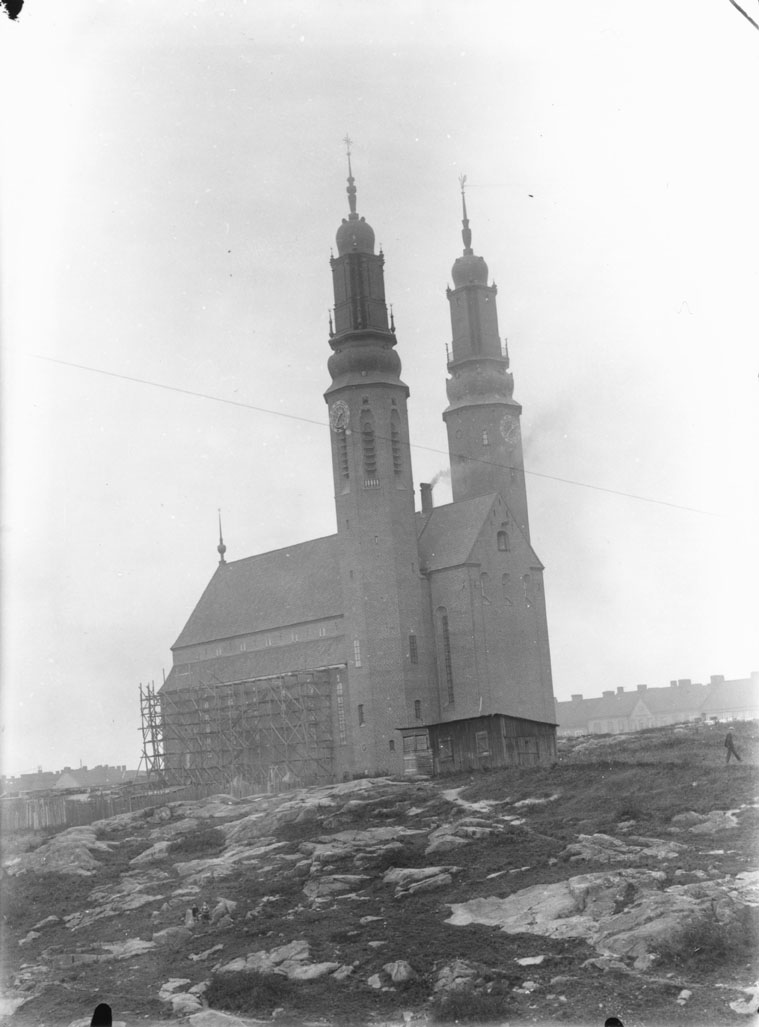
For years they built, until one day their masterpiece was finished. Upon the highest point of the hill, they had constructed a lightning catcher. The structure had two mighty towers reaching high up into the sky. And it worked! Every time Thor threw a lightning bolt, it was dissolved into one of the towers first and did not hit the village. The people of the village rejoiced! They were saved and slowly they could start to grow their community in the safe shadow of their construction. In honour of the wise lady, they gave the structure a name.  Hög Alid – High Alid.

You can still see it there today, high on the hilltop of Södermalm.  Today Stockholmers use it as a church but long ago it was built to protect the people from a very different god. 


högalid<